
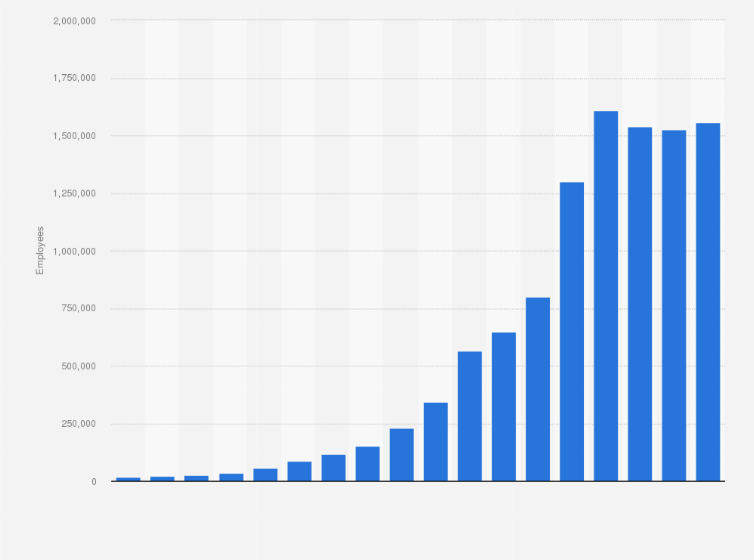
In the landscape of modern corporate finance and global business operations, few metrics are as staggering as the headcount of Amazon.com, Inc. To understand the sheer scale of Amazon is to understand a workforce that rivals the populations of mid-sized nations. As of the most recent fiscal reports, Amazon employs approximately 1.5 million full-time and part-time workers globally. This figure does not include the hundreds of thousands of independent contractors, delivery service partners, or seasonal gig workers who bolster the company’s logistics network during peak periods.

For investors, analysts, and business enthusiasts, the question of how many people are employed by Amazon is more than a curiosity; it is a vital indicator of the company’s operational overhead, its capacity for growth, and its shifting priorities toward automation and efficiency.
The Evolution of Amazon’s Human Capital: From Startup to Global Employer
The trajectory of Amazon’s workforce growth is a case study in aggressive scaling. In its early days as an online bookseller in the late 1990s, the company operated with a lean team of a few hundred employees. By 2010, that number had grown to approximately 33,700. However, the last decade saw an explosion in hiring that fundamentally altered the global labor market.
Historical Growth and the 2020 Pivot
The most significant surge in Amazon’s employment history occurred between 2019 and 2021. Driven by the global shift toward e-commerce during the pandemic, Amazon doubled its fulfillment network and hired nearly 800,000 people in a two-year window. At its peak in early 2022, the company’s headcount neared 1.6 million. This period represented one of the most rapid expansions of a corporate workforce in industrial history.
From a business finance perspective, this expansion was a high-stakes bet on the permanence of accelerated e-commerce trends. Amazon invested billions into “human capital” to ensure it could meet unprecedented demand. However, as the global economy stabilized and inflationary pressures mounted, the company had to recalibrate, leading to the first significant layoffs in its history and a strategic shift toward “lean” operations.
Current Headcount Statistics and Comparisons
To put Amazon’s 1.5 million employees into perspective, one must look at its peers. Walmart remains the world’s largest private employer with approximately 2.1 million workers. However, Walmart’s growth has been incremental over decades, whereas Amazon’s ascent was meteoric. Compared to the technology sector, Amazon is an anomaly. While companies like Alphabet (Google) or Meta (Facebook) employ between 60,000 and 190,000 people, Amazon’s massive logistics and fulfillment arm places it in a category closer to manufacturing and retail giants than pure software firms.
The Financial Impact of a Million-Person Workforce
Managing a workforce of 1.5 million people presents unique financial challenges and opportunities. For Amazon, labor is simultaneously its greatest asset and its most significant operating expense. In the realm of business finance, the management of these labor costs is the primary lever for expanding or contracting profit margins.
Labor Costs and Operating Margins
The cost of employing 1.5 million people is astronomical. Beyond base salaries, Amazon must account for health insurance, 401(k) matching, workers’ compensation, and the administrative costs of HR at scale. In 2023, Amazon’s fulfillment costs—a category heavily influenced by labor—accounted for a massive portion of its total operating expenses.
When labor costs rise—whether through minimum wage increases, competitive hiring markets, or unionization efforts—the impact on Amazon’s bottom line is immediate. Financial analysts closely watch the company’s “cost per shipment,” a metric that is inextricably linked to how efficiently Amazon can manage its massive roster of warehouse associates and delivery drivers.
The Efficiency Ratio: Revenue per Employee
One of the most telling metrics for investors is revenue per employee. This ratio highlights the difference between Amazon’s various business segments. Amazon Web Services (AWS), the company’s high-margin cloud computing arm, requires significantly fewer employees to generate billions in revenue compared to the retail division.
In the retail sector, the revenue per employee is lower because the business is labor-intensive. However, as Amazon integrates more AI-driven logistics and automated sorting, it aims to increase this ratio. Improving the efficiency of each human hour worked is a cornerstone of Amazon’s strategy to return more value to shareholders.
Logistics vs. Technology: Analyzing the Staffing Split
Amazon’s workforce is not a monolith. It is divided into two distinct worlds: the corporate/tech sector and the operations/fulfillment sector. The financial health of the company depends on how these two groups are balanced.
The Fulfillment and Operations Engine
The vast majority of Amazon’s 1.5 million employees work within the “Operations” category. These are the individuals in fulfillment centers, sortation centers, and delivery stations. This workforce is the physical backbone of the Amazon Prime promise.
Financially, this segment is characterized by high turnover and high recruitment costs. Amazon famously spends billions annually on “onboarding” and training to keep its logistics engine running. For the company, the goal is to optimize the “last mile” of delivery, which is historically the most expensive part of the supply chain. Every employee added to a fulfillment center must be justified by a corresponding increase in package volume and delivery speed.
AWS and the High-Value Tech Workforce
On the other side of the spectrum are the corporate employees, engineers, and data scientists, many of whom work for AWS. While they represent a smaller fraction of the total headcount, their compensation packages are significantly higher, often including substantial stock-based compensation (RSUs).
From a corporate finance standpoint, the “cost” of a tech employee is viewed as an investment in Research and Development (R&D). These employees build the proprietary algorithms and infrastructure that allow the rest of the company to function with less human intervention over time. The high profit margins of AWS essentially subsidize the massive labor costs of the retail and logistics side of the business.
Automation, AI, and the Future of Amazon’s Payroll
As we look at the trajectory of Amazon’s employment numbers, a clear trend emerges: the decoupling of revenue growth from headcount growth. This is being achieved through a massive transition from labor-intensive processes to capital-intensive automation.
Capital Expenditure in Robotics
Amazon is currently one of the world’s largest operators of industrial robotics. With over 750,000 robots deployed across its fulfillment centers, the company is systematically replacing repetitive manual tasks with automated solutions. Systems like “Proteus,” Amazon’s first fully autonomous mobile robot, and “Sparrow,” a robotic arm capable of handling millions of individual items, represent a fundamental shift in the company’s financial structure.
By shifting spending from “Operating Expenses” (wages) to “Capital Expenditures” (robotics and AI), Amazon can achieve higher long-term margins. While a robot requires a high upfront investment, it does not require a salary, benefits, or time off, and it can operate 24/7 with minimal marginal cost.
Strategic Headcount Reductions and Lean Operations
In 2023 and 2024, Amazon made headlines for cutting over 27,000 corporate roles. These layoffs were a signal to Wall Street that the company was moving away from the “growth at all costs” mentality of the pandemic era and toward a focus on efficiency. By utilizing AI to automate administrative tasks and streamlining middle management, Amazon is attempting to prove that it can grow its top-line revenue without a linear increase in its headcount.
Global Footprint and Economic Influence
The 1.5 million people employed by Amazon are spread across the globe, making the company a major economic player in dozens of countries. This geographic distribution is a strategic financial decision to minimize shipping distances and tap into diverse labor markets.
Domestic vs. International Staffing
While the United States remains Amazon’s largest market and employer base, the company has significant footprints in India, Germany, the United Kingdom, and Japan. In India, for example, Amazon has become a primary engine for job creation, not just through direct employment but through its marketplace that supports millions of small businesses.
Financially, this global spread allows Amazon to hedge against local economic downturns. If labor costs spike in one region, the company can often shift certain operational focuses to more cost-effective markets.

Indirect Employment and the Seasonal Surge
Finally, it is essential to consider the “Amazon ecosystem.” Beyond the 1.5 million direct employees, Amazon supports millions of indirect jobs. The Amazon Delivery Service Partner (DSP) program involves thousands of small businesses that employ hundreds of thousands of drivers who technically do not work for Amazon but are entirely dependent on its platform.
During the fourth quarter (the holiday season), Amazon typically hires an additional 200,000 to 250,000 seasonal workers. This surge is a masterclass in flexible financial planning; the company scales its workforce to meet the peak demand of “Black Friday” and “Cyber Monday” and then scales back to maintain its margins during the slower first quarter.
In conclusion, the number of people employed by Amazon—currently hovering around 1.5 million—is a metric that defines the scale of modern commerce. As the company continues to pivot toward AI and robotics, the composition of this workforce will likely shift from manual labor to technical oversight. For the business world, Amazon’s headcount remains the ultimate barometer for the balance between human effort and technological efficiency in the pursuit of global market dominance.
aViewFromTheCave is a participant in the Amazon Services LLC Associates Program, an affiliate advertising program designed to provide a means for sites to earn advertising fees by advertising and linking to Amazon.com. Amazon, the Amazon logo, AmazonSupply, and the AmazonSupply logo are trademarks of Amazon.com, Inc. or its affiliates. As an Amazon Associate we earn affiliate commissions from qualifying purchases.