
In the world of finance, few names carry as much weight and historical resonance as the Dow Jones Industrial Average (DJIA). For over a century, it has served as the pulse of the American economy, a shorthand for the health of the stock market that is cited daily by news anchors, financial advisors, and retail investors alike. If you have ever wondered exactly how many companies make up this prestigious index, the answer is deceptively simple: 30. However, the story behind those 30 companies, how they are selected, and how they influence your personal portfolio is a complex narrative of economic evolution and financial engineering.

The “Dow 30,” as it is often called, represents a curated selection of blue-chip companies that are leaders in their respective industries. Unlike other indices that might track thousands of stocks, the Dow focuses on a concentrated group of stalwarts. This concentration makes it unique, controversial, and indispensable all at once.
The Elite 30: A Legacy of Market Leadership
The Dow Jones Industrial Average was created by Charles Dow and his business partner Edward Jones in 1896. At its inception, the index contained only 12 companies, primarily those involved in heavy industry—railroads, cotton, gas, and sugar. As the American economy shifted from an agrarian and early industrial base toward a more diversified, consumer-driven, and technological landscape, the index expanded to 20 stocks in 1916 and finally to 30 stocks in 1928. It has remained at 30 companies ever since.
The Significance of the Number 30
The decision to limit the index to 30 companies is a deliberate one. While the S&P 500 offers a broader view of the market and the Nasdaq Composite focuses on technology, the Dow aims to provide a snapshot of the “commanding heights” of the U.S. economy. By maintaining a small number of components, the index highlights the performance of the most influential corporations in the country.
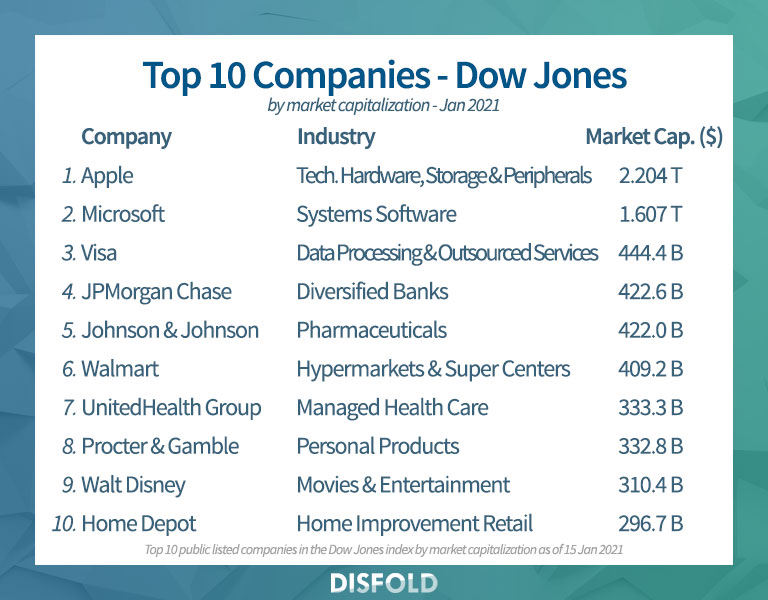
These companies are not just businesses; they are cultural and economic institutions. From the retail dominance of Walmart and Amazon to the technological ubiquity of Apple and Microsoft, the 30 components are selected because their individual fortunes are seen as a proxy for the broader economic environment. If these 30 giants are thriving, the logic goes, the American consumer and the global supply chain are likely in good health.
Who Selects the Components?
Unlike many indices that use a quantitative formula based on market capitalization, the Dow is maintained by a selection committee. The Averages Committee, which includes the editor-in-chief of The Wall Street Journal and representatives from S&P Dow Jones Indices, decides which companies are in and which are out.
There are no rigid rules for inclusion, but the committee generally looks for companies with an excellent reputation, a history of sustained growth, and interest among a large number of investors. Furthermore, they strive to maintain adequate sector representation. However, because there are only 30 slots, the committee must make difficult choices to ensure the index reflects the modern economy, which often leads to the removal of legacy companies to make room for rising stars.
The Mechanics of the Dow: Price-Weighting and the Divisor
One of the most critical aspects of understanding the 30 companies in the Dow is understanding how they are calculated. Most modern indices, such as the S&P 500, are “market-capitalization weighted.” This means that the larger a company’s total market value, the more influence it has on the index’s movement. The Dow Jones Industrial Average, however, is “price-weighted.”
The Price-Weighting Paradox
In a price-weighted index, the stock price per share determines how much influence a company has. This creates a unique dynamic: a company with a high share price, such as UnitedHealth Group or Goldman Sachs, has a significantly larger impact on the Dow’s daily movement than a company with a lower share price, such as Coca-Cola or Intel, even if the lower-priced company has a larger total market capitalization.
This methodology is often criticized by modern financial theorists who argue that share price is an arbitrary metric. A company can change its share price through a stock split without changing its fundamental value. For example, if a Dow component with a $200 share price undergoes a 2-for-1 stock split, its price drops to $100. In the S&P 500, this would have no impact on the index. In the Dow, that company’s influence would be cut in half overnight.
The Role of the Dow Divisor
To account for stock splits, spin-offs, and changes in the index components, the Dow uses a mathematical constant known as the “Dow Divisor.” Instead of simply dividing the sum of the 30 stock prices by 30, the total is divided by this ever-changing number. As of recent years, the divisor is actually a fraction less than one (approximately 0.15).
This means that a one-dollar move in any of the 30 stocks does not move the index by one point; it moves it by more than six points. This “multiplier effect” is what allows the Dow to reach levels of 30,000 or 40,000 even though the sum of the individual stock prices is much lower. Understanding the divisor is essential for any investor who wants to look under the hood of how the Dow actually functions.
The Evolution of the Index: From Smokestacks to Software
The Dow’s history is a reflection of the American corporate evolution. The “Industrial” in its name is largely a legacy term. Today, the index is diversified across healthcare, technology, finance, and consumer services.
The Shift Toward Technology and Services
For decades, General Electric (GE) was the quintessential Dow stock, representing the pinnacle of industrial conglomerate power. However, in 2018, GE was removed from the index after 111 years, signaling the end of an era. It was replaced by Walgreens Boots Alliance, reflecting the growing importance of the healthcare and retail sectors.
In more recent years, the index has moved aggressively to capture the digital economy. The inclusion of Apple, Microsoft, and Salesforce illustrates that “industry” now means software and data just as much as it once meant steel and oil. In early 2024, another major shift occurred when Amazon was added to the index, replacing Walgreens. This move was significant because it acknowledged the shift from traditional brick-and-mortar retail to e-commerce and cloud computing as the primary drivers of consumer activity.
The Survival of the Fittest
The 30 companies in the Dow are never permanent. The committee must constantly evaluate if a component still represents the peak of its industry. When a company falls into secular decline or loses its market leadership, it is replaced. This survivorship bias means that the Dow is essentially a collection of the “winners” of the corporate world. For investors, this provides a level of psychological comfort, knowing that the index is composed of companies with deep pockets and global reach.
Why the Dow Matters for Personal Finance
For the individual investor, the 30 companies of the Dow serve several strategic purposes. While it may not be as broad as a total market index, its focus on high-quality, dividend-paying stocks makes it a cornerstone of many conservative investment strategies.
The “Dogs of the Dow” Strategy
One of the most famous investment strategies involving the Dow 30 is the “Dogs of the Dow.” This strategy involves identifying the ten companies in the index with the highest dividend yields at the beginning of the year. The investor then allocates an equal amount of capital to each of these ten stocks and holds them for one year.
The rationale is that blue-chip companies with high yields are often temporarily undervalued or “out of favor” with the market. Because these companies are fundamentally strong (otherwise they wouldn’t be in the Dow), their stock prices eventually recover, allowing the investor to benefit from both the high dividend income and capital appreciation. This strategy highlights the Dow’s role not just as a benchmark, but as a pool for value-oriented investing.
Investing via ETFs and Index Funds
Because there are only 30 companies, the Dow is incredibly easy to track. The most popular way for individuals to invest in the index is through the SPDR Dow Jones Industrial Average ETF Trust (known by its ticker symbol, DIA, or “Diamonds”). This ETF holds all 30 stocks in the index in their price-weighted proportions.
For a personal finance portfolio, the Dow provides exposure to “Value” and “Large-Cap” factors. Because it excludes many speculative, unprofitable growth companies, the Dow tends to be less volatile than the Nasdaq during market downturns. It is often seen as a “safe haven” for equity investors who want market exposure but prefer the stability of established giants.

The Future of the 30 Blue Chips
As we look toward the future, the composition of the Dow 30 will continue to change. There is ongoing speculation about whether the index will eventually expand beyond 30 companies to provide better coverage of the economy, or if the selection committee will shift its weighting methodology.
However, the power of the Dow lies in its continuity. It provides a long-term bridge between the industrial past and the technological future. By following these 30 companies, investors can gain insight into global trade, consumer sentiment, and technological innovation.
While critics may argue that 30 stocks cannot possibly represent the entirety of a multi-trillion dollar economy, the Dow’s track record suggests otherwise. Its components are the gatekeepers of the American economy. Whether you are a seasoned day trader or a long-term retirement saver, understanding the makeup and mechanics of these 30 companies is essential for navigating the complexities of the financial markets. The Dow Jones Industrial Average remains the ultimate leaderboard of corporate America—a small but mighty list that tells the story of wealth, power, and progress.
aViewFromTheCave is a participant in the Amazon Services LLC Associates Program, an affiliate advertising program designed to provide a means for sites to earn advertising fees by advertising and linking to Amazon.com. Amazon, the Amazon logo, AmazonSupply, and the AmazonSupply logo are trademarks of Amazon.com, Inc. or its affiliates. As an Amazon Associate we earn affiliate commissions from qualifying purchases.