
Understanding how your Social Security payment is calculated is a cornerstone of effective retirement planning and financial literacy. Far from being a simple, one-size-fits-all equation, your monthly benefit is the result of a complex formula that considers decades of your earnings, inflation adjustments, and even the age at which you choose to begin receiving benefits. For many Americans, Social Security represents a significant portion of their retirement income, making a clear comprehension of its mechanics not just helpful, but essential.
This article will demystify the process, breaking down the key factors and steps the Social Security Administration (SSA) uses to determine your Primary Insurance Amount (PIA) and, ultimately, your monthly check. We’ll delve into how your lifetime earnings are translated into a benefit, the progressive nature of the calculation, and the various factors that can either increase or decrease your final payout. By the end, you’ll have a much clearer picture of what to expect and how your financial decisions today can impact your future Social Security benefits.

The Foundation: Your Earnings Record
At its heart, Social Security is an earned benefit. The more you’ve worked and contributed through FICA payroll taxes over your lifetime, the higher your potential benefit. However, it’s not simply a matter of summing up all your paychecks. The SSA employs a sophisticated method to account for inflation and focus on your most productive years.
A Lifetime of Contributions
Every time you receive a paycheck, a portion of your earnings is withheld for FICA (Federal Insurance Contributions Act) taxes, which fund both Social Security and Medicare. Self-employed individuals pay SECA (Self-Employment Contributions Act) taxes for the same purpose. These contributions are recorded by the SSA under your Social Security number, creating a detailed earnings record that tracks every year you’ve worked and the amount of income on which you paid Social Security taxes. It’s crucial to periodically review this record for accuracy, as any discrepancies could impact your future benefits. The SSA website (ssa.gov) allows you to create an account and access your personal earnings statement.
Indexed Earnings: Adjusting for Inflation
One of the most critical steps in the calculation process is indexing your earnings. A dollar earned in 1985 had significantly more purchasing power than a dollar earned today. To ensure fairness and reflect the general rise in wages over time, the SSA “indexes” your past earnings to current wage levels. This process adjusts your earnings from previous years to account for changes in the average wage index (AWI) of the national workforce.
For example, if the average wage index has doubled since you earned $30,000 in a particular year, your indexed earnings for that year might be treated as $60,000 for calculation purposes. This indexing is applied to earnings up to the “taxable maximum” for each year – the maximum amount of earnings subject to Social Security taxes. Earnings above this threshold in any given year are not considered for benefit calculation. Indexing ensures that your past contributions retain their real value relative to current economic standards, preventing your early career earnings from being unfairly diminished by inflation.
The “Highest 35 Years” Rule
The SSA doesn’t simply average all your working years. Instead, it identifies your 35 highest-earning indexed years. This rule is designed to benefit workers who may have had periods of unemployment, lower earnings early in their careers, or who took time off for family or education. By focusing on the 35 highest years, the system ensures that your benefit reflects your most substantial contributions.
What if you haven’t worked for 35 years? In such cases, the SSA will still use 35 years for the calculation, but any years with no earnings will be counted as zero. This means that if you’ve only worked for 25 years, ten years of “zero” earnings will be included in the calculation, which will naturally lower your overall average and, consequently, your benefit amount. This provision underscores the importance of a consistent and lengthy work history to maximize your Social Security benefits.
From Indexed Earnings to Average Indexed Monthly Earnings (AIME)
Once your highest 35 years of indexed earnings have been identified, the next step is to consolidate this information into a single, representative figure: your Average Indexed Monthly Earnings (AIME). This figure is a critical stepping stone towards determining your Primary Insurance Amount.
Summing Up Your Top Years
The first part of deriving your AIME involves a straightforward summation. The SSA adds up all of your indexed earnings from those 35 highest-earning years. This total represents the cumulative value of your most significant contributions to the Social Security system, adjusted for historical wage growth. For someone with a long, consistent work history, this sum will be substantial, reflecting decades of contributions at peak earning potential.
Dividing for AIME
With the total sum of your 35 highest indexed earning years in hand, the SSA then divides this sum by 420. Why 420? Because 35 years multiplied by 12 months equals 420 months. The result of this division is your Average Indexed Monthly Earnings (AIME).
The AIME is the average of your monthly indexed earnings over your 35 highest-earning years. It’s not your actual monthly earnings during those years, but rather a theoretical average that accounts for inflation and focuses on your most financially productive periods. This single dollar figure—your AIME—is the primary input for the next and arguably most crucial step in the benefit calculation: determining your Primary Insurance Amount (PIA). The higher your AIME, the higher your potential Social Security benefit, assuming all other factors remain constant.
Calculating Your Primary Insurance Amount (PIA)
Your Primary Insurance Amount (PIA) is the monthly benefit you would receive if you elect to begin receiving Social Security benefits exactly at your Full Retirement Age (FRA). It’s the benchmark figure from which all other benefit adjustments are made, whether you claim early or delay benefits. The calculation of your PIA is progressive, meaning it replaces a higher percentage of lifetime earnings for lower-income workers than for higher-income workers.
The Role of “Bend Points”
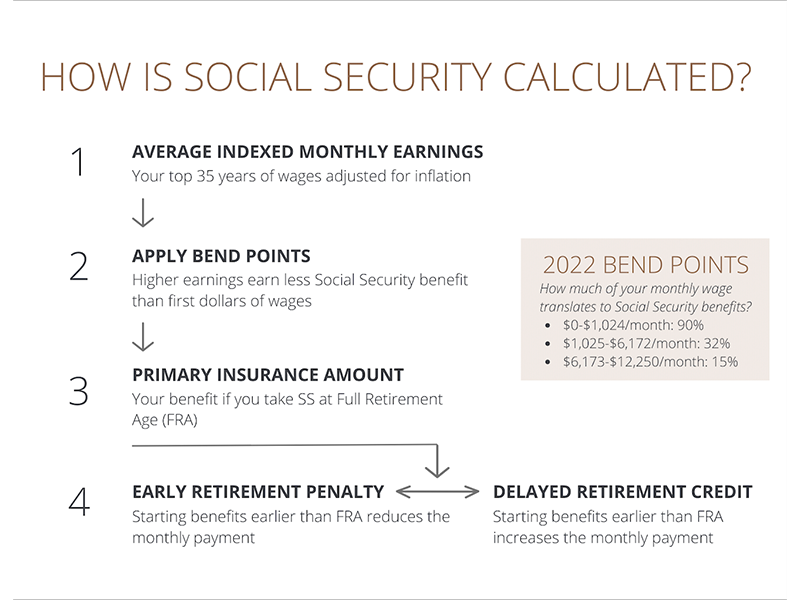
The progressive nature of Social Security benefits is achieved through a formula that incorporates “bend points.” These are specific dollar amounts in the AIME formula that separate different tiers of your average earnings. For the year you become eligible (age 62), your AIME is divided into three segments, and a different percentage is applied to each segment.
For example, for someone becoming eligible for Social Security benefits in 2024:
- 90% of the first $1,174 of your AIME
- 32% of your AIME between $1,174 and $7,078
- 15% of your AIME above $7,078
These bend points are dynamic and are adjusted annually to reflect changes in the national average wage index. The application of these percentages means that a significant portion of a lower-income earner’s AIME is replaced by Social Security, while higher earners see a smaller percentage of their higher earnings replaced. This structure ensures that Social Security provides a vital safety net for those with more modest lifetime earnings, while still providing a foundational benefit for higher earners.
A Progressive Formula
The bend point system is the core of Social Security’s progressive design. It is intentionally structured to provide a higher “replacement rate” for lower-income individuals. A person with an AIME of $2,000 will have a much larger percentage of their pre-retirement income replaced by Social Security compared to someone with an AIME of $10,000. While the higher earner will receive a larger absolute dollar amount in benefits, the proportion of their AIME that Social Security covers is lower.
This progressive formula reflects one of the fundamental goals of Social Security: to provide a basic level of income security to all eligible workers and their families, with a particular emphasis on protecting those who might otherwise struggle in retirement. It’s a key feature that distinguishes Social Security from a simple savings or insurance program, underscoring its role as a social safety net.
PIA as Your Full Retirement Age Benefit
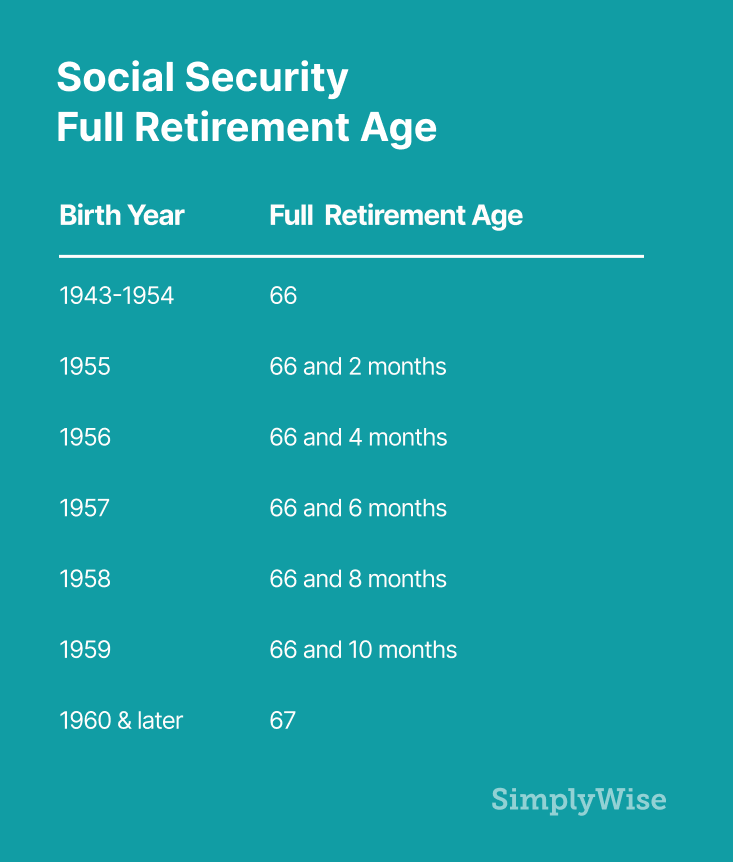
Once your PIA is calculated using your AIME and the bend points, this figure represents the exact monthly benefit you would receive if you file for Social Security benefits precisely at your Full Retirement Age (FRA). Your FRA depends on your birth year:
- Born 1943-1954: FRA is 66
- Born 1955: FRA is 66 and 2 months
- Born 1956: FRA is 66 and 4 months
- Born 1957: FRA is 66 and 6 months
- Born 1958: FRA is 66 and 8 months
- Born 1959: FRA is 66 and 10 months
- Born 1960 or later: FRA is 67
The PIA is the benchmark. Any decision to claim benefits before or after your FRA will result in an adjustment to this PIA, leading to either a permanently reduced or permanently increased monthly benefit.
Factors That Adjust Your Benefit Amount
While your PIA is the foundation, it’s rarely the exact amount you’ll receive. Several factors can significantly alter your monthly Social Security check, impacting your financial planning.
Your Claiming Age
The age at which you decide to start receiving Social Security benefits is arguably the most impactful decision you’ll make regarding your payment amount.
- Early Retirement (Age 62): You can start receiving retirement benefits as early as age 62. However, doing so results in a permanent reduction of your PIA. The reduction is calculated on a pro-rata basis for each month you claim before your FRA. For someone with an FRA of 67, claiming at age 62 results in a permanent reduction of approximately 30%. This means you’d receive only 70% of your PIA. While you receive benefits for more years, the monthly amount is substantially smaller.
- Full Retirement Age (FRA): As discussed, claiming at your FRA means you receive 100% of your calculated PIA. This is the age at which the SSA considers you “fully retired” in terms of your benefit entitlement.
- Delayed Retirement Credits (DRCs): If you choose to delay claiming benefits past your FRA, your monthly payment will increase. For each month you delay, up to age 70, you earn Delayed Retirement Credits (DRCs). These credits typically add 8% per year to your PIA (accrued monthly), making your benefit significantly larger. For someone with an FRA of 67, delaying until age 70 could result in an additional 24% increase (3 years x 8% per year) on top of their PIA. There is no additional benefit to delaying past age 70.
The decision of when to claim is highly personal, depending on your health, financial needs, other retirement income sources, and even life expectancy.
Cost-of-Living Adjustments (COLAs)
To protect the purchasing power of benefits from inflation, the SSA provides annual Cost-of-Living Adjustments (COLAs). Each year, typically in October, the SSA announces the COLA for the following year. This adjustment is based on the Consumer Price Index for Urban Wage Earners and Clerical Workers (CPI-W). If the CPI-W increases, your benefit amount will be adjusted upwards by that percentage. COLAs are applied to your benefit regardless of when you start receiving payments, ensuring that your monthly check keeps pace with general price increases over time.
The Annual Earnings Limit (for early claimants)
If you claim Social Security benefits before your Full Retirement Age and continue to work, your benefits may be temporarily reduced if your earnings exceed an annual limit. For example, in 2024, if you are under FRA, the SSA will deduct $1 from your benefits for every $2 you earn above $22,320. In the year you reach your FRA, the limit is higher ($59,520 in 2024), and the deduction is $1 for every $3 earned. Once you reach your FRA, there is no earnings limit, and you can earn as much as you like without impacting your Social Security benefits.
It’s important to note that any benefits withheld due to the earnings limit are not lost forever. When you reach your FRA, your benefit amount will be recalculated to credit you for the months during which benefits were withheld, effectively increasing your monthly payment for the remainder of your life.
Spousal and Survivor Benefits
Social Security is not just for individual workers; it also provides benefits to family members based on a worker’s earnings record. Spouses, ex-spouses, and surviving spouses can often claim benefits based on their partner’s (or former partner’s) work record if that amount is higher than their own earned benefit. These benefits are also subject to claiming age adjustments. For instance, a spouse claiming spousal benefits before their own FRA will also see a reduction in their payment. Survivor benefits, available to widows, widowers, and even dependent children, are also derived from the deceased worker’s PIA and can provide crucial financial support during difficult times.
Understanding Your Benefit Statement and Maximizing Your Social Security
Armed with a deeper understanding of how your Social Security payment is calculated, you can take proactive steps to ensure accuracy and make informed decisions.
Reviewing Your Social Security Statement
The most direct way to understand your personal Social Security situation is to regularly review your Social Security Statement. This document, available online at ssa.gov, provides an estimate of your future benefits at various claiming ages, a detailed history of your earnings, and information about potential disability and survivor benefits. It is vital to check your earnings record for accuracy. Any missing or incorrect earnings could lead to a lower benefit calculation. If you find errors, you can contact the SSA to correct them, providing documentation like W-2s or tax returns.
Strategic Claiming Decisions
The decision of when to claim Social Security is one of the most significant financial choices you’ll make in retirement. It’s not just about getting the most money over your lifetime, but about optimizing for your specific circumstances. Consider:
- Health and Longevity: If you expect to live a long life, delaying benefits to earn Delayed Retirement Credits often pays off. If your health is poor, claiming early might be more advantageous.
- Other Income Sources: Do you have sufficient retirement savings, pensions, or other income to cover your expenses if you delay Social Security?
- Spousal and Family Benefits: If married, coordinate with your spouse. Strategic claiming can maximize the total household benefit, especially if one spouse has a significantly higher earnings record.
- Work Plans: If you plan to continue working past FRA, the earnings limit won’t apply, making delayed claiming more appealing. If you need Social Security to supplement early retirement income, consider the earnings test implications.
Consulting with a financial advisor can help you analyze these factors and develop a claiming strategy tailored to your individual situation.
The Maximum Social Security Benefit
While the system is progressive and designed to replace a higher percentage of income for lower earners, there is a maximum monthly Social Security benefit. This limit is reached not by capping benefits directly, but by the taxable maximum on earnings (the highest amount of earnings on which Social Security taxes are paid in a given year) and the bend point formula itself. Even if you earn far above the taxable maximum for all 35 years used in the calculation, your AIME and subsequent PIA will be capped. For example, in 2024, the maximum monthly benefit for someone claiming at FRA (67) is $3,822, and for someone claiming at age 70 is $4,873.
The calculation of your Social Security payment is a nuanced process, rooted in your lifetime of contributions and designed with a progressive slant to support all workers. By understanding the key components – indexed earnings, AIME, PIA, bend points, and the impact of claiming age and COLAs – you gain valuable insight into one of your most important financial assets. This knowledge empowers you to plan more effectively for your retirement, ensuring that you make the most of the benefits you’ve earned.
aViewFromTheCave is a participant in the Amazon Services LLC Associates Program, an affiliate advertising program designed to provide a means for sites to earn advertising fees by advertising and linking to Amazon.com. Amazon, the Amazon logo, AmazonSupply, and the AmazonSupply logo are trademarks of Amazon.com, Inc. or its affiliates. As an Amazon Associate we earn affiliate commissions from qualifying purchases.