
The Dow Jones Industrial Average (DJIA), often referred to simply as “the Dow,” is perhaps the most recognizable financial barometer in the world. When news anchors report that “the market is up 200 points,” they are almost always referring to this venerable index. Established in 1896 by Charles Dow and Edward Jones, the index has evolved from a simple average of twelve industrial companies into a sophisticated, though often debated, measure of the American blue-chip economy.
However, despite its ubiquity, the actual mechanics behind the Dow’s daily movement remain a mystery to many retail investors. Unlike the S&P 500 or the Nasdaq Composite, which are market-capitalization-weighted, the Dow utilizes a price-weighting methodology. Understanding how this index is calculated is not just an academic exercise; it is essential for any investor who uses the Dow to gauge market health or inform their personal finance strategy.
The Core Methodology: Price-Weighting vs. Market-Cap Weighting
To understand the Dow’s calculation, one must first understand the concept of a price-weighted index. In most modern indices, such as the S&P 500, a company’s influence on the index is determined by its total market value (share price multiplied by the number of outstanding shares). In a market-cap-weighted system, a 1% move in a trillion-dollar company like Apple has a much larger impact on the index than a 1% move in a fifty-billion-dollar company.
The Dow Jones Industrial Average operates on a fundamentally different logic. In the Dow, the weight of a constituent stock is determined solely by its price per share.
The Basic Mathematical Premise
In its most primitive form, an average is calculated by adding up a series of numbers and dividing by the count of those numbers. If the Dow were calculated this way today, you would simply add the share prices of the 30 component companies and divide by 30.
However, if the index were calculated as a simple arithmetic mean, it would be susceptible to massive distortions. For instance, if a company underwent a 2-for-1 stock split, its share price would drop by half. Without an adjustment, the entire index would appear to have crashed, even though the actual value of the company and the wealth of its shareholders remained unchanged. To solve this, the Dow employs a “scaled” average, utilizing a mathematical constant known as the Dow Divisor.
The Influence of High-Priced Stocks
The most significant consequence of price-weighting is that stocks with higher nominal share prices exert more influence over the index’s direction, regardless of the company’s actual size. For example, a company trading at $500 per share has ten times the impact on the Dow as a company trading at $50 per share. If the $500 stock moves up by 1%, the index gains more points than if the $50 stock moves up by 5%. This “price bias” is the defining characteristic of the Dow’s calculation and is the primary reason it sometimes diverges from the S&P 500.
The Secret Ingredient: The Dow Divisor
The Dow Divisor is the most critical component of the DJIA calculation. It is a numerical constant used to maintain the continuity of the index over time. Without the divisor, the index would fluctuate wildly whenever a component company issued a dividend, underwent a stock split, or was replaced by another company.
How the Divisor Works
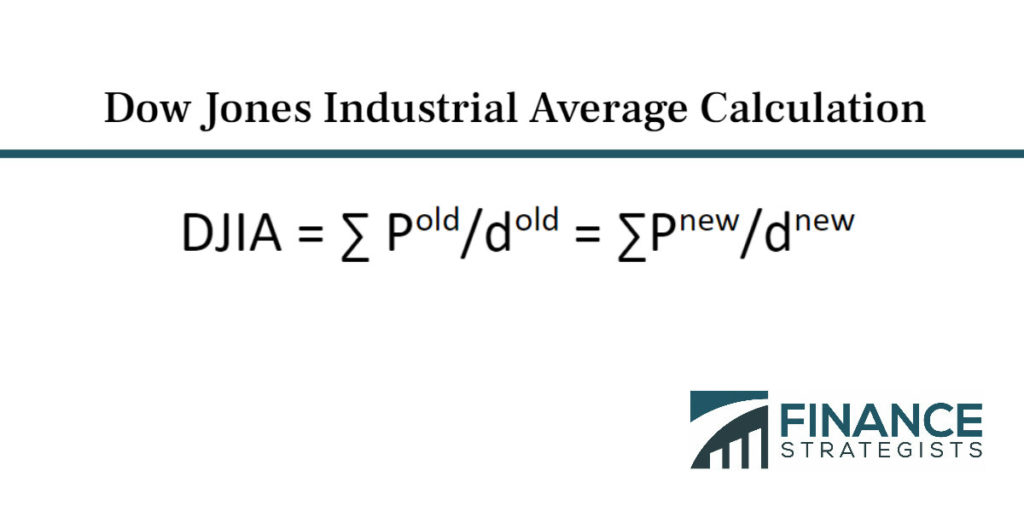
The formula for the Dow Jones Industrial Average is:
DJIA = Σp / d
(Where Σp is the sum of the prices of the 30 component stocks and d is the Dow Divisor.)
The divisor is not a static number. In fact, it is currently a value much less than one (as of recent years, it has hovered around 0.15). Because the divisor is a decimal less than one, the sum of the stock prices is actually “multiplied” in effect, meaning a $1 move in any single stock results in a multi-point move in the index.
Adjusting for Corporate Actions
Whenever a corporate action occurs that affects the share price without affecting the value of the company, the divisor must be adjusted. Common events that trigger a divisor change include:
-
Stock Splits: If a $200 stock splits 2-for-1 to become a $100 stock, the divisor is reduced so that the index value remains the same before and after the split.
-
Spin-offs: When a company divests a portion of its business, its share price typically drops. The divisor is adjusted to account for this artificial drop.
-
Component Changes: When the S&P Dow Jones Indices committee decides to remove one company and replace it with another, the new company will inevitably have a different share price. The divisor is recalculated to ensure the transition doesn’t cause a “jump” in the index level.
By constantly shifting the divisor, the Dow ensures that its value represents a historical continuum of the 30 companies’ collective price movements, rather than a literal average of current prices.

The Selection Process: Who Gets Included?
The calculation of the Dow is also influenced by the selection of its 30 components. Unlike the S&P 500, which has strict quantitative rules regarding market cap and liquidity, the Dow is managed by a selection committee. This adds a qualitative layer to how the “market” is defined.
The Averages Committee
The Dow is maintained by the Averages Committee, which includes the Editor in Chief of The Wall Street Journal and representatives from S&P Dow Jones Indices. There are no rigid rules for inclusion, but the committee generally looks for companies that:
-
Are incorporated and headquartered in the United States.
-
Have an excellent reputation and demonstrate sustained growth.
-
Are of interest to a large number of investors.
-
Represent a major industry within the broader economy.
Maintaining Sector Balance
Because the Dow only tracks 30 companies, the committee must be strategic about sector representation. As the American economy shifted from heavy industry and railroads to technology and healthcare, the Dow’s composition shifted accordingly. Traditional “industrial” companies like General Electric (a founding member) eventually gave way to tech giants like Microsoft, Apple, and most recently, Amazon.
When the committee replaces a company, it creates a ripple effect in the calculation. If a low-priced stock is replaced by a high-priced stock, the Dow Divisor must be adjusted upward to prevent the index from artificially spiking. This ensures that the inclusion of a high-priced tech giant doesn’t immediately “break” the historical comparison of the index.
Why the Dow’s Calculation Method is Criticized
While the Dow is the most famous index, its price-weighted calculation method is frequently criticized by modern economists and professional portfolio managers. Understanding these criticisms is vital for any investor using the Dow as a tool for financial decision-making.
The “Goldman Sachs” Effect
Critics often point to the fact that the Dow can be disproportionately moved by a single high-priced stock. For years, Goldman Sachs and UnitedHealth Group have held significant sway over the index because of their high nominal share prices. If UnitedHealth has a bad earnings day, it can drag the entire Dow into the red, even if the other 29 companies are performing well. In a market-cap-weighted index, this wouldn’t happen unless the company’s total valuation was also massive relative to the rest of the market.
The Problem with Stock Splits
Because price is the only metric that matters for weighting, a stock split can actually reduce a company’s influence on the Dow. When Apple executed a 4-for-1 split in 2020, its “weight” in the Dow dropped significantly, even though its market value remained the same. This creates a paradox: a company can become more successful and more valuable, but if it decides to make its shares more affordable for retail investors through a split, its impact on the Dow Jones Industrial Average diminishes.
The Small Sample Size
Representing the entire U.S. economy with only 30 stocks is a tall order. Critics argue that the Dow’s calculation is too narrow to capture the breadth of the modern market. However, proponents of the Dow point out that the 30 companies selected are so large and influential that their performance usually correlates highly with the broader market over long periods.
The Practical Value of the Dow in Modern Finance
Despite the mathematical quirks of its calculation, the Dow Jones Industrial Average remains a vital tool for business finance and personal investing. Its longevity provides a historical perspective that few other indices can match.
A Mirror of Blue-Chip Sentiment
The Dow’s calculation focuses on “blue-chip” companies—the established leaders of their respective industries. Because these companies are often “value” stocks that pay dividends, the Dow is frequently used as a gauge for the health of mature, profitable corporations. For an investor focused on stability and income, the Dow’s price-weighted movement can often be more relevant than the tech-heavy, growth-oriented fluctuations of the Nasdaq.
Psychological Impact and Market Breadth
The Dow is the “people’s index.” Because the numbers are large (currently in the tens of thousands) and the movements are reported in “points,” it provides a psychological anchor for the general public. When the Dow is calculated and reported daily, it serves as a sentiment indicator. Even if professional traders prefer the S&P 500 for its mathematical rigor, they cannot ignore the Dow because of its impact on investor psychology and consumer confidence.

Conclusion: The Enduring Legacy of the Price-Weighted Average
The calculation of the Dow Jones Industrial Average is a relic of a pre-computer era, designed for a time when an average had to be calculated by hand. Yet, through the clever use of the Dow Divisor and a rigorous selection committee, it has remained relevant for over 125 years.
By understanding that the Dow is a price-weighted index, investors can better interpret what “the market” is actually doing. They can recognize when a single high-priced stock is skewing the data and understand why a stock split at a major constituent matters for the index’s future. Ultimately, the Dow is not just a number; it is a meticulously maintained mathematical construct that bridges the gap between the industrial past and the digital future of global finance.
aViewFromTheCave is a participant in the Amazon Services LLC Associates Program, an affiliate advertising program designed to provide a means for sites to earn advertising fees by advertising and linking to Amazon.com. Amazon, the Amazon logo, AmazonSupply, and the AmazonSupply logo are trademarks of Amazon.com, Inc. or its affiliates. As an Amazon Associate we earn affiliate commissions from qualifying purchases.