
The Dow Jones Industrial Average (DJIA), often referred to simply as “the Dow,” is perhaps the most cited financial metric in the world. When news anchors report that the market is “up” or “down,” they are frequently referring to this venerable index. But when investors ask, “How high is the Dow Jones?” they are rarely asking for a simple numerical value. They are asking about valuation, historical context, and the economic health of the United States. To understand how high the Dow is today, one must look past the ticker symbol and explore the underlying mechanics of blue-chip stocks, the psychological barriers of market milestones, and the macroeconomic forces that propel thirty of America’s largest companies to new heights.

Understanding the Dow Jones Industrial Average: More Than Just a Number
The Dow Jones Industrial Average is not just a list of stocks; it is a living history of the American economy. Established in 1896 by Charles Dow and Edward Jones, the index originally tracked twelve industrial companies, most of which were involved in railroads, cotton, gas, and sugar. Today, the index has evolved into a concentrated basket of thirty “blue-chip” companies representing sectors as diverse as technology, healthcare, and entertainment.
The History and Evolution of the DJIA
To grasp how high the Dow is now, we must appreciate where it started. Its first closing value was 40.94. For much of the early 20th century, the index moved in increments that seem microscopic by today’s standards. It took decades to reach the 1,000-point milestone, a feat finally achieved in 1972. Since then, the pace of growth has accelerated exponentially. This acceleration is a reflection of both the compounding nature of corporate earnings and the inflationary pressures that gradually devalue currency, making nominal stock prices appear much higher over time.
The composition of the Dow is curated by a committee, which ensures that the index reflects the current state of the U.S. economy. This is why companies like Sears and General Electric—once the titans of industry—have been replaced by modern powerhouses like Apple, Microsoft, and UnitedHealth Group. When we measure the “height” of the Dow, we are essentially measuring the collective success and scale of these thirty institutional pillars.
Why the Dow Still Matters in a Digital Age
Critics often argue that the Dow is an antiquated measure because it only includes thirty companies and uses a price-weighted methodology. In contrast, the S&P 500 tracks 500 companies and is market-cap weighted. However, the Dow remains relevant because of its exclusivity. To be a “Dow component” is a badge of corporate honor, signifying stability, size, and influence. Because it focuses on established leaders, the Dow often serves as a barometer for “Main Street” sentiment. When the Dow hits a new high, it signals a level of confidence in the bedrock of the American corporate landscape that broader, more volatile indices might not capture as clearly.
Decoding the “Highs”: Historical Peaks and Modern Milestones
The numerical value of the Dow Jones is often viewed through the lens of “psychological levels.” Investors and the media tend to fixate on round numbers—20,000, 30,000, and recently, the 40,000 mark. These milestones are significant because they represent shifts in investor sentiment and the crossing of new frontiers in capital appreciation.
The Path to 40,000 and Beyond
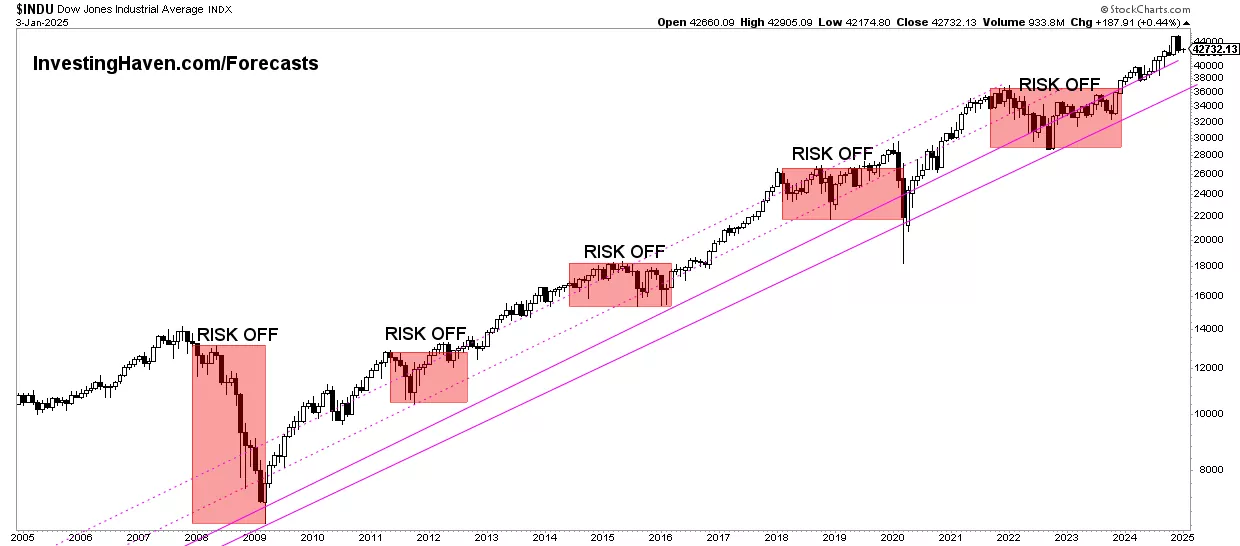
In recent years, the Dow has climbed to unprecedented levels, driven by a combination of technological innovation and aggressive monetary policy. The journey from 30,000 to 40,000 was marked by extreme volatility, including a global pandemic and a subsequent inflationary spike. Despite these challenges, the Dow’s ascent highlights the resilience of large-cap American businesses.
When analyzing how “high” the index is, one must consider the rate of change. A 1,000-point move when the Dow was at 10,000 represented a 10% shift. Today, at levels above 38,000, a 1,000-point move is less than 3%. This context is vital for investors who might feel intimidated by the large daily fluctuations reported in the news. The nominal “height” of the Dow is a testament to the long-term upward trajectory of equity markets, fueled by productivity gains and global expansion.
Inflation-Adjusted vs. Nominal Values
A critical distinction in finance is the difference between nominal value and real value. While the Dow may be at an all-time nominal high, its inflation-adjusted high tells a more nuanced story. If the index rises by 5% in a year where inflation is 7%, the “height” of the index has actually decreased in terms of purchasing power. Professional investors look at the “real” Dow to determine if the market is truly breaking new ground or simply keeping pace with the rising cost of goods and services. Currently, even when adjusted for inflation, the Dow has shown remarkable strength, though its peaks are less vertiginous than the raw numbers suggest.
The Mechanics of the Index: How Price Weighting Shapes the Total

To understand how high the Dow Jones can go, one must understand how it is calculated. Unlike most modern indices, the Dow is price-weighted. This means that companies with higher share prices have a greater influence on the index’s movement than those with lower share prices, regardless of the company’s actual market capitalization.
The Difference Between the Dow and the S&P 500
In a market-cap-weighted index like the S&P 500, a company like Apple (with a multi-trillion-dollar valuation) has a massive impact. In the Dow, Apple’s influence is determined solely by its stock price. If a company in the Dow undergoes a stock split, its influence on the index drops significantly, even if its market value remains the same. This quirk of the Dow’s construction means that “how high” the index sits is often a reflection of the share prices of a few key heavyweights, such as Goldman Sachs or UnitedHealth, which often trade at several hundred dollars per share.
Does One Stock Have Too Much Power?
Because of the price-weighting system, the Dow can be pushed to new highs by a handful of high-priced stocks, even if the majority of the thirty components are stagnant. This creates a unique dynamic where “the Dow’s height” might not always align with the broader market’s health. For example, if a high-priced industrial stock reports stellar earnings and jumps 10%, the Dow will see a significant point increase. This makes the index a fascinating study in corporate leadership; it rewards companies that maintain high share prices and effectively manage their capital structures.
Catalysts Behind the Surge: What Drives the Dow Upward?
When we observe the Dow reaching new altitudes, we are seeing the result of specific economic engines. These catalysts are what move the needle for the thirty blue-chip giants that comprise the index.
Federal Reserve Policy and Interest Rates
Perhaps no factor influences the height of the Dow more than the Federal Reserve. Interest rates are the gravity of the financial world. When rates are low, borrowing is cheap, and the present value of future corporate earnings increases, pulling the Dow higher. Conversely, when the Fed raises rates to combat inflation, it creates a “drag” on the index. The Dow’s recent highs have often been a reaction to the market’s anticipation of a “pivot” toward lower rates, which suggests a more favorable environment for business expansion and consumer spending.
Corporate Earnings and the Blue-Chip Advantage
At the end of the day, the Dow is a collection of businesses. Its height is ultimately supported by the earnings per share (EPS) of its components. The companies in the Dow are typically “mature” firms with established cash flows and global footprints. They are often the first to benefit from international trade and the most capable of weathering economic downturns. When these companies report record profits, the Dow naturally reaches for the clouds. The transition toward high-margin services and digital products among traditional Dow components has also bolstered their valuations, allowing the index to maintain its high elevation even in shifting economic climates.
Investment Strategies for a High-Level Market
For the individual investor, the question “How high is the Dow Jones?” is usually followed by “Is it too high to buy?” Navigating a market that is at or near all-time highs requires a disciplined approach to personal finance and asset allocation.
Buying at the Top: Risks and Rewards
There is a psychological barrier to investing when an index is at an all-time high. Investors fear a “reversion to the mean,” or a market correction. However, historical data suggests that the market spends a significant amount of time at or near record highs during bull markets. Waiting for a “dip” can often result in missing out on further gains. In the context of the Dow, being “high” is often a sign of momentum. For long-term investors, the focus should not be on the absolute height of the index today, but on the projected height of the index ten or twenty years from now.
The Role of Dividend Yields in a Maturing Index
One of the unique characteristics of the Dow components is their commitment to returning value to shareholders through dividends. Many Dow stocks are “Dividend Aristocrats” or “Dividend Kings,” having increased their payouts for decades. Even when the price of the index is high, the dividend yield provides a cushion and a source of passive income. For those focused on “Money” and personal finance, the Dow represents a conservative but effective way to build wealth. The height of the index is supplemented by the compounding effect of reinvested dividends, which can significantly outperform the nominal price appreciation of the index over time.
In conclusion, the height of the Dow Jones Industrial Average is a multi-faceted concept. It is a numerical milestone, a reflection of corporate earnings power, and a symbol of economic sentiment. Whether the Dow is at 30,000 or 50,000, its value lies in its ability to aggregate the successes of the titans of industry. For the savvy investor, “how high” the Dow is matters less than understanding the fundamental drivers—interest rates, earnings, and inflation—that will continue to push it toward new horizons in the years to come.
aViewFromTheCave is a participant in the Amazon Services LLC Associates Program, an affiliate advertising program designed to provide a means for sites to earn advertising fees by advertising and linking to Amazon.com. Amazon, the Amazon logo, AmazonSupply, and the AmazonSupply logo are trademarks of Amazon.com, Inc. or its affiliates. As an Amazon Associate we earn affiliate commissions from qualifying purchases.