
In the world of finance, percentages are more than just mathematical symbols; they are the fundamental language of value, risk, and growth. Whether you are tracking the performance of a stock portfolio, determining the health of a business through profit margins, or simply trying to optimize a personal budget, understanding how to calculate and interpret percentages is an essential skill.
For the modern investor and professional, numerical literacy is a prerequisite for success. Percentages allow us to normalize data, making it possible to compare a small-cap startup’s growth to that of a blue-chip giant. They help us understand the true cost of debt and the power of compound interest. This guide explores the mechanics of percentage calculations through the lens of personal and business finance, providing you with the tools to navigate the financial landscape with precision.

The Foundation of Financial Literacy: Mastering the Basic Percentage Formula
Before diving into complex financial models, one must have an intuitive grasp of the core equation. At its simplest level, a percentage represents a fraction of 100. In finance, this translates to understanding what portion of a “whole” (such as total capital or total revenue) a specific “part” (such as a dividend or an expense) represents.
The Core Equation for Financial Analysis
The standard formula to find a percentage is:
** (Part / Whole) × 100 = Percentage**
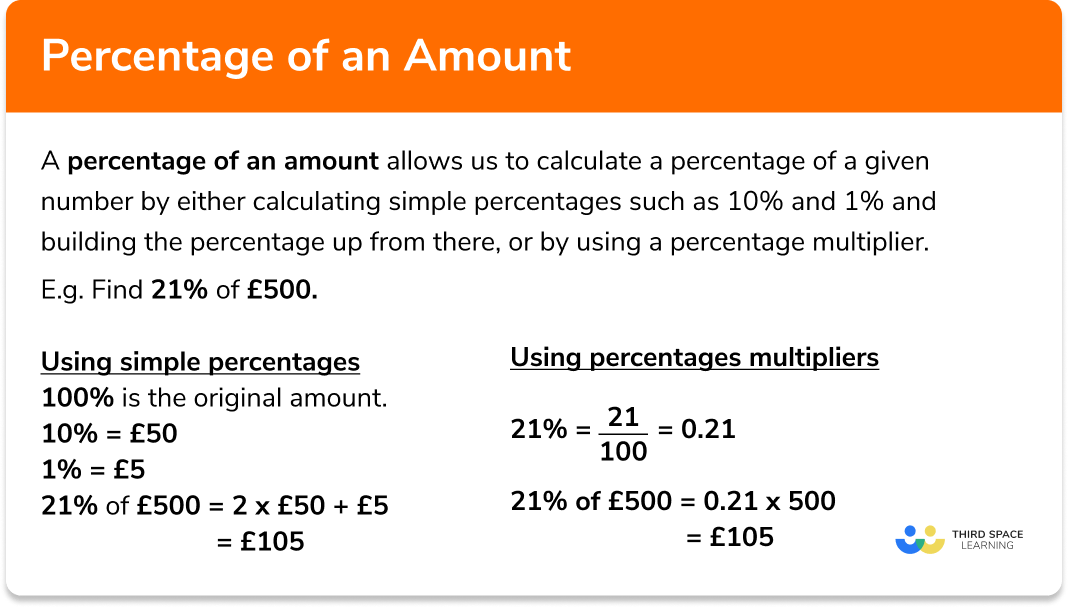
In a business context, if your total operating costs are $25,000 and your total revenue is $100,000, your expense ratio is calculated by dividing 25,000 by 100,000, resulting in 0.25. Multiplying by 100 gives you 25%. This simple calculation is the bedrock of vertical analysis in financial statements, allowing stakeholders to see exactly where every dollar of revenue is allocated.
Converting Decimals and Fractions for Financial Reporting
Professional financial analysts often work interchangeably with decimals and percentages. In Excel models and algorithmic trading, a 5% interest rate is expressed as 0.05. To convert a percentage to a decimal, you move the decimal point two places to the left. Conversely, to move from a decimal to a percentage, you move it two places to the right.
Understanding this conversion is vital when calculating interest over time. If you are calculating the interest on a $10,000 loan with a 7.5% annual rate, the calculation is $10,000 × 0.075. Mastering these quick conversions prevents errors in high-stakes environments where a misplaced decimal point can lead to significant financial discrepancies.
Percentages in Personal Finance: Budgeting and Debt Management
For the individual, percentage-based thinking is the key to sustainable wealth building. Fixed dollar amounts can be misleading; a $500 monthly savings goal might be heroic for a recent graduate but insufficient for a high-earning executive. Percentages provide a scalable framework for financial health.
The 50/30/20 Rule: A Percentage-Based Framework
One of the most effective ways to manage personal cash flow is the 50/30/20 rule. This strategy allocates 50% of after-tax income to “Needs” (housing, utilities, groceries), 30% to “Wants” (entertainment, dining out), and 20% to “Financial Goals” (debt repayment, savings, investments).
To implement this, you must first calculate your net income. If your take-home pay is $6,000 per month, your “Needs” budget is calculated as:
$6,000 × 0.50 = $3,000
By using percentages rather than rigid dollar amounts, your budget automatically scales as your income grows, ensuring that your lifestyle inflation does not outpace your savings rate.
Calculating Annual Percentage Rates (APR) and the Cost of Debt
Understanding how to calculate the percentage cost of borrowing is critical for long-term solvency. The Annual Percentage Rate (APR) represents the yearly cost of funds over the term of a loan. However, many consumers fail to calculate the “Effective Interest” they are paying when fees are included.
To find the true percentage impact of a loan, you must sum all interest and fees paid over a year and divide that by the principal balance. For example, a $1,000 credit card balance with $200 in annual interest charges represents a 20% cost of capital. Recognizing these high percentages is often the catalyst for aggressive debt-reduction strategies, such as the “debt avalanche” method, which prioritizes paying off debts with the highest percentage rates first.
Investment Mathematics: Measuring Growth and Risk
In the arena of investing, percentages are the primary metric for performance. Investors use them to calculate returns, assess volatility, and determine asset allocation. Without a firm grasp of these figures, an investor is essentially flying blind.
Calculating Return on Investment (ROI)
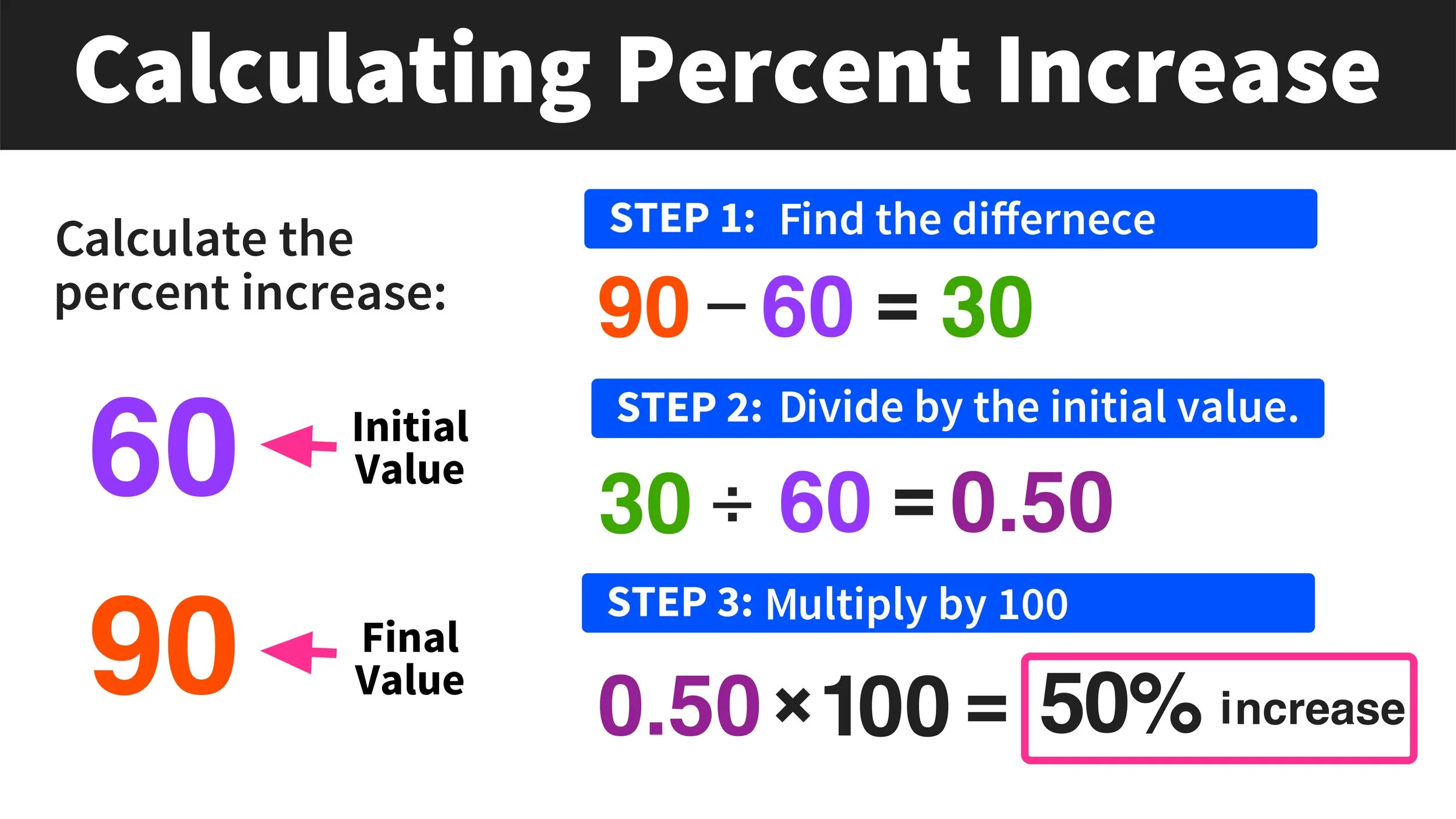
ROI is the most common percentage used to evaluate the efficiency of an investment. The formula is:
[(Current Value – Original Value) / Original Value] × 100 = ROI
Suppose you purchased shares of a technology company for $5,000 and sold them a year later for $6,200. Your profit is $1,200. To find the percentage gain:
($1,200 / $5,000) × 100 = 24%
This 24% return allows you to compare this investment’s performance against other benchmarks, such as the S&P 500 or the yield on a 10-year Treasury bond.
Understanding the Asymmetry of Percentage Gains and Losses
One of the most profound insights in financial math is the “asymmetry of loss.” Many novice investors believe that if a stock drops 50% in value, a 50% gain will bring them back to the break-even point. This is a mathematical fallacy.
If a $100 investment drops by 50%, it is worth $50. To get back to $100, the investment must now gain $50. However, $50 is 100% of the current $50 value. Therefore, a 50% loss requires a 100% gain to recover. This highlights why risk management and protecting the downside are so critical in professional wealth management; the percentage required to recover from a loss grows exponentially as the loss deepens.
Business Finance and Profitability Metrics
For business owners and corporate executives, percentage calculations are used to measure the “heartbeat” of the organization. These metrics, often referred to as margins, indicate how efficiently a company is converting its revenue into actual profit.
Gross and Net Profit Margins
A company’s Gross Profit Margin indicates the percentage of revenue exceeding the Cost of Goods Sold (COGS). It is calculated as:
[(Revenue – COGS) / Revenue] × 100
While Gross Margin shows production efficiency, the Net Profit Margin is the ultimate indicator of a company’s viability, as it accounts for all expenses, including taxes and interest. A business with $1 million in revenue and $100,000 in bottom-line profit has a 10% Net Profit Margin. In the world of business finance, comparing these percentages against industry averages is how investors determine if a company is “lean” or over-leveraged.
Sales Growth and Year-over-Year (YoY) Analysis
To determine if a business is expanding or contracting, analysts use Year-over-Year (YoY) percentage changes. This removes seasonal fluctuations and provides a clearer picture of long-term trends.
The formula for percentage growth is:
[(Current Period – Previous Period) / Previous Period] × 100
If a company had $500,000 in sales in Q3 of last year and $550,000 in Q3 of this year, the growth rate is 10%. Consistent double-digit percentage growth is often what drives high valuations in the equity markets, as it signals a scalable business model.
Advanced Tools for Financial Calculations
While manual calculations are vital for conceptual understanding, the modern financial professional relies on digital tools to ensure accuracy and speed when handling large datasets.
Utilizing Spreadsheet Formulas
In software like Microsoft Excel or Google Sheets, calculating percentages is streamlined. To find the percentage difference between two cells (A1 and B1), one would use the formula:
=(B1-A1)/A1
By clicking the “Percent Style” button in the toolbar, the software automatically multiplies the result by 100 and adds the percentage symbol. For complex financial modeling, such as Internal Rate of Return (IRR) or Compound Annual Growth Rate (CAGR), these tools use iterative percentage calculations that would be nearly impossible to perform manually.
Financial Calculators and Automated Systems
For mortgage planning or retirement forecasting, specialized financial calculators are indispensable. These tools calculate “percentage-based compounding,” where interest is earned on previously earned interest. Understanding the difference between simple interest (calculated only on the principal) and compound interest (calculated on the principal plus accumulated interest) is the difference between a mediocre financial plan and a robust one.
When using these tools, always ensure you are inputting the “periodic rate” correctly. If an annual interest rate is 6% but it compounds monthly, the percentage used for each calculation period is actually 0.5% (6% / 12 months).
Conclusion: The Power of Precision in Wealth Building
Calculating percentages is far more than a basic arithmetic exercise; it is a vital tool for strategic decision-making in both personal and business finance. From the 50/30/20 budgeting rule to the complex analysis of net profit margins and investment ROI, percentages allow us to cut through the noise of raw numbers and see the underlying reality of our financial health.
By mastering these calculations, you empower yourself to evaluate opportunities more clearly, manage risks more effectively, and ultimately, build wealth with a level of precision that “gut feeling” can never provide. In the world of money, the numbers rarely lie—provided you know how to calculate them.
aViewFromTheCave is a participant in the Amazon Services LLC Associates Program, an affiliate advertising program designed to provide a means for sites to earn advertising fees by advertising and linking to Amazon.com. Amazon, the Amazon logo, AmazonSupply, and the AmazonSupply logo are trademarks of Amazon.com, Inc. or its affiliates. As an Amazon Associate we earn affiliate commissions from qualifying purchases.