
Compound interest is often referred to as the “eighth wonder of the world,” a sentiment famously attributed to Albert Einstein. In the realm of personal finance, understanding how interest compounds—specifically on a daily basis—is one of the most critical skills an investor or a borrower can possess. While simple interest is calculated only on the principal amount of a loan or deposit, compound interest is calculated on the principal plus any accumulated interest from previous periods. When this occurs daily, the pace of growth (or debt accumulation) accelerates significantly.
Calculating interest compounded daily might seem daunting at first glance, involving complex algebraic formulas and fractional exponents. However, once the underlying logic is demystified, it becomes a powerful tool for financial planning. Whether you are looking to maximize the returns on a high-yield savings account or trying to understand why your credit card balance seems to grow so quickly, mastering the daily compound interest formula is essential.

Understanding the Mechanics of Daily Compound Interest
To calculate daily compound interest effectively, one must first distinguish between the frequency of compounding and the interest rate itself. Most financial institutions quote an Annual Percentage Rate (APR). However, the frequency with which that interest is added back into the balance—whether annually, monthly, or daily—determines the actual yield or cost, known as the Annual Percentage Yield (APY).
The Power of Frequent Compounding
The fundamental principle of daily compounding is that your interest earns interest every 24 hours. In a monthly compounding scenario, you wait 30 days for your interest to be added to your principal; only then does that new interest start earning for you. With daily compounding, the interest earned on Monday is added to your balance on Tuesday, meaning Tuesday’s interest is calculated on a slightly higher amount than Monday’s.
Over short periods, the difference between monthly and daily compounding might seem negligible—often just a few cents on a thousand dollars. However, over years or decades, or with larger sums of money, these microscopic daily additions snowball into substantial figures. This “snowball effect” is why savvy investors seek out daily compounding for their assets and why they are wary of it in their liabilities.
APR vs. APY: Why Daily Compounding Matters
When you see an interest rate advertised, it is usually the APR. But the APR does not tell the whole story if the interest compounds daily. The APY reflects the total amount of interest you will actually earn (or pay) in a year, taking the effects of compounding into account. Because daily compounding happens 365 times a year, the APY will always be higher than the APR. For example, a 5% APR compounded daily results in an APY of approximately 5.127%. Understanding this distinction prevents you from underestimating the true growth of your investments or the true cost of your loans.
The Mathematical Formula for Daily Compounding
To calculate the future value of an investment or a loan with daily compounding, we use the standard compound interest formula, adjusted for the frequency of the compounding periods.
Breaking Down the Variables
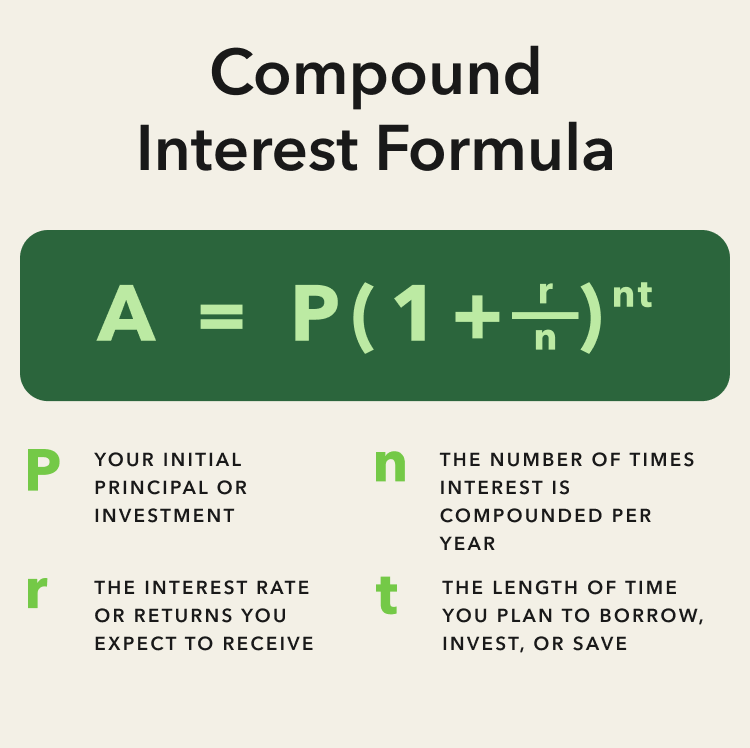
The formula is expressed as:
A = P(1 + r/n)^(nt)
Where:
-
A is the final amount (the future value of the investment/loan, including interest).
-
P is the principal amount (the initial sum of money).
-
r is the annual interest rate (represented as a decimal).
-
n is the number of times that interest is compounded per unit ‘t’. For daily compounding, this is typically 365.
-
t is the time the money is invested or borrowed for, expressed in years.
The Standard Daily Compound Formula
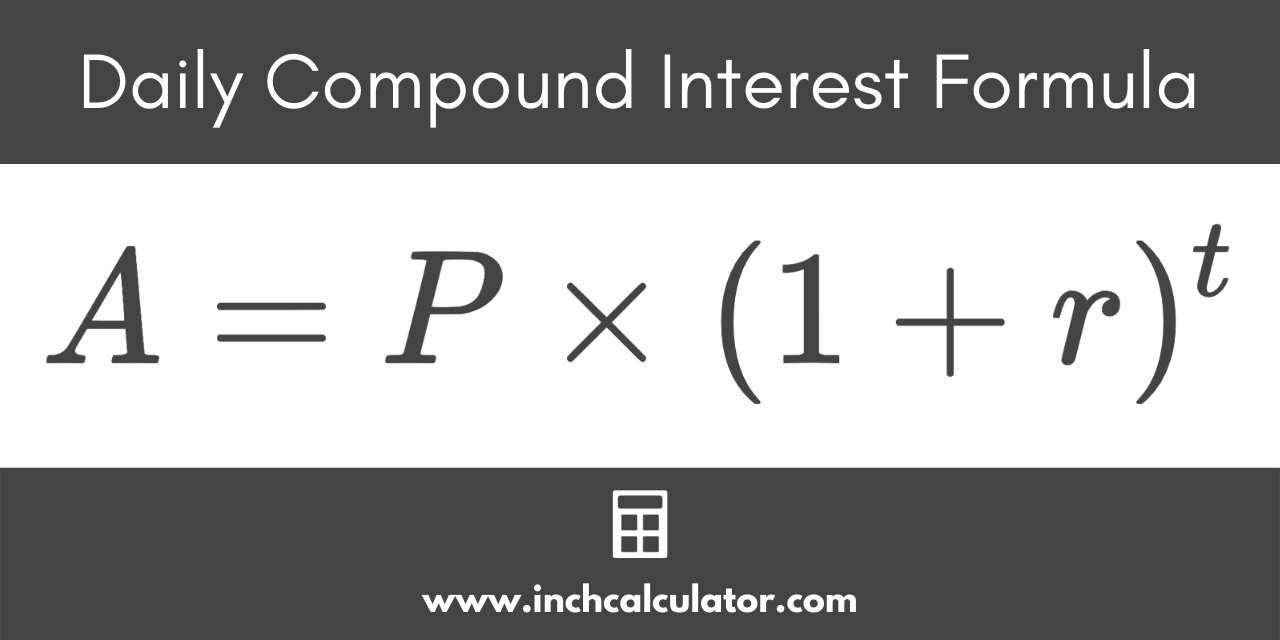
When we specifically look at daily compounding, we replace n with 365. The formula then becomes:
A = P(1 + r/365)^(365t)
In this equation, the term (r/365) represents the daily interest rate. This is the rate applied to your balance every single day. The exponent (365t) represents the total number of days the money is held. By raising the daily growth factor to the power of the total number of days, we account for the cumulative effect of interest building upon interest.
It is worth noting that some financial institutions use 360 days instead of 365 (often referred to as the “Banker’s Year”). While this is less common in modern consumer savings accounts, it is still prevalent in certain commercial lending and corporate finance sectors. Always check the terms of your agreement to see if you should be dividing by 360 or 365.
Step-by-Step: How to Calculate It Manually
While digital tools are convenient, walking through a manual calculation provides a deeper insight into how wealth is built. Let’s look at a practical example.
An Illustrative Example
Suppose you deposit $10,000 into a high-yield savings account with an annual interest rate of 4.5%, and the interest is compounded daily. You plan to leave the money untouched for exactly one year.
-
Identify the Variables:
-
P = $10,000
-
r = 0.045 (4.5% expressed as a decimal)
-
n = 365
-
t = 1
-
-
Calculate the Daily Interest Rate:
Divide the annual rate by the number of days in the year.
0.045 / 365 = 0.000123287
-
Add 1 to the Daily Rate:
This gives you the daily growth factor.
1 + 0.000123287 = 1.000123287
-
Raise the Factor to the Power of Total Days:
Since the time is one year, we raise it to the power of 365.
(1.000123287)^365 ≈ 1.04602
-
Multiply by the Principal:
$10,000 * 1.04602 = $10,460.20
In this scenario, you have earned $460.20 in interest. If the interest had been simple interest (not compounded), you would have earned exactly $450.00 ($10,000 * 0.045). The extra $10.20 is the result of your interest earning its own interest over the course of the year.
Accounting for Leap Years
In long-term financial modeling, leap years can introduce a slight variance. Most banks stick to a 365-day denominator regardless of the actual calendar year to maintain consistency. However, some sophisticated models or specific contracts may use 366 days during a leap year. For most personal finance goals, using 365 is the standard and provides a highly accurate estimate.
Using Modern Tools for Faster Results
While the manual formula is vital for understanding, it isn’t always practical for daily use, especially when dealing with fluctuating balances or multiple years. Digital tools can automate these calculations.
Excel and Google Sheets Shortcuts
Spreadsheet software is the most powerful tool for tracking compound interest. You can use the standard formula directly in a cell, or you can use the built-in “FV” (Future Value) function.
To calculate the future value in Excel, you would use:
=FV(rate/365, periods, payment, -principal)
For our previous example:
=FV(0.045/365, 365, 0, -10000)
Spreadsheets are particularly useful if you are making regular contributions to your savings. By adding a “payment” amount to the formula, you can see how daily compounding interacts with monthly deposits.
The Role of Financial Calculators
Many online financial calculators are pre-programmed for daily compounding. When using these, ensure you select “Daily” from the compounding frequency dropdown menu. These tools are excellent for “what-if” scenarios, such as determining how a 1% increase in interest rates or an extra five years of saving will impact your final balance.
Strategic Implications for Your Personal Finances
Understanding daily compounding is not just an academic exercise; it has real-world implications for how you manage your money. It highlights the importance of “time in the market” over “timing the market.”
Daily Compounding in Debt
The most aggressive use of daily compounding is often found in the credit card industry. Most credit card issuers calculate your interest based on a “daily periodic rate.” This means that every day you carry a balance, the interest is calculated and added to the total. This is why credit card debt can spiral out of control so quickly. If you have a high balance, the interest added today will serve as the basis for the interest charged tomorrow. To mitigate this, paying even small amounts toward your balance before the due date can reduce the average daily balance, effectively slowing down the compounding machine.
Maximizing Gains in High-Yield Savings
On the flip side, daily compounding is a major benefit for savers. When choosing between two banks offering the same APR, you should always choose the one that compounds daily over the one that compounds monthly or quarterly. Over a lifetime of saving, this choice can result in thousands of dollars in “free” money.
The Long-Term Impact of Small Daily Gains
The math of daily compounding teaches us a valuable lesson about consistency. Small, daily increments of growth lead to exponential results. This applies to more than just cash in a bank account; it applies to dividend reinvestment plans (DRIPs) and retirement accounts. The sooner you start, the more “days” the formula has to work its magic. Even if you cannot invest a large principal amount today, the time variable (t) in the formula is the most powerful component because it acts as an exponent.
By mastering the calculation of interest compounded daily, you transition from a passive participant in the financial system to an active strategist. You gain the ability to accurately project your wealth, evaluate the true cost of borrowing, and make informed decisions that align with your long-term financial goals. Whether you are using a scientific calculator, a spreadsheet, or an online tool, the logic remains the same: every day counts.
aViewFromTheCave is a participant in the Amazon Services LLC Associates Program, an affiliate advertising program designed to provide a means for sites to earn advertising fees by advertising and linking to Amazon.com. Amazon, the Amazon logo, AmazonSupply, and the AmazonSupply logo are trademarks of Amazon.com, Inc. or its affiliates. As an Amazon Associate we earn affiliate commissions from qualifying purchases.