
In the intricate world of personal finance, investing, and business, understanding percentages isn’t just a mathematical convenience—it’s a fundamental superpower. From calculating a discount on your groceries to deciphering your investment returns, or even strategizing your business’s profit margins, percentages are the universal language that translates raw numbers into actionable insights. Many financial decisions hinge on a clear grasp of percentage calculations, yet for many, it remains a source of confusion. This comprehensive guide aims to demystify percentages, providing you with the tools and confidence to wield them effectively in your financial life, ensuring you can make informed choices and optimize your monetary strategies.
The Foundation: Understanding What a Percentage Truly Means
Before diving into calculations, it’s crucial to grasp the core concept of a percentage. The word “percent” originates from the Latin “per centum,” meaning “by the hundred.” Essentially, a percentage is a way of expressing a number as a fraction of 100. It’s a standardized way to compare parts of different wholes, making complex data digestible and relatable. Instead of saying “15 out of 100,” we say “15%.” This simple notation allows for effortless comparison, whether you’re looking at a small local business’s growth or the vast economic shifts of a national market.
Defining the “Part” and the “Whole”
Every percentage calculation involves two core components: the “part” and the “whole.”
-
The Whole: This is the total, the original amount, or the baseline against which you are measuring. In financial terms, this could be your total income, the original price of an item, the initial investment amount, or the total market capitalization of a company.
-
The Part: This is the specific portion, change, or subset of the whole that you are interested in expressing as a percentage. This might be a discount amount, the interest earned, a profit, or a particular expense category within your budget.
Understanding which number represents the “part” and which represents the “whole” is the first critical step to correctly setting up any percentage calculation. Misidentifying these can lead to significantly skewed results and poor financial decisions.
The Ubiquity of Percentages in Finance
Percentages are the bedrock of almost every financial transaction and analysis.
-
Savings and Loans: Interest rates on savings accounts, mortgages, credit cards, and personal loans are all expressed as percentages.
-
Investing: Returns on investment (ROI), dividend yields, portfolio allocation, and market fluctuations are universally communicated through percentages.
-
Budgeting: Allocating income to different categories (housing, food, savings) is often done by assigning percentages of your total income.
-
Taxation: Sales tax, income tax, capital gains tax—all are percentage-based calculations applied to specific financial values.
-
Business Operations: Profit margins, markups, discounts, commissions, and growth rates are quintessential business metrics that rely heavily on percentages.
Without a solid understanding of how to work with percentages, navigating these common financial scenarios becomes a daunting, if not impossible, task.
Decimals and Fractions: The Unsung Heroes
While percentages are convenient for communication, in actual calculations, they are almost always converted into their decimal or fractional equivalents.
-
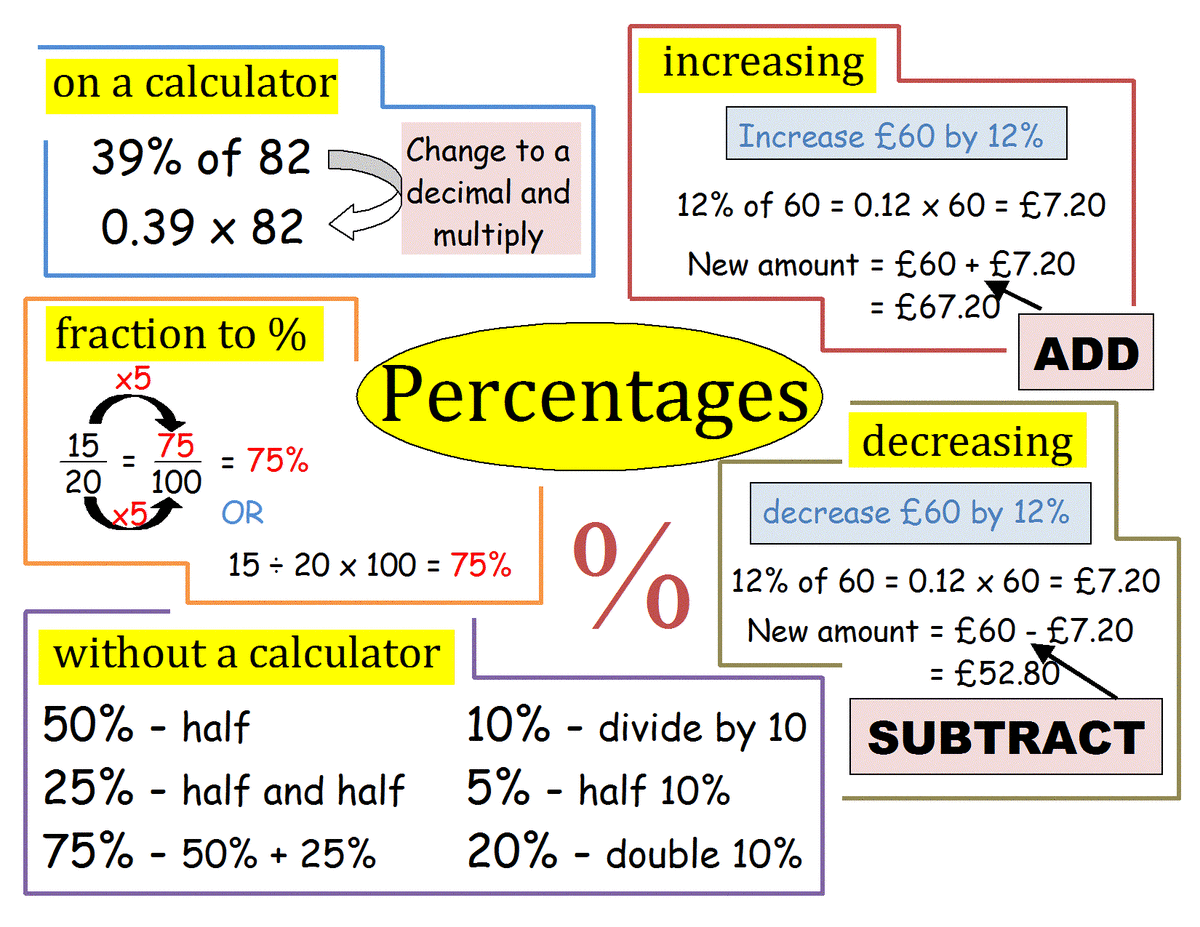
Percentage to Decimal: To convert a percentage to a decimal, simply divide by 100 (or move the decimal point two places to the left). For example, 25% becomes 0.25, and 5% becomes 0.05. This is the most common conversion for calculations.
-
Percentage to Fraction: To convert a percentage to a fraction, place the percentage over 100 and simplify. For example, 50% is 50/100, which simplifies to 1/2. While less common for direct financial calculations, understanding the fractional equivalent can offer intuitive insights into the proportion.
Most calculators and financial software operate with decimals, so familiarizing yourself with this conversion is paramount.
Core Methods for Calculating Percentages
There are several fundamental types of percentage calculations you’ll encounter regularly in financial contexts. Mastering these methods will empower you to analyze and respond to a wide array of monetary situations.
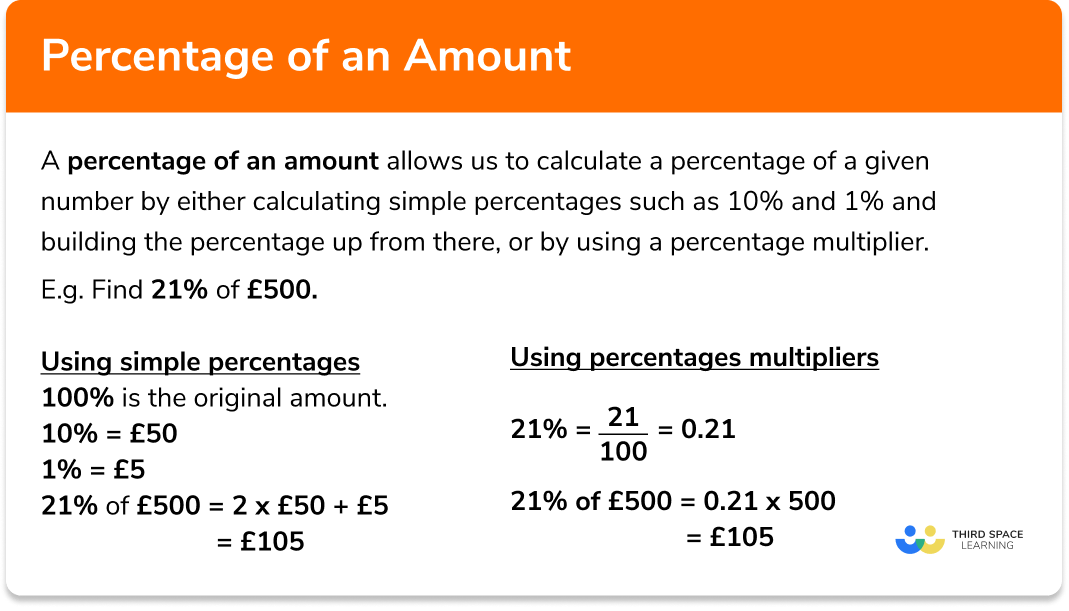
Method 1: Finding a Percentage of a Number (e.g., discounts, taxes)
This is perhaps the most common calculation: determining a specific portion of a given whole.
Formula: Percentage (as a decimal) × Whole Number = Part
Example 1 (Discount): You want to buy a new business laptop priced at $1,200, and it’s currently on a 15% discount.
-
Convert 15% to a decimal: 0.15
-
Calculate the discount amount: 0.15 × $1,200 = $180
-
The final price would be: $1,200 – $180 = $1,020
Example 2 (Sales Tax): If you purchase an item for $50 and the sales tax is 8%.
-
Convert 8% to a decimal: 0.08
-
Calculate the tax amount: 0.08 × $50 = $4
-
The total cost would be: $50 + $4 = $54
Method 2: Expressing One Number as a Percentage of Another (e.g., profit margins, test scores)
This method helps you understand what proportion one value represents of a larger value.
Formula: (Part ÷ Whole) × 100 = Percentage
Example 1 (Profit Margin): Your side hustle generated $5,000 in revenue and incurred $3,000 in costs. What is your profit margin (profit as a percentage of revenue)?
-
Calculate profit: $5,000 – $3,000 = $2,000 (This is the “part”)
-
Revenue is the “whole”: $5,000
-
(2,000 ÷ 5,000) × 100 = 0.4 × 100 = 40%
Your profit margin is 40%.
Example 2 (Budget Allocation): You earn $4,000 per month and spend $800 on rent. What percentage of your income goes to rent?
-
Part: $800
-
Whole: $4,000
-
(800 ÷ 4,000) × 100 = 0.2 × 100 = 20%
20% of your income is allocated to rent.
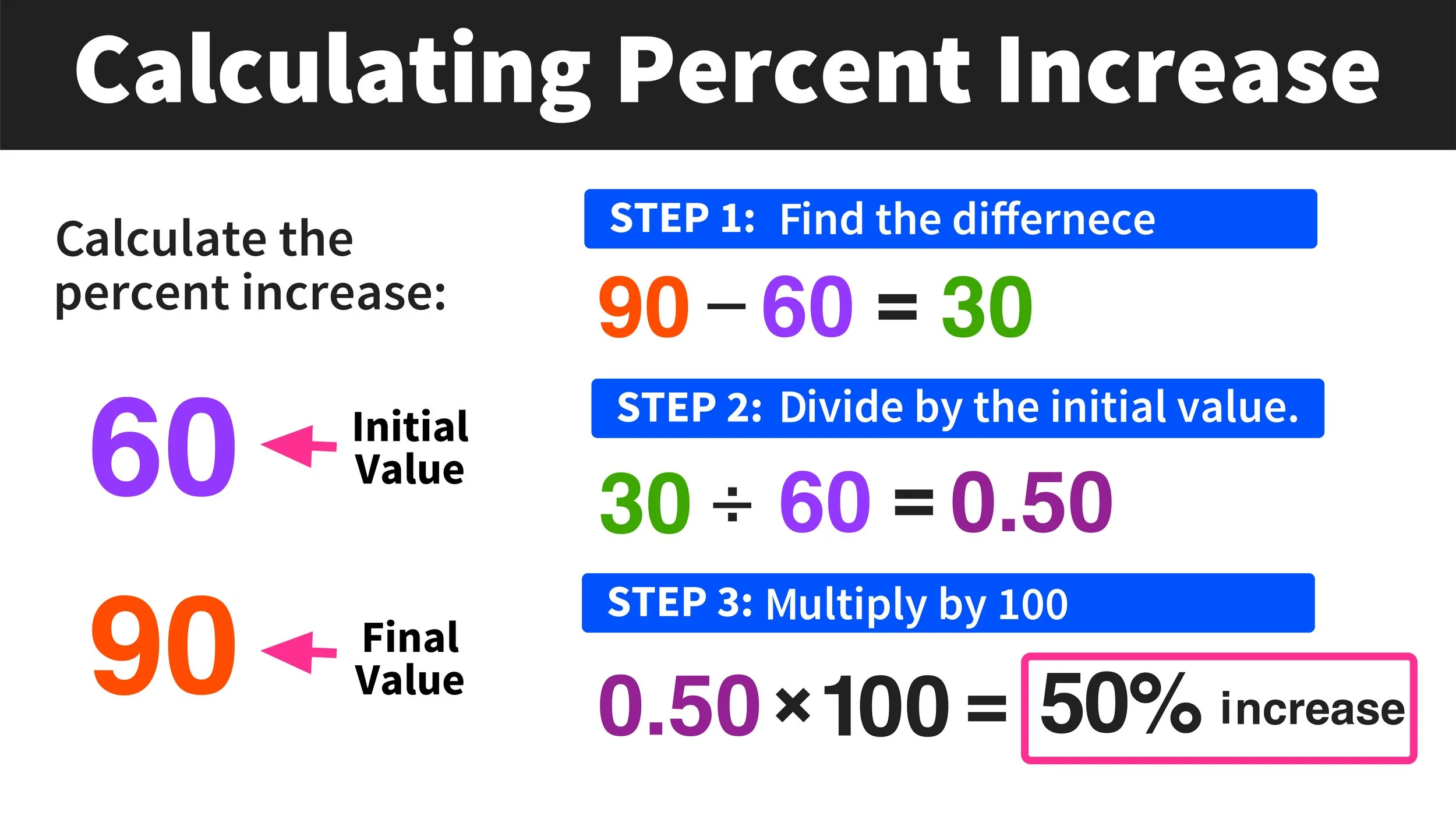
Method 3: Calculating Percentage Increase or Decrease (e.g., investment growth, inflation)
This is crucial for tracking growth, depreciation, or changes over time in financial values.
Formula: ((New Value – Old Value) ÷ Old Value) × 100 = Percentage Change
-
If the result is positive, it’s an increase.
-
If the result is negative, it’s a decrease.
Example 1 (Investment Growth): Your investment portfolio started at $10,000 and grew to $12,500 over a year.
-
New Value: $12,500
-
Old Value: $10,000
-
((12,500 – 10,000) ÷ 10,000) × 100 = (2,500 ÷ 10,000) × 100 = 0.25 × 100 = 25% increase
Example 2 (Value Decrease): A piece of equipment for your business was purchased for $500 and is now worth $350.
-
New Value: $350
-
Old Value: $500
-
((350 – 500) ÷ 500) × 100 = (-150 ÷ 500) × 100 = -0.3 × 100 = -30% decrease
Method 4: Working Backwards: Finding the Original Number (e.g., pre-tax price)
Sometimes you know the final value after a percentage has been applied (e.g., a discounted price or a price including tax) and need to find the original value.
Formula: Final Value ÷ (1 + or – Percentage as a decimal) = Original Value
-
Use
1 + percentagefor an increase (e.g., including tax). -
Use
1 - percentagefor a decrease (e.g., after a discount).
Example 1 (Finding Original Price with Tax): You paid $108 for an item, and the sales tax was 8%. What was the original price before tax?
-
Final Value: $108
-
Percentage (increase): 8% or 0.08
-
Original Price: $108 ÷ (1 + 0.08) = $108 ÷ 1.08 = $100
Example 2 (Finding Original Price with Discount): You bought an item for $85 after a 15% discount. What was the original price?
-
Final Value: $85
-
Percentage (decrease): 15% or 0.15
-
Original Price: $85 ÷ (1 – 0.15) = $85 ÷ 0.85 = $100
Practical Applications in Personal Finance and Investing
The ability to calculate percentages is not just an academic exercise; it directly translates into smarter financial decisions.
Budgeting and Expense Tracking
Percentages are invaluable for creating a balanced budget and understanding your spending habits.
-
50/30/20 Rule: A popular budgeting strategy suggests allocating 50% of your income to needs, 30% to wants, and 20% to savings and debt repayment. You can quickly calculate the dollar amounts for each category: If you earn $4,000 per month, 50% for needs is $2,000 (0.50 * $4,000).
-
Expense Analysis: By expressing each expense category (groceries, entertainment, transportation) as a percentage of your total income or total expenses, you can identify areas where you might be overspending or where adjustments could free up more funds for savings or investments.
Discounts, Sales Tax, and Tips
These everyday transactions rely on percentages. Knowing how to quickly calculate them saves you money and ensures you tip appropriately.
-
Comparing Discounts: Is a 20% off a $100 item better than $25 off a $150 item? You can calculate the exact savings in dollars using Method 1.
-
Calculating Total Cost: Quickly add sales tax to the price of an item.
-
Tipping: Easily determine a 15% or 20% tip on your restaurant bill. For example, for a $60 bill, a 20% tip is 0.20 × $60 = $12.
Interest Rates: Loans, Savings, and Credit Cards
Understanding how interest rates work is critical for borrowing wisely and saving effectively.
-
Loan Payments: While complex loan amortizations often require specialized calculators, knowing how to calculate simple interest (Principal × Rate × Time) gives you a foundational understanding. A 5% interest rate on a $1,000 loan for one year would mean $50 in interest.
-
Credit Card Interest: High credit card interest rates (e.g., 20% APR) can quickly accrue debt. Understanding this percentage helps you prioritize paying off high-interest balances.
-
Savings Growth: Knowing your savings account earns 0.5% interest means you can estimate your annual earnings (e.g., 0.005 × $10,000 = $50 per year).
Investment Returns and Portfolio Performance
For investors, percentages are the language of growth, risk, and comparison.
-
Return on Investment (ROI): This tells you the efficiency of an investment. If you invest $1,000 and sell for $1,200, your ROI is ((1,200 – 1,000) / 1,000) × 100 = 20%.
-
Portfolio Allocation: You might decide to allocate 60% of your portfolio to stocks and 40% to bonds. If your portfolio is worth $50,000, that’s $30,000 in stocks (0.60 * $50,000).
-
Dividend Yields: Expressed as a percentage, this indicates the annual dividend income relative to the stock’s price.
Percentages in Business and Side Hustles
For entrepreneurs and those with side hustles, percentages are essential for setting prices, evaluating performance, and making strategic decisions.
Profit Margins and Markups
These metrics are fundamental to business profitability.
-
Gross Profit Margin: (Revenue – Cost of Goods Sold) / Revenue × 100. This tells you how much profit your business makes from each sale after accounting for direct costs. A 30% gross profit margin means for every dollar of sales, 30 cents is profit before overheads.
-
Markup: Used to set selling prices based on cost. If an item costs you $10, and you want a 50% markup, your selling price would be $10 + (0.50 × $10) = $15.
Commission Structures
Many sales roles and affiliate marketing programs use commission based on percentages.
- If you earn a 10% commission on sales, and you make $5,000 in sales, your commission is 0.10 × $5,000 = $500. Understanding this helps you project income and set sales goals.
Analyzing Business Growth and Market Share
Percentages provide a clear picture of how your business is performing relative to itself and the competition.
-
Year-over-Year Growth: Compare this year’s revenue to last year’s using Method 3 to understand your growth trajectory.
-
Market Share: If the total market revenue for your product is $1 million, and your business captures $100,000 in revenue, your market share is ($100,000 / $1,000,000) × 100 = 10%.
Leveraging Tools and Avoiding Common Pitfalls
While understanding the formulas is key, modern tools make percentage calculations effortless, and being aware of common errors can save you from significant financial missteps.
The Power of Calculators and Spreadsheets
Don’t feel obliged to do complex percentage calculations by hand.
-
Basic Calculators: Most standard calculators have a ‘%’ button that simplifies many operations. Be sure to understand how your specific calculator handles percentages, as some variations exist.
-
Smartphone Apps: Numerous financial calculator apps are available that can handle intricate percentage-based calculations, from loan amortizations to investment growth.
-
Spreadsheets (Excel, Google Sheets): These are perhaps the most powerful tools. You can set up formulas to automatically calculate percentages across large datasets, making budgeting, financial modeling, and performance tracking incredibly efficient. For example, to calculate 15% of a number in cell A1, you’d type
=A1*0.15or=A1*15%.
Mental Math Shortcuts for Quick Estimates
While precise calculations are often needed, sometimes a quick mental estimate is sufficient.
-
Finding 10%: Move the decimal point one place to the left. (10% of $250 is $25).
-
Finding 5%: Find 10% and divide by 2. (5% of $250 is $12.50).
-
Finding 1%: Move the decimal point two places to the left. (1% of $250 is $2.50).
-
You can build up from these. For example, 17% of a number is 10% + 5% + 1% + 1%. These shortcuts are invaluable for quick checks, estimating tips, or rapidly assessing a discount.
Common Mistakes: Base Errors and Misinterpreting Changes
Even experienced individuals can fall prey to common percentage errors.
-
Changing Base: This is a frequent mistake. For example, if your investment drops by 20% in year one, and then increases by 20% in year two, you do not break even. If you start with $100, a 20% drop is -$20, leaving $80. A 20% increase on $80 is $16, bringing you to $96. The base changed! Always be mindful of what the “whole” or starting point is for each calculation.
-
Confusing Percentage Points with Percentage Change: If an interest rate goes from 5% to 6%, that’s a 1 percentage point increase. However, it’s a 20% percentage change ( ((6-5)/5) * 100 = 20%). The distinction is critical in financial reporting and analysis.
-
Rounding Errors: While minor rounding might seem insignificant, over large sums or many iterations, it can lead to substantial discrepancies. Use sufficient decimal places for accuracy, especially in business finance.
Why Accuracy Matters in Financial Decisions
In finance, small percentage errors can have profound consequences. Miscalculating interest rates on a large loan, underestimating profit margins, or incorrectly interpreting investment returns can lead to lost opportunities, unexpected costs, or flawed strategies. A robust understanding and application of percentage calculations provide a crucial layer of precision and confidence in every financial endeavor, empowering you to navigate the monetary landscape with greater acumen and success.
Mastering percentages isn’t just about math; it’s about gaining control over your financial narrative. By diligently applying these methods and insights, you transform from a passive observer of numbers into an active architect of your financial future.
aViewFromTheCave is a participant in the Amazon Services LLC Associates Program, an affiliate advertising program designed to provide a means for sites to earn advertising fees by advertising and linking to Amazon.com. Amazon, the Amazon logo, AmazonSupply, and the AmazonSupply logo are trademarks of Amazon.com, Inc. or its affiliates. As an Amazon Associate we earn affiliate commissions from qualifying purchases.