
Calculating a 20 percent discount is a fundamental skill in personal finance, empowering you to make informed purchasing decisions and effectively manage your budget. Whether you’re eyeing a new gadget, shopping for groceries, or assessing a service, quickly determining the final price after a discount can save you significant money over time. This guide breaks down the process into simple, actionable steps, and explores how this skill integrates into a broader financial strategy.
The Core Concept: Understanding Percentages and Discounts
Before diving into the mechanics, it’s crucial to grasp what a percentage truly represents in the context of discounts. A percentage is a way of expressing a number as a fraction of 100. So, 20 percent (20%) means 20 out of every 100. When something is “20 percent off,” it means you are saving 20 units for every 100 units of the original price.

Why Discounts Are More Than Just Savings
Understanding how to calculate discounts isn’t merely about finding a lower price; it’s a vital component of prudent financial management. For individuals focused on personal finance, every dollar saved through smart shopping is a dollar that can be allocated towards savings goals, investments, debt reduction, or other critical financial priorities. Regularly applying discount calculations helps cultivate a disciplined spending habit, preventing impulsive purchases and encouraging a more analytical approach to consumption. It’s about optimizing your outflow to maximize your financial inflow or retention.
Step-by-Step Methods for Calculating 20 Percent Off
There are several straightforward methods to calculate a 20 percent discount. Each offers a slightly different approach, allowing you to choose the one that best suits your mental arithmetic style or the tools available.
Method 1: The Subtraction Method (Two Steps)
This is perhaps the most intuitive method for many. You first calculate the discount amount, and then subtract it from the original price.
-
Calculate the Discount Amount: Convert the percentage to a decimal and multiply it by the original price.
-
To convert 20% to a decimal, divide 20 by 100, which gives you 0.20.
-
Formula:
Discount Amount = Original Price × 0.20 -
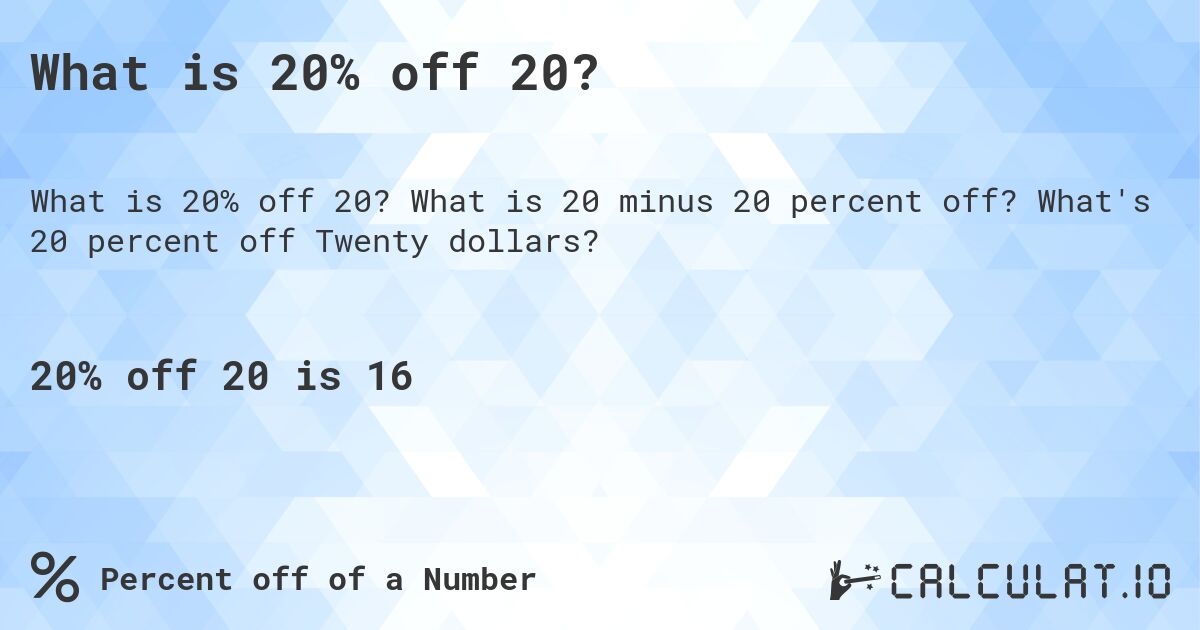
Example: If an item costs $50, the discount amount is
$50 × 0.20 = $10.
-
-
Subtract the Discount from the Original Price:
-
Formula:
Final Price = Original Price - Discount Amount -
Example: Using the $50 item, the final price is
$50 - $10 = $40.
-
Method 2: The Multiplier Method (One Step)
This method is often quicker once you understand the logic. Instead of finding the discount and subtracting, you directly calculate the remaining percentage of the price. If you’re taking 20% off, you are effectively paying 80% of the original price (100% – 20% = 80%).
-
Determine the Remaining Percentage: Subtract the discount percentage from 100%.
100% - 20% = 80%
-
Multiply the Original Price by the Remaining Percentage (as a decimal):
-
Convert 80% to a decimal:
80 / 100 = 0.80. -
Formula:
Final Price = Original Price × 0.80 -
Example: For a $50 item, the final price is
$50 × 0.80 = $40.
-
This method is particularly efficient as it streamlines the process into a single multiplication, reducing the chances of error and speeding up calculations, especially when using a calculator or spreadsheet.
Method 3: Mental Math Shortcuts
For simple numbers, you can often do these calculations in your head.
-
Find 10% First: A 10% discount is easy to calculate mentally: just move the decimal point one place to the left.
- Example: For $50, 10% is $5.00.
-
Double It for 20%: Since 20% is twice 10%, double the 10% amount.
- Example: Double $5.00 is $10.00. This is your discount.
-
Subtract:
Original Price - Discount = Final Price.- Example:
$50 - $10 = $40.
- Example:
This mental math approach is invaluable for quick assessments while shopping, allowing you to quickly gauge potential savings without needing a physical calculator.
Applying Discount Calculations in Real-World Financial Scenarios
Understanding how to calculate 20% off extends beyond simple single-item purchases. It becomes critical when dealing with more complex sales, budgeting, and overall financial planning.
Navigating Sales Tax and Multiple Discounts
A common financial question is whether sales tax is applied before or after a discount. Generally, sales tax is calculated on the discounted price, not the original price. This works in your favor, as you pay less tax.
-
Order of Operations:
-
Calculate the discount (
Original Price × 0.80). -
Add sales tax to the discounted price (
Discounted Price × (1 + Sales Tax Rate)).
-
Example: An item is $50, 20% off, and sales tax is 8%.
-
Discounted Price:
$50 × 0.80 = $40. -
Sales Tax Amount:
$40 × 0.08 = $3.20. -
Total Price:
$40 + $3.20 = $43.20.
-
-
When multiple discounts are offered (e.g., “20% off plus an additional 10% off”), they are almost always applied sequentially, not cumulatively added (i.e., not a 30% total discount).
-
Sequential Discounts Example: Item is $100, 20% off, then an additional 10% off.
-
First discount:
$100 × 0.80 = $80. -
Second discount applied to the new price:
$80 × 0.90 = $72.
The total saving is $28, not $30.
-
Understanding “Up To” Discounts and Minimum Spend
Many promotions state “Up To 20% Off.” This often means select items may be 20% off, while others are less, or that 20% is the maximum possible discount. Similarly, “spend $100 and get 20% off” implies a minimum spend threshold before the discount applies. Diligently reading the fine print ensures you’re not disappointed and helps you budget accurately, preventing overspending to reach a discount threshold if the underlying value isn’t there.
Leveraging Financial Tools for Discount Calculations
While mental math is useful, financial tools can enhance accuracy and efficiency, particularly for larger budgets or complex calculations.
Smartphone Calculators and Apps
Every smartphone comes equipped with a basic calculator that can handle percentage calculations. Many dedicated finance apps also incorporate discount calculators, sometimes even allowing you to input multiple percentages for stacking discounts, or to factor in sales tax. Integrating these into your shopping habits can make budget adherence much simpler.
Spreadsheet Functions for Budgeting
For comprehensive budgeting, especially for larger purchases or inventory management, spreadsheets like Microsoft Excel or Google Sheets are invaluable.
-
To calculate a 20% discount in a spreadsheet:
-
If the original price is in cell A1, you can use the formula
=A1*0.80in another cell to get the discounted price. -
Alternatively, to show the discount amount, use
=A1*0.20.
-
Spreadsheets allow you to quickly apply discount logic across numerous items, making it an essential tool for small business owners managing inventory, or for families planning significant expenses.
Beyond the Calculation: Strategic Financial Planning with Discounts
Knowing how to calculate discounts is just the first step. The real financial benefit comes from integrating this knowledge into a broader strategic approach to spending and saving.
The True Value of a Discount: Opportunity Cost
A discount is only a saving if you genuinely needed or planned to purchase the item. Buying something simply because it’s 20% off, but without a real need, is not saving; it’s still spending 80% of the price on an unnecessary item. Consider the opportunity cost: what else could that money have been used for? Could it have contributed to an emergency fund, a retirement account, or debt repayment?
Integrating Discounts into Your Personal Budget
Actively seeking and calculating discounts should be a deliberate part of your budget strategy.
-
Allocate “Discounted Funds”: When you save money on a purchase, mentally (or physically) allocate that saved amount. Instead of letting it disappear into general spending, move it to a savings account or apply it towards a financial goal.
-
Price Comparison: Use your calculation skills to compare discounted prices across different retailers. A 20% discount at one store might still be more expensive than another store’s regular price.
-
Timing Purchases: Strategic shoppers often wait for sales events where 20% (or more) discounts are common, allowing them to purchase planned items at a lower cost, thereby maximizing their purchasing power within their existing budget.
Mastering the calculation of “20 percent off” is a foundational element of effective personal finance. It empowers individuals to make smarter spending choices, stretch their budgets further, and ultimately contribute more effectively to their long-term financial well-being. By understanding the mechanics, leveraging available tools, and adopting a strategic mindset, discounts transform from simple price reductions into powerful financial optimization levers.
aViewFromTheCave is a participant in the Amazon Services LLC Associates Program, an affiliate advertising program designed to provide a means for sites to earn advertising fees by advertising and linking to Amazon.com. Amazon, the Amazon logo, AmazonSupply, and the AmazonSupply logo are trademarks of Amazon.com, Inc. or its affiliates. As an Amazon Associate we earn affiliate commissions from qualifying purchases.