
The advent of cryptocurrencies has ushered in a paradigm shift in how we perceive and interact with digital assets, security, and global networks. Far more than just an alternative form of money, cryptocurrencies represent a profound technological innovation built upon intricate cryptographic principles and distributed ledger systems. Understanding “how cryptocurrencies work” delves into the very architecture that underpins their existence, revealing a sophisticated interplay of cryptography, networking, and consensus mechanisms designed to create a secure, transparent, and immutable digital infrastructure. This exploration moves beyond the superficial understanding of digital cash to unravel the foundational technologies that empower this revolutionary asset class.
The Foundational Layer: Blockchain Technology
At the heart of virtually every cryptocurrency lies the blockchain – a distributed, decentralized, and immutable ledger that records all transactions across a network of computers. This innovative data structure is the bedrock upon which the entire cryptocurrency ecosystem is built, providing the transparency and security necessary for digital trust without reliance on central authorities.
Decentralized Ledger and Distributed Network
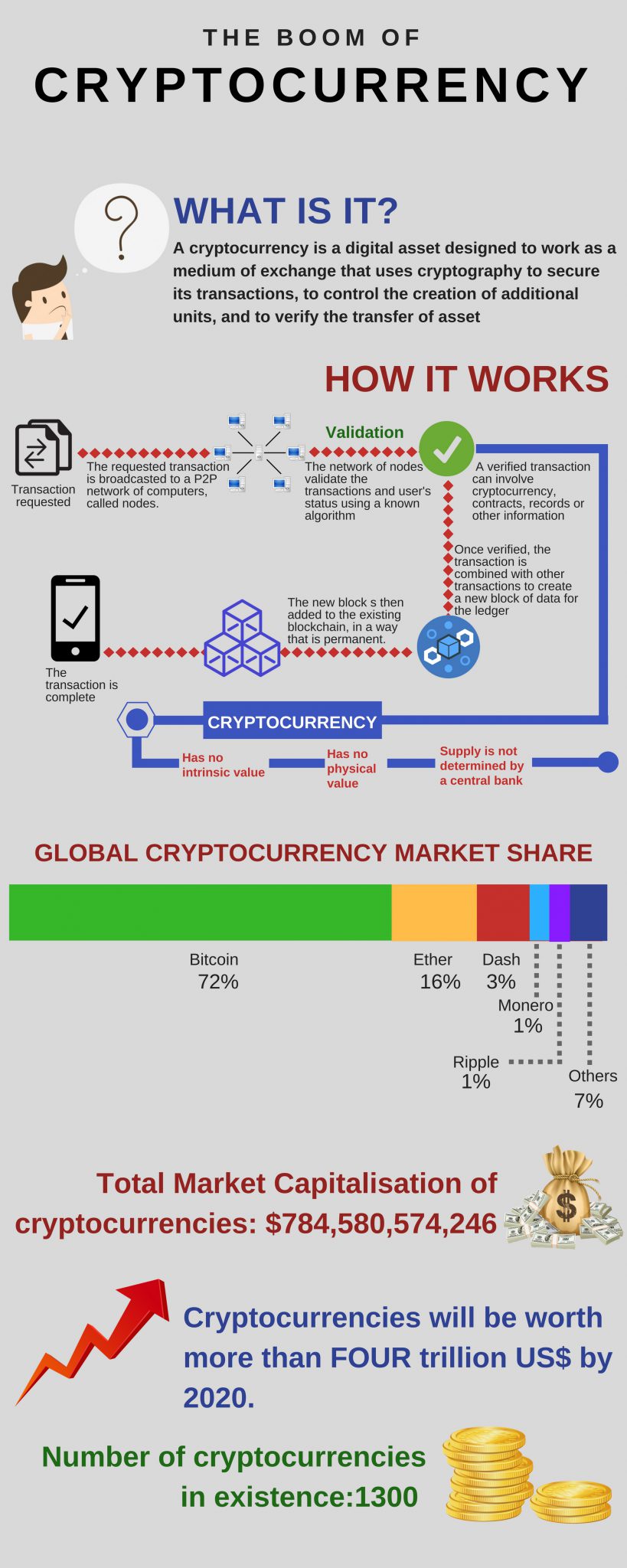
Unlike traditional financial systems where a central bank or institution maintains a single, authoritative ledger of transactions, a cryptocurrency’s blockchain is distributed across thousands, if not millions, of computers globally. Each participant in the network, known as a node, holds a copy of the entire ledger. This distributed nature eliminates single points of failure, making the network highly resilient to attacks, censorship, and outages. When a transaction occurs, it is broadcast to the network, verified by nodes, and then added to a new “block” of transactions. Once a block is validated, it is appended to the existing chain of blocks, creating a continuous, chronological record accessible to all participants. This peer-to-peer (P2P) network model ensures that no single entity has control, embodying the core principle of decentralization.
Blocks, Hashes, and the Chain
The “blockchain” derives its name from its structure: a chain of individual “blocks” of data. Each block contains a list of validated transactions, a timestamp, and a unique cryptographic identifier called a “hash.” Crucially, each new block also contains the hash of the previous block in the chain. This interlocking mechanism is what creates the “chain” and ensures the integrity of the entire ledger. If even a single piece of information within an old block were tampered with, its hash would change, invalidating the hash stored in the subsequent block, and effectively breaking the chain. This interdependency makes it extraordinarily difficult and computationally expensive to alter past transactions without being detected by the network.
Immutability and Transparency
The cryptographic linking of blocks, combined with the distributed nature of the network, confers two paramount properties to the blockchain: immutability and transparency. Immutability means that once a transaction is recorded on the blockchain and a block is added to the chain, it cannot be altered or deleted. This permanence provides an unparalleled level of security and trust, as participants can be confident that transaction histories are final. Transparency, on the other hand, means that the entire history of transactions is publicly viewable by anyone on the network. While the identities of the participants are typically pseudonymous (represented by cryptographic addresses), the flow of value between these addresses is fully auditable. This radical transparency, coupled with immutability, fosters an environment of verifiable trust where intermediaries are largely rendered unnecessary.
Cryptography: The Engine of Security and Trust
Cryptography is not merely an accessory to cryptocurrencies; it is their fundamental operating system. Without advanced cryptographic techniques, the concepts of digital ownership, secure transactions, and decentralized consensus would be impossible. It provides the mathematical assurances that enable trust in a trustless environment.
Public-Key Cryptography (Wallets and Transactions)
A cornerstone of cryptocurrency security is public-key cryptography, also known as asymmetric cryptography. Every participant in a cryptocurrency network possesses a pair of cryptographic keys: a public key and a private key.
- Public Key: This is analogous to a bank account number. It’s openly shared and used to generate a unique “wallet address” where others can send cryptocurrencies. Transactions sent to this address can only be unlocked by the corresponding private key.
- Private Key: This is the secret password that grants access to the funds associated with the public key. It’s absolutely crucial to keep private keys secure and confidential. Losing a private key means losing access to your cryptocurrencies, as there’s no central authority to reset it.
When you want to send cryptocurrencies, you use your private key to “sign” the transaction. This digital signature proves that you own the funds and authorize the transfer without revealing your private key itself.
Hashing Functions: Data Integrity and Proof-of-Work
Cryptographic hash functions are one-way mathematical algorithms that take an input (any data of any size) and produce a fixed-size, unique string of characters – the “hash” or “digest.” Key properties of hash functions in cryptocurrency include:
- Determinism: The same input always produces the same output hash.
- One-way: It’s computationally infeasible to reverse the process and derive the original input from the hash.
- Collision Resistance: It’s extremely difficult to find two different inputs that produce the same hash.
These properties are critical for data integrity. If even a single character in a block of transactions is altered, its hash will completely change, immediately indicating tampering. Hash functions are also central to “Proof-of-Work” (PoW) consensus mechanisms, where miners compete to find a specific hash for a new block, effectively solving a computational puzzle.
Digital Signatures: Verifying Authenticity
Digital signatures, created using public-key cryptography, are fundamental to verifying the authenticity and integrity of transactions. When a user initiates a transaction, their private key is used to create a unique digital signature for that specific transaction. This signature is then attached to the transaction and broadcast to the network. Any node on the network can use the sender’s public key to verify two things:
- Authenticity: That the transaction was indeed authorized by the owner of the private key (i.e., the funds’ owner).
- Integrity: That the transaction data has not been altered since it was signed.
This cryptographic proof eliminates the need for trusted third parties to confirm identities or transaction validity, reinforcing the decentralized nature of cryptocurrencies.
Consensus Mechanisms: Maintaining Network Agreement
In a decentralized network, where thousands of independent nodes operate without central coordination, a method is needed to ensure that all participants agree on the valid state of the blockchain. This is where consensus mechanisms come into play. They are the algorithms that allow distributed networks to achieve agreement on which transactions are legitimate and in what order they should be added to the blockchain.
Proof-of-Work (PoW): The Mining Process Explained
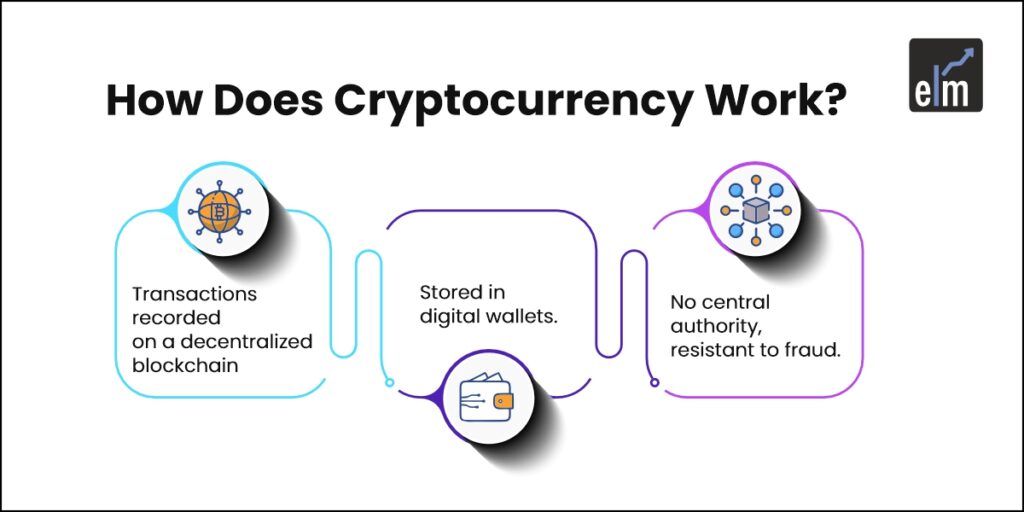
Proof-of-Work (PoW) is the original and most widely known consensus mechanism, famously used by Bitcoin and Ethereum (prior to its transition to PoS). In PoW, participants called “miners” compete to solve a complex computational puzzle. This puzzle involves finding a specific numerical value (a “nonce”) that, when combined with the block’s data and hashed, produces a result below a target threshold set by the network.
- Competition: Miners use specialized hardware to rapidly guess nonces and perform billions of hash calculations per second.
- Validation: The first miner to find the correct nonce broadcasts their newly formed block to the network. Other nodes verify the solution’s correctness (which is easy to do, even though finding it is hard).
- Reward: If the block is valid, it’s added to the blockchain, and the successful miner is rewarded with newly minted cryptocurrency (block reward) and transaction fees.
The “work” refers to the computational effort expended. This energy expenditure makes it extremely costly and practically impossible for a malicious actor to rewrite the blockchain, as they would need to outpace the computational power of the entire honest network.
Proof-of-Stake (PoS): A Greener Alternative
Proof-of-Stake (PoS) emerged as an alternative to PoW, primarily to address concerns about the high energy consumption of mining. In PoS, instead of miners, we have “validators.” Validators are chosen to create new blocks based on the amount of cryptocurrency they “stake” (lock up) as collateral.
- Staking: Participants pledge a certain amount of the network’s native cryptocurrency as a stake.
- Selection: The protocol randomly selects a validator to propose the next block, with the probability of selection proportional to the size of their stake.
- Validation & Reward: If the validator proposes a valid block, they receive a reward (transaction fees and sometimes a small block reward). If they act maliciously, they risk losing a portion or all of their staked assets (slashing).
PoS significantly reduces energy consumption as it doesn’t require intensive computational races. It also potentially allows for higher transaction throughput. Ethereum’s “Merge” to Ethereum 2.0 marked a major shift from PoW to PoS, highlighting its growing acceptance.
Other Consensus Models (Delegated PoS, Proof-of-Authority, etc.)
While PoW and PoS are the most prevalent, numerous other consensus mechanisms have been developed to suit different blockchain requirements:
- Delegated Proof-of-Stake (DPoS): Users “vote” for a limited number of delegates (witnesses or block producers) who are responsible for validating transactions and creating blocks. This offers faster transaction times but is more centralized than pure PoS.
- Proof-of-Authority (PoA): Blocks are validated by approved, pre-selected accounts (authorities) who are known and trusted entities. This is often used in private or consortium blockchains where identity and reputation are key.
- Proof-of-History (PoH): A component of Solana’s consensus, PoH is not a standalone consensus mechanism but a cryptographic clock that provides a verifiable order of events, enabling faster transaction processing and reducing overhead for the subsequent PoS mechanism.
Each mechanism strikes a different balance between decentralization, security, scalability, and efficiency, tailored to the specific goals of a blockchain network.
Transactions and Wallets: User Interaction with the Network
For users, interacting with cryptocurrencies primarily involves sending and receiving transactions, managed through digital wallets. These seemingly simple actions mask a complex choreography of cryptographic operations and network communications.
The Transaction Lifecycle: From Initiation to Confirmation
A cryptocurrency transaction begins when a user, using their private key, creates a digitally signed message specifying the amount of cryptocurrency to send, the recipient’s public address, and a transaction fee.
- Creation: The user’s wallet software constructs the transaction, signs it with the private key, and broadcasts it to the network.
- Propagation: The transaction is propagated across the P2P network to various nodes.
- Verification: Nodes verify the transaction’s validity (e.g., correct digital signature, sufficient funds, no double-spending).
- Inclusion in Block: Valid transactions are temporarily held in a “mempool” (memory pool) and selected by miners/validators to be included in the next block.
- Block Confirmation: Once a block containing the transaction is successfully added to the blockchain and subsequent blocks are built on top of it (gaining “confirmations”), the transaction is considered irreversible and complete. The number of confirmations required for finality varies by network and recipient.
Digital Wallets: Public and Private Keys
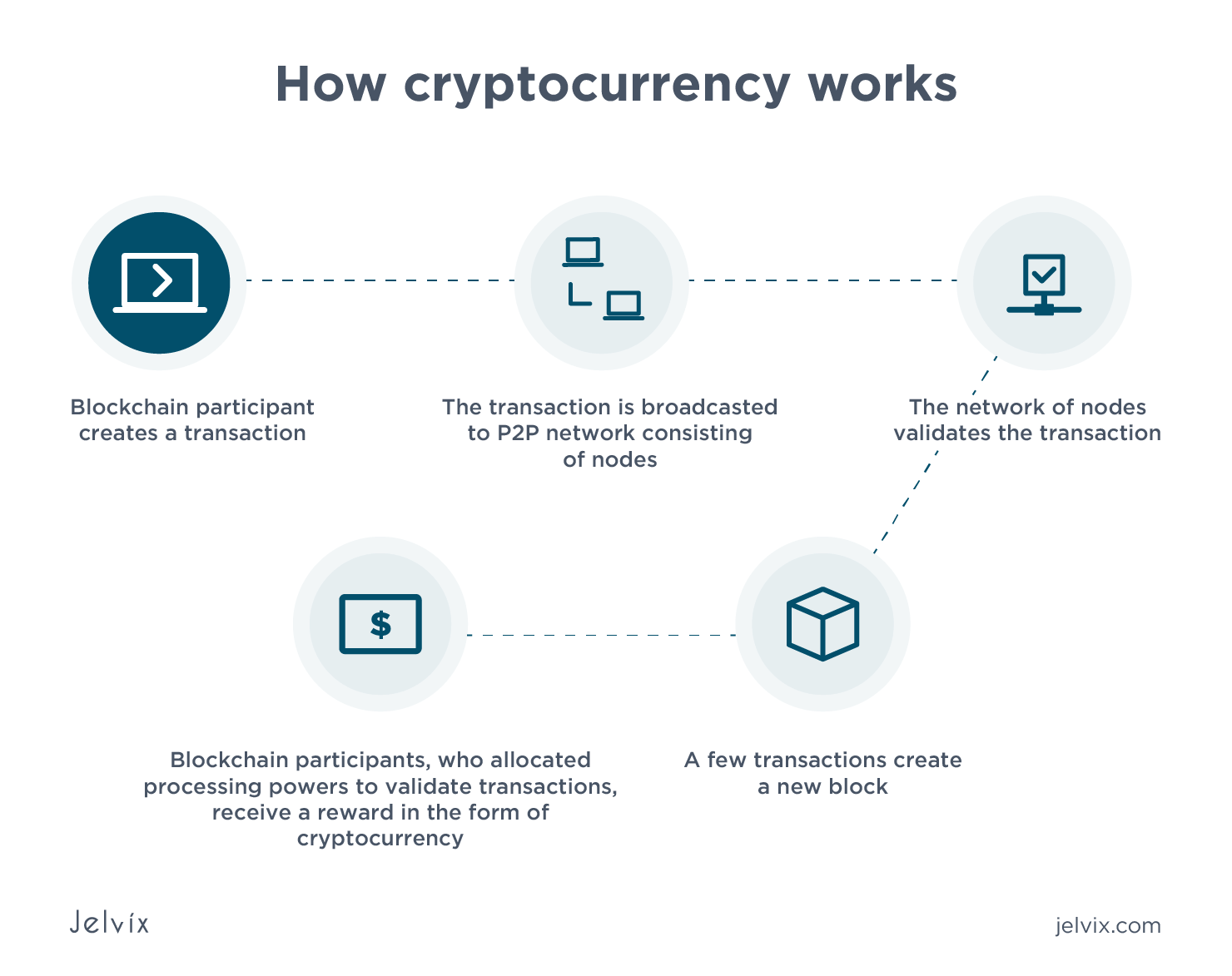
A “cryptocurrency wallet” doesn’t actually store cryptocurrencies. Instead, it securely stores the pair of public and private keys that grant access to your funds on the blockchain.
- Hot Wallets: Connected to the internet (e.g., mobile apps, desktop software, web-based wallets). Convenient for frequent transactions but generally considered less secure due to online exposure.
- Cold Wallets: Offline storage (e.g., hardware wallets, paper wallets). Highly secure for long-term holding as private keys are never exposed to the internet, but less convenient for frequent use.
The wallet software simplifies the complex cryptographic processes, allowing users to easily generate addresses, sign transactions, and view their balance without needing to understand the underlying math.
Transaction Fees and Network Congestion
Transaction fees are small amounts of cryptocurrency paid to miners or validators to incentivize them to include transactions in a block and secure the network. The fee amount often fluctuates based on network demand:
- Demand: During periods of high network activity and congestion, users might offer higher fees to ensure their transactions are prioritized and confirmed quickly.
- Block Size/Gas Limits: Blockchains have limits on the amount of data or computational operations (gas) that can be included in a single block. When demand exceeds these limits, fees rise.
These fees are a critical component of the economic model that sustains decentralized networks, compensating those who expend resources to maintain the blockchain’s integrity and process transactions.
Beyond Basic Transactions: Smart Contracts and Decentralized Applications
The foundational technology of blockchain extends far beyond simple value transfers, enabling the creation of programmable money and entire ecosystems of decentralized applications. These advanced functionalities unlock new possibilities for automation, trustless execution, and novel digital economies.
Smart Contracts: Self-Executing Agreements
Smart contracts are self-executing contracts with the terms of the agreement directly written into lines of code. They run on a blockchain, meaning they are immutable, transparent, and operate without the need for intermediaries.
- Code as Law: Once deployed, a smart contract’s code cannot be changed, and its execution is automatic and deterministic when predefined conditions are met.
- Use Cases: Smart contracts power a vast array of applications, including:
- Decentralized Finance (DeFi): Lending, borrowing, automated market makers.
- Non-Fungible Tokens (NFTs): Defining ownership and scarcity of unique digital assets.
- Supply Chain Management: Tracking goods with verifiable provenance.
- Voting Systems: Creating transparent and tamper-proof electoral processes.
Ethereum pioneered the widespread use of smart contracts, providing a Turing-complete blockchain that allows for the execution of complex computational logic directly on the network.
Decentralized Applications (dApps): Building on Blockchain
Decentralized Applications (dApps) are applications that run on a decentralized network, typically using smart contracts on a blockchain. Unlike traditional apps that rely on central servers, dApps leverage the distributed nature of blockchain for their backend logic and data storage.
- Open Source & Decentralized: dApps are often open source, governed by consensus, and store their data on public blockchains, making them resistant to censorship and single points of failure.
- Front-end Interaction: While the backend is decentralized, dApps often have a user-friendly front-end interface (like a website) that interacts with the underlying smart contracts.
- Examples: DeFi protocols (Uniswap, Aave), blockchain-based games (Axie Infinity), decentralized social media platforms, and digital identity solutions.
Oracles: Bridging On-Chain and Off-Chain Data
A limitation of blockchains is their inability to inherently access real-world data outside their network (off-chain data). This is where “oracles” come in. Oracles are third-party services that bring external data into the blockchain for use by smart contracts.
- Data Feeds: Oracles can provide smart contracts with information such as real-world asset prices, weather data, sports scores, or verified identities.
- Reliability: The reliability and security of oracles are paramount, as faulty or malicious data can lead to incorrect smart contract execution. Decentralized oracle networks (DONs) like Chainlink aim to address this by aggregating data from multiple independent sources and using cryptographic proof to ensure data integrity.
Oracles are critical for expanding the utility of smart contracts, enabling them to react to events and information beyond the confines of the blockchain itself, thereby connecting the digital ledger to the physical world.
In conclusion, understanding “how cryptocurrencies work” is a journey into the intricate world of advanced computing, cryptography, and network theory. It’s about appreciating the ingenuity behind a system that can establish trust and agreement among disparate parties without a central authority. From the immutable ledger of the blockchain and the unyielding security of cryptography to the democratic decision-making of consensus mechanisms and the programmable logic of smart contracts, each component plays a vital role in creating a robust, resilient, and transformative digital infrastructure. As this technology continues to evolve, its fundamental workings will remain the key to unlocking its full potential across a myriad of applications, fundamentally reshaping our digital future.
aViewFromTheCave is a participant in the Amazon Services LLC Associates Program, an affiliate advertising program designed to provide a means for sites to earn advertising fees by advertising and linking to Amazon.com. Amazon, the Amazon logo, AmazonSupply, and the AmazonSupply logo are trademarks of Amazon.com, Inc. or its affiliates. As an Amazon Associate we earn affiliate commissions from qualifying purchases.