
Home improvement projects are more than just aesthetic upgrades; they are significant financial investments in one of your most valuable assets. Whether you are a first-time homeowner looking to paint a bedroom or a seasoned real estate investor managing a full-scale renovation, the costs associated with materials and tools can escalate rapidly. In the realm of personal finance, efficiency is just as important as income. Finding ways to reduce expenditures at major retailers like Home Depot is not merely about “couponing”—it is a sophisticated approach to capital allocation and budget management.

To master the art of the Home Depot discount, one must look beyond the circulars and understand the underlying mechanics of retail pricing, loyalty programs, and financial tools. This guide explores the diverse strategies you can employ to ensure that every dollar spent contributes to the maximum possible return on investment.
Leveraging Financial Tools and Credit Strategies
The most immediate and consistent way to secure a discount at Home Depot involves the strategic use of financial instruments. How you choose to pay for your materials can dictate your immediate savings as well as your long-term cash flow.
The Home Depot Consumer Credit Card
For those who frequent the orange aisles, the Home Depot Consumer Credit Card is often the first line of defense against high prices. While typical credit cards offer generic rewards, this specific tool frequently offers a “sign-up” discount, such as $25 off a $25 to $999 purchase, or $100 off purchases over $1,000.
Beyond the initial incentive, the card offers rotating periods of 6 to 24 months of deferred interest on major purchases. From a personal finance perspective, this allows you to keep your cash in high-yield savings accounts or other investments longer, effectively using the retailer’s money for free—provided you pay the balance before the promotional period ends.
Pro Xtra and Volume Pricing
If you are managing a large-scale project, such as a kitchen remodel or a basement build-out, the Pro Xtra loyalty program is essential. While marketed toward contractors, any high-volume shopper can join. The real power of Pro Xtra lies in the Volume Pricing Program (VPP).
When your cart reaches a certain threshold—typically around $1,500—you can take your list to the Pro Desk and ask them to run it through the “Bid Room.” This is where the standard retail price is bypassed. Depending on the margins of the specific items, the Bid Room can shave anywhere from 5% to 20% off the total. In the context of business finance, this is a crucial step in maintaining healthy margins on a project.
High-Yield Cash Back and Third-Party Gift Cards
For those who prefer not to open store-specific lines of credit, the secondary gift card market and high-yield cash-back cards offer a viable alternative. Platforms like Raise or CardCash often sell Home Depot gift cards at a 3% to 7% discount. By purchasing these cards ahead of a major buy, you lock in an immediate discount.
Furthermore, using a credit card that offers 2% to 5% cash back on “home improvement” or “wholesale” categories adds another layer of savings. Combining a discounted gift card with a cash-back portal like Rakuten can result in a cumulative discount of over 10% before you even step foot in the store.
Strategic Shopping and Seasonal Timing
In the world of retail, timing is everything. Home Depot operates on a seasonal calendar that dictates when prices drop on specific categories. Understanding this cycle allows you to plan your project spending around the lowest price points.
The “Spring Black Friday” and Holiday Sales
While most consumers associate Black Friday with electronics, Home Depot utilizes “Spring Black Friday” (usually in April) to clear inventory and capture the gardening and outdoor renovation market. During this window, you can find massive discounts on mulch, pavers, patio furniture, and grills.
Additionally, the weeks leading up to the Fourth of July and Labor Day are prime times for appliance shopping. Major appliances like refrigerators and washing machines are often discounted by 30% to 40%. From a budgeting standpoint, deferring an appliance purchase until these holiday windows can save a household thousands of dollars.
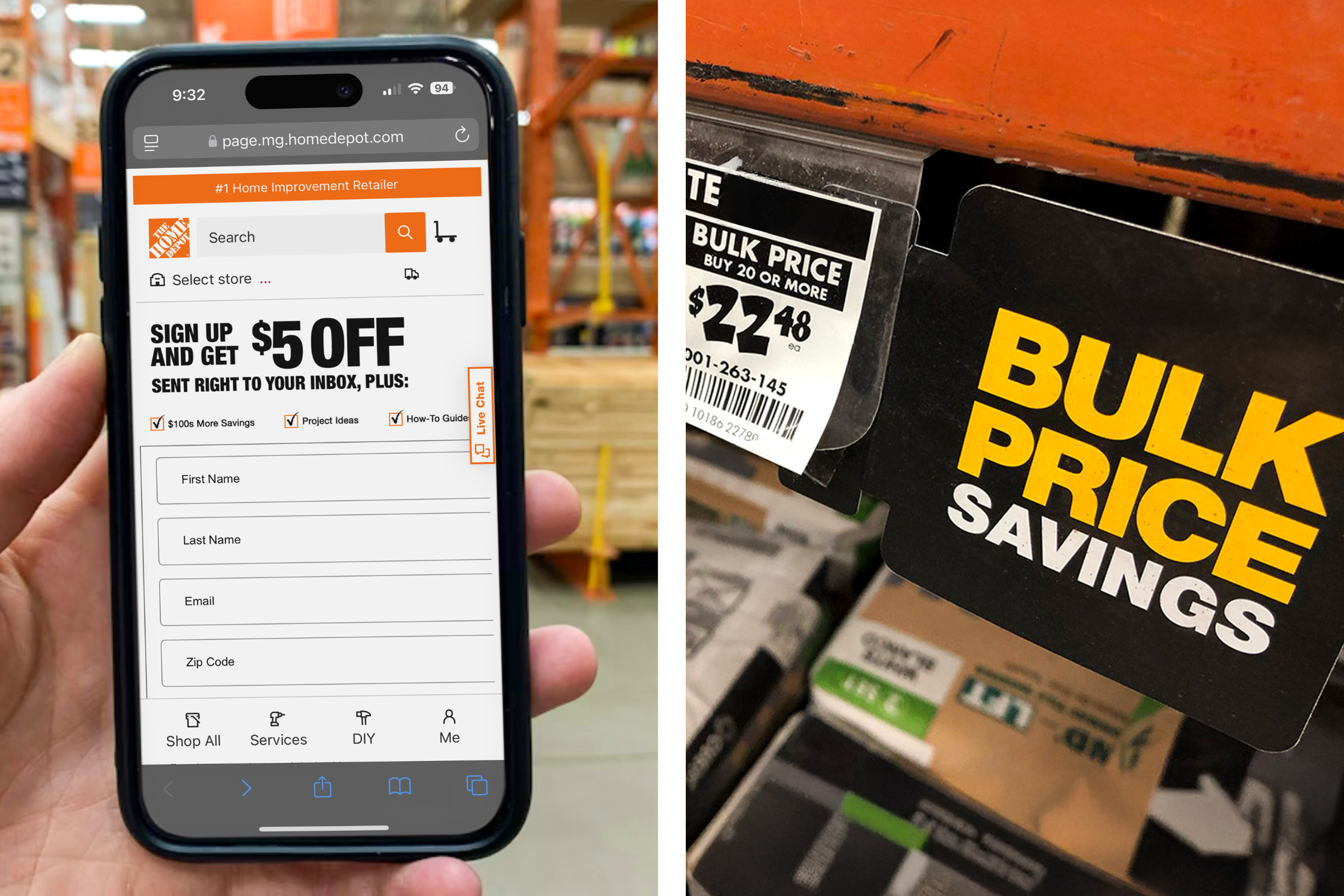
Decoding the Price Tags
A keen eye for detail can reveal “hidden” discounts on the shelves. Home Depot’s pricing system uses specific endings to signal the status of an item:
-
Prices ending in .06: These are typically clearance items that have been marked down and will likely see another price drop in six weeks. They are usually printed on yellow tags.
-
Prices ending in .03: This is the “final” price. If you see an item ending in .03, it is at its absolute lowest point before being removed from the floor. This is the optimal time to buy.
The 11% Rebate Program
One of the best-kept secrets in home improvement finance is the 11% Price Match Guarantee. In markets where Home Depot competes directly with the Midwest-based chain Menards, Home Depot offers an 11% rebate in the form of a gift card. Because Menards runs 11% off sales frequently, Home Depot maintains a dedicated portal (Home Depot Rebates) where customers can upload their receipts to receive a matching 11% credit. This effectively lowers the cost of every single item in your cart, provided you are in a qualifying geographic region.
Specialized Discount Programs and Negotiation
Beyond general sales and credit offers, Home Depot provides significant discounts to specific demographics and through direct negotiation on the floor.
The Military Discount
Home Depot offers a 10% discount to active-duty military members, veterans, and their spouses. In recent years, this process has been digitized. To access it, you must register through the Home Depot app and verify your status via SheerID. Once verified, a QR code in the app is scanned at checkout. For a veteran undertaking a $5,000 renovation, this “thank you” for service translates into a $500 direct saving—a substantial boost to any project budget.
The Art of the “Open Box” and Floor Model
Negotiation is often overlooked in retail environments, but it is highly effective at Home Depot, particularly in the appliance and tool departments. Floor models, “scratch and dent” items, or products with damaged packaging are all eligible for discounts.
If you find a lawnmower with a torn box or a dryer with a small side scratch that will be hidden by a cabinet, do not hesitate to ask a department manager for a discount. Managers often have the authority to take 10% to 20% off for such imperfections to clear the floor space. In the realm of personal finance, choosing “functional over perfect” is a hallmark of savvy wealth building.
Price Matching Policy
Home Depot’s price match policy is a powerful tool for the price-conscious consumer. They will match the price of an identical item from a competitor, including online retailers like Amazon or Lowe’s, provided the item is in stock. While they no longer offer the “price match plus 10%” incentive they once did, the ability to consolidate your shopping at one location while honoring the lowest market price ensures you never overpay for a commodity item.
Maximizing Digital and Residual Savings
In the digital age, your smartphone is perhaps your most effective tool for lowering your Home Depot bill. Leveraging the retailer’s digital ecosystem can provide ongoing savings that accumulate over time.
The “Special Buy of the Day”
The Home Depot website and mobile app feature a “Special Buy of the Day” section. These are highly curated, deep-discount offers that last for 24 hours only. These often include bundled tools, smart home kits, or vanity sets. For a homeowner who is not in a rush, checking these daily deals can lead to finding a required item at 40% to 50% off its standard retail price.
Email and SMS Sign-ups
While many avoid marketing emails, the initial “welcome” coupon for Home Depot is worth the subscription. New sign-ups for their email or SMS alerts typically receive a coupon for $5 off a $50 purchase. While modest, it is a 10% discount on a small project. For the savvy shopper, using “burner” email addresses for different projects can provide a recurring, albeit small, discount stream.
Rental Tool Buy-Backs
Home Depot’s tool rental department periodically refreshes its inventory. When they do, they sell off their used professional-grade tools (like Hilti drills or Makita saws) at a fraction of their original cost. These tools are maintained by in-house technicians and are built to handle much more abuse than standard consumer models. Purchasing a used “Pro” tool for the price of a new “Consumer” tool is a smart move for your long-term tool library, providing better performance and longevity for less capital.

Conclusion: The Holistic Approach to Savings
Securing a discount at Home Depot is not about a single “hack”; it is about layering multiple strategies to create a compounding effect on your savings. By combining seasonal timing with the 11% rebate, utilizing a high-reward credit card, and checking for “Bid Room” pricing on large orders, you can significantly reduce the “soft costs” of your home investments.
In the broader context of personal finance, these savings represent more than just a cheaper hammer or a discounted gallon of paint. They represent the preservation of capital that can be redirected toward debt reduction, further investments, or higher-quality materials that increase the overall value of your property. By treating your Home Depot trips with the same analytical rigor as a stock market investment, you ensure that your home remains a source of wealth rather than just a drain on your bank account.
aViewFromTheCave is a participant in the Amazon Services LLC Associates Program, an affiliate advertising program designed to provide a means for sites to earn advertising fees by advertising and linking to Amazon.com. Amazon, the Amazon logo, AmazonSupply, and the AmazonSupply logo are trademarks of Amazon.com, Inc. or its affiliates. As an Amazon Associate we earn affiliate commissions from qualifying purchases.