
The sight of a sea of red across a brokerage dashboard is a familiar, yet often unsettling, experience for investors. Whether you are a seasoned portfolio manager or a retail investor checking your 401(k), the question is always the same: “Why is the market down today?” While the immediate impulse is to look for a single “smoking gun,” the reality of the financial markets is far more complex. The stock market is a massive, real-time voting machine that aggregates global news, economic data, corporate performance, and human emotion into a single price point.
When the market dips, it is rarely the result of a singular event. Instead, it is usually a confluence of macroeconomic pressures, shifting monetary policies, and a recalibration of investor expectations. To understand why the market is down today, we must peel back the layers of the global financial system and examine the fundamental drivers that dictate the flow of capital.
The Macroeconomic Engine: Interest Rates and Inflation
The most significant driver of market movement in the modern era is the relationship between inflation and the actions of central banks, particularly the Federal Reserve. Because the “price of money” dictates the value of every other asset class, shifts in interest rate expectations are often the primary cause for sudden market downturns.
The Federal Reserve’s Balancing Act
Central banks have a dual mandate: to promote maximum employment and to maintain stable prices. When inflation rises above the target (typically around 2%), the Federal Reserve employs its most potent tool—raising interest rates. Higher rates make borrowing more expensive for businesses and consumers alike. This cools the economy, which is the intended goal, but it also creates a “valuation drag” on stocks. When interest rate outlooks turn more aggressive than the market anticipated, investors often sell off equities in favor of safer assets.
The Discounted Cash Flow Problem
From a technical perspective, the value of a company today is the present value of its future earnings. To calculate this, analysts use a “discount rate,” which is heavily influenced by the prevailing interest rate on government bonds. When interest rates rise, the discount rate increases, which mathematically lowers the present value of future profits. This is why high-growth tech stocks, which promise large profits in the distant future, are often the hardest hit on days when bond yields spike.
The Specter of a Recession
A “down” market is often a forward-looking indicator. If economic data—such as Manufacturing PMI, retail sales, or unemployment claims—suggests that the economy is slowing faster than expected, the market begins to price in a recession. Investors fear that the Fed’s “tightening” has become too restrictive, leading to a hard landing. On days when “bad news is actually bad news,” the market drops because the prospect of declining corporate revenue outweighs the hope for lower interest rates.
Corporate Earnings and the Gravity of Growth Expectations
While the “macro” environment sets the stage, individual corporate performance provides the script. Stock prices are ultimately a reflection of a company’s ability to generate profit. When the market is down, it is often because the collective expectations for corporate America have hit a wall of reality.
The Weight of the “Magnificent Seven”
In the modern market, a handful of mega-cap technology companies—often referred to as the “Magnificent Seven”—account for a disproportionate share of the major indices (S&P 500 and Nasdaq). If one or two of these giants report lackluster earnings or provide cautious guidance for the future, they can drag the entire market down with them. Even if 400 other companies in the S&P 500 are up, a significant drop in a trillion-dollar company can result in a red day for the index.
Guidance vs. Reality
In the world of investing, the past is irrelevant; only the future matters. During earnings season, a company might report record-breaking profits for the previous quarter, yet its stock price may still plummet. This occurs because the “guidance”—the company’s forecast for the next several months—came in lower than analysts expected. If a company signals that consumer spending is slowing or that input costs are rising, the market reacts instantly by repricing the stock lower.
Sector-Specific Contagion
Market downturns are often localized before they become systemic. For example, a crisis in the regional banking sector or a sudden drop in oil prices can lead to a sell-off in the Financial or Energy sectors. However, because many investors hold diversified ETFs, a sharp drop in one sector can lead to automated selling across others as funds rebalance their holdings, creating a “contagion” effect that pulls the broader market lower.
Geopolitical Instability and Global Supply Chains
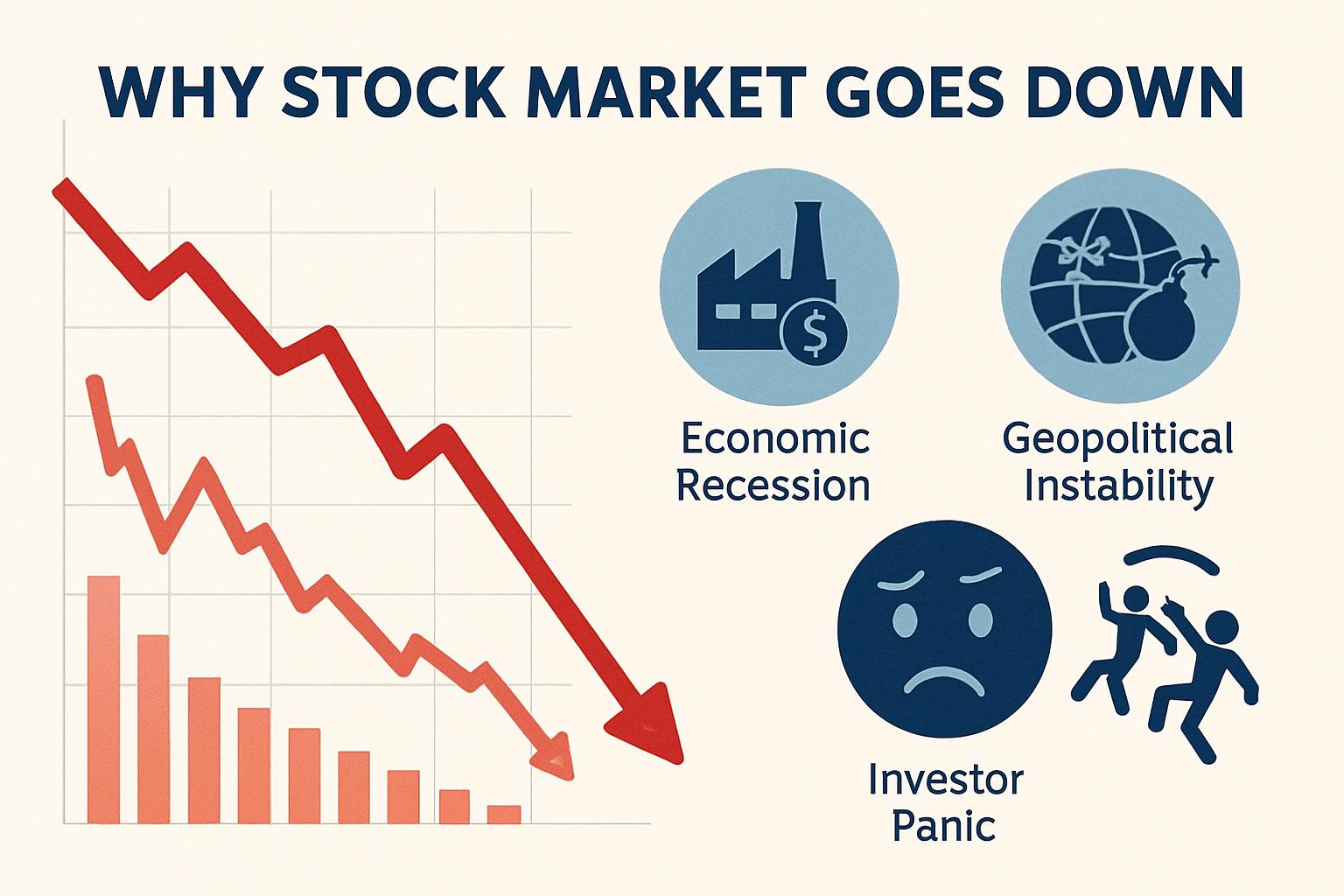
Equities do not exist in a vacuum. They are deeply sensitive to the geopolitical climate. In an interconnected global economy, a conflict on one continent can have immediate repercussions for a manufacturing plant on another.
Energy Security and Commodity Volatility
Geopolitical tensions in oil-producing regions often lead to spikes in crude oil prices. Higher energy costs act as a “tax” on both corporations and consumers. For a company, it means higher shipping and manufacturing costs; for a consumer, it means less discretionary income to spend on products. When energy prices become volatile, the market often de-risks, leading to a broad sell-off as investors brace for higher inflation and lower margins.
Trade Policy and Protectionism
Changes in trade relations between major economies, such as the U.S. and China, can send shockwaves through the market. Threats of tariffs, export bans on critical technologies (like semiconductors), or disruptions in the shipping lanes of the Red Sea create uncertainty. The market hates uncertainty more than almost anything else. When the “rules of the game” for global trade are in flux, investors often move capital out of equities and into “safe-haven” assets like gold or the U.S. Dollar.
The Flight to Quality
On days when geopolitical news is particularly grim, we see a phenomenon known as the “flight to quality.” Investors sell what they perceive as “risk-on” assets (stocks, particularly in emerging markets or small caps) and buy “risk-off” assets (U.S. Treasuries or cash). This mass exit from the equity market causes prices to drop sharply, even if the underlying companies are performing well.
Market Mechanics and Investor Psychology
Beyond the fundamentals of economics and earnings lies the “plumbing” of the financial system—the technical triggers and psychological factors that amplify market moves.
The Impact of Algorithmic and High-Frequency Trading
Today, a vast majority of market trades are executed not by humans, but by algorithms. These “algos” are programmed to sell when certain technical levels are breached. For example, if the S&P 500 falls below its 200-day moving average, it can trigger a wave of automated selling. This creates a feedback loop: the price drops, triggers more sell orders, which drops the price further. This is why market downturns often seem more violent and rapid than they used to be.
Fear, Greed, and Loss Aversion
Investor psychology plays a massive role in market volatility. Behavioral finance teaches us that the pain of a loss is felt twice as intensely as the joy of a gain—a concept known as “loss aversion.” When the market starts to dip, fear can quickly turn into panic. Retail and institutional investors alike may sell their positions simply to prevent further losses, regardless of the long-term value of their holdings. This herd mentality often drives the market down further than the economic data would suggest is rational.
Margin Calls and Forced Liquidations
In a bull market, many investors use “leverage”—borrowed money—to increase their returns. However, leverage is a double-edged sword. When the market drops, brokers may issue “margin calls,” requiring investors to deposit more cash or sell their positions to cover the debt. This leads to forced liquidations. When large hedge funds are forced to sell their “winners” to cover losses in their “losers,” it creates downward pressure across the entire market, leading to a broad-based decline.
Strategy Over Stress: How to Respond to a Market Dip
While understanding why the market is down is important, the more critical question for the investor is how to respond. A down day—or even a down month—is a natural part of the market cycle.
The Power of the Long-Term Perspective
Historically, the stock market has a positive bias. Despite wars, recessions, and pandemics, the long-term trend of the equity market has been upward. For the disciplined investor, a down market is often seen not as a disaster, but as a “sale.” Maintaining a time horizon of five, ten, or twenty years allows an investor to look past the daily noise of the “why” and focus on the “what”: the compounding growth of quality assets.
Rebalancing and Dollar-Cost Averaging
Smart investors use market downturns to their advantage through dollar-cost averaging (DCA). By investing a fixed amount of money at regular intervals, you naturally buy more shares when prices are low and fewer when prices are high. Additionally, a down market is an excellent time for portfolio rebalancing. If a sell-off has left you underweight in equities compared to your target allocation, the dip provides an opportunity to buy back in at lower valuations, setting the stage for future gains when the market inevitably recovers.
Avoiding the “Panic Sell” Trap
The most significant risk in a down market is not the loss of portfolio value on paper, but the permanent loss of capital that occurs when an investor panics and sells at the bottom. The market is a weighing machine in the long run but a voting machine in the short run. Understanding that “today” is just one data point in a decades-long journey is the key to maintaining the emotional fortitude required to build true wealth.
In conclusion, the market is down today because of a complex interplay between the cost of capital, the expectations for future growth, global stability, and the inherent volatility of human emotion. By deconstructing these factors, investors can move from a state of reactionary fear to one of informed confidence, recognizing that volatility is the price one pays for the superior long-term returns that the stock market provides.
aViewFromTheCave is a participant in the Amazon Services LLC Associates Program, an affiliate advertising program designed to provide a means for sites to earn advertising fees by advertising and linking to Amazon.com. Amazon, the Amazon logo, AmazonSupply, and the AmazonSupply logo are trademarks of Amazon.com, Inc. or its affiliates. As an Amazon Associate we earn affiliate commissions from qualifying purchases.