
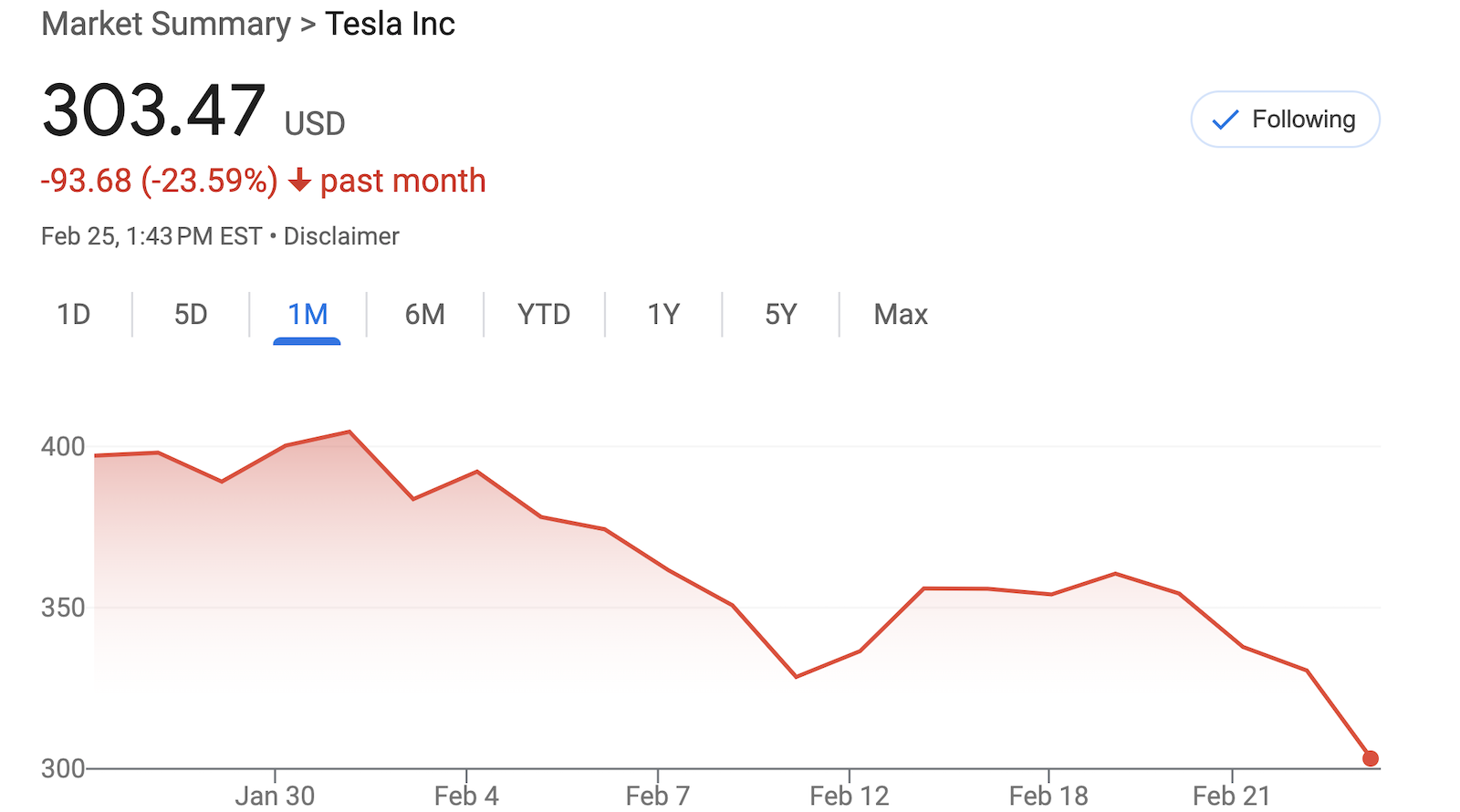
Tesla, Inc. (TSLA) has long been the bellwether for the electric vehicle (EV) industry and a cornerstone of modern growth-oriented portfolios. However, the stock is notorious for its gut-wrenching volatility. When Tesla shares experience a downward trajectory, it is rarely due to a single isolated event. Instead, it is usually the result of a complex interplay between macroeconomic headwinds, shifting fundamental metrics, and evolving investor sentiment.
To understand why Tesla stock is down today, investors must look beyond the headlines and examine the underlying financial mechanics. From margin compression to the shifting landscape of global interest rates, several key factors are currently weighing on the valuation of Elon Musk’s flagship enterprise.
1. Macroeconomic Headwinds and Interest Rate Sensitivity
As a high-growth stock with a premium valuation, Tesla is disproportionately sensitive to the broader economic environment. Unlike traditional value stocks that offer dividends and steady earnings, Tesla’s valuation is heavily predicated on its projected future cash flows.
The Impact of Federal Reserve Policy
When the Federal Reserve maintains a “higher for longer” stance on interest rates, it creates a twofold problem for Tesla. First, higher interest rates increase the discount rate used by analysts to value future earnings. In financial modeling, as the discount rate rises, the present value of those future profits shrinks, leading to a natural compression in the stock’s Price-to-Earnings (P/E) multiple.
Secondly, Tesla’s product is a high-ticket consumer durable. Most consumers do not buy Teslas with cash; they finance them. As auto loan rates climb, the monthly payment for a Model 3 or Model Y increases significantly, even if the sticker price remains the same. This dampens demand and forces Tesla to choose between lower sales volumes or lower profit margins.
Inflation and Consumer Spending Power
Persistent inflation has eroded the discretionary income of the middle class, which is Tesla’s primary target demographic. While the brand has successfully moved from a niche luxury player to a mass-market manufacturer, it is now exposed to the cyclicality of the broader automotive market. When consumers feel the pinch at the grocery store and in their utility bills, they are more likely to defer the purchase of a new vehicle, leading to inventory build-up—a metric that investors monitor with hawk-like precision.
2. Fundamental Shifts: Margins, Deliveries, and Pricing Strategy
For years, the “Tesla Bull Case” was built on the idea that Tesla enjoyed software-like margins in a hardware-heavy industry. However, the financial reality of the past several quarters has challenged this narrative, leading to a recalibration of the stock’s price.
The Price War and Margin Compression
In an aggressive bid to maintain market share and stimulate demand, Tesla has engaged in a global price war. While price cuts help clear inventory and keep the factories running, they have a devastating effect on the company’s operating margins.
Investors who were once used to seeing automotive gross margins (excluding regulatory credits) above 25% have had to adjust to figures dipping into the mid-teens. This transition from a high-margin “tech company” profile to a more traditional “automaker” profile is a primary driver of the downward pressure on the stock. When margins contract, the “earnings” part of the P/E ratio drops, often leading to a sharp sell-off as institutional investors rebalance their positions.
Delivery Misses and Growth Deceleration
Tesla is valued as a growth company, and growth companies are punished severely when they stop growing at an exponential rate. Recent delivery reports have occasionally fallen short of analyst expectations, signaling a potential saturation of the early-adopter EV market.
Wall Street analysts track “days of supply” and “inventory turnover” closely. When Tesla’s production exceeds its deliveries, it suggests that the brand may be losing its “must-have” status or that the total addressable market (TAM) for EVs at current price points is smaller than previously estimated. Any downward revision in annual delivery guidance is almost always met with a corresponding drop in share price.
3. The Competitive Landscape and Market Share Erosion
Tesla once enjoyed a near-monopoly on the “cool, long-range EV” market. Today, that monopoly has evaporated, replaced by a hyper-competitive global landscape that is forcing Tesla to fight for every percentage point of market share.

The Rise of Chinese Manufacturers
Perhaps the greatest financial threat to Tesla comes from China, specifically from companies like BYD, Li Auto, and Xiaomi. These companies benefit from lower labor costs, integrated supply chains, and significant government subsidies. BYD, in particular, has challenged Tesla for the title of the world’s largest EV maker.
For investors, the success of Chinese OEMs (Original Equipment Manufacturers) represents a structural risk to Tesla’s long-term earnings potential in the world’s largest auto market. If Tesla is forced to compete on price in China, its global profitability will continue to suffer, a reality that the market is currently pricing in.
Legacy Automakers and the “Hybrid” Hedge
While Tesla remains committed to a purely electric future, many legacy automakers like Toyota, Ford, and GM have pivoted back toward hybrids and plug-in hybrids (PHEVs) in response to consumer demand. This shift has slowed the “S-curve” adoption of pure battery electric vehicles (BEVs). As the transition to full electrification takes longer than expected, Tesla’s projected dominance is being pushed further into the future, causing some investors to move their capital into more diversified or defensive automotive plays.
4. Institutional Sentiment and Governance Risks
Stock prices are not just a reflection of spreadsheets; they are a reflection of investor psychology. For Tesla, the “Elon Musk Premium” has long been a double-edged sword, and lately, it has contributed to the stock’s volatility.
The “Key Person” Risk and Management Focus
Tesla investors have grown increasingly concerned about Elon Musk’s divided attention. Between managing X (formerly Twitter), SpaceX, xAI, and Neuralink, there is a lingering fear that Tesla’s core operations are lacking the granular oversight they once had.
From a financial governance perspective, this manifests as “Key Person Risk.” If the market perceives that the CEO is distracted or that his personal brand is becoming a liability to the corporate brand, institutional investors may demand a higher risk premium, which lowers the stock price. Furthermore, legal battles over Musk’s multi-billion dollar compensation package create uncertainty regarding corporate governance and board independence.
Algorithmic Trading and Technical Breakouts
From a technical analysis standpoint, Tesla stock often follows specific patterns. Many institutional funds use algorithmic trading systems that trigger “sell” orders when the stock breaks below key support levels, such as the 50-day or 200-day moving averages.
When Tesla stock is down today, it may be because it hit a “technical trap,” where a small fundamental piece of bad news triggered a cascade of automated selling. This creates a feedback loop where the price drops, more stop-loss orders are triggered, and the downward momentum accelerates. For the retail investor, this volatility can be dizzying, but for the market, it is a standard re-rating process.
5. The Valuation Reality Check: AI vs. Automotive
The fundamental debate surrounding Tesla’s stock price often boils down to one question: Is Tesla a car company or an AI/Robotics company?
The P/E Ratio Dilemma
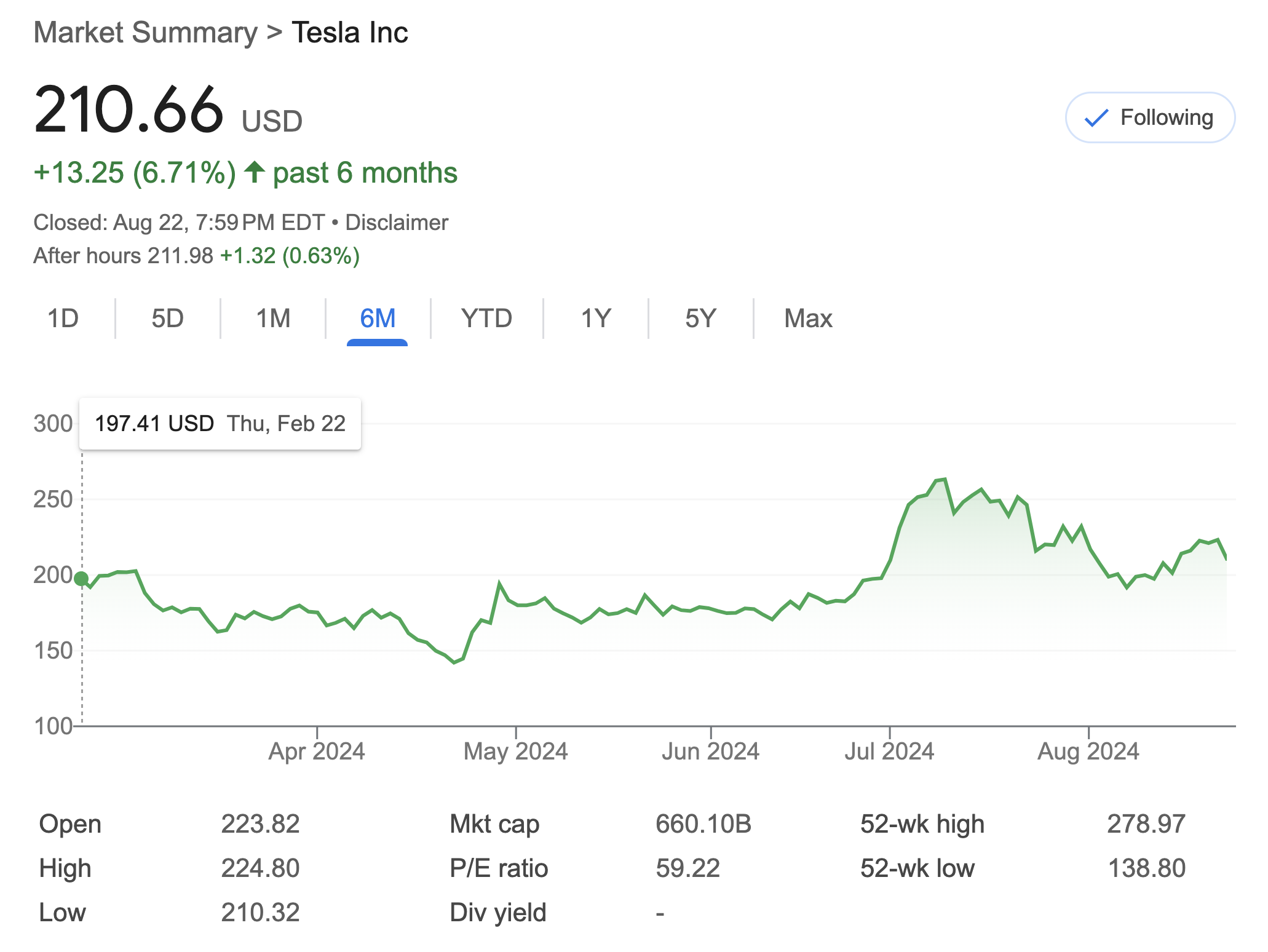
By traditional automotive standards, Tesla is drastically overvalued. Companies like Ford or Volkswagen often trade at P/E ratios between 5x and 10x. Tesla, even after recent pullbacks, often trades at a P/E significantly higher than the S&P 500 average.
The justification for this premium has always been Tesla’s potential in Full Self-Driving (FSD), the Optimus robot, and its energy storage business. However, when the stock drops, it is often a sign that the market is losing patience with the “AI story.” If FSD milestones are delayed or if regulatory hurdles seem insurmountable, investors begin to value Tesla more like a hardware manufacturer and less like a software giant. This “valuation gravity” is a constant downward force on the stock whenever growth in the core automotive business slows.
Capital Expenditure and Cash Flow
Tesla is currently in a “heavy spend” phase. Developing the Cybertruck, expanding Gigafactories in Texas and Berlin, and investing billions into Dojo (Tesla’s supercomputer) requires massive capital expenditure (CapEx). While these investments are necessary for future growth, they weigh on free cash flow in the short term. In a market that currently prizes “flight to quality” and immediate profitability, Tesla’s heavy spending on unproven future technologies can be a point of contention for conservative institutional portfolios.
Conclusion: Navigating the TSLA Volatility
Tesla’s stock is down today because the market is recalibrating its expectations. The era of “easy growth” fueled by low interest rates and a lack of competition has ended. In its place is a new, more disciplined financial environment where Tesla must prove it can maintain profitability while fighting a multi-front war against global competitors and macroeconomic headwinds.
For the long-term investor, these periods of decline represent a fundamental test of the thesis: do you believe in the transition to an AI-driven, autonomous future, or do you see a maturing car company facing inevitable margin normalization? Until Tesla can provide clear evidence of its next leg of growth—be it through a cheaper “Model 2,” a breakthrough in FSD, or a surge in the Energy division—the stock is likely to remain a high-beta asset, sensitive to every shift in the global financial winds.
aViewFromTheCave is a participant in the Amazon Services LLC Associates Program, an affiliate advertising program designed to provide a means for sites to earn advertising fees by advertising and linking to Amazon.com. Amazon, the Amazon logo, AmazonSupply, and the AmazonSupply logo are trademarks of Amazon.com, Inc. or its affiliates. As an Amazon Associate we earn affiliate commissions from qualifying purchases.