
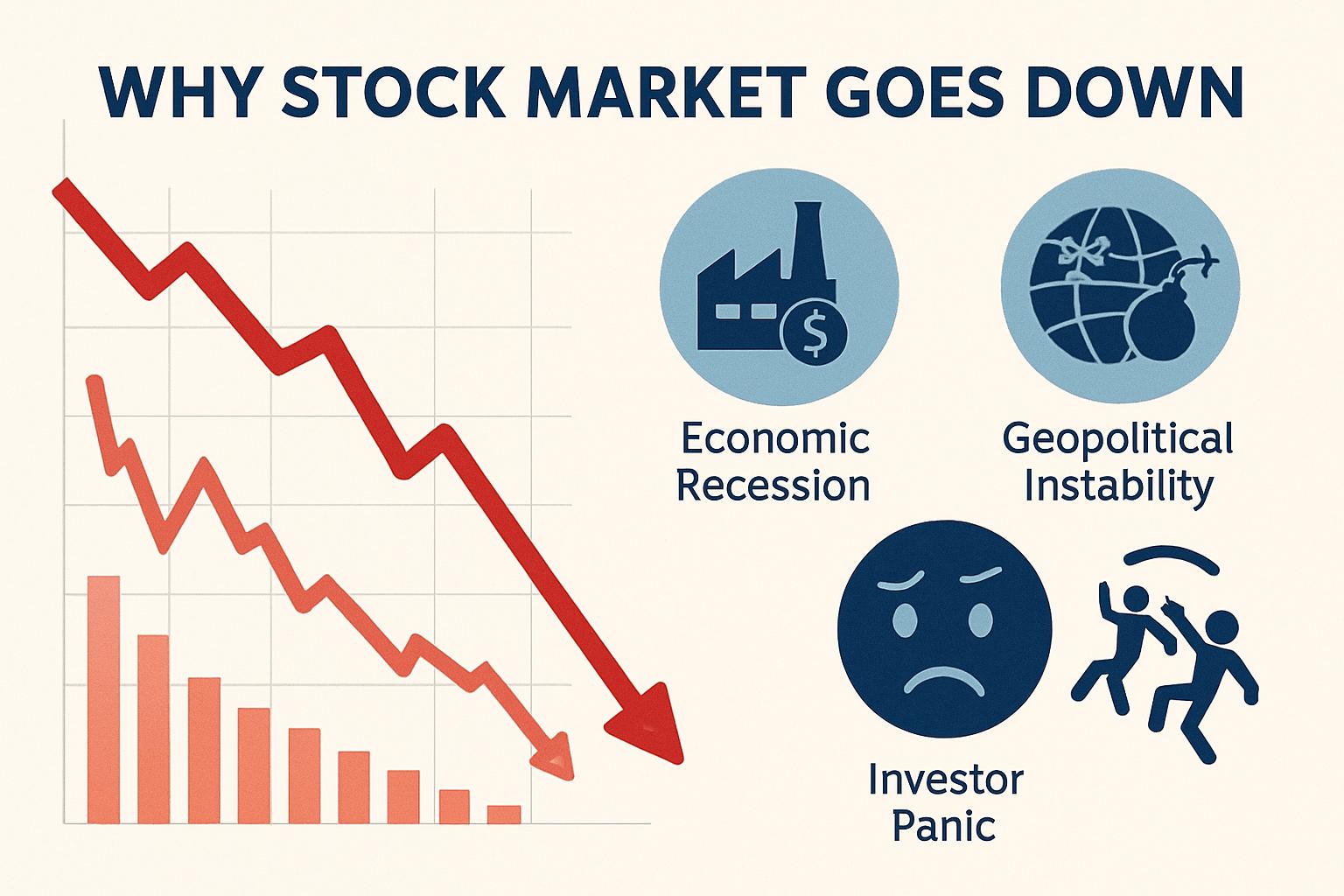
The stock market is often described as a “manic-depressive” entity, swinging between irrational exuberance and profound pessimism. When the major indices—the S&P 500, the Dow Jones Industrial Average, and the Nasdaq Composite—begin to slide, investors naturally seek a singular culprit. However, the reality of a market downturn is rarely the result of a single event. Instead, it is typically a confluence of macroeconomic shifts, corporate performance anxieties, and geopolitical tremors that combine to erode investor confidence. Understanding why the market is down requires a deep dive into the mechanics of finance, the psychology of risk, and the current state of the global economy.
The Macroeconomic Landscape: Interest Rates and Inflation
The most significant driver of equity valuations is the cost of money, which is dictated by central bank policy. For much of the last decade, investors enjoyed a “cheap money” environment characterized by near-zero interest rates. When that environment shifts, the stock market reacts violently.
The Federal Reserve’s Monetary Policy
The Federal Reserve has a dual mandate: to promote maximum employment and to maintain stable prices. When inflation rises above the target 2% threshold, the Fed utilizes its primary tool—the federal funds rate. Raising interest rates is intended to cool the economy by making borrowing more expensive for both consumers and businesses.
For the stock market, higher interest rates act as a form of gravity. First, they increase the “discount rate” used in financial models to value future cash flows. Since a stock’s value is essentially the present value of all future earnings, a higher discount rate makes those future dollars worth less today, leading to lower stock prices. This is particularly punishing for growth stocks and technology companies that expect the bulk of their profits to arrive years in the future.
Sticky Inflation and Consumer Spending
Inflation itself is a double-edged sword for the market. While moderate inflation can allow companies to raise prices and grow nominal revenue, hyper-inflation or “sticky” inflation—which remains high despite intervention—erodes purchasing power. When consumers have to spend more on essentials like housing, food, and energy, they have less discretionary income to spend on the products and services offered by publicly traded companies.
Furthermore, inflation increases the input costs for businesses. From raw materials to labor, if expenses rise faster than a company can raise its prices, profit margins contract. Investors, sensing this squeeze on profitability, often sell off shares in anticipation of weaker quarterly reports.
Corporate Earnings and Growth Projections
The stock market is ultimately a forward-looking mechanism. Investors are not buying a company’s past success; they are buying its future earnings potential. When the outlook for that potential dims, the market reflects that pessimism almost instantly.
The Impact of Higher Borrowing Costs on Profitability
Most large corporations carry significant debt loads to fund expansions, acquisitions, or share buybacks. In a low-rate environment, servicing this debt is inexpensive. However, as interest rates rise, the cost of refinancing old debt or taking out new loans increases. This interest expense eats directly into the bottom line.
Moreover, higher rates make it more difficult for companies to justify capital expenditures. If the “hurdle rate”—the minimum return a company needs to justify a project—rises because of debt costs, companies may cancel expansion plans. A lack of expansion leads to a slowdown in projected growth, which is a primary reason why stock multiples (Price-to-Earnings ratios) compress during downturns.
Sector-Specific Slumps: Tech vs. Value
Not all sectors react to a downturn in the same way. The technology sector, which has dominated market returns for years, is highly sensitive to interest rate changes. Because many tech firms are valued based on their long-term innovation and “disruption” potential rather than current dividends, they are often the first to be sold off when the economic tide turns.
Conversely, “value” sectors like utilities, consumer staples, and healthcare tend to be more resilient, but they are not immune. If the market downturn is driven by fears of a total economic recession, even these defensive stocks can see declines as institutional investors liquidate positions to cover losses elsewhere or to move into the safety of government bonds.
Geopolitical Tensions and Global Supply Chains
We live in a hyper-globalized economy where a conflict in one part of the world or a policy change in another can have immediate repercussions on the New York Stock Exchange. Geopolitics introduces “unknown unknowns”—events that are difficult to model or predict, leading to increased market volatility.
Energy Prices and Commodity Volatility
Energy is the lifeblood of the global economy. When geopolitical tensions arise in oil-producing regions or trade routes are threatened, the price of crude oil and natural gas tends to spike. Since energy is a primary input for manufacturing and transportation, high energy prices act as a “tax” on the entire economy.
When the price of oil rises, it fuels inflation, which in turn forces central banks to keep interest rates high. This creates a feedback loop that is detrimental to the stock market. Investors keep a close eye on the “energy complex” as a leading indicator of where the broader market might head; if energy prices remain volatile, the stock market often remains depressed.
International Trade and Policy Uncertainty
Trade wars, tariffs, and shifts in foreign policy also contribute to market declines. If a major economy imposes restrictions on the export of essential components—such as semiconductors or rare earth minerals—it can paralyze entire industries. The uncertainty surrounding international relations makes it difficult for multinational corporations to plan their supply chains and pricing strategies. Markets hate uncertainty more than they hate bad news; when the rules of global trade are in flux, investors often retreat to the sidelines.
Market Sentiment and Technical Corrections
While fundamental economic data is crucial, the stock market is also driven by human psychology and technical factors. Once a decline starts, it can often become a self-fulfilling prophecy.
Profit Taking and Mean Reversion
Following a period of sustained market growth, many institutional investors and hedge funds look for an opportunity to “lock in” their gains. This is known as profit-taking. When a large volume of shares is sold simultaneously, it puts downward pressure on prices.
Furthermore, markets often undergo “mean reversion.” If stock prices have become disconnected from their underlying fundamental value—meaning they have become too expensive relative to their earnings—a correction is a natural way for the market to return to historical norms. A 10% decline from recent highs is considered a correction, while a 20% decline is categorized as a bear market. These phases, while painful, are a standard part of the market cycle.
The Role of Algorithmic Trading and Volatility
In the modern era, a significant portion of market volume is driven by high-frequency trading algorithms. These programs are designed to react to specific price triggers or news keywords in milliseconds. If a key technical support level is broken—for example, if the S&P 500 falls below its 200-day moving average—algorithms may trigger a massive wave of automated selling. This can exacerbate a minor decline into a significant rout, creating the “flash crashes” or rapid intraday drops that leave retail investors bewildered.
Strategic Navigating: How Investors Should Respond
When the market is down, the emotional impulse is to sell and “save” what remains of one’s portfolio. However, history suggests that the most successful investors are those who can separate their emotions from their financial strategy.
Dollar-Cost Averaging in a Down Market
One of the most effective strategies during a downturn is dollar-cost averaging (DCA). By investing a fixed amount of money at regular intervals, regardless of the share price, investors automatically buy more shares when prices are low and fewer when prices are high. This lowers the average cost per share over time. Rather than trying to “time the bottom”—which is notoriously difficult even for professionals—DCA allows investors to benefit from the eventual recovery.
Rebalancing and Risk Assessment
A market downturn is a powerful litmus test for an investor’s risk tolerance. If the sight of a portfolio in the red causes significant distress, it may be an indication that the portfolio was too heavily weighted in aggressive equities.
Rebalancing involves selling assets that have performed relatively well (like bonds or cash) and buying assets that have become “on sale” (like stocks). This disciplined approach ensures that an investor maintains their target asset allocation. Moreover, it forces the investor to adhere to the most fundamental rule of investing: buy low and sell high. While the current market decline may feel permanent, the historical trajectory of the stock market has always been upward over the long term, rewarded to those who remain patient and focused on fundamental value.
aViewFromTheCave is a participant in the Amazon Services LLC Associates Program, an affiliate advertising program designed to provide a means for sites to earn advertising fees by advertising and linking to Amazon.com. Amazon, the Amazon logo, AmazonSupply, and the AmazonSupply logo are trademarks of Amazon.com, Inc. or its affiliates. As an Amazon Associate we earn affiliate commissions from qualifying purchases.