
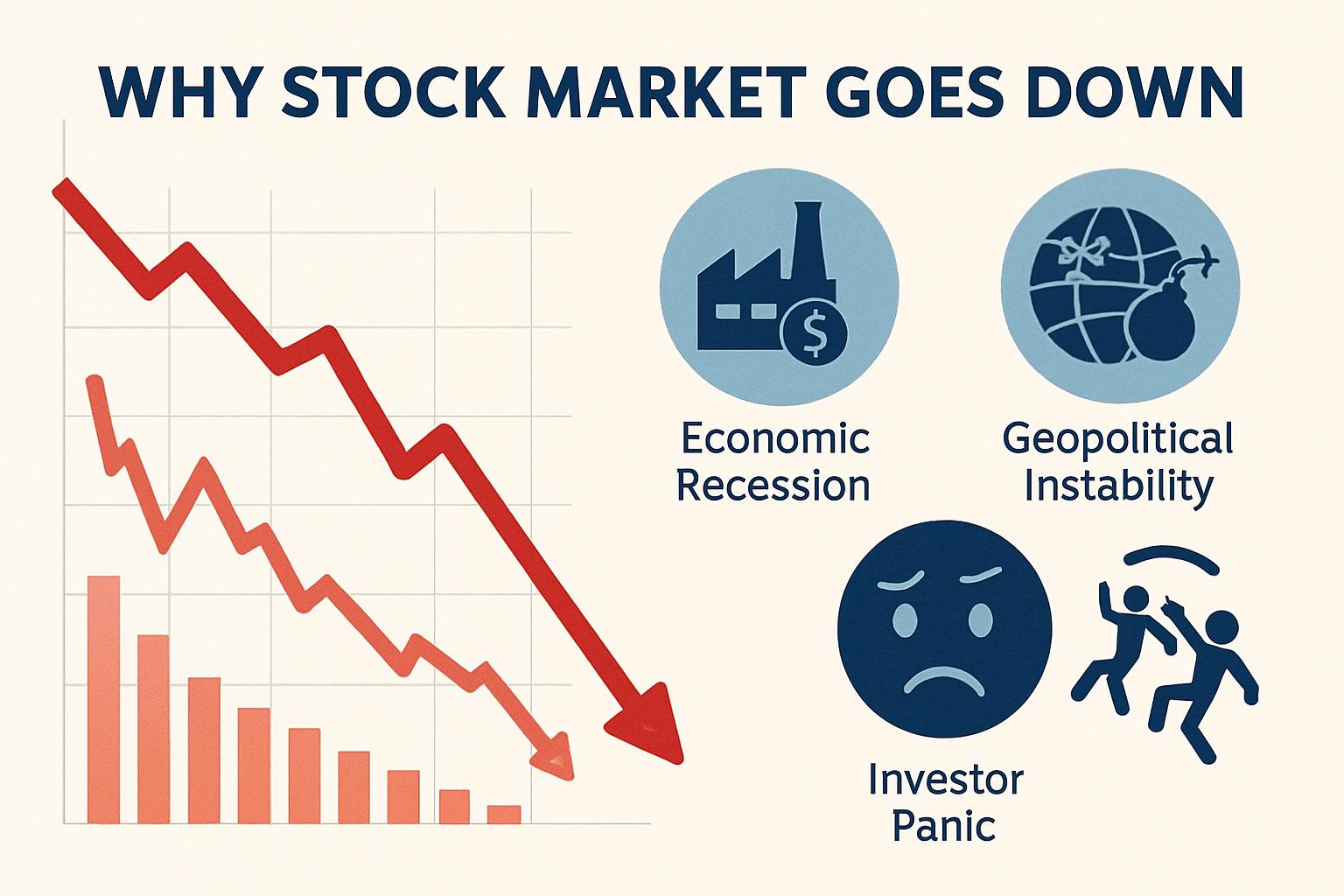
The stock market is a complex ecosystem driven by a combination of hard data, forward-looking expectations, and human emotion. When the red arrows dominate the ticker tape, investors naturally search for immediate answers. While every market session has its unique nuances, the reasons for a sudden downturn usually fall into a few primary categories: macroeconomic shifts, corporate performance, geopolitical instability, and internal market mechanics. Understanding these drivers is essential for any investor looking to navigate volatility without falling prey to panic.
Macroeconomic Catalysts and the Federal Reserve’s Influence
The most frequent driver of broad market sell-offs is the macroeconomic environment, specifically the trajectory of interest rates and inflation. Markets are essentially weighing the current value of future cash flows. When the economic landscape shifts, those valuations must be recalculated.
The Impact of Interest Rates and Discount Rates
Central banks, particularly the Federal Reserve in the United States, use interest rates as a primary lever to control the economy. When inflation rises above the target, the Fed increases the federal funds rate to cool spending. For the stock market, higher interest rates are a double-edged sword. First, they increase the cost of borrowing for companies, which can eat into profit margins and delay expansion plans. Second, in a high-interest-rate environment, the “discount rate” used in financial modeling increases. This disproportionately affects growth stocks and technology companies, as their valuations are heavily based on projected earnings far into the future. When the discount rate goes up, the present value of those future earnings goes down, leading to a share price decline.
Inflation and Consumer Purchasing Power
Inflation is another critical factor. While moderate inflation can be a sign of a growing economy, runaway inflation erodes the purchasing power of consumers. If the cost of living spikes, discretionary spending—the lifeblood of sectors like retail, travel, and entertainment—drops. Furthermore, companies face rising input costs, from raw materials to labor. If a company cannot pass these costs on to the consumer, its margins contract, leading investors to re-evaluate the stock’s worth.
Economic Indicators and “Bad News is Good News”
Market participants closely watch indicators such as the Consumer Price Index (CPI), the Jobs Report, and Gross Domestic Product (GDP) data. Interestingly, the market’s reaction to this data can sometimes feel counterintuitive. In a period where the Fed is looking to cool the economy, a “strong” jobs report might actually cause the stock market to drop. Investors fear that a robust labor market will give the Fed more “room” to raise interest rates further or keep them higher for longer, thereby pressuring equity valuations.
Corporate Earnings and Growth Expectations
While the “macro” view sets the stage, the “micro” view—individual company performance—is what drives the specific movements of sectors and indices. Stock prices are fundamentally driven by earnings. When companies fail to meet expectations or provide a cautious outlook, the market reacts swiftly.
Earnings Misses and Guidance Revisions
Four times a year, public companies report their financial results. A market drop is often triggered when heavyweight companies, particularly those in the S&P 500 or Nasdaq 100, report earnings that fall short of analyst estimates. However, the “miss” itself is often less important than the “guidance.” Guidance is a company’s projection of its future performance. If a CEO suggests that the coming months will see slower growth due to economic headwinds or supply chain issues, investors will sell the stock today in anticipation of a weaker tomorrow.
The Sector Contagion Effect
The stock market is interconnected. If a major player in the semiconductor industry reports a decline in demand, it doesn’t just affect that one stock. It sends a ripple effect through the entire technology sector. Investors begin to wonder if the downturn is systemic. This “contagion” can lead to a broader market sell-off as traders de-risk their portfolios across related industries, fearing that the reported weakness is a harbinger of a broader economic slowdown.
Profit Taking and Valuation Resets
Sometimes, the market drops not because of bad news, but because the “good news” has already been priced in. Following a period of significant gains, institutional investors may decide to lock in profits. This selling pressure can trigger a cascading effect. If a sector has become overvalued—meaning stock prices have outpaced actual earnings growth—a “valuation reset” is inevitable. In these scenarios, even a decent earnings report might be met with selling, as the market concludes that the stock has nowhere to go but down in the short term.
Geopolitical Uncertainty and Global Market Contagion

Stock markets loathe uncertainty. While economic data is quantifiable, geopolitical events are often unpredictable, making them a primary driver of market volatility and sudden “black swan” events.
International Conflict and Energy Prices
War or the threat of conflict can disrupt global trade routes and energy supplies. Since oil and gas are foundational inputs for almost every industry, a spike in energy prices acts like a global tax on both companies and consumers. When geopolitical tensions rise, investors often flee “risk-on” assets like stocks and move into “safe havens” like gold or government bonds. This flight to quality results in a sharp drop in equity indices.
Trade Relations and Regulatory Shifts
The global economy is deeply integrated, especially between major powers like the U.S., China, and Europe. Changes in trade policy, such as the imposition of tariffs or export bans on critical technologies, can disrupt supply chains and increase costs for multinational corporations. Similarly, sudden regulatory crackdowns in a major economy can wipe out billions in market cap overnight, causing a drag on global indices as investors reassess the risk of international exposure.
Currency Fluctuations
For multinational corporations, the strength of the domestic currency is a major factor in profitability. A “strong dollar,” for example, makes American goods more expensive abroad and reduces the value of international revenue when it is converted back into USD. If the currency markets shift rapidly due to geopolitical news, it can lead to downward revisions in earnings estimates for some of the world’s largest companies, pushing the stock market lower.
Investor Psychology and Technical Market Factors
Not all market drops are rooted in fundamental economic or corporate shifts. Often, the speed and depth of a decline are amplified by human psychology and the technical structure of the modern financial system.
The Feedback Loop of Fear
Fear is a more powerful motivator than greed in the short term. When the market begins to slip, the “Fear and Greed Index” often swings toward extreme fear. Retail and institutional investors alike may succumb to panic selling, driven by the desire to protect remaining capital. This creates a self-fulfilling prophecy: selling leads to lower prices, which triggers more fear, which leads to more selling.
Algorithmic Trading and Stop-Loss Orders
In the modern era, a significant portion of market volume is driven by high-frequency trading (HFT) and algorithms. These programs are often set to sell automatically when certain price thresholds are breached. If a stock drops past a “support level,” these algorithms can trigger a massive wave of automated selling in milliseconds. Furthermore, many retail investors use “stop-loss” orders to limit their downside. When a market dip hits these price points, those orders are converted into market sell orders, adding further fuel to the downward momentum.
Margin Calls and Forced Liquidation
Many investors trade on “margin,” which means they borrow money from their brokerage to buy more stocks. When the value of their portfolio drops significantly, the brokerage may issue a “margin call,” requiring the investor to deposit more cash or sell assets to cover the loan. If the investor cannot provide the cash, the brokerage will forcibly sell their stocks. Forced liquidations like these often happen at the worst possible time, contributing to a rapid decline in prices as large blocks of shares are dumped onto the market regardless of their fundamental value.
Navigating the Downward Trend: Strategies for Long-Term Success
While a dropping market can be unsettling, it is a natural and necessary part of the market cycle. Long-term wealth is often built not by avoiding downturns, but by how an investor behaves during them.
The Power of Dollar-Cost Averaging
For the disciplined investor, a market drop is an opportunity to lower their average cost basis. Through dollar-cost averaging (DCA), you invest a fixed amount of money at regular intervals, regardless of the price. When the market is down, your fixed investment buys more shares. Over time, this strategy reduces the impact of volatility and can lead to significant gains when the market inevitably recovers.
Rebalancing and Portfolio Diversification
A market sell-off is a good time to review portfolio allocations. Diversification across different asset classes—such as bonds, real estate, and international equities—can help cushion the blow when the domestic stock market takes a hit. Rebalancing involves selling some of the assets that have performed well and buying those that have dipped, ensuring your risk profile remains aligned with your long-term goals.
Maintaining a Long-Term Perspective
The history of the stock market is a series of peaks and valleys, but the long-term trajectory has historically been upward. Market corrections (a drop of 10%) and bear markets (a drop of 20% or more) are uncomfortable, but they are also the periods where the highest future returns are often generated. Successful “Money” management requires the emotional fortitude to look past the “today” of a market drop and focus on the “decade” ahead. By understanding the macroeconomic, corporate, and psychological reasons for today’s decline, you can move from a position of reaction to a position of strategic action.
aViewFromTheCave is a participant in the Amazon Services LLC Associates Program, an affiliate advertising program designed to provide a means for sites to earn advertising fees by advertising and linking to Amazon.com. Amazon, the Amazon logo, AmazonSupply, and the AmazonSupply logo are trademarks of Amazon.com, Inc. or its affiliates. As an Amazon Associate we earn affiliate commissions from qualifying purchases.