
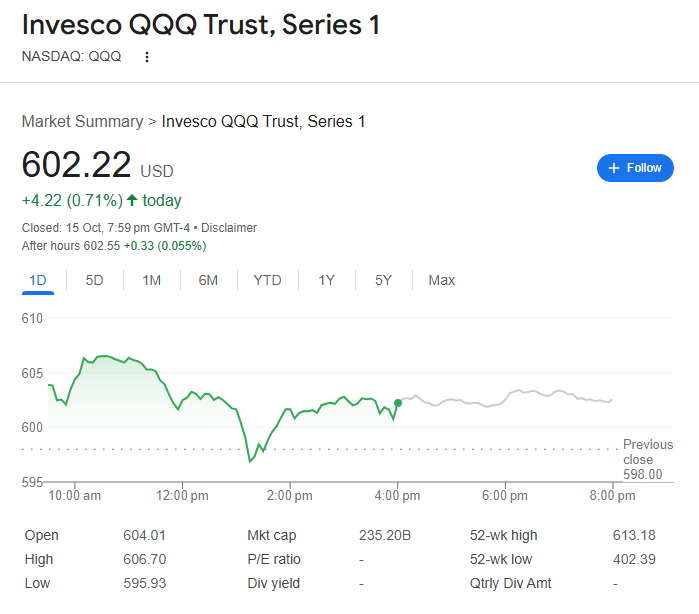
The Invesco QQQ Trust, which tracks the Nasdaq-100 Index, is often viewed as the primary barometer for the health of the technology sector and growth-oriented investing. Because the index is modified market-capitalization weighted and composed of the 100 largest non-financial companies listed on the Nasdaq Stock Market, its daily fluctuations carry significant weight for retail and institutional investors alike. When QQQ experiences a downward trend, it rarely happens in a vacuum. Instead, it is typically the result of a complex interplay between macroeconomic policy, sector-specific headwinds, and the individual performance of a handful of “mega-cap” companies that dominate the fund’s allocation.

Understanding why QQQ is down today requires a multi-faceted analysis of the financial ecosystem. From the Federal Reserve’s stance on interest rates to the shifting tides of artificial intelligence sentiment, several key catalysts act as the primary drivers of volatility within this specific exchange-traded fund (ETF).
The Macroeconomic Landscape: Interest Rates and Inflationary Pressure
The most common reason for a decline in QQQ is a shift in the macroeconomic environment, specifically regarding the “cost of money.” Because the Nasdaq-100 is heavily weighted toward technology and growth stocks, it is more sensitive to interest rate fluctuations than broader indices like the Dow Jones Industrial Average.
The Federal Reserve’s Influence
Growth stocks, which make up the bulk of QQQ, derive much of their value from projected future earnings. Financial analysts use a “discounted cash flow” (DCF) model to determine the present value of these companies. When the Federal Reserve raises interest rates—or when the market anticipates that rates will remain “higher for longer”—the discount rate used in these models increases. This mathematically reduces the present value of those future earnings, leading to a compression in price-to-earnings (P/E) multiples. Consequently, even if a company’s fundamentals remain strong, its stock price may fall simply because the macroeconomic environment makes future growth less valuable in today’s dollars.
Yield Curves and the Risk-Free Rate
The yield on the 10-year U.S. Treasury note is often referred to as the “risk-free rate.” When Treasury yields spike, they offer a more attractive, guaranteed return for investors compared to the inherent risk of the stock market. This often triggers a rotation out of high-valuation growth stocks and into fixed-income assets. If you see the 10-year yield climbing rapidly on a day when QQQ is down, you are likely witnessing a strategic reallocation of capital across the global financial markets.
Sector Concentration: When Tech Giants Stumble
While QQQ contains 100 companies, it is notoriously “top-heavy.” A significant portion of the fund’s total value is concentrated in a small group of companies often referred to as the “Magnificent Seven”—Apple, Microsoft, Alphabet, Amazon, Nvidia, Meta, and Tesla. Because of this concentration, QQQ can be pulled down by just a few bad actors, even if the majority of the other 90+ companies are trading in the green.
The “Magnificent Seven” Effect
If Apple reports a slowdown in iPhone sales in China, or if Nvidia faces new export restrictions on its AI chips, the impact on QQQ is immediate and outsized. Investors must look at the intraday performance of these individual heavyweights to understand the fund’s movement. When these companies experience a collective sell-off due to profit-taking or negative news cycles, the index reflects that sentiment regardless of the health of smaller software or biotech firms within the ETF.
Earnings Season Volatility
During quarterly earnings seasons, QQQ is prone to sharp movements. Because expectations for top-tier tech companies are often sky-high, even a “beat” on earnings can lead to a share price decline if the company’s forward guidance is conservative. If a major constituent like Microsoft suggests that cloud computing growth is decelerating, it creates a ripple effect throughout the entire software-as-a-service (SaaS) sector, dragging the entire QQQ index down with it.
Market Sentiment and Geopolitical Headwinds
Beyond the numbers on a balance sheet, the stock market is driven by human and algorithmic sentiment. Global events and regulatory shifts can create an environment of uncertainty, which is the primary enemy of high-multiple growth stocks.
Global Supply Chain and Trade Policy
The technology sector is deeply globalized. Many QQQ components rely on complex supply chains that run through East Asia and Europe. Geopolitical tensions, such as trade disputes or regional conflicts, can threaten the production of semiconductors or the delivery of consumer electronics. When investors perceive an increased risk to global trade, they often “de-risk” by selling off growth assets.
Regulatory Crackdowns and Antitrust Concerns
The dominance of big tech has made it a frequent target for regulators in the United States and the European Union. News regarding antitrust lawsuits, new privacy regulations, or legislative hearings can cause sudden drops in the share prices of Google, Meta, or Amazon. Because these companies represent such a large percentage of QQQ, regulatory “noise” is a frequent culprit behind a red day for the fund.
Technical Analysis and Market Mechanics
Sometimes, the reason QQQ is down has less to do with the “why” of the economy and more to do with the “how” of market trading. Technical levels and algorithmic triggers play a massive role in daily price action.
Profit Taking and Mean Reversion
After a period of prolonged growth, it is natural for institutional investors to “trim” their positions to lock in gains. This profit-taking can create a snowball effect. If QQQ has been trading significantly above its 50-day or 200-day moving average, technical traders may anticipate a “mean reversion,” where the price pulls back to its historical average. Once a certain technical support level is broken, automated selling programs may trigger, accelerating the downward momentum.
Liquidity Gaps and Algorithmic Trading
In the modern market, a vast majority of trades are executed by algorithms rather than humans. These algorithms are programmed to respond to specific data points, such as an unexpected Consumer Price Index (CPI) reading or a break in a trend line. If liquidity is low—meaning there are fewer buyers than sellers at a specific price point—these algorithms can cause the price to “gap down” quickly. This is often why the market seems to drop “for no reason” in the middle of a trading session; it is frequently a mechanical response to a lack of immediate buying pressure.
Navigating the Downturn: Long-Term Strategies for QQQ Investors
For the individual investor, seeing QQQ in the red can be unsettling, but it is a fundamental part of the market cycle. Technology and innovation are historically volatile, and the high returns associated with the Nasdaq-100 come with the “tax” of periodic drawdowns.
The Importance of a Long-Term Horizon
Historically, QQQ has shown a remarkable ability to recover from downturns, driven by the relentless pace of technological advancement. Investors who focus on daily fluctuations often fall prey to emotional trading, selling at the bottom and missing the subsequent recovery. Maintaining a long-term perspective allows an investor to view a “down day” as a minor fluctuation in a much larger upward trajectory.
Rebalancing and Dollar-Cost Averaging
Professional wealth managers often use down days in QQQ as an opportunity for dollar-cost averaging. By investing a fixed amount of money at regular intervals, regardless of the price, investors naturally buy more shares when prices are low and fewer when prices are high. This strategy mitigates the risk of “timing the market” and can lead to a lower average cost basis over time. Additionally, a dip in QQQ might be a signal to rebalance a portfolio that has become too heavily weighted in tech, ensuring that your risk profile remains aligned with your financial goals.

Assessing the Fundamentals
When QQQ is down, the most important question to ask is: “Has the fundamental story changed?” Is the decline due to a temporary increase in interest rates or a one-day panic? Or is there a systemic shift in how technology companies generate revenue? In most cases, daily volatility is noise. As long as the core components of the Nasdaq-100—companies that are at the forefront of AI, cloud computing, and digital transformation—continue to innovate and generate cash flow, the long-term outlook for the index remains a cornerstone of modern growth investing.
In summary, QQQ is down today likely because of a combination of rising interest rates, a pull-back in mega-cap tech earnings, or broader market sentiment regarding the global economy. By stripping away the noise and looking at the underlying mechanics of interest rates, sector weighting, and technical levels, investors can gain the clarity needed to make informed decisions rather than emotional ones.
aViewFromTheCave is a participant in the Amazon Services LLC Associates Program, an affiliate advertising program designed to provide a means for sites to earn advertising fees by advertising and linking to Amazon.com. Amazon, the Amazon logo, AmazonSupply, and the AmazonSupply logo are trademarks of Amazon.com, Inc. or its affiliates. As an Amazon Associate we earn affiliate commissions from qualifying purchases.