
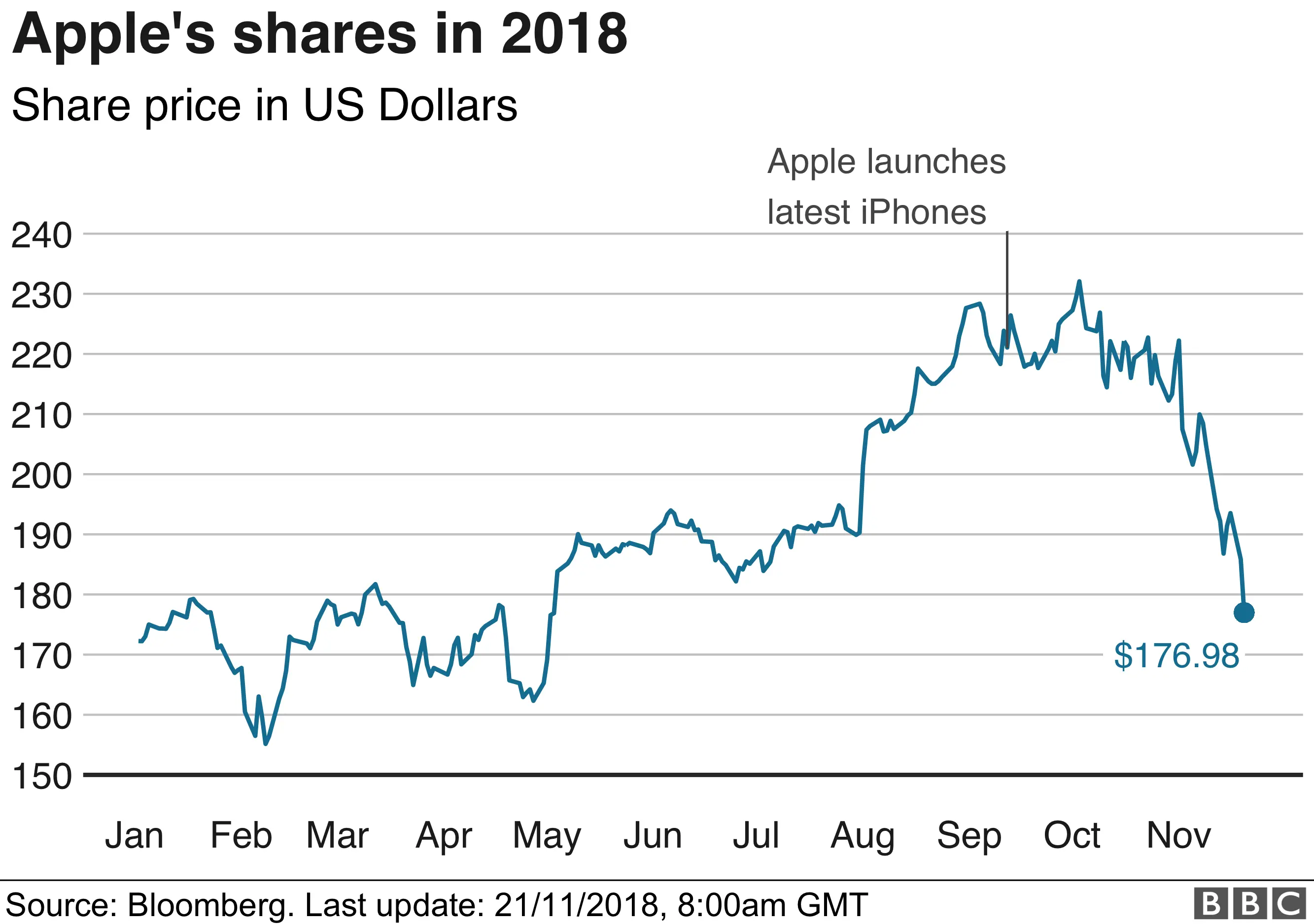
For over a decade, Apple Inc. (AAPL) has served as the bedrock of the modern investment portfolio. As the world’s most valuable company for various stretches of time, it represented not just a technology leader, but a financial fortress—a “safe haven” asset that investors flocked to during times of market volatility. However, recent quarters have seen a shift in narrative. The “buy and hold forever” mantra is being tested as the stock faces downward pressure, leaving retail and institutional investors alike asking a critical question: Why is Apple stock falling?
The answer is not found in a single quarterly report or a solitary product launch. Instead, the decline is the result of a complex convergence of macroeconomic headwinds, shifting geopolitical dynamics, regulatory scrutiny, and a perceived lag in the most significant technological pivot of the decade: Artificial Intelligence. To understand the trajectory of AAPL, one must look beyond the ticker symbol and dissect the fundamental pillars that have historically supported its trillion-dollar valuation.
The China Conundrum and Global Demand Saturation
One of the most significant contributors to the recent slump in Apple’s stock price is the mounting pressure in the Greater China market. Traditionally, China has represented roughly 18% to 20% of Apple’s total revenue, serving as both a critical manufacturing hub and its most important growth engine. However, that engine is currently sputtering.
The resurgence of domestic competition, most notably from Huawei, has dramatically altered the landscape. With the release of the Mate 60 series and subsequent models featuring high-end, domestically produced chips, Chinese consumers have begun shifting their loyalty back to home-grown brands. This “nationalist buying” trend, coupled with reports of government restrictions on iPhone usage in state-owned enterprises, has led to double-digit declines in iPhone shipments within the region. For investors, China is no longer a guaranteed source of growth; it has become a primary source of risk.
Furthermore, we are witnessing a global “smartphone fatigue.” The smartphone market has reached a state of maturity where incremental hardware updates—a slightly better camera, a faster processor, or a new chassis material—are no longer enough to trigger mass upgrade cycles. Consumers are holding onto their devices for longer periods, extending the replacement cycle from two years to upwards of four. For a company that still derives the majority of its revenue from hardware sales, specifically the iPhone, this lengthening cycle poses a direct threat to year-over-year revenue growth.
The AI Narrative Gap and Investor Impatience
In the current market environment, “AI” has become the ultimate valuation multiplier. Companies like Nvidia, Microsoft, and Alphabet have seen their market caps swell as they position themselves at the forefront of the Generative AI revolution. Apple, conversely, has been perceived as being late to the party.
While Apple has integrated machine learning into its ecosystem for years (via features like Siri, computational photography, and predictive text), it lacked a clear “AI strategy” in the eyes of Wall Street for much of the initial boom. Investors tend to be forward-looking; they are less concerned with what a company did yesterday and more focused on how it will capture the next massive TAM (Total Addressable Market).
The perception that Apple fell behind in the Large Language Model (LLM) race led to a rotation of capital. Large institutional funds began trimming their AAPL positions to reallocate capital into “pure-play” AI stocks or software giants with more aggressive AI roadmaps. Although Apple has recently begun unveiling its “Apple Intelligence” framework, the delay created a vacuum of excitement. The market is currently in a “show me” phase, waiting for evidence that AI integration will actually drive a meaningful “super-cycle” of device upgrades. Until that evidence manifests in the earnings reports, the stock remains vulnerable to the narrative that Apple is a “legacy” tech giant rather than a future-facing AI leader.
The Regulatory War on the Walled Garden
Apple’s “Walled Garden”—the seamless integration between hardware, software, and services—has been its greatest competitive advantage. It creates high switching costs for users and allows Apple to command high margins through its Services segment, which includes the App Store, iCloud, and Apple Music. However, this garden is currently under siege by regulators globally.
In the United States, the Department of Justice (DOJ) filed a landmark antitrust lawsuit against Apple, alleging that the company has maintained an illegal monopoly over the smartphone market by suppressing competition and locking in users. Simultaneously, the European Union’s Digital Markets Act (DMA) has forced Apple to allow third-party app stores and alternative payment methods, directly challenging the 30% commission (the “Apple Tax”) that feeds its high-margin Services revenue.
From an investor’s perspective, these legal battles represent two major threats:
-
Margin Erosion: If Apple is forced to lower its commission rates or allow users to bypass its payment systems, the growth and profitability of the Services segment—the very segment that has compensated for slowing hardware sales—could be significantly impaired.
-
Structural Integrity: The value of the Apple ecosystem lies in its control. If regulators successfully force “interoperability,” the friction required to switch from an iPhone to an Android device disappears, potentially leading to a slow migration of the user base.
Legal proceedings of this magnitude take years to resolve, but the “regulatory overhang” creates a persistent cloud of uncertainty that prevents the stock from achieving its previous valuation premiums.
Macroeconomics: Interest Rates and Capital Allocation
The broader economic environment cannot be ignored when analyzing Apple’s performance. For much of the last two years, the Federal Reserve’s “higher-for-longer” interest rate policy has shifted the calculus for equity valuations. When “risk-free” assets like U.S. Treasuries offer yields of 4% to 5%, the appetite for high-multiple growth stocks diminishes.
Apple’s valuation has historically been stretched. When its growth slows to low single digits, justifying a Price-to-Earnings (P/E) ratio in the high 20s or 30s becomes difficult for value-conscious institutional investors. If the “Earnings” part of the P/E ratio isn’t growing rapidly due to the factors mentioned above (China, hardware stagnation), the only way for the ratio to normalize is for the “Price” to come down.
Additionally, Apple has long been a champion of capital return. Its massive share buyback programs have been a primary driver of Earnings Per Share (EPS) growth, even when net income growth was modest. While Apple continues to authorize billions in buybacks, the sheer size of the company makes it harder for these programs to move the needle as much as they once did. Investors are now looking for organic growth rather than growth engineered through financial alchemy.
Is the Sell-Off a Buying Opportunity or a Paradigm Shift?
The decline in Apple stock represents a transition period for the company. We are moving away from the era of “easy growth” driven by global smartphone expansion and into an era defined by geopolitical maneuvering, regulatory adaptation, and the integration of artificial intelligence.
For the long-term investor, the bull case for Apple remains centered on its massive installed base. With over 2.2 billion active devices, Apple possesses one of the most loyal and affluent customer bases in history. This ecosystem provides a recurring revenue stream that is rarely matched in the corporate world. The decline in stock price has brought valuations down to more reasonable levels, potentially offering a margin of safety that didn’t exist when the stock was at its all-time highs.
However, the “falling” nature of the stock is a reminder that even the mightiest companies are not immune to market cycles or technological shifts. The coming year will be a “proving ground” for the company. Success will depend on whether “Apple Intelligence” can spark a new hardware upgrade cycle and whether the Services division can remain resilient in the face of global regulatory mandates. Until these questions are answered with hard data, volatility is likely to remain the new normal for the world’s most famous consumer electronics brand. In the world of finance, no company is entitled to a permanent upward trajectory; Apple is currently rediscovering that fundamental truth.
aViewFromTheCave is a participant in the Amazon Services LLC Associates Program, an affiliate advertising program designed to provide a means for sites to earn advertising fees by advertising and linking to Amazon.com. Amazon, the Amazon logo, AmazonSupply, and the AmazonSupply logo are trademarks of Amazon.com, Inc. or its affiliates. As an Amazon Associate we earn affiliate commissions from qualifying purchases.