
Apple Inc. (AAPL) has long been considered the “fortress” of the stock market. For institutional investors and retail traders alike, it represents a gold standard of cash flow, brand loyalty, and capital return. However, even the world’s most valuable companies are not immune to the gravity of shifting economic cycles. When Apple’s stock price begins to slide, it sends ripples through the S&P 500 and the Nasdaq-100, leading investors to ask: what has changed?
The decline in Apple’s share price is rarely the result of a single factor. Instead, it is typically a confluence of macroeconomic headwinds, shifting valuation multiples, and evolving geopolitical risks. Understanding why Apple is dropping requires a clinical look at the broader financial landscape and the specific fiscal challenges facing the Cupertino giant.
The Macroeconomic Headwinds: Interest Rates and the Cost of Capital
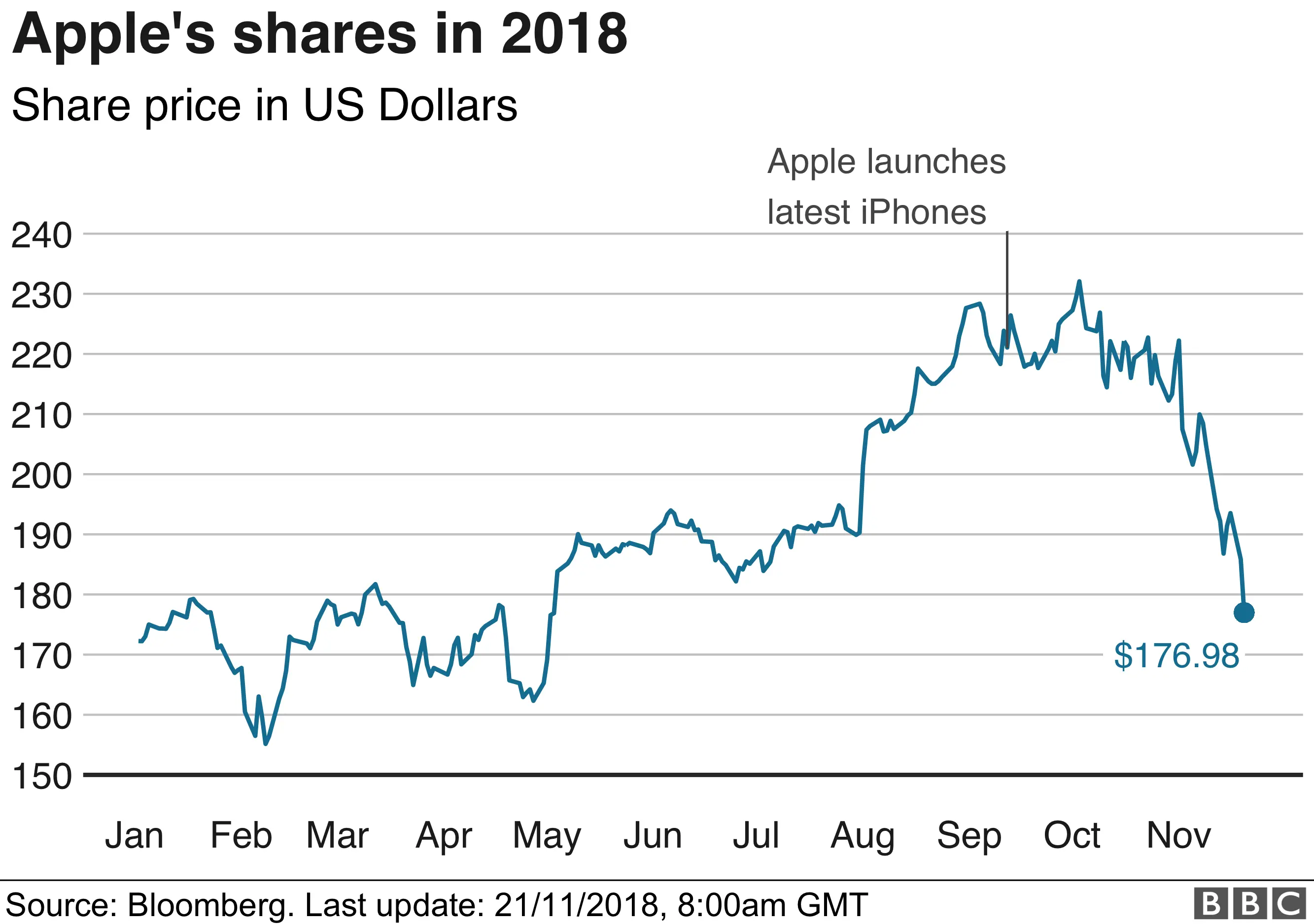
The primary driver behind recent volatility in mega-cap tech stocks, including Apple, is the shifting landscape of global monetary policy. For over a decade, tech companies thrived in a “cheap money” environment characterized by near-zero interest rates. As the Federal Reserve and other central banks pivoted toward aggressive rate hikes to combat inflation, the fundamental math of stock valuation changed.
The Impact of Rising Bond Yields
When interest rates rise, the yield on “risk-free” assets like U.S. Treasury bonds increases. For institutional investors, this creates a higher hurdle rate for equities. If an investor can earn a guaranteed 4% or 5% on a bond, they are less likely to pay a premium for a stock trading at 30 times earnings.
From a technical perspective, Apple’s stock is valued based on the present value of its future cash flows. When the discount rate—driven by interest rates—goes up, the present value of those future earnings goes down. This “multiple contraction” explains why Apple can report solid earnings yet still see its stock price stagnate or decline. The market is simply unwilling to pay the same premium for those earnings that it was during the era of zero-rate policy.
Currency Fluctuations and the Strong Dollar
As a global powerhouse, Apple generates more than half of its revenue outside the United States. This international exposure becomes a liability when the U.S. dollar strengthens against the Euro, Yen, and Yuan. When Apple sells an iPhone in London or Tokyo, it collects revenue in local currency. If the dollar is strong, those local earnings convert back into fewer dollars on the corporate balance sheet.
Foreign exchange headwinds have consistently shaved billions of dollars off Apple’s top-line growth in recent quarters. For investors focused on year-over-year growth metrics, these currency “drags” can make the company look like it is stalling, even if unit sales remain healthy.
Valuation and the “Growth Stock” Dilemma
Apple is currently navigating a transition in how it is perceived by the market. For years, it was valued as a high-growth hardware company. Today, it is often viewed as a “staple” or a “value” play within the tech sector. However, its valuation often suggests it should still be growing at double-digit rates, creating a disconnect that leads to price corrections.
The Law of Large Numbers
One of the greatest challenges facing Apple is the “law of large numbers.” With annual revenues hovering around $400 billion, it is mathematically difficult to sustain high-percentage growth. Adding 10% to the top line requires finding an additional $40 billion in revenue—roughly the equivalent of a Fortune 100 company—every single year.
Investors are increasingly concerned that the iPhone, which remains the company’s primary engine of profit, has reached a point of global saturation. When replacement cycles lengthen—meaning people keep their phones for four years instead of two—it creates a “growth gap” that the market reacts to by de-rating the stock.
Institutional Rotation and Profit Taking
Because Apple is the largest component of many index funds and ETFs, it is often the first stock sold when fund managers want to “take chips off the table” or rotate into different sectors. If a portfolio manager believes that energy or healthcare will outperform tech in the next six months, they must sell their largest holdings to rebalance. This institutional selling pressure can drive the price down regardless of the company’s fundamental health.
Geopolitical Risks and Supply Chain Fragility
Apple’s financial destiny is inextricably linked to its manufacturing footprint in Asia and its consumer base in China. In recent years, this has become a source of significant anxiety for the market, manifesting as a “risk premium” that weighs on the stock price.
The China Conundrum
China is both a critical manufacturing hub and Apple’s third-largest market. Any cooling of the Chinese economy or increase in regulatory scrutiny from Beijing directly impacts Apple’s bottom line. Investors have reacted negatively to reports of government-affiliated workers being discouraged from using foreign devices, as well as the resurgence of local competitors like Huawei.
Furthermore, the threat of trade “decoupling” between the U.S. and China poses a long-term structural risk. While Apple is diversifying its manufacturing to India and Vietnam, these transitions are expensive and take years to complete. The uncertainty surrounding this transition leads many investors to reduce their exposure to the stock.
Regulatory Scrutiny and Antitrust Pressures
Beyond manufacturing, Apple faces mounting legal and regulatory challenges in the U.S. and the European Union. Concerns over the “walled garden” of the App Store and the 30% commission Apple takes on digital sales have led to significant legal battles. If regulators force Apple to allow third-party app stores or alternative payment systems, it could threaten the high-margin Services revenue that investors have come to rely on. The market hates uncertainty, and the constant drumbeat of antitrust investigations provides a steady stream of “sell” signals.
The Services Pivot: Can it Fill the Gap?
To offset the slowing growth of hardware sales, Apple has leaned heavily into its Services division, which includes the App Store, iCloud, Apple Music, and Apple Pay. From an investment standpoint, this is a brilliant move because Services carry significantly higher profit margins than hardware.
Margin Expansion vs. Total Growth
While the Services segment is growing, the question remains whether it can grow fast enough to sustain the company’s overall valuation. High-margin revenue is great, but if the “moat” around the hardware (the iPhone) begins to shrink, the ecosystem that feeds the Services division is at risk.
Investors are currently debating whether Apple is a “hardware company with a services tail” or a “software company that happens to sell phones.” The stock often drops when the market feels the company is relying too heavily on price increases or subscription fees rather than genuine technological innovation to drive revenue.
The Lack of a “Next Big Thing”
In the world of investing, “what have you done for me lately?” is the prevailing sentiment. The market has been waiting for Apple’s next major hardware category—be it the Vision Pro, an autonomous vehicle, or a foldable device—to provide a new leg of growth. When these products face delays or enter the market at price points that suggest they won’t be “mass market” for several years, the “innovation premium” evaporates from the stock price.
The Investor’s Perspective: Is This a Correction or a Trend?
Despite the downward pressure, it is essential to look at Apple’s capital allocation strategy. Apple is famous for its massive share buyback programs and growing dividends.
The Safety Net of Share Buybacks
Apple has returned hundreds of billions of dollars to shareholders through buybacks. By reducing the total number of shares outstanding, the company increases its earnings per share (EPS) even if total net income stays flat. This financial engineering provides a “floor” for the stock price. When the stock drops significantly, Apple’s own treasury department often steps in to buy shares, which can stabilize the price.
Long-term Support Levels
For the disciplined investor, drops in Apple stock are often viewed through the lens of technical analysis and historical support levels. The stock has a history of moving in “stair-step” patterns—long periods of consolidation followed by rapid breakouts. Short-term drops are frequently seen as healthy corrections that wash out “weak hands” and allow long-term institutional investors to build larger positions at more attractive price-to-earnings ratios.
In conclusion, Apple’s recent stock performance is a reflection of a complex global economy. It is a story of high interest rates, a cooling smartphone market, and the geopolitical tensions of a bipolar world. While the “fortress” remains intact, the cost of entry and the expectations for growth have shifted. For those watching the ticker, the drop isn’t necessarily a sign of failure, but a recalibration of what one of the world’s most successful businesses is worth in a changing financial era.
aViewFromTheCave is a participant in the Amazon Services LLC Associates Program, an affiliate advertising program designed to provide a means for sites to earn advertising fees by advertising and linking to Amazon.com. Amazon, the Amazon logo, AmazonSupply, and the AmazonSupply logo are trademarks of Amazon.com, Inc. or its affiliates. As an Amazon Associate we earn affiliate commissions from qualifying purchases.