
The stock market is often viewed through two distinct lenses: as a high-stakes casino for the adventurous or as a sophisticated engine for long-term wealth creation. For the majority of successful investors, the reality lies firmly in the latter. Investing in stocks is not merely a hobby or a speculative endeavor; it is a fundamental pillar of modern personal finance and one of the most effective ways to participate in the growth of the global economy.
At its core, buying a stock means purchasing a piece of a business. When that business thrives, the investor thrives. But the motivations for entering the market go far beyond simple profit-seeking. From the pursuit of financial independence to the necessity of outpacing inflation, the reasons people invest in stocks are as varied as the investors themselves. By understanding these motivations, one can better navigate the complexities of the financial markets and build a portfolio that serves their specific life goals.

The Power of Compounding: Building Wealth Over Time
Perhaps the most compelling reason to invest in stocks is the mathematical phenomenon known as compound interest—or, more accurately in the context of equities, compound growth. When Albert Einstein famously referred to compound interest as the “eighth wonder of the world,” he was highlighting the exponential power of a return that earns its own return.
The Role of Time in Value Appreciation
In the stock market, time is often more important than the timing of your entry. When you invest in a diversified portfolio, the value of your assets can grow through capital appreciation. If your investments grow by an average of 7% to 10% annually—which has been the historical norm for the broad market over several decades—your initial capital does not just grow linearly. Each year’s gains are calculated based on the new, higher total from the previous year.
Over a period of twenty, thirty, or forty years, this effect produces a hockey-stick curve of wealth accumulation. This is why financial advisors emphasize starting early; a small amount invested in one’s twenties can easily outperform a much larger sum invested in one’s fifties, simply because the younger investor has more “time in the market” for compounding to work its magic.
Reinvesting Dividends for Exponential Gains
Compounding is further accelerated when investors choose to reinvest their dividends. Many companies distribute a portion of their profits back to shareholders in the form of cash. By using that cash to buy more shares of the same stock—often automated through a Dividend Reinvestment Plan (DRIP)—the investor increases their total ownership. This creates a feedback loop: more shares lead to higher dividend payouts, which lead to even more shares. Over long horizons, reinvested dividends can account for a significant portion of the total return of a stock market index.
Inflation Protection: Preserving Purchasing Power
While many people view keeping cash in a savings account as “safe,” it is actually subject to a slow and invisible erosion known as inflation. Inflation is the steady increase in the price of goods and services, which means each dollar you own buys less tomorrow than it does today.
Stocks as a Hedge Against Rising Costs
Historically, the returns provided by the stock market have significantly outpaced the rate of inflation. While consumer prices may rise by 2% or 3% in a typical year, the stock market has historically provided higher average annual returns. By investing in stocks, individuals are essentially converting their cash into productive assets.
Companies are, by their nature, inflation-resistant to some degree. When the cost of raw materials or labor goes up, companies generally raise the prices of their products or services to maintain profit margins. As their revenues and earnings grow in nominal terms, their stock prices tend to follow suit. Therefore, owning equity is one of the few ways to ensure that your net worth grows faster than the cost of living.
The Risk of Holding Too Much Cash
For those with long-term goals, such as retirement, the greatest risk is often not market volatility, but “longevity risk”—the risk of outliving one’s money because its purchasing power was destroyed by inflation. By allocating a portion of their wealth to the stock market, investors mitigate this risk, ensuring that their capital remains productive and capable of supporting their future needs in a more expensive world.

Generating Passive Income and Financial Independence
For many, the ultimate goal of investing is to reach a point where their assets generate enough income to cover their living expenses. This is the definition of financial independence. Stocks play a crucial role in this journey by providing a source of passive income that does not require active labor.
The Appeal of Dividend-Yielding Stocks
Not all investors are focused solely on share price appreciation. Many seek out “Income Stocks”—established companies with a history of paying consistent and growing dividends. These are often found in sectors like utilities, consumer staples, and healthcare. For a retiree, a portfolio of high-quality dividend stocks can function like a self-funded pension, providing regular quarterly checks that can be used to fund a lifestyle without needing to sell the underlying shares.
The Path to Early Retirement (FIRE)
The “Financial Independence, Retire Early” (FIRE) movement relies heavily on the stock market. Proponents of this lifestyle focus on aggressive saving and investing in low-cost index funds. The goal is to accumulate a “nest egg” large enough that they can safely withdraw a small percentage (often cited as 4%) each year to live on. Without the growth and income potential of the stock market, reaching these ambitious financial milestones would be nearly impossible for the average earner.
Diversification and Strategic Risk Management
Another reason people invest in stocks is to diversify their wealth. Relying solely on a salary or a single business venture is inherently risky. Investing in the stock market allows an individual to spread their financial interests across hundreds or even thousands of different companies and industries.
Lowering Portfolio Volatility
Through instruments like Mutual Funds and Exchange-Traded Funds (ETFs), an investor can gain exposure to the entire economy with a single purchase. If one sector, such as technology, experiences a downturn, it may be offset by gains in another sector, like energy or industrials. This diversification helps to smooth out the “bumps” in the road, making it easier for investors to stay the course during periods of market turbulence.
Participating in Global Innovation
Stocks also offer a way to participate in the success of industries that an individual could never enter on their own. Most people do not have the capital or the expertise to start a global pharmaceutical company or a leading-edge semiconductor firm. However, by buying shares in companies like Pfizer or NVIDIA, they can profit from the innovations and breakthroughs these giants achieve. Investing in stocks is, in essence, a way to hire the smartest CEOs and engineers in the world to work for you.
Accessibility and Liquidity in the Modern Era
In the past, investing in stocks was a complex process reserved for the wealthy, involving expensive brokers and high commission fees. Today, the democratization of the financial markets has made it easier than ever for the average person to participate.
Low Barriers to Entry
The rise of fintech apps and commission-free trading has removed the gatekeepers. Many platforms now allow for fractional share investing, meaning an individual can start with as little as $1 or $5. This accessibility has changed the demographic of the “average investor,” allowing young professionals and students to start building their portfolios long before they reach their peak earning years.
The Benefit of High Liquidity
Stocks are also highly liquid assets compared to other investments like real estate or fine art. If an investor needs cash for an emergency, they can sell their shares and have the funds available within a few days. This flexibility provides a layer of security, knowing that while the capital is working to grow, it is not permanently “locked away” and can be accessed if life circumstances change.
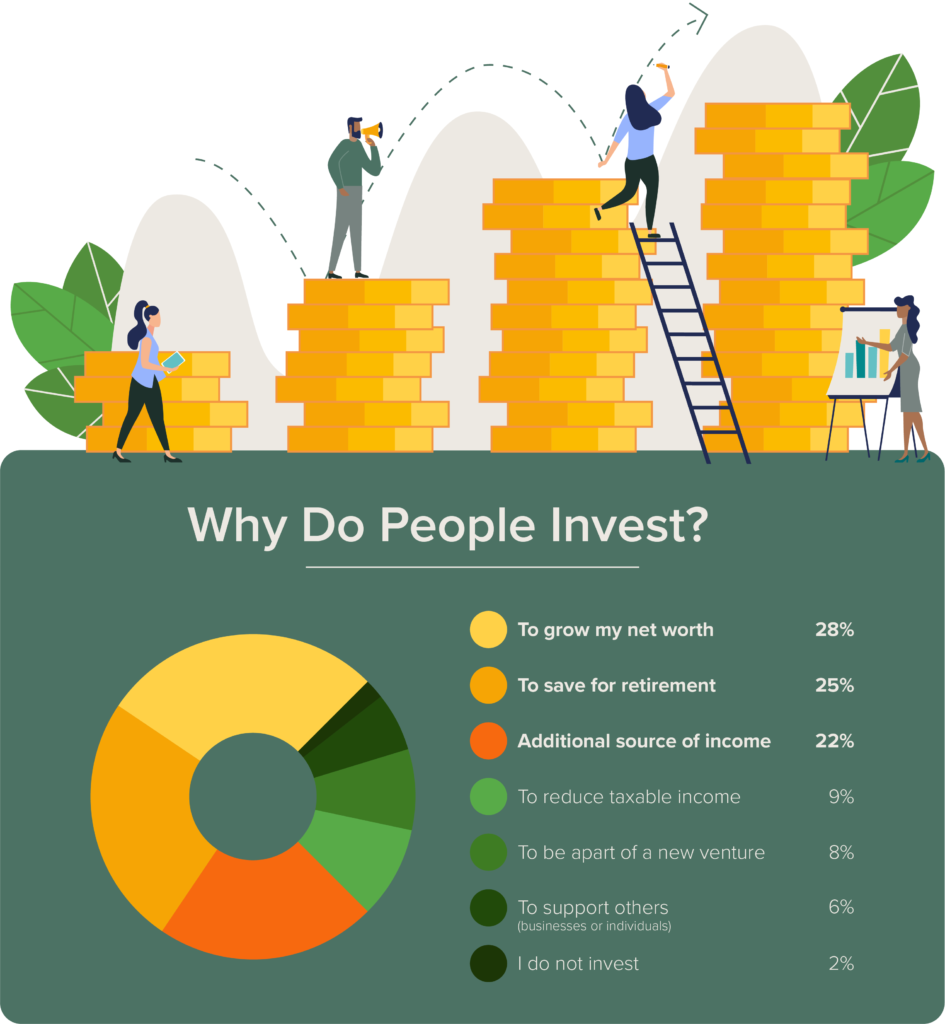
Conclusion: The Psychology of Ownership
Ultimately, people invest in stocks because it changes their relationship with the economy. Instead of being mere consumers whose money flows out to large corporations, investors become owners who benefit from the value those corporations create. It is a shift from a mindset of scarcity to a mindset of growth. By leveraging the power of compounding, protecting against inflation, and securing passive income streams, investors use the stock market as a tool to design a more secure and prosperous future. Whether the goal is a comfortable retirement, a child’s education, or simply the freedom to pursue one’s passions, the stock market remains one of the most accessible and proven paths to achieving financial success.
aViewFromTheCave is a participant in the Amazon Services LLC Associates Program, an affiliate advertising program designed to provide a means for sites to earn advertising fees by advertising and linking to Amazon.com. Amazon, the Amazon logo, AmazonSupply, and the AmazonSupply logo are trademarks of Amazon.com, Inc. or its affiliates. As an Amazon Associate we earn affiliate commissions from qualifying purchases.