
The global investment landscape is currently witnessing a stark divergence. While many Western indices have hovered near record highs, the Chinese equity market has faced a prolonged period of turbulence and downward pressure. For investors tracking the CSI 300 or the Hang Seng Index, the question of “why” is multifaceted, involving a complex tapestry of domestic economic shifts, regulatory overhangs, and shifting geopolitical realities. Understanding the decline requires looking beyond a single day’s trading and analyzing the structural and cyclical factors that are reshaping the second-largest economy in the world.

The Property Sector Drag: From Growth Engine to Systemic Risk
For decades, the real estate sector was the primary engine of the Chinese economy, contributing nearly 25% to 30% of its total GDP. Today, that same engine is the most significant weight on the stock market. The crisis, which began with the “Three Red Lines” policy designed to deleverage over-indebted developers, has evolved into a systemic drag on investor confidence.
The Looming Shadow of Real Estate Debt
The fall in stock prices is inextricably linked to the liquidity crises faced by giants like Evergrande and Country Garden. When these massive developers began defaulting on their obligations, it triggered a chain reaction. It wasn’t just the developers’ stocks that plummeted; the contagion spread to the financial institutions that backed them and the materials companies that supplied them. Investors are currently pricing in the long-term reality that the era of hyper-growth in Chinese construction is over, leaving a vacuum in the economy that has yet to be filled.
Wealth Effects and the Impact on Middle-Class Consumption
In China, a significant portion of household wealth—estimated at over 70%—is tied up in real estate. As property values stagnate or decline, the “negative wealth effect” takes hold. When people feel poorer because their primary asset is losing value, they spend less. This reduction in domestic consumption directly impacts the earnings of consumer-facing companies listed on the Shanghai and Shenzhen exchanges. Stock prices are falling today because the market anticipates a prolonged period of weak internal demand, as the middle class prioritizes saving and debt repayment over discretionary spending.
Macroeconomic Headwinds and the Deflationary Spiral
While most of the developed world has been battling inflation over the last two years, China is facing the opposite problem: deflation. Falling prices might sound beneficial for consumers, but for a stock market, deflation is a toxic signal of economic malaise.
Weak Domestic Demand and the Consumer Confidence Crisis
Recent Consumer Price Index (CPI) and Producer Price Index (PPI) data have frequently hovered in negative territory. This indicates that manufacturers are forced to cut prices to move inventory, and consumers are delaying purchases in anticipation of even lower prices in the future. For corporations, this means shrinking profit margins and declining revenue growth. Investors are selling off Chinese equities because the fundamental “growth story” that made China an attractive investment for twenty years is being replaced by a narrative of stagnation.
Demographic Shifts and Long-term Structural Pressures
The stock market is also reacting to the “graying” of China. The shrinking working-age population and the aging demographic profile mean that the labor force is contracting while the social safety net requirements are expanding. These demographic realities suggest that the double-digit GDP growth of the past is gone for good. Markets are currently repricing Chinese assets to reflect a “new normal” of lower growth, which naturally leads to lower price-to-earnings (P/E) multiples for even the most established blue-chip companies.
Geopolitical Friction and Foreign Capital Outflow

The movement of capital is the lifeblood of any stock market, and in recent months, there has been a notable exodus of foreign portfolio investment from mainland China and Hong Kong.
The “Uninvestable” Narrative and Capital Flight
A few years ago, the narrative among global fund managers was “FOMO” (fear of missing out) regarding China. Today, that has shifted toward “de-risking.” Major institutional investors, including pension funds and sovereign wealth funds, have reduced their exposure to Chinese equities. This selling pressure is driven by concerns over regulatory unpredictability and the potential for sudden policy shifts that can wipe out entire industries overnight—as seen in the previous crackdowns on the tutoring and gaming sectors.
Trade Restrictions and the Tech-War Impact
Geopolitical tensions, particularly with the United States and the European Union, continue to weigh heavily on market sentiment. Export controls on high-end semiconductors and AI technology have hampered the growth prospects of China’s tech leaders. Furthermore, the threat of increased tariffs and the “China Plus One” strategy—where companies move manufacturing to countries like Vietnam or India—suggests that China’s dominance in global supply chains is being challenged. Investors are wary of the “geopolitical risk premium” that now must be attached to any Chinese stock, leading to a natural downward adjustment in valuations.
The Search for a Catalyst: Government Policy and the Road to Recovery
One of the primary reasons the market continues to fall “today” is a perceived lack of a “bazooka” stimulus from the central government. In previous downturns, Beijing would often unleash massive infrastructure spending or monetary easing to jumpstart the economy. This time, the response has been more measured.
Stimulus Skepticism: Why Policy Pivots Haven’t Stuck
While the People’s Bank of China (PBoC) has implemented various interest rate cuts and liquidity injections, the market has often reacted with a “sell the news” mentality. There is a growing sense of skepticism among investors that incremental monetary policy can solve what are essentially structural problems. Small cuts to the Reserve Requirement Ratio (RRR) are seen as “band-aids” that do not address the core issue of weak confidence among both consumers and private business owners.
Monetary Policy Limitations and the Liquidity Trap
China currently faces what some economists call a “liquidity trap,” where lowering interest rates fails to stimulate borrowing because businesses see no profitable investment opportunities and consumers are too concerned about the future to take on debt. Without a massive fiscal stimulus package—one that directly targets consumption or social safety nets—investors remain unconvinced that a sustained rally is imminent. The market is falling today because it is waiting for a signal of “bottoming out” that hasn’t quite arrived yet.
Navigating Chinese Equities in a New Era
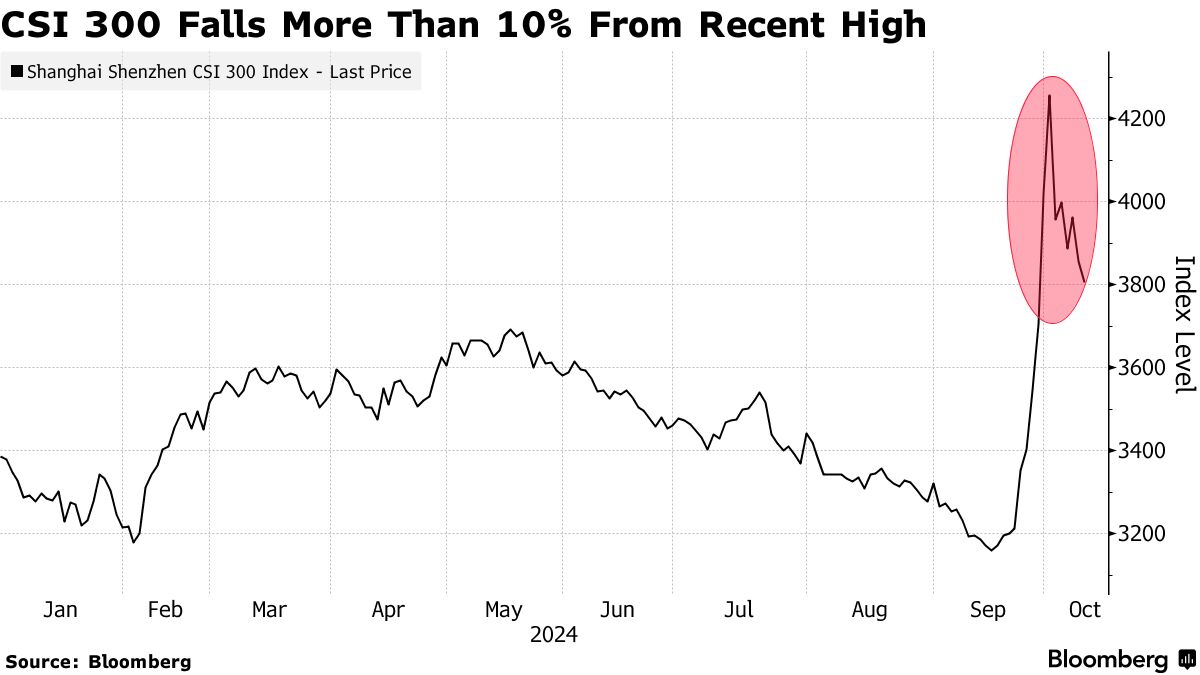
The current decline in the Chinese stock market is not a random fluctuation but a reflection of a profound transition. The country is attempting to pivot from a growth model fueled by debt and real estate to one powered by high-tech manufacturing and “new productive forces.” This transition is inherently painful and filled with uncertainty.
For the value investor, the current environment presents a paradox. On one hand, many Chinese companies are trading at their cheapest valuations in a decade, with dividend yields that are increasingly attractive compared to historical averages. On the other hand, the “value trap” risk is high; a cheap stock can stay cheap indefinitely if the underlying economic environment does not improve.
The volatility we see today is the market’s attempt to price in a future where China is a more mature, slower-growing, and domestically focused economy. Until there is more clarity on the resolution of the property crisis and a stabilization of the geopolitical relationship with the West, the Chinese stock market is likely to remain in a state of flux. Investors are no longer just looking at earnings reports; they are looking for a fundamental restoration of trust in the structural integrity of the Chinese economic miracle. As that trust is rebuilt—or further tested—the markets will continue to react with the high degree of sensitivity we are witnessing today.
aViewFromTheCave is a participant in the Amazon Services LLC Associates Program, an affiliate advertising program designed to provide a means for sites to earn advertising fees by advertising and linking to Amazon.com. Amazon, the Amazon logo, AmazonSupply, and the AmazonSupply logo are trademarks of Amazon.com, Inc. or its affiliates. As an Amazon Associate we earn affiliate commissions from qualifying purchases.