
For many investors, opening a brokerage account to find a sea of red can be a jarring experience. The stock market, while historically a powerful engine for wealth creation, is rarely a straight line upward. When the “bears” take control and prices begin to slide, the immediate question is always: Why?
Understanding why stocks are going down requires looking past the daily ticker tape and examining the complex web of economic indicators, corporate performance, and human psychology. Market downturns are rarely the result of a single event; rather, they are the culmination of several overlapping factors that shift the balance from buyers to sellers. In this deep dive, we will explore the primary catalysts for market declines and how they impact your portfolio.
Macroeconomic Pressures: The Role of Inflation and Interest Rates
The most common driver of modern market volatility is the interplay between inflation and the monetary policy set by central banks, such as the Federal Reserve in the United States. In the world of finance, the price of money—expressed through interest rates—is the gravity that holds stock valuations in place.
The Federal Reserve’s Balancing Act
When inflation rises, the purchasing power of currency erodes. To combat this, central banks raise interest rates to cool the economy. Higher interest rates make borrowing more expensive for both consumers and businesses. For an investor, this is a double-edged sword. First, it slows down economic growth as consumers spend less on credit-sensitive items like homes and cars. Second, it increases the “risk-free” rate of return. If an investor can get a 5% return on a safe government bond, they are less likely to risk their capital in the volatile stock market unless the potential returns are significantly higher.
How Rising Rates Impact Corporate Valuations
From a technical standpoint, stock prices are often calculated using a “Discounted Cash Flow” (DCF) model. This model values a company based on the present value of its future earnings. When interest rates go up, the “discount rate” used in these calculations also increases. This mathematically lowers the current value of those future earnings. This is why high-growth companies—specifically those in the tech sector that expect to make most of their money years into the future—often see their stock prices hit the hardest when interest rates rise.
Corporate Health and Earnings Expectations
At its core, a share of stock is a claim on a company’s future profits. If the outlook for those profits begins to dim, the stock price will inevitably follow. Investors are forward-looking; they don’t buy a stock for what it did last year, but for what they expect it to do next year.
The “Earnings Recession” and Margin Compression
Even if a company is still making money, its stock might drop if its profit margins are shrinking. Inflation doesn’t just affect consumers; it affects businesses too. Rising costs for raw materials, energy, and labor (input costs) can eat into a company’s bottom line. If a company cannot pass these higher costs on to its customers through higher prices, its margins compress. When Wall Street analysts begin to revise their earnings estimates downward, it often triggers a broad sell-off across the affected sectors.
Sector-Specific Slumps vs. Broad Market Trends
Sometimes, stocks go down because a specific industry is facing a “reckoning.” For example, if a major retail giant reports a massive buildup in unsold inventory, it signals that consumer demand is waning. This can drag down the entire retail sector. Similarly, if a major bank reports an increase in loan defaults, it can trigger a sell-off in the financial sector. Because the modern stock market is highly interconnected through Exchange Traded Funds (ETFs), a slump in one major sector can often lead to “contagion,” where investors sell off their broader holdings to mitigate risk.
Geopolitical Uncertainty and Global Supply Chains
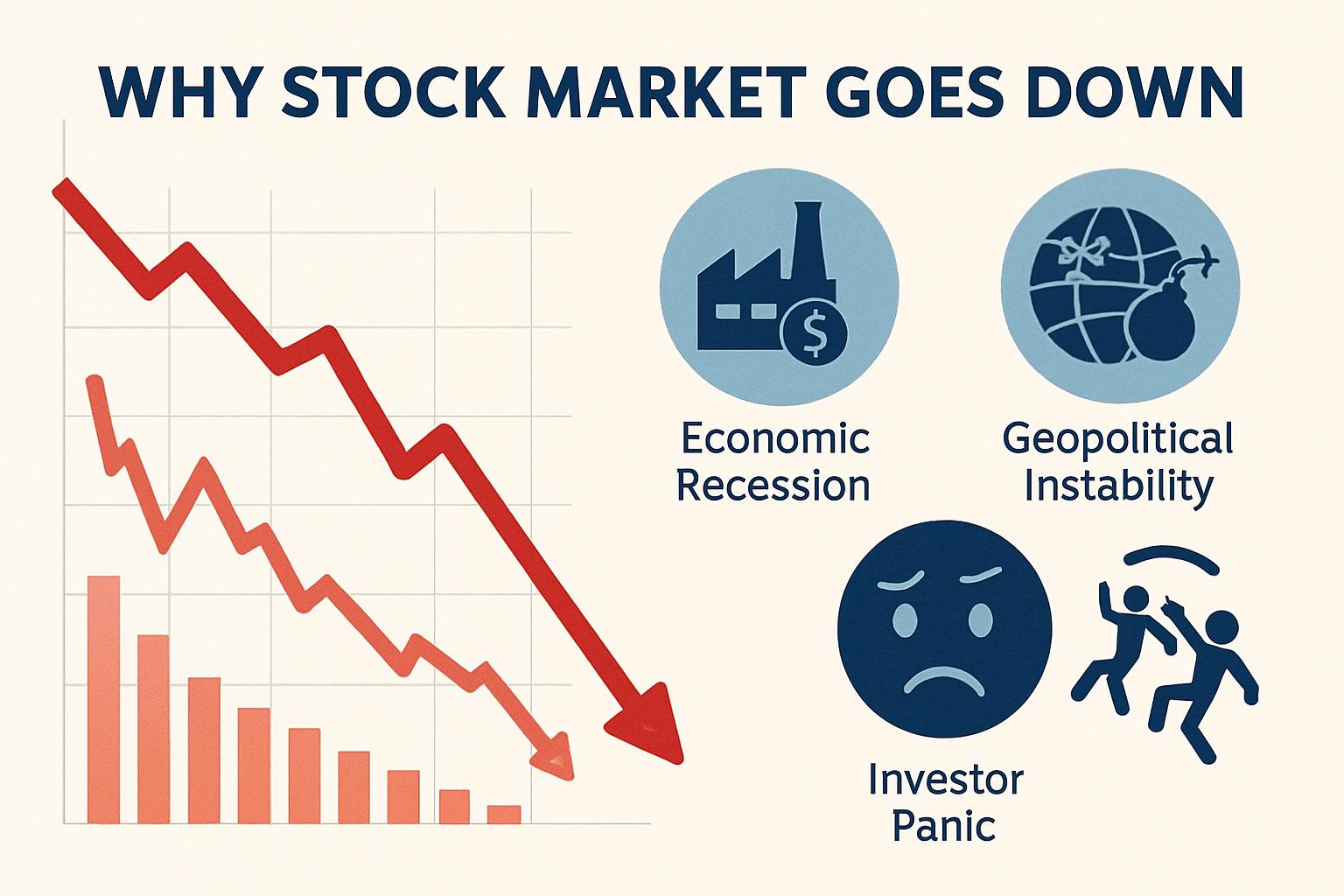
Markets crave stability and predictability. Geopolitical tension is the enemy of both. When conflict arises between nations or trade policies shift abruptly, it creates a layer of uncertainty that makes it difficult for businesses to plan for the future.
Trade Tensions and Energy Volatility
In a globalized economy, very few companies operate in a vacuum. A conflict in Eastern Europe can spike the price of oil and natural gas, raising transportation costs for every business on the planet. Similarly, trade disputes between major economies like the U.S. and China can lead to tariffs, which increase the cost of goods and disrupt established supply chains. When the “cost of doing business” becomes unpredictable due to international friction, investors often retreat to “safe-haven” assets like gold or government bonds, pulling money out of the stock market.
The Shift from Globalization to Reshoring
We are currently witnessing a structural shift in how global business is conducted. After decades of hyper-globalization, many companies are now “reshoring” or “friend-shoring” their operations to avoid geopolitical risks. While this may lead to more stable supply chains in the long run, the transition is incredibly expensive. Building new factories and moving labor forces requires massive capital expenditure. In the short term, these costs can weigh heavily on corporate balance sheets, leading to lower stock prices as the market adjusts to this new, more expensive reality.
Psychological Factors: Market Sentiment and Investor Behavior
While the math of interest rates and earnings is important, the stock market is ultimately driven by human beings—and humans are not always rational. Fear and greed are the two primary emotions that dictate market cycles.
The Transition from Greed to Fear
During a bull market, “Fear Of Missing Out” (FOMO) often drives prices to unsustainable levels. When a correction begins, that greed quickly turns to fear. As prices drop, some investors panic and sell their holdings to “prevent further loss.” This creates a feedback loop: selling leads to lower prices, which triggers more fear, which leads to more selling. This phenomenon is often referred to as “capitulation,” and it is usually the final phase of a market downturn before a recovery begins.
Algorithmic Trading and Liquidity Crunches
In the modern era, a significant portion of stock market trading is done by computers using complex algorithms. These algorithms are often programmed to sell automatically when certain price levels are breached. This can lead to “flash crashes” or accelerated declines that seem disconnected from actual economic news. Furthermore, in times of extreme stress, “liquidity” can dry up. This means there aren’t enough buyers to meet the volume of sellers, causing prices to gap downward aggressively.
Strategies for Navigating a Downward Market
Seeing the value of your investments decline is difficult, but for the disciplined investor, a downward market is not a disaster—it is a phase of the cycle. Knowing why stocks are going down allows you to make informed decisions rather than emotional ones.
Rebalancing and Diversification
A downward market is an excellent time to review your asset allocation. If your portfolio was too heavily weighted in high-risk tech stocks, a downturn serves as a reminder of the importance of diversification. Rebalancing involves selling assets that have performed well (relatively speaking) and buying assets that have become undervalued. This forces you to follow the golden rule of investing: “Buy low, sell high.”
The Importance of a Long-Term Perspective
Historically, the stock market has recovered from every single downturn it has ever faced. Whether it was the Great Depression, the 2008 financial crisis, or the 2020 pandemic crash, the market has eventually reached new all-time highs. For those with a long time horizon—such as retirement savers—a market decline is actually an opportunity to “buy the dip.” By practicing dollar-cost averaging (investing a set amount of money at regular intervals), you end up buying more shares when prices are low and fewer shares when prices are high, lowering your average cost over time.
In conclusion, stocks go down for a variety of reasons: from the heavy hand of the Federal Reserve and the shifting tides of corporate earnings to the complexities of global politics and the frailty of human psychology. By understanding these mechanisms, you can move away from the “noise” of the daily news cycle and focus on a robust, long-term financial strategy. Remember, the market is a device for transferring money from the impatient to the patient. Stay focused on your goals, and treat volatility as a teacher rather than an enemy.
aViewFromTheCave is a participant in the Amazon Services LLC Associates Program, an affiliate advertising program designed to provide a means for sites to earn advertising fees by advertising and linking to Amazon.com. Amazon, the Amazon logo, AmazonSupply, and the AmazonSupply logo are trademarks of Amazon.com, Inc. or its affiliates. As an Amazon Associate we earn affiliate commissions from qualifying purchases.