
Costco Wholesale Corporation is a global retail powerhouse, often cited by economists and investment analysts as a gold standard for operational efficiency and shareholder value. However, unlike many private retail chains or family-owned legacies, the question of “who owns Costco” does not have a single-name answer. As a publicly traded entity listed on the NASDAQ under the ticker symbol COST, Costco is owned by thousands of individual and institutional investors.
For those navigating the world of personal finance and institutional investing, understanding the ownership structure of Costco provides a masterclass in how modern corporate governance works. It is a company characterized by high institutional backing, stable leadership, and a business model that prioritizes long-term financial health over short-term quarterly spikes.
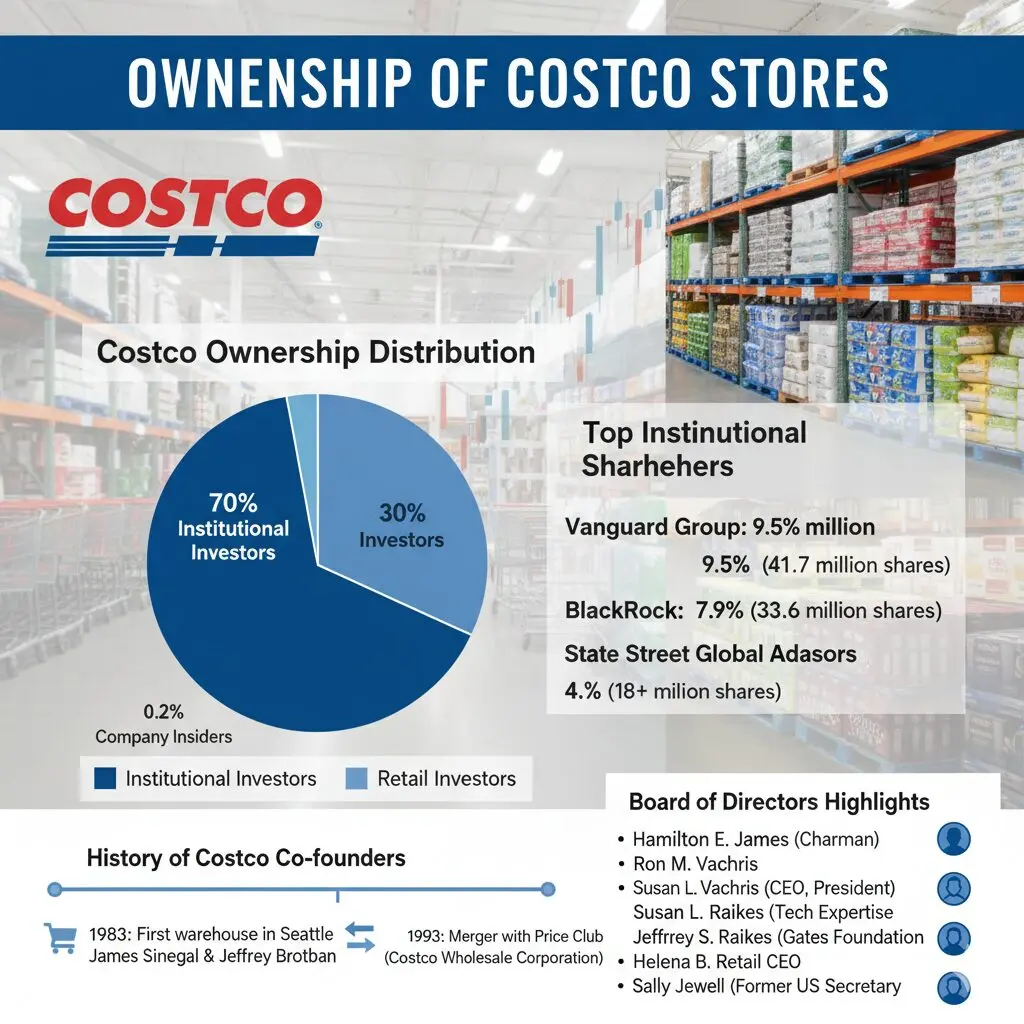
The Public Ownership Model: Analyzing the Major Shareholders
Because Costco is a publicly traded company, its “owners” are its shareholders. These range from retail investors holding a few shares in their 401(k)s to massive financial institutions that manage trillions of dollars in assets.
Institutional Giants: Vanguard, BlackRock, and State Street
The lion’s share of Costco is owned by institutional investors. As of late 2023 and early 2024, the largest shareholders are the “Big Three” of the indexing world. The Vanguard Group typically leads the pack, holding approximately 8% to 9% of the company’s total shares. Following closely is BlackRock, Inc., with a stake hovering around 6% to 7%. State Street Corporation also maintains a significant position, often around 4%.
These institutions do not “run” the company in the traditional sense; rather, they hold the stock on behalf of their clients through mutual funds and Exchange-Traded Funds (ETFs). For a finance-minded individual, this high level of institutional ownership is a signal of stability. When the world’s largest asset managers hold a stock in such high volume, it suggests a level of confidence in the company’s fiduciary responsibility and market longevity.
Insider Ownership and the Board of Directors
While institutional investors hold the majority, a small but significant portion of the company is owned by “insiders”—the executives and members of the Board of Directors. This includes key figures like CEO Ron Vachris and former CEO Craig Jelinek.
Historically, the late Charlie Munger, the legendary Vice Chairman of Berkshire Hathaway, was one of Costco’s most vocal proponents and a significant individual shareholder. Munger famously praised Costco for its “meritocratic” culture and its refusal to compromise on value. Insider ownership is a crucial metric for investors because it ensures that the people making the decisions have “skin in the game,” aligning their financial interests with those of the general public.
Costco’s Financial Engine: Membership Fees and High-Volume Sales
To understand the value of owning Costco stock, one must understand the unique way the company generates money. Costco does not operate like a traditional retailer; it operates more like a high-end subscription service that happens to sell groceries and electronics.
The Role of Membership Revenue in Stabilizing Stock Value
In the world of business finance, “predictability” is a premium asset. Costco’s primary source of profit is not the markup on its goods, but the annual membership fees paid by its 120+ million cardholders. Most items in a Costco warehouse are marked up by no more than 14% to 15%, which barely covers the overhead costs of operating the massive buildings.
The membership fees, however, drop almost directly to the bottom line (net profit). With a renewal rate consistently above 90% in North America, Costco enjoys a recurring revenue stream that provides a massive financial cushion. For an investor, this means that even during a retail slump, Costco has a guaranteed influx of cash that protects the stock from the volatility seen in traditional “big-box” retail competitors.
Supply Chain Efficiency and Profit Margins
Costco’s financial strategy is built on the concept of “extreme volume.” By carrying a limited number of Stock Keeping Units (SKUs)—roughly 4,000 compared to a typical supermarket’s 30,000—Costco leverages immense bargaining power with suppliers. They buy in such massive quantities that they can dictate prices, passing those savings to the consumer while maintaining a lean operational budget.

This efficiency is reflected in the company’s Return on Invested Capital (ROIC). From a financial analysis perspective, Costco’s ability to turn inventory into cash is among the fastest in the industry. This high inventory turnover ratio is a key reason why the company maintains such a strong balance sheet with relatively low debt compared to its market capitalization.
Evaluating Costco as a Long-Term Investment
For those looking at Costco from an “Online Income” or “Investing” niche perspective, the stock has historically been a “buy and hold” favorite. It is often categorized as a defensive stock—one that performs well even when the broader economy is struggling.
Historical Stock Performance and Dividend Growth
Over the last decade, Costco’s stock performance has significantly outperformed the S&P 500. This growth is driven by consistent comparable-store sales growth and international expansion. But beyond share price appreciation, Costco is also a disciplined payer of dividends.
While its quarterly dividend yield may seem modest compared to some utility stocks, Costco is famous for its “Special Dividends.” Every few years, when the company finds itself with an excess of cash on its balance sheet, it issues a large, one-time payment to shareholders. For example, in early 2024, Costco paid out a special dividend of $15 per share. For long-term investors, these “bonuses” significantly enhance the total return on investment.
Resilience During Economic Downturns
In the realm of personal finance, investors often seek “recession-proof” assets. Costco fits this description because of its value proposition. When inflation rises or the economy tightens, consumers flock to Costco to save money on bulk essentials. This “counter-cyclical” nature makes it a cornerstone of many conservative investment portfolios. The company’s financial health is bolstered by its “Kirkland Signature” private label, which offers higher margins for the company while providing lower costs for the consumer—a win-win that drives shareholder value.
The Legacy of Governance and Future Outlook
Ownership of a company isn’t just about who holds the shares; it’s about the philosophy of the people managing those assets. Costco’s governance has remained remarkably consistent since its founding by James Sinegal and Jeffrey Brotman in 1983.
The Influence of Jim Sinegal and the “Costco Way”
Jim Sinegal’s philosophy was simple: take care of the customers, take care of the employees, and the shareholders will eventually be rewarded. This “stakeholder capitalism” was once viewed skeptically by Wall Street, which pressured the company to raise prices and cut employee benefits. Sinegal famously refused, arguing that a loyal workforce and a loyal customer base were the only ways to ensure long-term financial success.
Today’s management continues this legacy. By paying wages well above the retail average and offering robust benefits, Costco experiences incredibly low employee turnover. In the world of business finance, turnover is an “invisible killer” of profits due to the high cost of training and lost productivity. Costco’s low turnover is a competitive financial advantage that is often overlooked by casual observers but highly valued by seasoned analysts.
Expansion Plans and Emerging Markets
As we look at the future of Costco’s ownership value, the focus shifts to international growth. The company has seen massive success in markets like China, Japan, and Iceland. Each new warehouse represents a capital expenditure that begins generating high-margin membership fees almost immediately.
For investors, the runway for growth remains long. As Costco penetrates more international markets and expands its e-commerce capabilities (an area where it has traditionally been slow but is now investing heavily), the intrinsic value of the company continues to rise.

Conclusion: A Distributed Ownership with Concentrated Value
In summary, Costco Wholesale is owned by the public. It is a democratic ownership structure dominated by large institutional funds like Vanguard and BlackRock, yet steered by a management team that remains fiercely loyal to its founding principles.
From a “Money” perspective, Costco represents a unique blend of growth and stability. Its ownership doesn’t lie in the hands of a single billionaire founder, but in a collective of investors who value a business model predicated on volume, loyalty, and fiscal discipline. Whether you are an individual looking to diversify your portfolio or a student of corporate finance, Costco serves as a premier example of how a publicly owned company can maintain a “small business” soul while operating on a massive, profitable, global scale.
aViewFromTheCave is a participant in the Amazon Services LLC Associates Program, an affiliate advertising program designed to provide a means for sites to earn advertising fees by advertising and linking to Amazon.com. Amazon, the Amazon logo, AmazonSupply, and the AmazonSupply logo are trademarks of Amazon.com, Inc. or its affiliates. As an Amazon Associate we earn affiliate commissions from qualifying purchases.