
The question “who owns Alphabet Inc.?” might seem straightforward, but for a behemoth like the parent company of Google, YouTube, and Waymo, the answer is a fascinatingly complex tapestry of individuals, institutions, and intricate financial mechanisms. Far from being owned by a single entity, Alphabet’s ownership is distributed across millions of stakeholders globally, yet paradoxically, a select few wield outsized control. Understanding this structure is paramount for investors, market analysts, and anyone interested in the financial underpinnings of one of the world’s most influential corporations. This exploration delves into the sophisticated financial architecture that defines Alphabet’s ownership, revealing the interplay between public investment, founder control, and institutional power, all firmly rooted in the realm of business finance and investing.
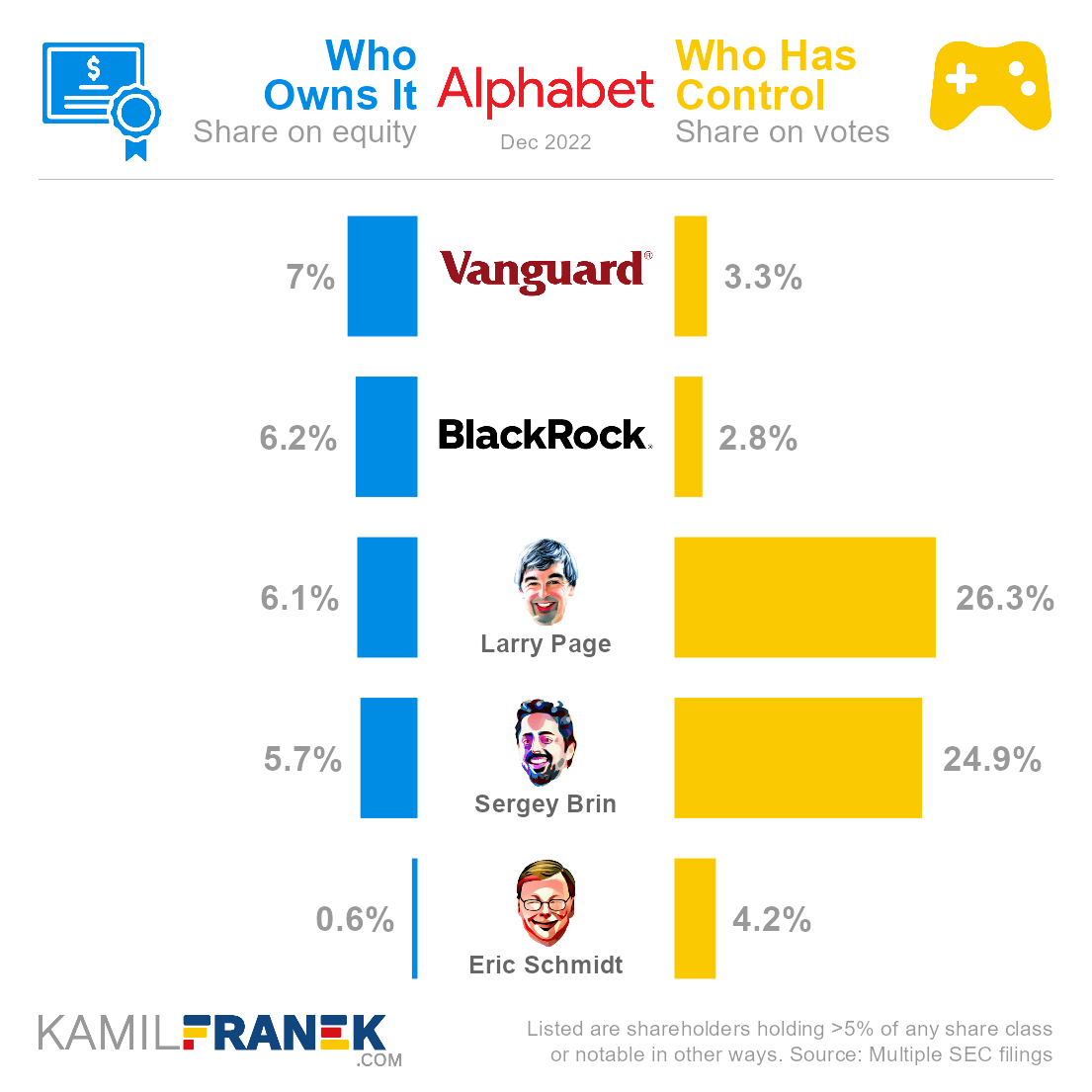
The Publicly Traded Paradox: Dispersed Ownership, Concentrated Control
Alphabet Inc. is a publicly traded company, listed on the NASDAQ exchange under the ticker symbols GOOGL (Class A shares) and GOOG (Class C shares). This means that, technically, ownership is distributed among anyone who purchases its stock. However, the nature of its share classes creates a unique scenario where widespread public ownership coexists with highly concentrated voting power, a critical distinction for understanding its corporate governance and financial strategy.
Understanding Alphabet’s Dual-Class Share Structure
Alphabet employs a sophisticated dual-class (or arguably tri-class) share structure, a common tactic among tech companies looking to preserve founder control while raising capital from public markets. This structure fundamentally differentiates voting rights from economic ownership.
- Class A Shares (GOOGL): These are common shares held by public investors, and each Class A share carries one vote. These shares trade actively on the stock market and represent the primary way for most individual and institutional investors to gain exposure to Alphabet’s financial performance.
- Class C Shares (GOOG): These shares were created in 2014 through a stock split. They are also publicly traded and represent an economic interest in Alphabet, but they carry no voting rights. The purpose of Class C shares was to provide Alphabet with a liquid equity currency for acquisitions, employee compensation, and further stock issuance without diluting the voting power of Class A and especially Class B shareholders. For investors, owning GOOG shares grants exposure to the company’s financial growth without influencing corporate decisions.
- Class B Shares: This is the linchpin of concentrated control. Class B shares are not publicly traded and are primarily held by the company’s founders, Larry Page and Sergey Brin, along with a few early insiders. Crucially, each Class B share carries ten votes. This super-voting power means that while Page and Brin may own a relatively smaller percentage of the total outstanding shares compared to institutional investors, their Class B holdings grant them a substantial, often majority, control over voting matters, including board elections and major corporate decisions.
This structure allows Alphabet to raise vast amounts of capital from the public market without ceding control over its long-term vision and strategic direction to external pressures or short-term investor demands. For potential investors, recognizing this dichotomy is vital: investing in Alphabet means buying into its financial success, but understanding that corporate governance is heavily influenced by its founders.
The Enduring Influence of the Co-founders
Despite stepping down from their executive roles at Alphabet in 2019, Larry Page and Sergey Brin remain profoundly influential figures due to their Class B shares. Their combined voting power effectively gives them control over a majority of shareholder votes. This means they can steer the company’s trajectory, approve major strategic shifts, and appoint board members, even if their direct economic ownership (the monetary value of their shares) is dwarfed by large institutional funds.
This founder-led control has significant implications for Alphabet’s financial strategy. It enables the company to pursue long-term, ambitious “moonshot” projects (like those under Other Bets, such as Waymo or Verily) that might not deliver immediate financial returns, but could yield substantial value decades down the line. Such ventures often require a degree of patience and conviction that short-term-focused public shareholders might not always possess. From a financial perspective, this structure prioritizes long-term value creation over quarterly earnings targets, which can be both a strength and a point of contention for different investor profiles. It offers stability in leadership but also centralizes power, meaning the company’s ultimate direction rests heavily on the vision of a few individuals.
The Institutional Behemoths: Major Players in Alphabet’s Ownership Landscape
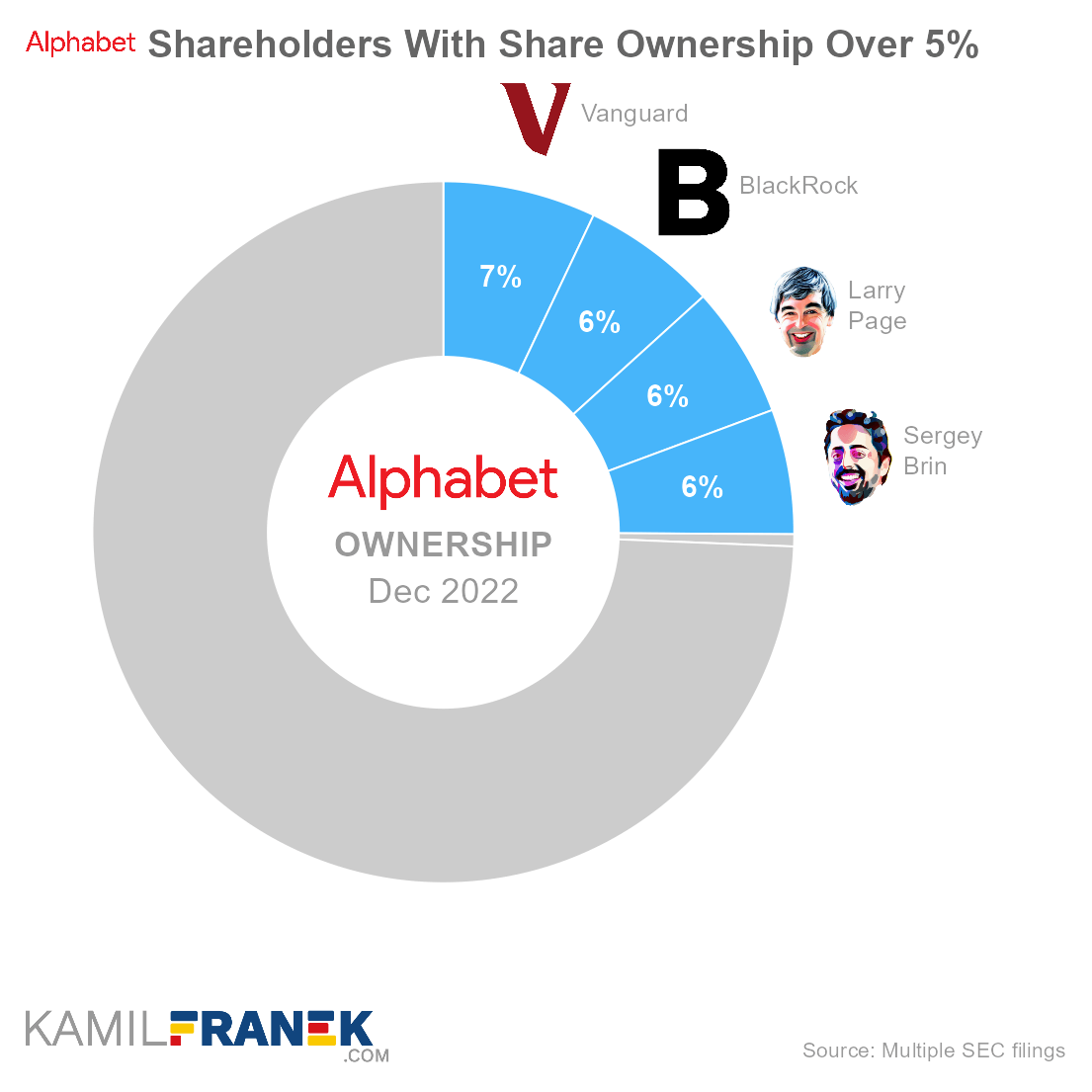
While the founders retain control over voting, the vast majority of Alphabet’s economic ownership is held by large institutional investors. These asset management firms, mutual funds, and pension funds collectively own billions of dollars worth of Alphabet stock, making them significant stakeholders in the company’s financial performance. Their investments are crucial not just for Alphabet’s market capitalization but also for the broader financial ecosystem.
Top Institutional Investors and Their Stakes
Leading the pack of Alphabet’s institutional owners are some of the world’s largest asset managers. While exact percentages fluctuate quarterly, firms like Vanguard Group, BlackRock Inc., State Street Corp., and Fidelity Investments consistently rank among the top holders.
- Vanguard Group: As one of the largest investment management companies globally, Vanguard holds substantial stakes in virtually every major publicly traded company through its vast array of index funds and ETFs. Its ownership in Alphabet reflects the company’s inclusion in major market indices like the S&P 500, which Vanguard’s funds are designed to track.
- BlackRock Inc.: Similar to Vanguard, BlackRock, with its iShares ETFs and other funds, is another gargantuan institutional investor. Its holdings in Alphabet are a consequence of its diversified investment strategies across numerous sectors and market caps.
- State Street Corp.: Through its SPDR ETFs and other investment vehicles, State Street also maintains a significant position in Alphabet, representing a broad market exposure for its clients.
- Fidelity Investments: As a prominent mutual fund company and brokerage, Fidelity manages numerous active and passive funds that invest in Alphabet, catering to a diverse client base ranging from individual retirement savers to large institutions.
These firms typically hold Class A and Class C shares, reflecting their focus on the economic performance of Alphabet. Their collective holdings provide immense liquidity to Alphabet’s stock, facilitate efficient market pricing, and underscore the company’s status as a foundational component of global equity portfolios. While these institutions usually don’t dictate strategic direction due to the founder’s super-voting shares, their immense financial stake means they are deeply invested in Alphabet’s financial health, profitability, and stock appreciation.
The Role of Passive vs. Active Investing
The ownership stakes of these institutional behemoths can largely be categorized into passive and active investing strategies.
- Passive Investing: A substantial portion of institutional ownership comes from passive funds (e.g., index funds, ETFs) that aim to replicate the performance of a specific market index. Since Alphabet is a major component of indices like the S&P 500 and NASDAQ 100, these funds automatically purchase and hold Alphabet shares in proportion to its weighting in these indices. These investors are not typically involved in active corporate governance or strategic debates; their financial interest is in the company’s overall market performance as a part of the broader market. Their buying and selling activity is driven by index rebalancing rather than specific company-level analysis.
- Active Investing: A smaller, but still significant, portion is held by actively managed funds. These funds employ professional managers who conduct in-depth research and analysis to select stocks they believe will outperform the market. Active managers holding Alphabet shares do so because they have identified specific reasons—such as strong growth prospects, innovative product pipelines, or robust financial health—that they believe will lead to superior returns. While their voting power is limited, active institutional investors might engage in “shareholder activism lite,” communicating their concerns or suggestions to management, especially regarding executive compensation, environmental, social, and governance (ESG) factors, or capital allocation strategies that directly impact financial returns. Their buy/sell decisions can influence stock prices based on their perception of Alphabet’s future financial trajectory.
For Alphabet, the presence of both passive and active institutional money ensures a stable and deep market for its shares, providing consistent demand for its stock and reflecting its perceived value within the global financial markets.
Beyond the Giants: Retail Investors and Employee Stakes
While institutional investors dominate in sheer volume, Alphabet’s ownership extends to millions of individual investors and its own employees, each contributing to the company’s broad-based financial backing. These segments, though smaller in aggregate voting power, are crucial for market liquidity and employee alignment.
The Democratic Nature of Public Ownership
The accessibility of the stock market means that anyone with a brokerage account can purchase Alphabet shares. Millions of individual or “retail” investors own Class A or Class C shares, either directly or through mutual funds and retirement accounts. These investors typically hold shares for a variety of reasons: long-term growth, diversification of their personal finance portfolios, or belief in Alphabet’s future innovations.
For retail investors, owning Alphabet stock means participating directly in the financial success of a global technology leader. While their individual voting power (if holding Class A shares) is minuscule compared to the founders or large institutions, collectively, their buy and sell decisions contribute to market sentiment, stock price movements, and overall market capitalization. Investing in Alphabet is often seen as a cornerstone of a diversified portfolio due to its consistent revenue growth, strong market position, and innovation pipeline. This widespread ownership democratizes access to the wealth generated by the company, allowing ordinary citizens to benefit from its financial prosperity.
Employee Stock Ownership and Incentives
Alphabet also has a significant portion of its shares held by current and former employees. Employee stock ownership plans (ESOPs), stock options, and restricted stock units (RSUs) are common components of compensation packages in the tech industry. For a company like Alphabet, attracting and retaining top talent is critical, and offering equity is a powerful incentive.
- Alignment of Interests: When employees own a piece of the company, their financial interests become directly aligned with the company’s financial success. This fosters a sense of ownership, motivates high performance, and encourages long-term commitment.
- Retention: As Alphabet’s stock value appreciates, employee holdings become a significant personal asset, creating a strong incentive to remain with the company and contribute to its continued financial growth.
- Wealth Creation: For many employees, their stock grants represent a substantial portion of their personal wealth, linking their financial future directly to Alphabet’s performance on the stock market.
From a business finance perspective, employee stock ownership is a strategic tool. It’s a non-cash compensation method that ties individual effort to collective financial outcomes, contributing to a motivated workforce and potentially reducing immediate cash outflows for salaries while enhancing shareholder value through improved performance.
Governance, Strategy, and Financial Implications of Ownership
The intricate ownership structure of Alphabet Inc. is not merely a technicality; it has profound implications for its corporate governance, strategic direction, and overall financial health and market valuation. Understanding these connections is crucial for investors assessing Alphabet as a long-term investment.
How Ownership Structure Impacts Corporate Decisions
The super-voting Class B shares held by Larry Page and Sergey Brin mean that they effectively control the Board of Directors and major corporate decisions, even if they hold a minority of the total outstanding shares. This arrangement has several key financial implications:
- Long-Term Vision: The founders’ control allows Alphabet to prioritize long-term strategic investments and “moonshot” projects that may not yield immediate profits but could generate significant future revenue streams or technological breakthroughs. This contrasts with companies where short-term investor pressures might force management to focus solely on quarterly earnings. For investors with a long-term horizon, this can be seen as a strength, fostering innovation and sustainable growth.
- Stability and Consistency: Founder control can lead to greater stability in strategic direction, as the company is less susceptible to hostile takeovers or sudden shifts in direction dictated by activist investors. This can reassure investors looking for predictable leadership.
- Reduced Shareholder Activism: The dual-class structure largely insulates Alphabet from typical shareholder activism, where large institutional investors might push for changes in management, strategy, or capital allocation. While this allows the company to pursue its vision unhindered, some critics argue it reduces accountability to the broader shareholder base, potentially impacting governance in ways that aren’t always optimal for all investors. This is a critical consideration for those investing primarily for strong corporate governance.
Investor Confidence and Market Valuation
The unique ownership structure plays a significant role in Alphabet’s market valuation and investor confidence. Investors who understand and accept this structure often see it as a positive, associating founder control with visionary leadership and a commitment to innovation.
- Trust in Leadership: Many investors place high confidence in Page and Brin’s track record of innovation and successful leadership, viewing their continued control as a benefit that ensures Alphabet remains at the forefront of technological advancement. This confidence can translate into a premium in the company’s stock price.
- Predictability of Strategy: The stability of control means less uncertainty regarding the company’s strategic direction, which can be attractive to investors seeking long-term predictability.
- Growth Prospects: The ability to invest in long-term, high-risk, high-reward ventures (like AI, autonomous vehicles, and life sciences through Other Bets) is often seen as a driver of future growth, positively influencing analyst ratings and investor sentiment. The market often values these future growth opportunities, even if they currently dilute earnings.
However, some investors may view concentrated control as a governance risk, especially if they believe it could lead to decisions not fully aligned with broad shareholder interests or if the founders’ vision falters. This sentiment can sometimes create downward pressure or a “governance discount” on the stock compared to companies with more dispersed ownership and stronger independent board oversight.

The Future of Alphabet’s Ownership: Succession and Evolution
As Alphabet continues to evolve, the question of long-term ownership and control remains pertinent. While Page and Brin maintain their super-voting shares, the eventual succession plan for leadership and the potential evolution of the share structure are topics of ongoing discussion among financial analysts and investors.
The gradual dilution of Class B shares over time (for example, if founders sell portions or if new, non-voting shares are issued for acquisitions) could eventually shift the balance of power. Any significant changes to this structure would have profound implications for Alphabet’s financial strategy, governance, and market perception. Investors continually monitor these dynamics, as they directly impact the long-term investment thesis for one of the world’s most valuable companies.
In conclusion, “who owns Alphabet Inc.” is a question best answered by dissecting its sophisticated financial engineering. While millions of public investors hold economic stakes, the enduring control of its founders, empowered by a dual-class share structure, dictates its strategic future. This unique blend of widespread financial backing and concentrated voting power is a defining characteristic of Alphabet, shaping its corporate governance, investment decisions, and ultimately, its trajectory in the global economy. For anyone engaging with the financial markets, understanding this nuanced ownership is key to grasping Alphabet’s true value and potential.
aViewFromTheCave is a participant in the Amazon Services LLC Associates Program, an affiliate advertising program designed to provide a means for sites to earn advertising fees by advertising and linking to Amazon.com. Amazon, the Amazon logo, AmazonSupply, and the AmazonSupply logo are trademarks of Amazon.com, Inc. or its affiliates. As an Amazon Associate we earn affiliate commissions from qualifying purchases.