
The question of who owns Google is one of the most common inquiries in the world of business finance, yet the answer is far more complex than a single name or a solitary founder. While Larry Page and Sergey Brin are the household names associated with the tech giant’s inception in a California garage, the modern reality of Google’s ownership involves a sophisticated web of institutional investors, multi-class share structures, and a massive parent company known as Alphabet Inc.
Understanding the ownership of Google requires looking beyond the products we use every day and examining the financial architecture of one of the most valuable corporations in history. Today, Google is a wholly-owned subsidiary of Alphabet Inc., a publicly traded holding company. This means that if you own even a single share of Alphabet stock, you are, in a technical sense, a partial owner of Google.

The Corporate Architecture: From Google to Alphabet Inc.
In 2015, the corporate world witnessed one of the most significant restructurings in history. Google announced that it was reorganizing its sprawling interests under a new parent company called Alphabet Inc. This move was not merely a cosmetic name change; it was a strategic financial decision designed to provide greater transparency and management focus.
The 2015 Restructuring and Its Financial Logic
The primary motivation behind the creation of Alphabet was to separate Google’s core business—search, advertising, maps, YouTube, and Android—from its more speculative “moonshot” projects. These projects, now referred to as “Other Bets,” include ventures like Waymo (autonomous driving), Verily (life sciences), and Wing (drone delivery). From a business finance perspective, this allowed investors to see exactly how much profit the core Google business was generating without it being obscured by the heavy research and development costs of the speculative ventures.
How the Holding Company Model Protects Assets
By operating as a holding company, Alphabet Inc. provides a layer of financial protection and organizational clarity. Each subsidiary under the Alphabet umbrella operates with its own leadership and financial targets. For the owners—the shareholders—this structure minimizes risk. If one of the “Other Bets” were to fail, the legal and financial fallout is largely contained within that specific entity, protecting the massive cash reserves and assets held by the core Google subsidiary.
The Power Dynamics: Founders, Shares, and Voting Rights
When discussing ownership in the context of a public company, it is vital to distinguish between economic ownership and voting control. While thousands of individuals and institutions own Alphabet stock, the ultimate control over the company’s direction remains concentrated in the hands of its founders.
Larry Page and Sergey Brin’s Super-Voting Shares
Alphabet Inc. utilizes a controversial but effective multi-class share structure. This structure is divided into three categories: Class A, Class B, and Class C shares.
- Class A (GOOGL): These are held by regular investors and carry one vote per share.
- Class B: These are held exclusively by the founders and early insiders. Crucially, Class B shares carry ten votes per share and are not traded on public exchanges.
- Class C (GOOG): These shares have no voting rights at all and are typically used for employee compensation and certain types of acquisitions.
Through their heavy concentration of Class B shares, Larry Page and Sergey Brin maintain over 50% of the total voting power. This means that even though they have sold billions of dollars worth of stock over the years, they still “own” the decision-making process of the company. In the world of business finance, this is often referred to as “founder control,” ensuring that the original visionaries can pursue long-term goals without being forced into short-term decisions by activist investors.
The Role of Executive Leadership in Ownership
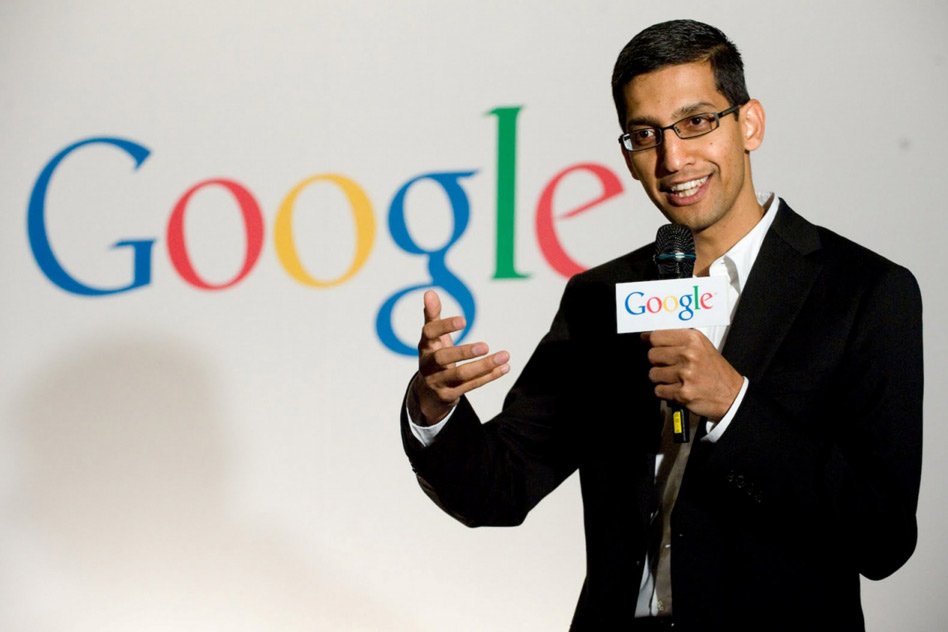
While the founders hold the voting power, the day-to-day management and a significant portion of the equity-based compensation belong to the executive team, led by CEO Sundar Pichai. Pichai, who took over as CEO of Google in 2015 and later Alphabet in 2019, holds a substantial amount of restricted stock units (RSUs). While he does not “own” the company in the way the founders do, his financial interests are perfectly aligned with the shareholders, as his personal net worth is inextricably linked to the performance of Alphabet’s stock.
Institutional Influence: Who Really Owns the Stock?

While the founders control the votes, the vast majority of the “economic ownership”—the right to the company’s profits and assets—belongs to institutional investors. These are massive financial organizations that manage money on behalf of millions of individual savers, pension funds, and insurance policyholders.
The Vanguard Group and BlackRock’s Dominance
The largest owners of Alphabet Inc. are the “Big Three” asset management firms: The Vanguard Group, BlackRock, and State Street Corporation. As of the latest financial filings, Vanguard typically holds between 7% and 8% of the company, while BlackRock holds approximately 6%.
These institutions do not buy the stock because they want to run a search engine; they buy it because Google is a cornerstone of the global economy. Most of these holdings are through index funds and ETFs (Exchange Traded Funds). If you have a 401(k) or a retirement account that tracks the S&P 500, you are indirectly an owner of Google through these institutional giants.
Individual Shareholders and Retail Investors
Beyond the institutions and the founders, a significant portion of Alphabet is owned by retail investors. This category includes everyone from high-net-worth individuals to small-scale investors using apps to buy fractional shares. The democratization of the stock market has allowed the general public to take an ownership stake in Google’s future. This distributed ownership model provides the company with a stable capital base, as it is not reliant on a single wealthy individual or a small group of private equity firms for its funding.
Financial Performance and the Value of Ownership
Ownership is only valuable if the entity being owned is productive. From a financial standpoint, the “owners” of Google are invested in one of the most efficient money-generating machines ever created. To understand the value of this ownership, one must look at the company’s revenue streams and capital allocation.
Advertising: The Primary Engine of Wealth
The vast majority of Alphabet’s revenue—and by extension, the value of its ownership—is derived from Google Services. This includes Google Search, YouTube ads, and the Google Network. In a typical fiscal year, advertising accounts for nearly 80% of total revenue. This dominant market position in the digital advertising space creates a “moat,” a term popularized by Warren Buffett to describe a business’s ability to maintain competitive advantages over its rivals to protect its long-term profits and market share.
Diversification: Google Cloud and “Other Bets”
For the modern investor, the appeal of owning Google lies in its diversification. Google Cloud has emerged as a significant secondary revenue stream, competing directly with Amazon Web Services (AWS) and Microsoft Azure. Furthermore, the “Other Bets” segment, while currently operating at a loss, represents the future potential of the company. Owners are essentially betting that one of these ventures—perhaps Waymo’s autonomous taxis or Verily’s health tech—will become the “next Google,” providing exponential returns on investment in the decades to come.
The Future of Ownership and Market Valuation
As Alphabet Inc. continues to evolve, the nature of its ownership and its financial standing in the global market will face new challenges and opportunities. From stock splits to regulatory scrutiny, several factors will influence what it means to be an owner of this tech titan in the future.
Stock Splits and Accessibility
In 2022, Alphabet executed a 20-for-1 stock split. From a business finance perspective, a stock split does not change the fundamental value of the company, but it significantly changes the accessibility of ownership. By lowering the price per share from thousands of dollars to a more manageable double or triple-digit figure, the company invited a new wave of retail investors into the fold. This increased liquidity and widened the base of owners, further stabilizing the stock’s performance in the public markets.
Long-term Investment Outlook for Alphabet Shareholders
The future for Google’s owners is currently tied to the company’s ability to navigate the shift toward Artificial Intelligence (AI). As AI changes the way users interact with the internet, Alphabet must protect its search monopoly to maintain its financial health. For shareholders, the focus remains on how the company manages its massive cash reserves—often exceeding $100 billion—through share buybacks and strategic acquisitions. Share buybacks are particularly important for owners, as they reduce the total number of shares outstanding, effectively increasing each remaining shareholder’s “piece of the pie.”
In conclusion, “the owner” of Google is not a single entity, but a tiered hierarchy of stakeholders. At the top sit Larry Page and Sergey Brin, who hold the reins of power through super-voting shares. Below them are the institutional giants like Vanguard and BlackRock, who provide the financial bedrock. Finally, there are millions of individual investors worldwide who participate in the company’s growth. Together, these groups form the ownership structure of a corporation that has become an inextricable part of the global financial and technological landscape.
aViewFromTheCave is a participant in the Amazon Services LLC Associates Program, an affiliate advertising program designed to provide a means for sites to earn advertising fees by advertising and linking to Amazon.com. Amazon, the Amazon logo, AmazonSupply, and the AmazonSupply logo are trademarks of Amazon.com, Inc. or its affiliates. As an Amazon Associate we earn affiliate commissions from qualifying purchases.