
Understanding how to calculate your monthly loan repayments is a cornerstone of sound financial management. Whether you’re considering a mortgage, a car loan, student debt, or a personal loan, the ability to accurately project your monthly financial commitment is crucial for budgeting, planning, and making informed decisions. Far from being a mere numerical exercise, this knowledge empowers you to understand the true cost of borrowing, optimize your repayment strategy, and ultimately take control of your financial future.
In an age where debt is a common reality for many individuals and businesses, demystifying the calculation process moves you from a passive borrower to an active financial participant. This article will break down the essential components of loan repayments, explain the universal formula, introduce practical tools, and discuss strategic considerations to help you confidently navigate the world of borrowing. By the end, you’ll have a clear grasp of how your payments are structured and what steps you can take to manage them effectively.

Understanding the Fundamentals of Loan Repayments
Before diving into complex formulas, it’s essential to grasp the basic elements that constitute any loan and influence its repayment structure. These core components are universal across nearly all types of amortized loans.
Key Components of a Loan
Every loan is built upon a few fundamental pillars:
- Principal (P): This is the original amount of money you borrow. It’s the face value of the loan before any interest or fees are applied. Reducing the principal is the ultimate goal of any repayment plan.
- Interest Rate (i): Expressed as an annual percentage rate (APR), the interest rate is the cost of borrowing money. It’s the fee charged by the lender for the use of their funds. For monthly calculations, this annual rate will need to be converted to a monthly rate.
- Loan Term (n): This refers to the duration over which you agree to repay the loan, typically expressed in years. A 30-year mortgage, a 5-year car loan, or a 10-year student loan all represent different loan terms. The term directly impacts the total number of payments you’ll make and, consequently, the size of each monthly payment.
The Amortization Process
Most common loans, such as mortgages and auto loans, are “amortized.” Amortization is the process of paying off debt over time through regular, fixed payments. What makes amortization interesting is how these payments are split between principal and interest.
In the early stages of an amortized loan, a larger portion of your monthly payment goes towards interest, and a smaller portion goes towards reducing the principal. As the loan matures, this ratio gradually shifts. More of your payment begins to chip away at the principal, and less goes towards interest. This is because the interest is calculated on the remaining principal balance. As the principal balance decreases, so does the interest portion of your payment, leaving more room to reduce the principal further. Understanding this dynamic is crucial for appreciating the long-term impact of your payments.
The Importance of a Fixed vs. Variable Rate
The nature of your interest rate significantly impacts the predictability and calculation of your monthly repayments:
- Fixed Interest Rate: With a fixed rate, your interest rate remains constant throughout the entire loan term. This means your monthly principal and interest payment will never change (unless you refinance or make extra payments). Fixed rates offer stability and predictability, making budgeting much simpler. The calculations we will discuss are primarily for fixed-rate loans.
- Variable Interest Rate (Adjustable-Rate): A variable rate loan, often called an Adjustable-Rate Mortgage (ARM), has an interest rate that can fluctuate based on a specified market index (e.g., prime rate, LIBOR). This means your monthly payments can go up or down over the loan term. While variable rates might start lower than fixed rates, they introduce an element of uncertainty and require more flexible financial planning. Calculating future payments for variable-rate loans involves projecting future interest rate movements, which adds a layer of complexity not covered by a simple fixed formula.
The Universal Loan Repayment Formula Explained
The core of calculating monthly loan repayments lies in a standard mathematical formula that accounts for the principal, interest rate, and loan term. While it might look intimidating at first, breaking it down makes it quite manageable.
Breaking Down the Formula
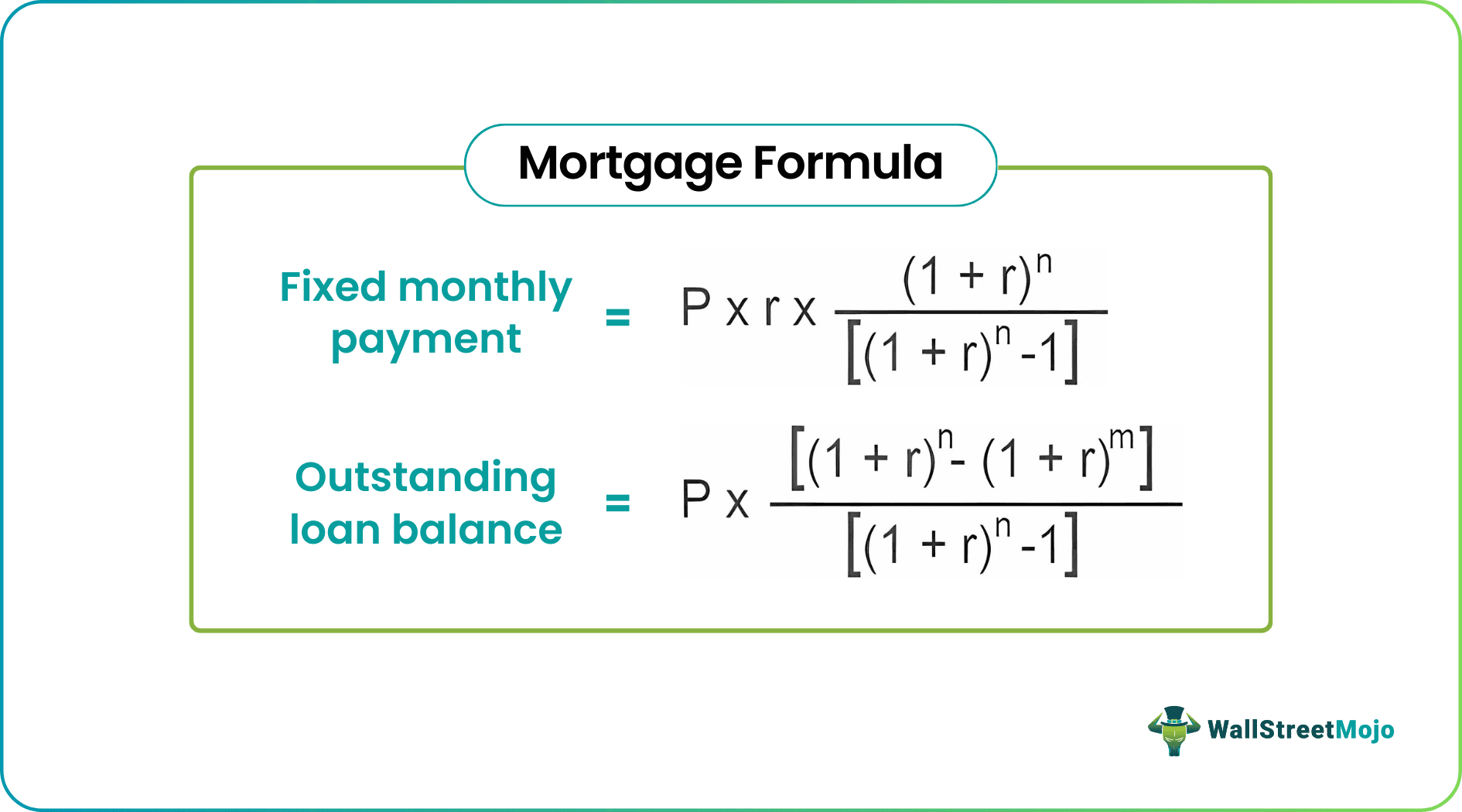
The formula for calculating the monthly payment (M) for an amortized loan is:
M = P [ i(1 + i)^n ] / [ (1 + i)^n – 1]
Let’s define each variable clearly:
- M = Monthly Payment: This is the figure you’re trying to calculate – the fixed amount you’ll pay each month.
- P = Principal Loan Amount: The total amount of money you borrowed.
- i = Monthly Interest Rate: This is the annual interest rate divided by 12 (since there are 12 months in a year). For example, if the annual rate is 6%, then
i = 0.06 / 12 = 0.005. It’s crucial to express this as a decimal. - n = Total Number of Payments: This is the loan term in years multiplied by 12. For instance, a 30-year mortgage would have
n = 30 * 12 = 360payments.
Step-by-Step Application: An Example
Let’s walk through an example to illustrate how to use the formula.
Scenario: You take out a personal loan for $20,000 (P) with an annual interest rate of 5% for a term of 5 years.
-
Calculate the Monthly Interest Rate (i):
- Annual rate = 5% = 0.05
i = 0.05 / 12 = 0.00416667(It’s best to use as many decimal places as possible for accuracy).
-
Calculate the Total Number of Payments (n):
- Loan term = 5 years
n = 5 * 12 = 60payments
-
Plug the values into the formula:
M = 20000 [ 0.00416667(1 + 0.00416667)^60 ] / [ (1 + 0.00416667)^60 – 1]
-
Solve the components step-by-step:
(1 + i) = 1 + 0.00416667 = 1.00416667(1 + i)^n = (1.00416667)^60 ≈ 1.28335889i(1 + i)^n = 0.00416667 * 1.28335889 ≈ 0.00534733(1 + i)^n – 1 = 1.28335889 – 1 = 0.28335889
-
Complete the calculation:
M = 20000 * (0.00534733 / 0.28335889)M = 20000 * 0.01887856M ≈ $377.57
So, your estimated monthly repayment for this loan would be approximately $377.57. While using a calculator or spreadsheet is far more practical for everyday use, understanding the manual calculation reinforces how each variable impacts the final payment.
Practical Tools and Resources for Calculation
While the formula provides the theoretical basis, modern financial tools make calculating monthly loan repayments instantaneous and effortless. These resources are invaluable for comparison shopping and financial planning.
Online Loan Calculators
The internet is replete with free, user-friendly online loan calculators provided by banks, financial institutions, and independent financial websites. These tools typically require you to input the principal amount, interest rate, and loan term, and they instantly display your estimated monthly payment, total interest paid, and sometimes even a full amortization schedule.
Benefits of Online Calculators:
- Speed and Convenience: Get instant results without manual calculations.
- “What If” Scenarios: Easily adjust variables (e.g., increase down payment, shorten loan term) to see how they impact your payment.
- Amortization Schedules: Many calculators provide a detailed breakdown of how much principal and interest you’ll pay each month over the life of the loan.
- Comparison: Use multiple calculators from different sources to ensure consistency and explore options.
Popular platforms like Bankrate, NerdWallet, Zillow (for mortgages), and your own bank’s website often feature excellent loan calculators.
Spreadsheet Software (Excel/Google Sheets)
For those who prefer a more hands-on approach or need to integrate loan calculations into broader financial models, spreadsheet software like Microsoft Excel or Google Sheets is incredibly powerful. They offer built-in financial functions that simplify the process.
The primary function for calculating payments is the PMT function:
=PMT(rate, nper, pv, [fv], [type])
Where:
rate: The interest rate per period (e.g., annual rate / 12).nper: The total number of payments in the loan (e.g., loan term in years * 12).pv: The present value, or the principal loan amount. This should be entered as a negative number if it represents money received.[fv]: Optional. The future value, or a cash balance you want to attain after the last payment. Defaults to 0.[type]: Optional. Indicates when payments are due (0 for end of period, 1 for beginning of period). Defaults to 0.
Example using PMT function:
For our $20,000 loan at 5% for 5 years:
=PMT(0.05/12, 5*12, -20000)
This will yield $377.42. (Note: Slight differences may occur due to rounding precision in manual calculation vs. software).
Spreadsheets also allow you to create detailed amortization schedules. You can set up columns for payment number, beginning balance, interest paid, principal paid, and ending balance, dynamically calculating each row to see the full life of the loan.
Financial Advisors and Banking Tools
While self-service tools are excellent for basic calculations, there are times when professional advice is invaluable.
- Financial Advisors: For complex financial situations, such as structuring business loans, consolidating multiple debts, or planning for large investments like real estate, a financial advisor can provide personalized guidance. They can help you understand the long-term implications of various loan structures and integrate them into your broader financial plan.
- Banking Tools and Loan Officers: When applying for a loan, your bank’s loan officers are equipped to provide precise payment schedules and explain all associated costs. They often have proprietary tools that account for specific lender fees, escrow requirements (for mortgages), and other variables that might not be included in generic online calculators. Always verify your calculations with the lender’s official figures before committing to a loan.
Factors Influencing Your Monthly Payment (Beyond the Formula)
While the core formula uses principal, interest, and term, several other practical considerations can indirectly or directly impact the monthly outflow associated with your loan.
Down Payments
A down payment is an initial upfront payment made when purchasing an expensive item with borrowed money, such as a house or a car. A larger down payment directly reduces the principal (P) amount that needs to be financed.
Impact:
- Lower Principal: A higher down payment means you borrow less money.
- Lower Monthly Payments: With a smaller principal, your calculated monthly payment will be lower.
- Reduced Total Interest: Borrowing less also means you pay interest on a smaller sum, significantly reducing the total interest paid over the life of the loan.
- Improved Loan Terms: Lenders often view borrowers with substantial down payments as lower risk, which can sometimes lead to more favorable interest rates or loan approval.
Loan Term Length
The duration of your loan (n) is a critical factor influencing both your monthly payment and the total cost of the loan.
Short Loan Term (e.g., 15-year mortgage vs. 30-year):
- Higher Monthly Payments: You’re paying off the same principal over fewer payments, so each payment is larger.
- Less Total Interest Paid: Despite higher monthly payments, you pay significantly less interest over the life of the loan because you’re paying it off faster, and the principal balance declines more quickly.
- Builds Equity Faster: Particularly relevant for mortgages, a shorter term means you own your asset outright sooner.
Long Loan Term (e.g., 30-year mortgage):
- Lower Monthly Payments: The principal is spread out over more payments, making each individual payment smaller and more affordable.
- More Total Interest Paid: While monthly payments are lower, you end up paying substantially more interest over the long run because the loan is outstanding for a longer period.
- Slower Equity Build-Up: It takes longer to pay down the principal and build significant equity in the asset.
Choosing the right loan term involves balancing affordability with the total cost of borrowing.
Fees and Charges
While not directly part of the monthly principal and interest calculation, various fees and charges can significantly impact the overall cost of your loan and sometimes even influence the amount you need to borrow, thus affecting your monthly payment.
- Origination Fees: A fee charged by the lender for processing a loan application. It’s often expressed as a percentage of the loan amount (e.g., 1% of the principal). This can be paid upfront or rolled into the loan principal, increasing your “P” and thus your monthly payment.
- Closing Costs: For mortgages, these include a range of fees such as appraisal fees, title insurance, attorney fees, and recording fees. Like origination fees, they can be paid out-of-pocket or financed, impacting your total loan amount.
- Prepaid Interest/Escrow: For mortgages, you might need to pre-pay interest for the remaining days of the month you close, or set up an escrow account for property taxes and homeowner’s insurance. While escrow payments are collected monthly with your mortgage payment, they are separate from the principal and interest portion and can fluctuate.
Always inquire about all fees and charges to get a complete picture of your loan’s cost.
Prepayment Penalties vs. Benefits
The option to pay off a loan earlier than scheduled can be a powerful financial strategy, but it’s important to understand the associated terms.
- Prepayment Penalties: Some loans, especially certain mortgages or personal loans, may include a clause that charges a fee if you pay off the loan entirely or make significant extra payments before the scheduled term ends. This compensates the lender for the lost interest income. Always check your loan agreement for such clauses.
- Benefits of Early Repayment: If no penalty exists, making extra principal payments can lead to substantial savings. Each extra dollar applied directly to the principal reduces the amount on which future interest is calculated. This not only saves you money in interest but also shortens the loan term, freeing up your cash flow sooner. Even small, consistent extra payments can have a dramatic impact over the life of a loan.
Strategic Planning and Financial Implications
Calculating your monthly loan repayments is just the first step. The true value comes from using this knowledge to inform your financial strategy and make decisions that align with your long-term goals.
Budgeting for Loan Repayments
Integrating loan repayments into your budget is non-negotiable for financial stability. Once you’ve calculated your monthly obligation, ensure it fits comfortably within your income and expenditure framework.
- Allocate Dedicated Funds: Treat loan payments as fixed, non-negotiable expenses.
- The 50/30/20 Rule: As a guideline, aim to allocate no more than 20% of your take-home income towards debt repayments (excluding mortgage, which typically falls under the 50% “needs” category).
- Emergency Fund Consideration: Always ensure your budget also allows for saving, particularly building an emergency fund, before aggressively tackling extra loan payments. Relying too heavily on debt reduction without a safety net can be risky.
The Power of Extra Payments
As highlighted earlier, making additional payments directly to the principal can yield significant savings. Even modest, consistent extra payments can cut years off a loan term and save thousands in interest.
- “Snowball” or “Avalanche” Method: For multiple loans, consider a debt reduction strategy. The “snowball” method prioritizes paying off the smallest loan first for psychological momentum, while the “avalanche” method targets the loan with the highest interest rate first for maximum financial efficiency.
- Round Up Payments: Simply rounding up your payment to the nearest $50 or $100 can add up over time.
- Windfalls and Bonuses: Use tax refunds, work bonuses, or unexpected income to make lump-sum principal payments.
Refinancing Considerations
Refinancing involves taking out a new loan to pay off an existing one, typically to secure better terms.
- Lower Interest Rate: If market rates have dropped or your credit score has improved, refinancing to a lower interest rate can significantly reduce your monthly payments and total interest paid.
- Shorter or Longer Term: You might refinance to a shorter term to pay off the loan faster, or to a longer term to reduce monthly payments (though this increases total interest).
- Cash-Out Refinance: For homeowners, a cash-out refinance allows you to tap into your home equity, converting it into cash, but it also increases your loan principal.
Always calculate the costs of refinancing (e.g., new closing costs) against the potential savings to determine if it’s financially advantageous.
Debt-to-Income (DTI) Ratio
Your calculated loan repayments directly impact your debt-to-income (DTI) ratio, a key metric lenders use to assess your borrowing capacity. DTI is the percentage of your gross monthly income that goes towards paying your monthly debt payments.
- Calculation: Total monthly debt payments / Gross monthly income.
- Lender Thresholds: Most lenders prefer a DTI ratio below 36%, with some going up to 43% for certain loans. A higher DTI indicates a greater risk and can hinder your ability to secure future loans or get favorable terms.
- Future Borrowing: Understanding your current and projected DTI is vital if you anticipate needing additional loans in the future (e.g., a car loan after a mortgage).

Conclusion
Mastering the calculation of monthly loan repayments is an essential skill for anyone navigating the financial landscape. It transforms the often-abstract concept of debt into concrete, manageable figures, empowering you to make informed decisions. By understanding the core formula, leveraging readily available tools, and considering the broader factors that influence your payments, you gain invaluable control over your financial destiny.
Remember, a loan is not merely a number but a commitment that impacts your present and future financial health. With the insights gained from this guide, you are better equipped to budget effectively, strategically manage your debt, and pave the way for a more secure financial future. Take the time to calculate, analyze, and plan – your financial well-being depends on it.
aViewFromTheCave is a participant in the Amazon Services LLC Associates Program, an affiliate advertising program designed to provide a means for sites to earn advertising fees by advertising and linking to Amazon.com. Amazon, the Amazon logo, AmazonSupply, and the AmazonSupply logo are trademarks of Amazon.com, Inc. or its affiliates. As an Amazon Associate we earn affiliate commissions from qualifying purchases.