
To understand who controls Google, one must look beyond the sprawling campus of the Googleplex in Mountain View and delve into the complex financial architecture of its parent company, Alphabet Inc. While the average user perceives Google as a search engine or a provider of digital tools, from a financial perspective, it is a massive corporate entity governed by a unique structure designed to concentrate power in the hands of a few. Control over Google is not a singular concept; it is a blend of voting rights, institutional investment, and executive management that dictates the direction of one of the most valuable companies in history.
The Architecture of Authority: Understanding the Dual-Class Share Structure
The most significant factor in the control of Google is the company’s dual-class (and later, triple-class) share structure. When Google went public in 2004, its founders, Larry Page and Sergey Brin, implemented a system specifically designed to ensure they maintained long-term control over the company’s vision, regardless of the demands of short-term Wall Street investors.
Class A, B, and C Shares Explained
Alphabet Inc. utilizes three distinct classes of stock, each with different voting rights. This structure is the primary mechanism that separates economic ownership from actual decision-making power.
-
Class A Shares (GOOGL): These are the shares held by most public investors. Each Class A share carries one vote. These are the shares traded on the Nasdaq that provide the general public with a financial stake in the company’s success.
-
Class B Shares: These are the “power” shares. They are not traded on public exchanges and are held primarily by Larry Page, Sergey Brin, and a small group of early insiders. Crucially, each Class B share carries ten votes. This ten-to-one ratio allows the holders of Class B shares to exercise majority voting power even if they own a minority of the total equity.
-
Class C Shares (GOOG): Introduced in 2014, these shares have zero voting rights. They were created primarily for employee compensation and as currency for acquisitions. By issuing Class C shares, the company can raise capital or reward workers without diluting the voting power of the Class B holders.
The Founders’ Iron Grip
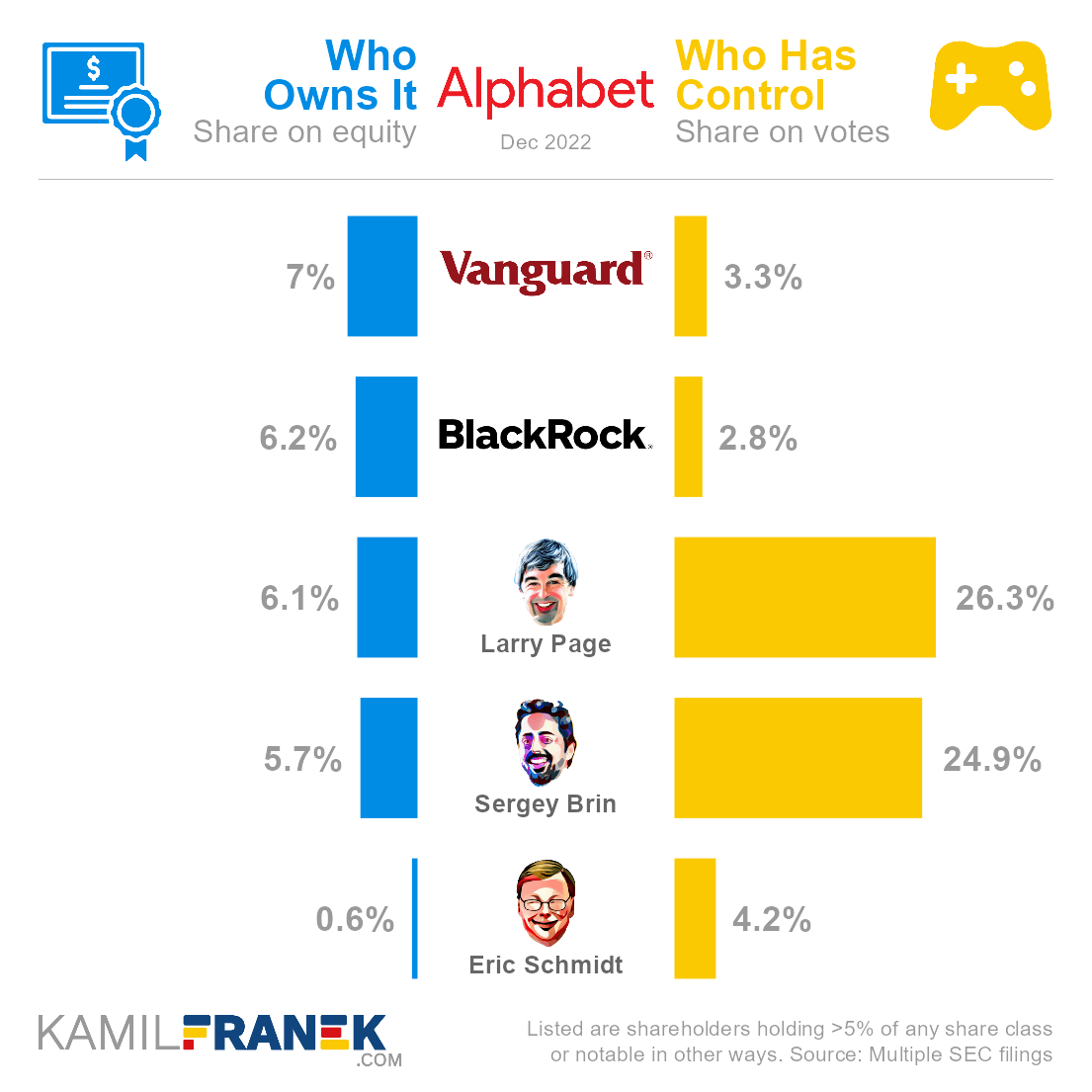
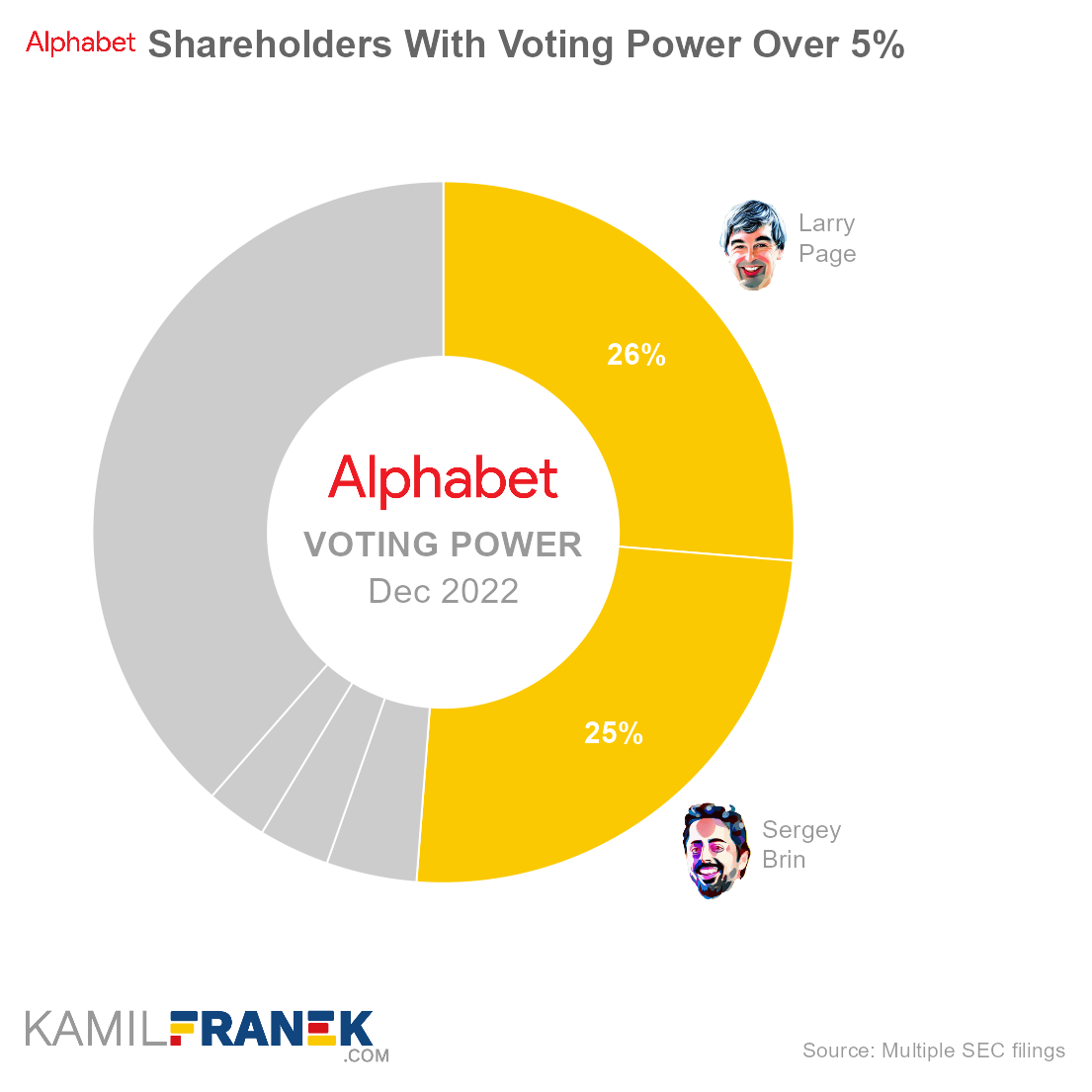
As of the most recent filings, Larry Page and Sergey Brin collectively control more than 51% of the total voting power of Alphabet Inc. Despite stepping down from their daily executive roles in 2019, they remain on the Board of Directors and retain the ultimate “veto” over any major corporate decision. This includes the power to approve or block mergers, acquisitions, the election of board members, and changes to the corporate charter.
This concentration of power is a double-edged sword for investors. On one hand, it protects the company from hostile takeovers and allows leadership to focus on “moonshot” projects that may not be profitable for a decade. On the other hand, it means that outside shareholders have very little recourse if they disagree with the company’s direction. In the world of Google, the founders’ word remains the final law.
The Institutional Giants: The Silent Partners of Silicon Valley
While the founders hold the voting control, the economic control—and a different type of influence—lies with institutional investors. Because Alphabet is a staple of the S&P 500 and other major indices, nearly every major mutual fund and pension fund in the world owns a piece of the company.
The Dominance of Passive Management
The largest external shareholders of Alphabet are the “Big Three” of the asset management world: Vanguard Group, BlackRock, and State Street Global Advisors. Together, these institutions manage trillions of dollars and hold significant percentages of Alphabet’s Class A and Class C stock.
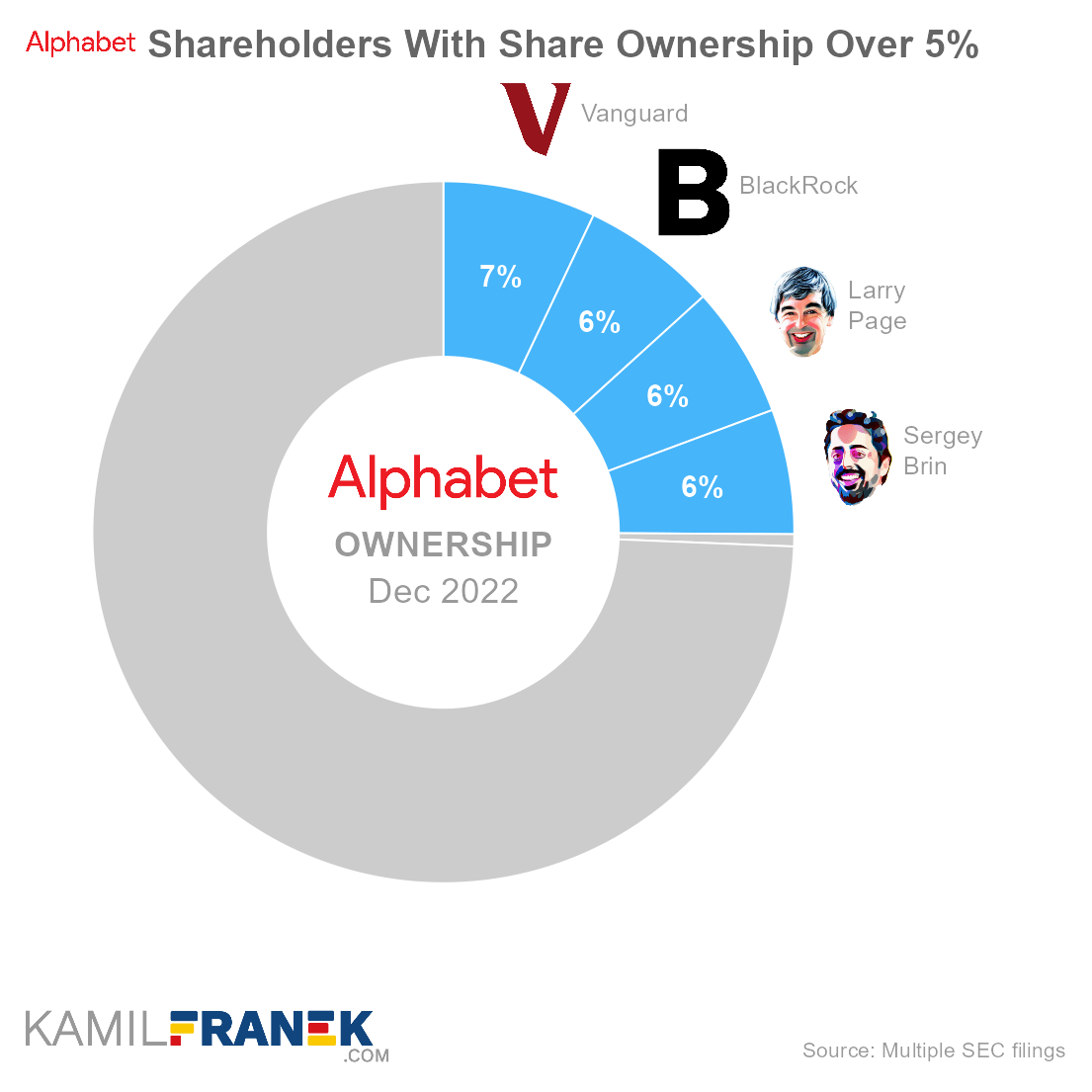
Vanguard typically holds the largest stake, often hovering around 7-8% of the company’s total equity. BlackRock follows closely behind. While these firms do not have the voting power to override Page and Brin, they represent the interests of millions of retail investors. Their “control” is expressed through engagement with the board and influence over Environmental, Social, and Governance (ESG) standards. When BlackRock’s CEO issues a letter regarding corporate responsibility or climate change, Alphabet’s leadership listens, as these firms are the stewards of the company’s market valuation.
Influence Beyond the Vote
Institutional investors exert pressure through quarterly earnings calls and analyst ratings. If major funds like Fidelity or T. Rowe Price lose confidence in Alphabet’s financial management, they may sell off large blocks of shares. While this wouldn’t strip Page and Brin of their voting rights, it would cause the stock price to plummet, eroding the founders’ personal wealth and making it more expensive for the company to raise capital or attract talent. Therefore, while they don’t “control” the vote, the financial markets act as a massive regulatory force on the company’s behavior.
Leadership and Governance: The Executive Trio and the Board
While the founders hold the votes and the institutions hold the capital, the day-to-day operational control is vested in the executive leadership team and the Board of Directors. This is where strategy is translated into revenue.
Sundar Pichai and the Operational Mandate
Sundar Pichai, the CEO of both Google and Alphabet, is the face of the company’s operational control. Since taking the helm of Google in 2015 and Alphabet in 2019, Pichai has been responsible for navigating the company through an era of unprecedented growth and regulatory scrutiny.
Pichai’s control is managerial. He decides the allocation of resources across the company’s core products—Search, YouTube, Cloud, and Android. His leadership style is characterized by a focus on Artificial Intelligence and a disciplined approach to spending, a shift from the more experimental era of the founders. However, it is important to remember that Pichai serves at the pleasure of the Board of Directors, which is ultimately controlled by the founders.
The Board of Directors: Oversight and Strategy
The Alphabet Board of Directors acts as the bridge between the shareholders and the executive team. The board includes influential figures from across the tech and finance sectors. Their role is to oversee the company’s long-term strategy, manage executive compensation, and ensure legal compliance.
While the board is technically independent, the voting structure means that no director can be elected without the approval of Page and Brin. This creates a governance environment where the board functions more as an advisory council to the founders rather than a check on their power. Key figures, such as Ruth Porat, the President and Chief Investment Officer (and former CFO), play a critical role in “controlling” the purse strings. Porat is often credited with bringing “Wall Street discipline” to Google, ensuring that the company’s massive cash reserves are used efficiently through share buybacks and strategic investments.
Market Forces and Financial Accountability
Beyond the internal structures of shares and boards, Google is controlled by the realities of the global economy and the specific financial engine that drives its growth.
The Pressure of Quarterly Performance
Google is, at its heart, an advertising company. More than 75% of Alphabet’s total revenue is derived from Google Search, YouTube ads, and the Google Network. This creates a form of “market control” where the company must constantly innovate to maintain its dominance in the digital ad space.
If ad revenue slows, the company faces immediate pressure from the financial community to cut costs. This was evident in early 2023 when Alphabet, facing a post-pandemic slowdown in digital spending, announced its first major round of mass layoffs. This decision demonstrated that even a company with a dual-class share structure is not immune to the demands of the bottom line. The “market” effectively controls the company’s margins and its appetite for risk.
Regulation and Antitrust: The External Controllers
In the modern era, governments have become some of the most potent entities “controlling” Google. Through the Department of Justice (DOJ) in the United States and the European Commission in the EU, regulators are attempting to force changes in how Google conducts its business.
Antitrust lawsuits regarding search dominance and advertising technology represent an external attempt to break the company’s control over the digital ecosystem. If these legal challenges are successful, the result could be a forced divestiture of certain business units (like Chrome or the ad-tech stack). In this sense, the legal and regulatory framework of the countries in which Google operates acts as a terminal control mechanism, capable of restructuring the company in ways that even the founders could not prevent.
Conclusion: A Multi-Layered Hierarchy
Who controls Google? The answer is a hierarchy of power. At the summit are Larry Page and Sergey Brin, who hold the legal voting power to decide the company’s ultimate fate. Just below them is Sundar Pichai and the executive team, who exercise operational control over the company’s vast resources. Surrounding them are the institutional investors like Vanguard and BlackRock, who provide the capital and demand financial returns. Finally, the market and global regulators act as external constraints, defining the boundaries within which the company can grow.
While the founders have designed Alphabet to be a fortress of “founder control,” the reality of managing a multi-trillion-dollar enterprise means that power is constantly being negotiated between those who own the votes, those who own the stock, and those who regulate the industry. In the financial world, control is never absolute; it is a balance of interests that ensures the engine of Google continues to generate value for its diverse stakeholders.
aViewFromTheCave is a participant in the Amazon Services LLC Associates Program, an affiliate advertising program designed to provide a means for sites to earn advertising fees by advertising and linking to Amazon.com. Amazon, the Amazon logo, AmazonSupply, and the AmazonSupply logo are trademarks of Amazon.com, Inc. or its affiliates. As an Amazon Associate we earn affiliate commissions from qualifying purchases.