
The financial landscape for individual investors underwent a seismic shift when Charles Schwab Corporation announced its acquisition of TD Ameritrade Holding Corporation. This landmark deal, finalized in late 2020, marked a profound consolidation within the discount brokerage sector, fundamentally altering the competitive dynamics, service offerings, and technological infrastructure available to millions of retail and institutional clients. The transaction, valued at approximately $26 billion, was a strategic maneuver by Schwab to fortify its position as the undisputed leader in the investment services industry, driven by an era of zero-commission trading and intense competition.
The Landmark Acquisition: Charles Schwab and TD Ameritrade
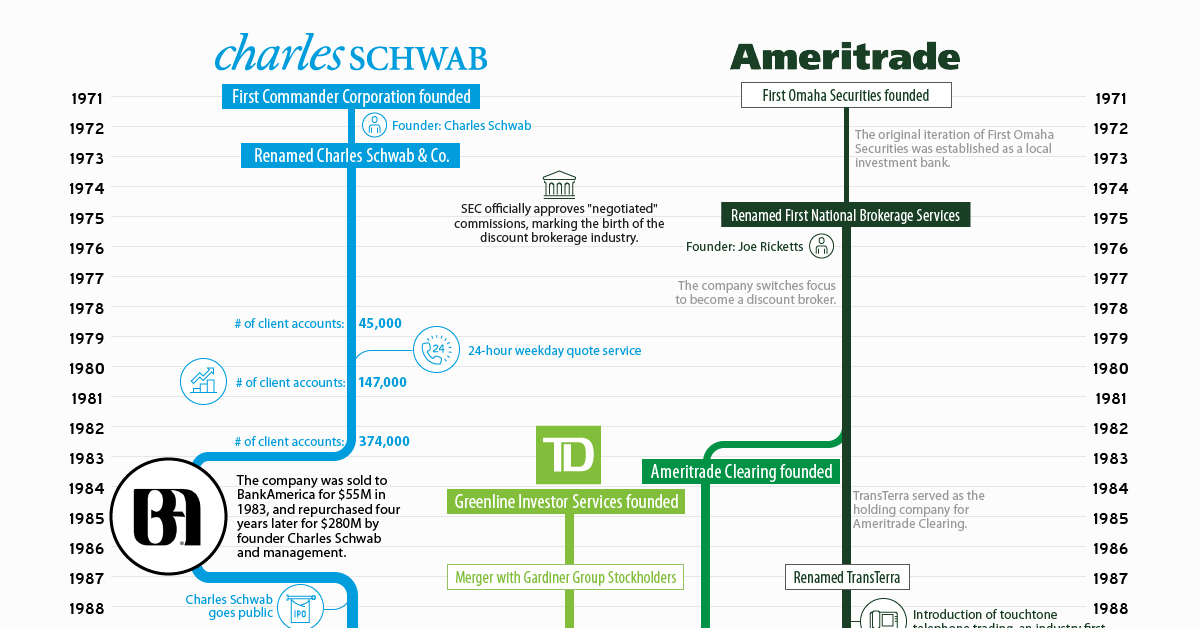
The merger of Charles Schwab and TD Ameritrade represented more than just two large companies joining forces; it was a response to evolving market conditions and an aggressive play for scale. Prior to the acquisition, both firms were titans in the discount brokerage space, serving distinct yet often overlapping client bases with robust trading platforms, research tools, and advisory services. Schwab, known for its pioneering role in discount brokerage and significant presence in wealth management, saw an opportunity to dramatically expand its client assets and accounts, leveraging TD Ameritrade’s strong brand recognition, particularly among active traders and independent investment advisors.
A Shift in the Brokerage Landscape
For years, Charles Schwab and TD Ameritrade were formidable rivals, each vying for market share by offering competitive pricing, innovative technology, and a wide array of investment products. However, the brokerage industry was undergoing immense pressure, primarily from the advent of zero-commission trading. When companies like Robinhood popularized commission-free stock and ETF trades, established players like Schwab and TD Ameritrade were compelled to follow suit in late 2019, eliminating trading commissions for most online equity, ETF, and options trades. While beneficial for investors, this move significantly eroded a primary revenue stream for brokerages, necessitating a pivot towards revenue generated from cash balances, margin lending, and other fee-based services.
This shift created an imperative for scale. Larger firms could better absorb the revenue loss from commissions, leverage greater assets under management (AUM) for lending and interest income, and more efficiently invest in the technology and infrastructure required to maintain a competitive edge. The acquisition of TD Ameritrade by Schwab was a direct strategic response to this new reality, designed to create a financial services behemoth capable of navigating these pressures while delivering enhanced value to shareholders.
The Rationale Behind the Merger
The strategic rationale underpinning Schwab’s acquisition of TD Ameritrade was multifaceted, focusing primarily on achieving unparalleled scale and capturing significant synergies. From Schwab’s perspective, the deal offered several compelling advantages:
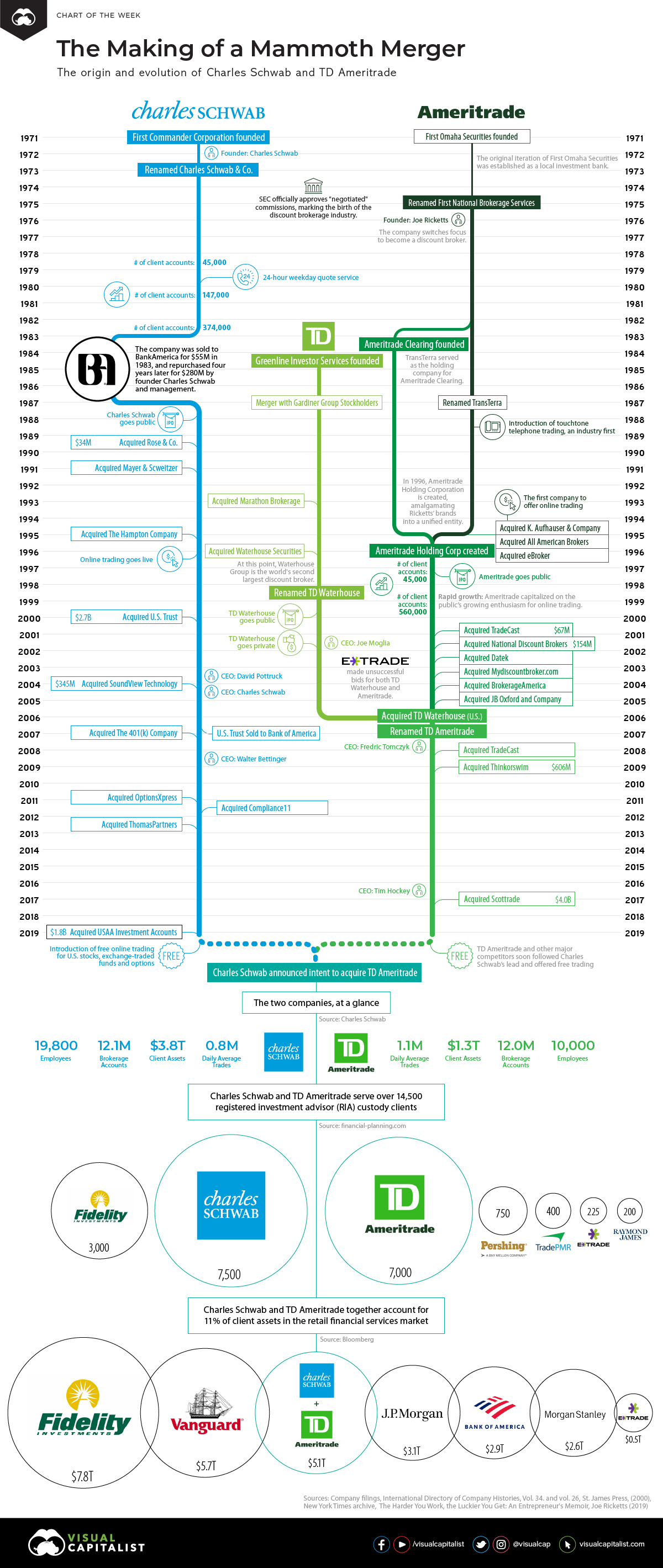
- Expanded Client Base and Assets: The merger immediately propelled Schwab’s client assets to over $6 trillion and its client accounts to more than 28 million, solidifying its position as the largest publicly traded investment services firm. This massive influx of assets and clients provided an enormous foundation for growth.
- Cost Synergies: A major driver for any large acquisition is the potential for cost savings. Schwab projected substantial annual expense synergies, anticipated to reach $1.8 billion to $2.0 billion. These savings would come from eliminating redundant technology platforms, consolidating real estate, streamlining operational processes, and reducing overlapping administrative functions.
- Enhanced Offering for Active Traders: TD Ameritrade was particularly renowned for its advanced trading platform, thinkorswim, which was highly favored by active and sophisticated traders. By integrating thinkorswim into its ecosystem, Schwab aimed to attract and retain this valuable segment of the market, which it historically had less penetration with compared to its core long-term investor base.
- Advisor Services Growth: Both firms had robust businesses serving independent registered investment advisors (RIAs). Combining these platforms allowed for greater efficiency and a more comprehensive offering to RIAs, a critical and growing segment of the wealth management industry.
- Competitive Advantage: The combined entity was positioned to exert significant competitive pressure on smaller rivals and effectively compete with large banking institutions entering the investment space, such as JPMorgan Chase’s investment offerings. The increased scale also provided more resources for innovation and digital transformation.
Financial Implications and Market Impact
The acquisition had profound financial implications, not just for the merging entities but for the broader financial services market. It triggered a wave of consolidation discussions and strategic reconsiderations across the industry, reinforcing the idea that scale had become a paramount factor for survival and prosperity in a commission-free environment.
Shareholder Value and Synergy
For shareholders of both companies, the deal presented a complex financial proposition. TD Ameritrade shareholders received 1.0837 shares of Schwab common stock for each share of TD Ameritrade common stock held, valuing the transaction at a significant premium over TD Ameritrade’s pre-announcement trading price. Schwab argued that the long-term benefits of the massive cost synergies and expanded market leadership would generate significant shareholder value, despite the initial dilution for Schwab shareholders. The integration process, while costly and complex in the short term, was projected to yield substantial earnings accretion once synergies were fully realized.
Regulatory Scrutiny and Approval
Given the immense size of the combined entity and its potential impact on market competition, the acquisition faced considerable regulatory scrutiny. Both the Department of Justice (DOJ) and the Securities and Exchange Commission (SEC) reviewed the transaction for anti-trust concerns. To gain approval, Charles Schwab agreed to divest TD Ameritrade’s institutional clearing and custody business, which serves independent registered investment advisors, to Interactive Brokers. This divestiture helped alleviate concerns about market concentration in the RIA custody space, paving the way for the deal’s ultimate approval. The careful navigation of these regulatory hurdles was critical to the successful closing of the acquisition.
Impact on Competitors and Industry Consolidation
The Schwab-TD Ameritrade merger sent shockwaves through the industry. Competitors immediately recognized the implications of such a dominant player emerging. Fidelity Investments, ETRADE (which was subsequently acquired by Morgan Stanley), and Interactive Brokers all had to reassess their strategies to compete with a combined Schwab. The deal accelerated the trend of consolidation, as smaller firms found it increasingly difficult to compete on price, technology investment, and brand recognition against such a giant. Morgan Stanley’s acquisition of ETRADE, announced just months after the Schwab-TD Ameritrade deal, was a direct consequence of this new competitive landscape, as large wealth management firms sought to bolster their digital brokerage offerings and client bases.
Navigating the Transition: What It Meant for Investors
For the millions of individual investors holding accounts at TD Ameritrade, the acquisition initiated a multi-year integration process involving account migrations, platform changes, and adjustments to service models. Schwab’s meticulous approach aimed to minimize disruption while eventually migrating all TD Ameritrade client assets to Schwab’s platform.
Account Migration and Platform Changes
The integration process was phased, with account conversions occurring in tranches over several years. This involved transferring client data, holdings, and account features from TD Ameritrade’s systems to Schwab’s. A key aspect of this transition was the eventual retirement of TD Ameritrade’s core trading platforms, with clients being transitioned to Schwab’s equivalent offerings. However, recognizing the strong loyalty of active traders to TD Ameritrade’s thinkorswim platform, Schwab made a strategic decision to integrate and retain thinkorswim, leveraging its advanced capabilities to serve active traders across the combined entity. This was a significant win for active traders who feared losing their preferred tools.
Fee Structures and Service Offerings
While the core promise of zero-commission trading remained intact, investors experienced adjustments in other areas. Schwab generally maintained competitive fee structures for services like margin rates, mutual fund trading, and advisory fees. The integration aimed to standardize service offerings, providing clients with access to Schwab’s broader ecosystem, including its vast network of branches, investment education resources, and wealth management solutions. For many former TD Ameritrade clients, this meant access to a wider array of financial planning and advisory services, potentially enhancing their overall investment experience.
Opportunities and Challenges for Customers
The merger presented both opportunities and challenges for investors. Opportunities included access to a wider range of investment products, potentially lower overall costs through greater scale efficiencies, and enhanced financial planning resources. For active traders, the retention of thinkorswim was a major benefit. Challenges, however, often centered around adapting to new interfaces, understanding revised administrative processes, and potentially re-establishing relationships with new customer service teams. Schwab’s communication strategy and dedicated support during the migration phases were crucial in addressing these concerns and ensuring a relatively smooth transition for the vast majority of clients.
The Future of Discount Brokerage and Wealth Management
The acquisition of TD Ameritrade by Charles Schwab is not merely a historical event; it provides a potent lens through which to view the future trajectory of the investment and wealth management industry. The combined entity sets a new benchmark for scale, innovation, and integrated financial services.
The Rise of Zero-Commission Trading
The prevalence of zero-commission trading has fundamentally altered the brokerage business model. Brokerages now primarily generate revenue from cash sweep programs (earning interest on uninvested cash balances), margin lending, payment for order flow (PFOF), and asset-based advisory fees. This shift makes having a massive asset base and a large number of client accounts absolutely critical for profitability. Schwab, post-merger, is exceptionally well-positioned to capitalize on these revenue streams due to its unparalleled scale, especially when interest rates are favorable.
Integrated Financial Planning and Digital Tools
The future of investing is increasingly moving towards comprehensive financial planning, integrating various aspects of an individual’s financial life, from banking and lending to retirement planning and estate services. The combined Schwab-Ameritrade entity is equipped with a vast array of digital tools and human advisory services to cater to these evolving needs. The strategic decision to retain and enhance thinkorswim also signals a commitment to serving diverse investor segments, from sophisticated active traders to long-term passive investors seeking holistic wealth management. This integrated approach leverages technology to deliver personalized advice and services at scale.
A New Era of Scale and Competition
The consolidation epitomized by the Schwab-TD Ameritrade deal marks a new era where scale is king. Large, diversified financial services firms are better equipped to withstand fee compression, invest in cutting-edge technology (including AI and advanced data analytics), meet stringent regulatory requirements, and attract top talent. While competition remains fierce, particularly from fintech disruptors and other large financial institutions, the combined Schwab entity has cemented its position as a dominant force. Its sheer size and breadth of offerings will continue to shape the industry, pushing rivals to innovate and consolidate further, ensuring that the financial services landscape remains dynamic and highly competitive for years to come.
aViewFromTheCave is a participant in the Amazon Services LLC Associates Program, an affiliate advertising program designed to provide a means for sites to earn advertising fees by advertising and linking to Amazon.com. Amazon, the Amazon logo, AmazonSupply, and the AmazonSupply logo are trademarks of Amazon.com, Inc. or its affiliates. As an Amazon Associate we earn affiliate commissions from qualifying purchases.