
Navigating the complexities of state income tax is a critical aspect of personal finance that touches nearly every working American. While federal income tax often grabs the spotlight, state income tax obligations can be equally intricate, varying significantly across jurisdictions and influencing everything from your take-home pay to your overall financial planning. For individuals, remote workers, and businesses alike, understanding where and how to pay state income tax is not just about compliance; it’s about optimizing financial outcomes and avoiding costly penalties. This comprehensive guide delves into the nuances of state income tax, offering insights into residency rules, multi-state scenarios, and practical strategies for effective financial management.

Understanding the Fundamentals of State Income Tax Liability
Before diving into the specifics of where to pay, it’s essential to grasp the foundational principles that determine your state income tax liability. Unlike the uniform federal tax code, state tax laws are a patchwork of distinct regulations, creating a landscape that requires careful attention.
What is State Income Tax and Who Pays It?
State income tax is a tax levied by individual states on an individual’s or entity’s income. The income subject to tax typically includes wages, salaries, investment income, and business profits. The fundamental question of who pays it hinges primarily on two core concepts: residency and source of income.
-
Residency: Your state of residence (or domicile) is generally the primary determinant of where you owe state income tax on all your income, regardless of where it was earned. A “resident” is typically someone who intends to make that state their permanent home, or who spends a significant portion of the year (e.g., more than 183 days) within its borders. Domicile is a legal concept indicating your true, fixed, and permanent home. Establishing or changing domicile often involves demonstrating intent through various actions like registering to vote, obtaining a driver’s license, opening bank accounts, and owning property.
-
Source of Income: Even if you are not a resident of a particular state, you may still owe income tax to that state if you earn income from sources within its borders. This is particularly relevant for non-residents who work in a state (even for a few days), own rental property there, or operate a business within its boundaries. These individuals are typically required to file a non-resident tax return in the state where the income was sourced.
States Without Income Tax: A Significant Financial Consideration
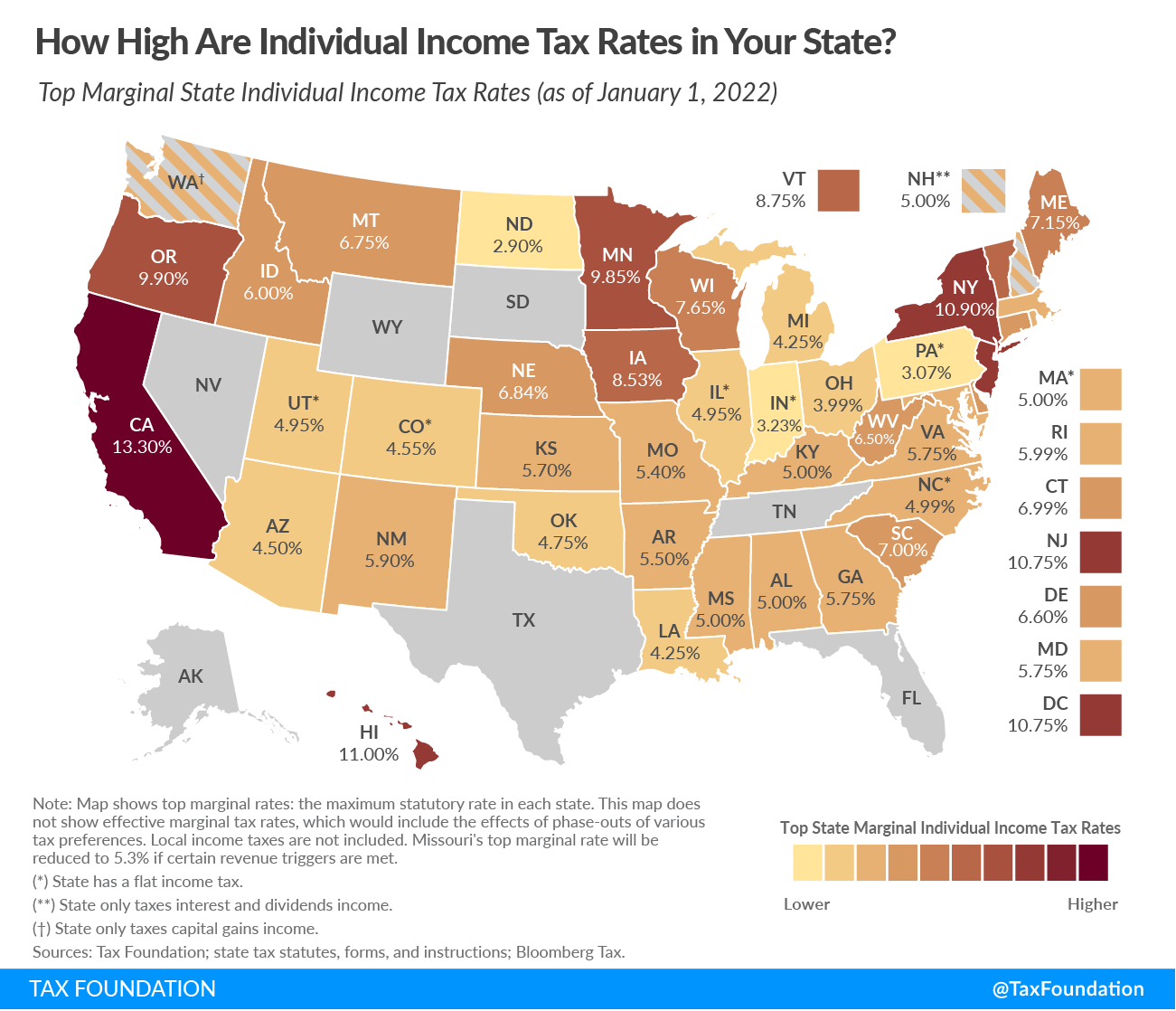
A crucial starting point for many individuals and businesses is identifying states that do not impose a state income tax on wages and salaries. As of 2024, nine states fall into this category: Alaska, Florida, Nevada, New Hampshire (taxes only interest and dividends), South Dakota, Tennessee (taxes only interest and dividends), Texas, Washington, and Wyoming.
For residents of these states, the absence of state income tax can translate into substantial savings, significantly increasing take-home pay. This factor often plays a considerable role in relocation decisions for both individuals and companies, influencing retirement planning, remote work arrangements, and business investment strategies. However, it’s important to remember that these states typically rely on other forms of taxation, such as higher property taxes or sales taxes, to fund state services. A holistic financial analysis is always recommended before making a move solely based on income tax savings.
Key Factors Determining Your Tax Situs
Your “tax situs”—the specific jurisdiction where your income is taxable—is determined by a confluence of factors, requiring careful evaluation:
-
Physical Presence: The amount of time you spend in a state is often the most straightforward indicator of residency. Most states have a “183-day rule” or similar threshold for establishing residency.
-
Location of Employer/Business Activity: For sourced income, where your employer is located, or where your business actively conducts its operations, dictates income tax obligations.
-
Domiciliary Intent: For individuals, actions that demonstrate your intent to make a state your permanent home (e.g., voter registration, driver’s license, property ownership, mailing address) are critical evidence.
-
Type of Income: Different types of income (wages, capital gains, rental income, business profits) may be taxed differently or have different sourcing rules depending on state law.
Understanding these factors is the first step in accurately determining your state income tax obligations and planning your financial strategy accordingly.
Navigating Multi-State Income and Remote Work Challenges
The modern workforce, characterized by increased mobility and the proliferation of remote work, often finds individuals and businesses earning income in multiple states. This scenario introduces a layer of complexity, making multi-state tax compliance a significant financial challenge.
The Rise of Remote Work and Its Tax Implications
The shift to remote work has profoundly altered the landscape of state income tax. What was once a niche issue for business travelers and contractors is now a widespread concern for employees working from home across state lines.
-
Physical Presence Rules for Remote Workers: If an employee lives in one state but works remotely for an employer located in another state, both states might claim taxing rights. The state where the employee physically performs the work may tax their wages as sourced income. Simultaneously, the state where the employer is located might attempt to tax the income if it applies certain “convenience of the employer” rules, arguing that the employee is working remotely for their own convenience rather than a business necessity. This can lead to dual taxation if not properly managed.
-
Nexus for Businesses: For businesses, having employees working remotely in a state where the company previously had no physical presence can create “nexus”—a sufficient connection to a state that triggers tax obligations, including income tax, sales tax, or other business taxes. This necessitates careful monitoring and understanding of each state’s nexus rules.
Reciprocal Agreements and Tax Credits: Avoiding Double Taxation
To mitigate the burden of double taxation (where two states claim the right to tax the same income), many states have established mechanisms:
-
Reciprocal Agreements: A number of states have reciprocal agreements that allow residents of one state to work in a neighboring state without having to pay income tax in the non-resident state. Instead, they only pay tax to their state of residence. For example, if you live in Wisconsin and work in Minnesota, due to a reciprocal agreement, you would generally only pay income tax to Wisconsin. It is crucial to ensure that the correct state tax is withheld from your paycheck in such situations, often requiring employees to submit a specific form to their employer.
-
Tax Credits for Taxes Paid to Other States: In the absence of a reciprocal agreement, most states offer a credit for taxes paid to another state on the same income. This credit prevents you from paying tax on the same income twice. For instance, if you live in State A but earn income in State B, State B will tax the income earned within its borders as a non-resident. Then, when you file your resident return in State A, State A will tax your worldwide income but will allow you to claim a credit for the income taxes you paid to State B on that shared income. This mechanism is vital for multi-state filers and requires meticulous record-keeping to calculate accurately.
Part-Year Residency and Moving Across State Lines
Relocating to a new state during the tax year brings about specific filing requirements:
-
Part-Year Residency: If you move from one state to another, you will typically be considered a part-year resident in both states. This means you’ll file a resident return in your original state for the portion of the year you lived there and a resident return in your new state for the remainder of the year. Income is usually prorated based on the period of residency in each state.
-
Final Returns: You’ll need to understand each state’s rules for allocating income and deductions during your periods of part-year residency. For instance, some states might require you to allocate income based on the specific dates earned, while others might allow a more general proration. Capital gains realized after moving might only be taxable in the new state of residence, even if the asset was acquired in the old state. This requires careful tracking of dates of income realization and changes in residency.
The intricacies of multi-state taxation underscore the importance of professional advice and robust financial tools for accurate compliance.
Methods and Tools for Paying State Income Tax

Once you’ve determined your state income tax obligations, the next step is understanding the various methods and tools available for payment. The landscape has evolved significantly, offering both traditional and technologically advanced solutions.
Traditional Filing Methods
The foundational methods for filing and paying state income tax remain accessible for those who prefer them:
-
Paper Forms: All states provide official tax forms that can be downloaded, printed, filled out manually, and mailed to the respective state tax agency. This method requires careful attention to detail to ensure accuracy and timely submission.
-
Mail Payments: Along with paper forms, payment can typically be made by check or money order, mailed with the return or a separate payment voucher. While reliable, this method is slower and lacks the immediate confirmation of digital alternatives.
-
Direct Bank Payments (ACH Credit): Many states offer the option to pay directly from your bank account via an ACH (Automated Clearing House) credit. This typically involves setting up a payment through your bank, which then sends the funds to the state’s account. This method requires careful setup to ensure the payment is correctly attributed to your tax liability.
Digital Solutions and E-Filing
The digital revolution has transformed tax filing, making it more convenient, efficient, and often more accurate:
-
State Tax Portals: Most state tax departments now offer secure online portals where taxpayers can create accounts, file their state returns directly, and make payments electronically. These portals often provide features like payment history, notices, and direct communication with the tax department.
-
Tax Software: Commercial tax preparation software (e.g., TurboTax, H&R Block, TaxAct) are widely used for state income tax filing. These tools guide users through the process, automatically calculate taxes, identify deductions, and facilitate electronic filing (e-filing) directly to the state. Many also offer direct debit payment options from your bank account.
-
Third-Party Payment Processors: Some states partner with third-party payment processors to handle credit card or debit card payments for taxes. While convenient, these services often charge a small processing fee.
-
Free File Programs: Similar to the federal Free File program, some states offer their own Free File programs or participate in a federal-state partnership that allows eligible taxpayers to file their state returns for free using guided software, typically based on income thresholds.
Estimated Taxes and Withholding Adjustments
Proactive tax planning is crucial, especially for those with income not subject to standard payroll withholding:
-
Estimated Taxes: Individuals who are self-employed, independent contractors, or receive significant income from investments or other sources not subject to employer withholding are generally required to pay estimated state income taxes throughout the year. These payments are typically made quarterly (e.g., April, June, September, January) to cover the tax liability. Failure to pay sufficient estimated taxes can result in underpayment penalties.
-
Withholding Adjustments: For employees, adjusting your W-4 form with your employer allows you to modify the amount of state income tax withheld from each paycheck. This can be particularly useful for multi-state filers, those with significant deductions, or individuals who want to avoid a large tax bill (or refund) at year-end. Regularly reviewing and adjusting withholding can help match your payments more closely to your actual tax liability.
Financial Tools and Professional Assistance
Given the complexity, leveraging financial tools and expert advice can be invaluable:
-
Budgeting Software and Apps: While not directly for tax payment, budgeting tools can help you set aside funds for estimated tax payments or unforeseen tax liabilities.
-
Tax Calculators: Online tax calculators can provide estimates of your state tax liability, aiding in planning and withholding adjustments.
-
Professional Tax Preparers: For complex situations involving multi-state income, business income, or significant life changes, engaging a qualified tax professional (e.g., CPA, enrolled agent) is highly recommended. They can ensure compliance, identify legitimate deductions, and advise on optimal tax strategies.
Common Pitfalls and Best Practices for Compliance
Navigating state income tax requires diligence. Overlooking details or misunderstanding rules can lead to significant financial repercussions. Adopting best practices is key to maintaining compliance and financial well-being.
The Dangers of Non-Compliance
Ignoring state income tax obligations is a risky endeavor that can lead to a cascade of negative consequences:
-
Penalties and Interest: States impose penalties for late filing, late payment, and underpayment of estimated taxes. These penalties can be a percentage of the unpaid tax, and interest will also accrue on the outstanding balance, significantly increasing your overall liability.
-
Audits: State tax authorities conduct audits to verify the accuracy of returns. If discrepancies are found, you may owe additional tax, penalties, and interest. Audits can be time-consuming and stressful.
-
Liens and Levies: For severe non-compliance or unpaid taxes, states have the power to place liens on your property or levy your bank accounts and wages to collect outstanding debts.
-
Legal Action: In extreme cases of willful tax evasion, legal action, including criminal charges, can be pursued.
Maintaining Meticulous Records
Thorough record-keeping is the bedrock of accurate tax reporting and a robust defense in case of an audit:
-
Proof of Residency: Keep documents demonstrating your domicile and physical presence, such as utility bills, voter registration, driver’s license, property deeds/leases, and bank statements.
-
Income Sources: Retain all W-2s, 1099s, K-1s, and other income statements. For self-employment, maintain detailed records of all income and expenses.
-
Deductions and Credits: Keep receipts, invoices, and other documentation supporting any deductions or credits you claim.
-
Multi-State Activity: Log dates and locations of work performed in different states, especially for remote workers or business travelers, to support income allocation.
Staying Informed About State Tax Law Changes
State tax laws are not static; they are subject to continuous legislative changes, court rulings, and administrative interpretations.
-
Monitor Legislative Updates: Keep an eye on news and publications from your state’s tax department or reputable financial news sources regarding tax law changes.
-
Consult Tax Professionals: Tax advisors are typically well-versed in the latest changes and can provide specific guidance tailored to your situation.
-
Review State Tax Department Websites: State tax agencies are primary sources for current laws, forms, and instructions.
Proactive Planning for Life Events
Significant life events often have tax implications that require proactive planning:
-
Marriage or Divorce: Changes in marital status impact filing status, deductions, and credits.
-
Children: The birth or adoption of children can open up new deductions and credits.
-
Retirement: Planning for retirement often involves considering income sources (pensions, Social Security, withdrawals from retirement accounts) and how they are taxed in different states, potentially influencing where you choose to retire.
-
Business Changes: Starting, expanding, or selling a business will significantly alter your tax profile and obligations.
-
Relocation: As discussed, moving to a new state necessitates a thorough understanding of part-year residency rules and potential changes to your overall tax burden.
By understanding the rules, leveraging available tools, and adhering to best practices, individuals and businesses can confidently navigate the intricate landscape of state income tax, ensuring compliance and optimizing their financial health. The journey through state income tax regulations is a continuous one, demanding vigilance and informed decision-making to secure your financial future.
aViewFromTheCave is a participant in the Amazon Services LLC Associates Program, an affiliate advertising program designed to provide a means for sites to earn advertising fees by advertising and linking to Amazon.com. Amazon, the Amazon logo, AmazonSupply, and the AmazonSupply logo are trademarks of Amazon.com, Inc. or its affiliates. As an Amazon Associate we earn affiliate commissions from qualifying purchases.