
Travel is often the most significant discretionary expense in a household budget, yet it remains one of the most volatile in terms of pricing. For the financially conscious individual, mastering the art of finding cheap flight tickets is not merely about snagging a vacation deal; it is a strategic exercise in capital preservation and resource allocation. In an era of dynamic pricing algorithms and fluctuating fuel surcharges, understanding the mechanics of the aviation market allows you to redirect thousands of dollars toward your investment portfolio, retirement accounts, or high-yield savings.
By treating airfare acquisition as a financial discipline rather than a matter of luck, you can unlock global experiences without compromising your long-term financial goals. This guide explores the sophisticated tools, psychological frameworks, and credit strategies required to navigate the complex landscape of modern airfare.

The Financial Strategy of Travel Optimization
To find the cheapest flight tickets, one must first shift their perspective from that of a consumer to that of a value investor. In the world of personal finance, every dollar saved on a recurring or large-scale expense is a dollar that can be put to work in the markets.
Viewing Travel as a Line Item in Your Budget
Most people approach travel by picking a destination and then looking for a price. From a financial optimization standpoint, this is backwards. To maximize your “travel ROI,” you should ideally monitor prices and let the market dictate your destination. By utilizing the “Explore” features on major search engines, you can identify regions where the supply of seats exceeds demand, leading to significant price drops. This flexible approach can reduce your total travel expenditure by 40% to 60% annually.
The Opportunity Cost of Overpaying
Consider the opportunity cost of an extra $500 spent on a transcontinental flight due to poor timing or lack of research. If that $500 were instead invested in a low-cost index fund with an average annual return of 7%, it would grow to nearly $2,000 over 20 years. When you multiply this by several trips per year, the “convenience fee” of not hunting for cheap tickets becomes a multi-decade drain on your net worth. Finding cheap flights is, therefore, a fundamental component of a comprehensive wealth-building strategy.
High-Performance Search Engines and Data-Driven Tools
The digital marketplace for airfare is fragmented. To find the most competitive prices, you must use tools that aggregate data from hundreds of airlines while providing the transparency needed to make an informed financial decision.
Google Flights and the Power of Data Visualization
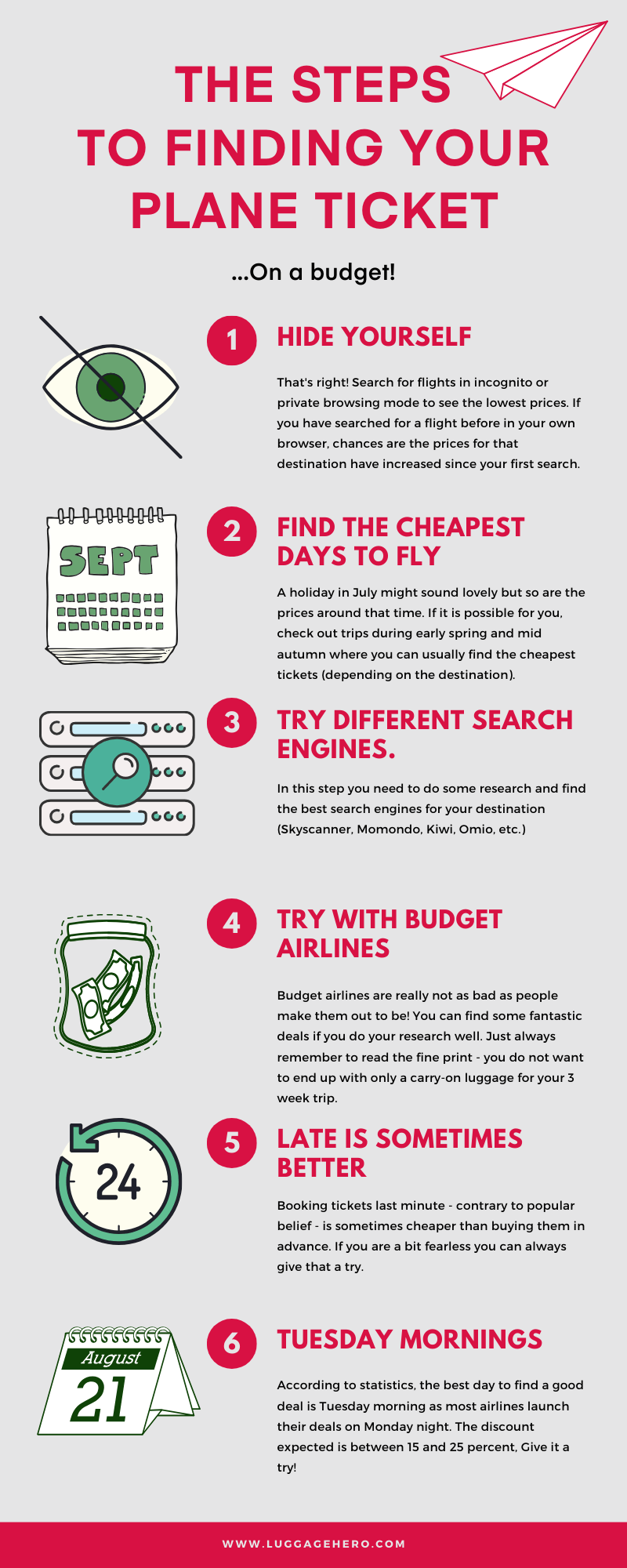
Google Flights has become the gold standard for price transparency. Unlike traditional travel agencies that may have biased results based on commissions, Google Flights provides a clean, data-driven interface. Its most valuable feature for the financially savvy traveler is the “Price Graph” and “Date Grid.” These tools allow you to visualize price fluctuations over weeks or months, identifying the exact moment when a fare hits its floor. Furthermore, the “Track Prices” feature acts as a limit order for travel, notifying you via email when a fare drops below its current valuation.
Utilizing Aggregators for Budget Carrier Arbitrage
While Google Flights is excellent for legacy carriers, aggregators like Skyscanner and Momondo often excel at finding “hacker fares.” These are itineraries that combine two one-way tickets from different, often competing, airlines to create a lower total round-trip price. In many cases, budget carriers (LCCs) do not list their inventory on the major Global Distribution Systems (GDS) used by high-end travel agents. Using these aggregators ensures you are seeing the absolute bottom of the market, including smaller regional players that offer significant savings.
ITA Matrix: The Professional’s Choice
For those who want to dive deeper into the technical side of airfare pricing, the ITA Matrix—the software that powers Google Flights—allows for highly specific queries. You can search for flights by price per mile, filter by specific aircraft types, or search for “hidden city” opportunities. While the interface is less user-friendly, the level of granular control it provides is unmatched for individuals looking to optimize every cent of their travel spend.
Strategic Booking Windows and Market Volatility

Timing the market is notoriously difficult in stocks, but in airfare, there are predictable patterns driven by corporate travel cycles and consumer behavior.
The Myth of the “Tuesday Booking”
For years, the conventional wisdom suggested that booking on a Tuesday afternoon resulted in the lowest prices. In the age of AI-driven dynamic pricing, this is largely a myth. Airlines now adjust prices in real-time based on demand, search volume, and competitor moves. Instead of focusing on the day of the week you book, focus on the “Goldilocks window.” For domestic flights, this is typically 1 to 3 months before departure; for international trips, it is 2 to 8 months. Booking too early can be just as expensive as booking too late, as airlines often wait until the mid-range window to begin discounting unsold inventory.
Seasonality and Shoulder Season Arbitrage
The most expensive time to fly is when everyone else is flying. From a financial perspective, traveling during peak summer or major holidays represents the worst value for money. “Shoulder seasons”—the periods between peak and off-peak—offer the best balance of weather and price. For example, visiting Europe in late September or October can result in airfare savings of 50% compared to July, while still providing a high-quality experience. By decoupling your travel schedule from the standard holiday calendar, you capitalize on the price sensitivity of the broader market.
Travel Hacking: Leveraging Credit Card Rewards and Points
One of the most effective ways to find “cheap” flight tickets is to remove the cash element entirely. Travel hacking—the strategic use of credit card rewards—is essentially a way to generate a secondary currency specifically for travel.
Maximizing Sign-Up Bonuses for Outsized Value
In the personal finance community, credit card sign-up bonuses (SUBs) are viewed as one of the highest-margin “side hustles” available. By hitting a minimum spend requirement on a new travel rewards card, you can often earn enough points for a round-trip international flight. When you calculate the value of those points against the spend required, the “return on investment” can easily exceed 20%. This is an unparalleled way to subsidize travel costs using your existing monthly expenses like groceries and utilities.
The Transfer Partner Ecosystem
The real wealth in the points world lies in “transferable currencies” such as Chase Ultimate Rewards, American Express Membership Rewards, or Capital One Miles. Rather than redeeming points at a fixed value through a bank portal (which usually gives you a measly 1 to 1.5 cents per point), you can transfer those points to airline partners. This allows you to book high-value tickets—especially in premium cabins—at a fraction of the retail cost. Understanding the “cents per point” (CPP) valuation is crucial here; if a $1,000 flight costs 50,000 points, you are getting 2 cents of value per point. Your goal should always be to exceed the baseline valuation to maximize your financial efficiency.
Alternative Tactics for the Modern Financial Strategist
Beyond standard search engines and points, there are several “alternative” methods to lower your airfare costs that require a bit more effort but yield high rewards.
Position-Based Searching and “Empty Leg” Logic
Sometimes, the cheapest way to get from Point A to Point B is to first fly to Point C. This is known as a positioning flight. If you live in a mid-sized city, the cost of an international flight might be $1,200. However, if you can find a cheap $100 domestic flight to a major hub like New York or London, and then book a separate international ticket from that hub for $600, you have saved $500. This requires careful planning regarding layover times and baggage, but it is a powerful tool for those in expensive airfare markets.
Error Fares and Flash Sales
Occasionally, due to human error or technical glitches, airlines will list fares for a fraction of their intended price—such as a $200 round-trip ticket from San Francisco to Tokyo. These “error fares” are usually short-lived. Subscribing to services that monitor these glitches (like Going, formerly Scott’s Cheap Flights) allows you to act quickly. From a financial standpoint, these are “asymmetric bets”—the risk is a few minutes of your time, while the reward is a massive reduction in travel expenses.
Hidden City Ticketing
Hidden city ticketing is the practice of booking a flight with a layover in your actual destination and simply getting off the plane there. For example, a direct flight from New York to Charlotte might be $400, but a flight from New York to Orlando with a layover in Charlotte might only be $150. By booking the latter and ending your journey in Charlotte, you save $250. While this carries risks—such as not being able to check bags and potential friction with the airline—it remains a legal (though controversial) way to exploit the inefficiencies of hub-and-spoke pricing models.
Conclusion: The Long-Term Wealth Impact of Smart Travel
Finding cheap flight tickets is not about deprivation; it is about optimization. By applying the same rigorous analysis to your travel purchases that you apply to your stock picks or business expenses, you turn a major liability into a manageable cost. Every dollar saved at the boarding gate is a dollar that remains in your control, compounding over time. Whether through data-driven search tools, the strategic use of credit card equity, or exploiting market inefficiencies, the path to affordable global travel is paved with financial literacy. In the end, the goal is to see the world without compromising your ability to own a piece of it.
aViewFromTheCave is a participant in the Amazon Services LLC Associates Program, an affiliate advertising program designed to provide a means for sites to earn advertising fees by advertising and linking to Amazon.com. Amazon, the Amazon logo, AmazonSupply, and the AmazonSupply logo are trademarks of Amazon.com, Inc. or its affiliates. As an Amazon Associate we earn affiliate commissions from qualifying purchases.