
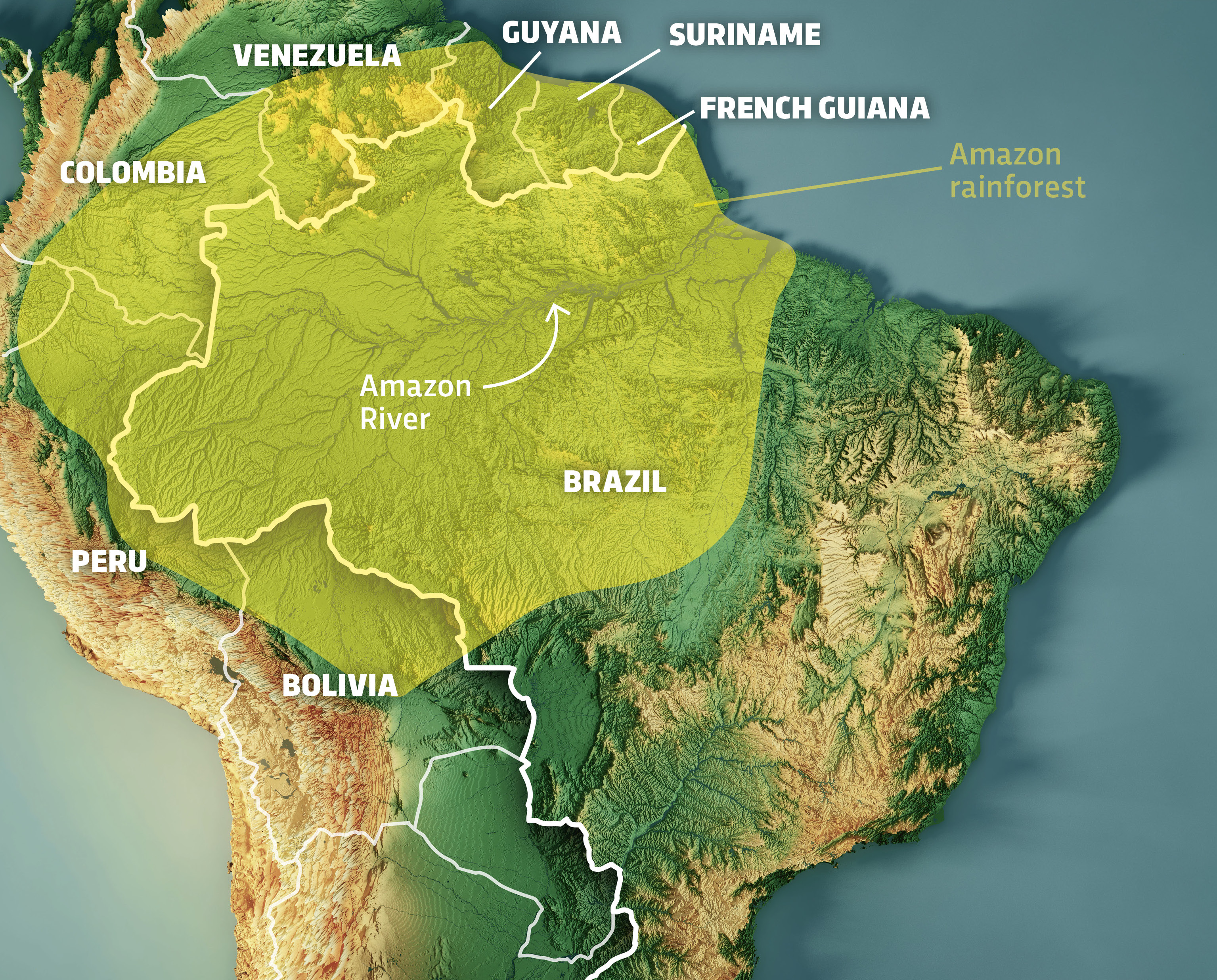
When someone asks, “Where is the Amazon?” the traditional answer points toward the dense rainforests and winding rivers of South America. However, in the modern digital landscape, the answer is vastly different and significantly more complex. Today, “the Amazon” is not just a geographical location; it is a sprawling, invisible, and ubiquitous technological ecosystem that powers a significant portion of the modern internet, defines the standards of global logistics, and resides in millions of homes through ambient intelligence.
To understand where Amazon truly is in a technological sense, we must look beyond the retail storefront and delve into the server racks, the algorithmic foundations of its fulfillment centers, and the low-earth orbit satellites that represent its next frontier. This article explores the physical and digital coordinates of the Amazon tech empire, tracing its presence from hyperscale data centers to the edge of space.
The Invisible Backbone: Where AWS Lives
If the internet had a physical heart, a significant part of it would beat within Amazon Web Services (AWS). When we ask where Amazon is, the most technically accurate answer is: in the massive, nondescript data centers scattered across the globe that comprise the world’s most comprehensive cloud platform.
Regions and Availability Zones
AWS does not exist as a single “supercomputer” in one location. Instead, it is organized into geographic “Regions.” As of today, these regions are strategically placed in North America, South America, Europe, Asia Pacific, the Middle East, and Africa. Within these regions are “Availability Zones” (AZs)—distinct locations engineered to be isolated from failures in other AZs.
This distributed architecture is where the “cloud” takes physical form. For instance, the US East (N. Virginia) region is often cited as the most concentrated area of internet infrastructure in the world. When a major app or website goes down, it is often because of a technical hiccup in these specific physical buildings. This is “where” Amazon is for the developers, enterprise corporations, and government agencies that rely on its compute power.
The Sovereignty of the Cloud
In recent years, the “where” of Amazon has become a matter of national security and data sovereignty. Amazon has expanded its tech footprint into “Sovereign Clouds,” specifically designed to meet the stringent data residency requirements of the European Union and other jurisdictions. By building infrastructure that allows data to stay within specific borders, Amazon has mapped its technology to the political geography of the world, ensuring that while the cloud is global, the data remains local.
Beyond the Warehouse: The Logistics Tech Frontier
While many view Amazon’s fulfillment centers as mere warehouses, they are, in reality, some of the most sophisticated robotics laboratories on the planet. To find the “tech” of Amazon, one must look at the floor of a fulfillment center, where the physical and digital worlds collide.
Robotics and Automation in Fulfillment
The “where” of Amazon’s logistics is defined by Amazon Robotics (formerly Kiva Systems). In these facilities, thousands of drive units—autonomous mobile robots—maneuver heavy shelving units to human workers. This is not just mechanical movement; it is a massive coordination problem solved by real-time pathfinding algorithms, computer vision, and machine learning.
The technology here is focused on “spatial AI.” The robots must understand their location relative to others within centimeters to prevent collisions and maximize efficiency. This technological layer transforms a simple storage building into a high-speed processing unit, where software dictates the movement of every physical item.
The Algorithms of Last-Mile Delivery
Amazon’s technological presence extends to the very street you live on. The “where” is found in the proprietary routing software used by delivery drivers. These algorithms don’t just find the fastest route; they account for factors like left-hand turns (which are slower and more dangerous), package weight distribution in the van, and predictive window delivery times. This “Last Mile” tech is a massive data-crunching exercise that turns GPS coordinates into a seamless delivery experience, effectively placing Amazon’s software on every public road.
The Edge of Interaction: Where Alexa and IoT Reside
Amazon has moved from being a destination you visit on a browser to an “ambient” presence in the physical environment. Through its Echo devices and the Alexa voice service, the tech giant has established a permanent residence in the “private” geography of the home.
Ambient Intelligence in the Smart Home
The philosophy behind Amazon’s consumer tech is “Ambient Computing”—the idea that technology should be there when you need it but vanish into the background when you don’t. Where is the Amazon in this context? It is in the microphone arrays of an Echo Dot, the Ring doorbells guarding suburban porches, and the Sidewalk network—a shared wireless network that helps smart devices work better.
This represents a shift in tech infrastructure from centralized servers to “Edge Computing.” Processing is increasingly happening on the device itself or at the local network level to reduce latency. This means Amazon’s technological “border” is now the threshold of the consumer’s front door.
Privacy and the Perimeter of Personal Data
The expansion of Amazon tech into the home brings up the critical question of the digital perimeter. As Amazon integrates more sensors (cameras, microphones, motion detectors) into its hardware, the “where” of the brand becomes synonymous with the “where” of our personal lives. The technology is tasked with a difficult balance: providing utility through presence while respecting the physical boundaries of privacy.
The AI Frontier: Where Generative Intelligence Meets Retail
The most recent shift in Amazon’s location is internal—it is moving deeper into the layers of Artificial Intelligence. While AWS has offered machine learning tools for years, the rise of Generative AI has pushed Amazon to redefine its tech stack.
Bedrock and the Democratization of LLMs
Amazon’s AI strategy is centered on “Amazon Bedrock,” a service that allows developers to build and scale generative AI applications using foundation models. Unlike competitors who focus on a single model, Amazon’s “where” in the AI space is as a platform or a marketplace. It provides the infrastructure (Trainium and Inferentia chips) and the software environment for others to build their AI. This positions Amazon as the “foundry” of the AI revolution, providing the heat and the tools for others to forge their digital products.
Personalization Engines and Predictive Analytics
On the consumer side, Amazon’s AI is located within the “Flywheel.” Every search query, every hover over an image, and every “Save for Later” click feeds into a massive neural network. This technology predicts what you want before you know you want it. In this sense, Amazon resides in the “predictive space” of human behavior. It is a technological entity that lives in the gap between a consumer’s desire and their purchase.
The Future Horizon: Space, Satellites, and Quantum Computing
Finally, to answer “Where is the Amazon?” we must eventually look up. The company is currently expanding its technological footprint into the final frontier: Earth’s orbit and the microscopic world of subatomic particles.
Project Kuiper: Amazon in Low Earth Orbit
Project Kuiper is Amazon’s initiative to increase global broadband access through a constellation of over 3,000 satellites in Low Earth Orbit (LEO). This moves Amazon’s infrastructure from the ground to the sky. By creating a global mesh network in space, Amazon aims to provide high-speed internet to unserved and underserved communities. When this project is fully realized, “the Amazon” will literally be everywhere on the planet’s surface, accessible via a small satellite antenna.
Braket and the Quest for Quantum Supremacy
At the other end of the physical scale is Amazon Braket, a fully managed quantum computing service. While quantum computing is still in its nascent stages, Amazon is positioning itself as the gateway to this next era of computation. By providing a development environment where researchers can test algorithms on quantum hardware, Amazon is ensuring its presence in the future of cryptography, materials science, and complex system modeling.

Conclusion: A Borderless Tech Entity
So, where is the Amazon? It is no longer a question of geography.
Technologically, Amazon is in the Northern Virginia data centers that keep the internet running. It is in the robotic drive units scurrying across warehouse floors in Ohio. It is in the AI models predicting supply chain disruptions in real-time. It is in the smart speakers sitting on kitchen counters in London, and soon, it will be in the satellite constellation orbiting 300 miles above our heads.
Amazon has evolved from a bookstore into a global digital utility. Its “location” is best defined as a comprehensive layer of software, hardware, and infrastructure that sits beneath the surface of modern life. Whether we are streaming a movie, ordering a tool, or running a multinational corporation’s database, we are operating within the boundaries of Amazon’s technological map. The Amazon is no longer just a place on a map; it is the map itself.
aViewFromTheCave is a participant in the Amazon Services LLC Associates Program, an affiliate advertising program designed to provide a means for sites to earn advertising fees by advertising and linking to Amazon.com. Amazon, the Amazon logo, AmazonSupply, and the AmazonSupply logo are trademarks of Amazon.com, Inc. or its affiliates. As an Amazon Associate we earn affiliate commissions from qualifying purchases.