
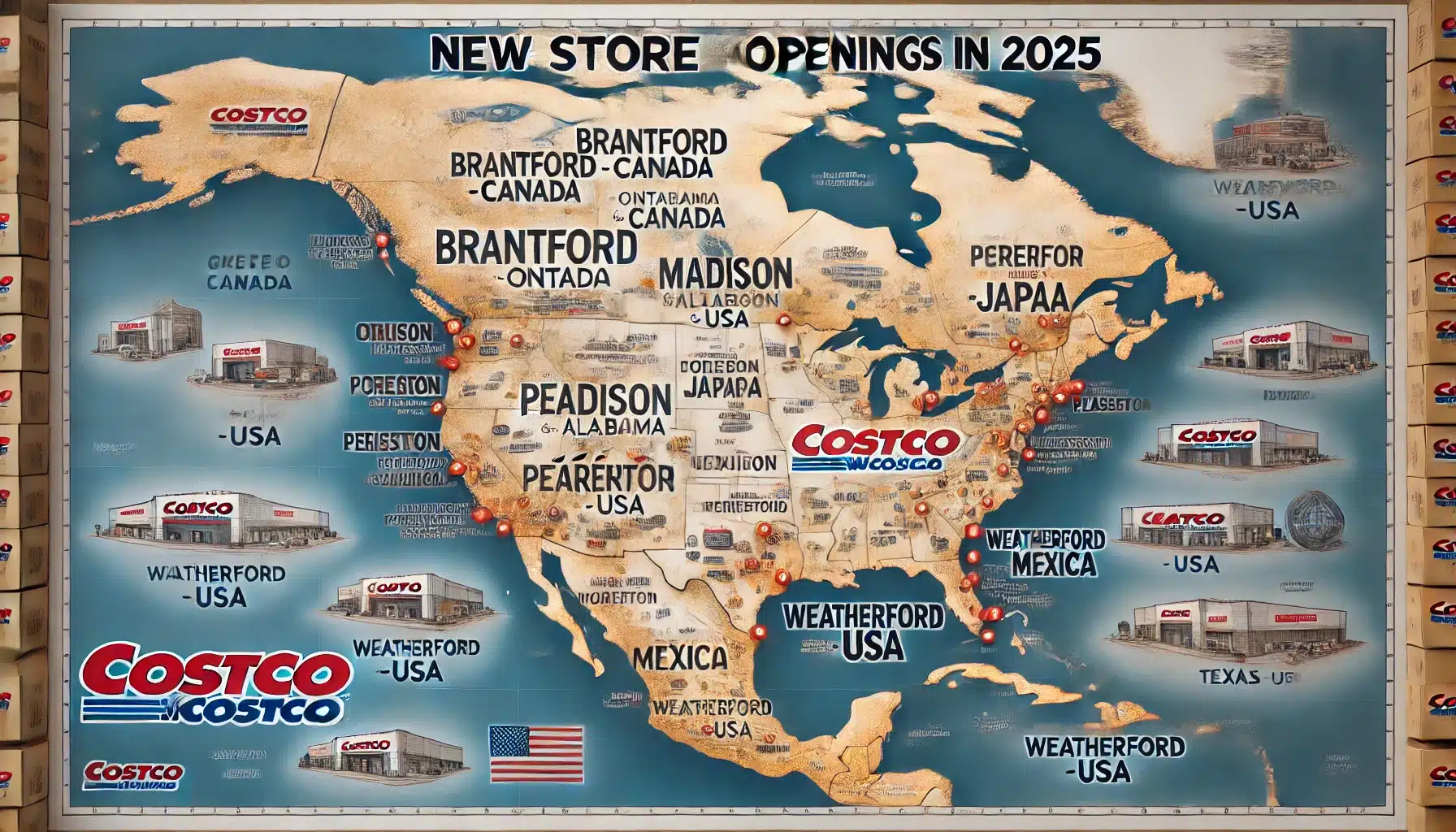
Costco Wholesale Corporation (COST) remains a titan of the retail industry, not merely because of its bulk-buy model, but because of its disciplined approach to financial growth and market penetration. As we look toward 2025, the company’s expansion strategy serves as a masterclass in capital allocation and long-term value creation. For investors, financial analysts, and business enthusiasts, the “where” and “why” of Costco’s 2025 store openings offer critical insights into the company’s fiscal health and its ability to capture market share in an increasingly volatile economic landscape.
The Financial Blueprint of Costco’s 2025 Expansion
Costco’s growth is never haphazard. Unlike many retailers that aggressively overextend during boom cycles, Costco maintains a steady cadence of 25 to 30 new openings per fiscal year. This measured pace is funded primarily through operational cash flow, allowing the company to expand without taking on significant debt.
Capital Expenditure and Revenue Per Square Foot
In 2025, a significant portion of Costco’s estimated $4 billion to $4.5 billion capital expenditure budget is earmarked for new warehouse construction and logistics infrastructure. Each new warehouse represents a massive financial commitment, typically costing between $30 million and $100 million depending on land acquisition and local construction costs. However, the return on investment (ROI) is staggering. Costco averages over $200 million in sales per warehouse annually, a figure that far outpaces competitors like Sam’s Club or BJ’s Wholesale.
The Membership Model as a Growth Engine
The expansion in 2025 is predicated on the strength of Costco’s membership-driven revenue model. In the most recent fiscal quarters, membership renewal rates have hovered around 92% in the U.S. and Canada. This recurring revenue provides the financial “moat” that allows Costco to sell goods at razor-thin margins. When Costco identifies a new location for 2025, they aren’t just looking for shoppers; they are looking for long-term subscribers who will stabilize their cash flow for decades.
Operational Efficiency and “The Costco Flywheel”
Every new store opening in 2025 is designed to enhance the “Costco Flywheel.” By adding more locations, the company increases its purchasing power with suppliers, which lowers the cost of goods. These savings are passed to members, which increases membership loyalty and attracts new sign-ups, which in turn provides the capital for the next store. The 2025 roadmap is a direct manifestation of this cycle.
Domestic Growth: Targeted Expansion in High-Wealth Corridors
The United States remains the primary theater for Costco’s 2025 expansion. While some analysts suggest the U.S. market is approaching saturation, Costco’s data-driven approach tells a different story. They are focusing on high-growth regions where demographic shifts—particularly the migration to the Sunbelt—provide fresh opportunities.
The Southeastern Surge: Florida and the Carolinas
Real estate data and local planning board filings indicate a heavy emphasis on the Southeastern U.S. for 2025. States like Florida, North Carolina, and South Carolina are seeing an influx of high-earning households moving from the Northeast and Midwest. Costco’s 2025 strategy focuses on these “wealth migration” zones. New locations are being vetted in burgeoning suburbs where the median household income aligns with the typical Costco member (roughly $100,000+).
Strengthening the Western Stronghold
Despite its deep roots in the Pacific Northwest and California, Costco continues to find “white space” in the West. For 2025, the company is looking at infill locations in major metropolitan areas where existing stores are currently over-capacity. If a store in Irvine, California, or Seattle, Washington, is doing $400 million in annual sales, it is often more financially sound to open a “relief” store nearby to capture diverted traffic and improve the customer experience, rather than allowing the original store to become unmanageable.
The Rise of the Costco Business Center
A key sub-sector of the 2025 expansion is the “Business Center” model. These warehouses do not carry the usual “treasure hunt” items like apparel or toys; instead, they focus exclusively on the needs of small businesses, restaurants, and convenience stores. With high-margin delivery services attached to these locations, the 2025 rollout of more Business Centers is a strategic move to capture a larger share of B2B (business-to-business) spending.
International Frontiers: Diversifying the Portfolio
While the U.S. is the foundation, the most explosive growth potential for Costco in 2025 lies internationally. International stores often boast higher membership growth rates and provide a hedge against U.S. economic downturns and currency fluctuations.

Accelerating the China Strategy
Following the massive success of its first few stores in China, Costco is expected to continue its aggressive (by their standards) push into the Chinese market in 2025. The Chinese consumer’s appetite for high-quality, authentic international brands fits perfectly with Costco’s Kirkland Signature offerings. From a financial perspective, the China expansion is highly lucrative due to the sheer density of the target population and the high volume of sales per unit.
Expanding Footprints in Japan and South Korea
Japan and South Korea represent some of Costco’s most loyal international markets. In 2025, the company is expected to navigate the complex real estate landscapes of these nations to open additional warehouses. These markets are particularly important because they demonstrate Costco’s ability to adapt its bulk-selling model to urban environments with smaller living spaces, proving that the brand’s value proposition is universal.
The European Perspective: The UK and Spain
Costco’s footprint in Europe is smaller, but 2025 will see continued incremental growth in the United Kingdom and Spain. These locations serve as essential testing grounds for logistical efficiency in the European Union. By expanding here, Costco diversifies its supply chain and gains better leverage with European manufacturers, which benefits the global inventory.
The Economic Impact: Real Estate and Local Markets
The opening of a Costco in 2025 is more than a retail event; it is a significant economic catalyst for the chosen community. The “Costco Effect” influences everything from local employment to commercial real estate values.
Job Creation and Wage Leadership
Each new warehouse in 2025 will employ approximately 200 to 300 individuals. Financially, Costco is known for its “efficiency wage” theory—paying significantly higher than the industry average to reduce turnover and increase productivity. This injects millions of dollars in payroll into local economies, creating a secondary spending effect that benefits other local businesses.
Real Estate Appreciation and Outparcel Development
The announcement of a new Costco location in 2025 often leads to a spike in nearby commercial real estate prices. Developers frequently vie for “outparcels”—the smaller lots surrounding the warehouse—knowing that the 2,000 to 5,000 cars a Costco attracts daily will provide a steady stream of customers for gas stations, restaurants, and smaller retail shops. For real estate investors, tracking Costco’s 2025 permit filings is a primary strategy for identifying the next “hot” commercial zone.
Infrastructure and Tax Revenue
Costco warehouses contribute millions in property and sales tax revenue to local municipalities. In 2025, we will see local governments increasingly offering infrastructure improvements or tax incentives to lure Costco to their jurisdictions, recognizing that the long-term fiscal gain of having a Costco far outweighs the initial cost of road improvements or utility connections.
Investor Outlook: What Store Growth Means for COST Stock
For shareholders, the 2025 expansion plan is a signal of continued stability and growth. While Costco’s stock often trades at a high Price-to-Earnings (P/E) ratio compared to other retailers, this premium is justified by its consistent execution.
Driving Top-Line and Bottom-Line Growth
New store openings are the primary driver of top-line revenue growth. However, the true financial benefit of the 2025 expansion is the growth in the “deferred revenue” account—where membership fees are held. As new stores open, the membership base expands, providing high-margin income that drops directly to the bottom line.
Dividend Sustainability and Special Dividends
Costco has a history of returning value to shareholders through regular dividends and occasional massive “special dividends.” The cash-generative nature of its 2025 expansion plan suggests that the company will remain in a strong position to continue this trend. Investors view the 2025 roadmap as a sign that the company is not just resting on its laurels but is actively seeking ways to deploy capital effectively.

Future-Proofing Through E-commerce Integration
While the 2025 focus is on physical warehouses, these new locations also serve as logistical hubs for Costco’s e-commerce business. By placing warehouses closer to major population centers, Costco reduces its “last-mile” delivery costs and improves the efficiency of its “Buy Online, Pick Up in Warehouse” (BOPIS) program. This hybrid approach ensures that the 2025 expansion addresses the modern consumer’s need for both physical bulk shopping and digital convenience.
In conclusion, Costco’s 2025 expansion is a calculated, financially disciplined move to solidify its dominance in the global retail market. By targeting high-growth domestic regions and untapped international markets, the company is ensuring that its membership-driven engine continues to hum, providing value to consumers and robust returns for investors. Whether you are looking at the company from the perspective of personal finance or corporate strategy, Costco’s 2025 footprint is a definitive map of where the money is moving in retail.
aViewFromTheCave is a participant in the Amazon Services LLC Associates Program, an affiliate advertising program designed to provide a means for sites to earn advertising fees by advertising and linking to Amazon.com. Amazon, the Amazon logo, AmazonSupply, and the AmazonSupply logo are trademarks of Amazon.com, Inc. or its affiliates. As an Amazon Associate we earn affiliate commissions from qualifying purchases.