
In the landscape of modern commerce, few corporate identities are as pervasive as Amazon’s. While the brand exists for most consumers as a digital storefront or a smiling brown box on a doorstep, its physical presence is anchored in massive, multi-billion-dollar corporate headquarters that serve as the brain centers for its global operations. Identifying where Amazon’s headquarters is located is not merely a question of geography; it is an exploration of a brand strategy that favors urban integration, architectural innovation, and a dual-hub system designed to attract the world’s most elite talent.

Today, Amazon operates under a unique “HQ1” and “HQ2” model, with its primary historical roots in Seattle, Washington, and its secondary major expansion in Arlington, Virginia. This dual-headquarters approach represents a significant evolution in corporate identity, signaling a shift from a single-city tech giant to a bi-coastal powerhouse that commands influence over the world’s political and financial capitals.
Seattle: The Birthplace of the Urban Campus Strategy
Amazon’s primary headquarters, often referred to as HQ1, is located in the heart of Seattle, Washington. Unlike many of its Silicon Valley counterparts—such as Apple, Google, or Meta, which traditionally opted for sprawling, secluded suburban campuses—Amazon made a conscious brand decision to embed itself within the urban fabric of the city.
The South Lake Union Transformation
Amazon’s presence in Seattle is concentrated largely in the South Lake Union neighborhood and the Denny Triangle. This choice was a foundational element of its brand strategy. By building an “urban campus,” Amazon positioned itself as a company that is part of the community rather than isolated from it. This integration allows employees to live, work, and play in a high-density environment, which Amazon has long used as a recruiting tool for young, ambitious professionals who prefer the vibrancy of city life over the monotony of a suburban office park.
The Seattle headquarters is not a single building but a massive network of over 40 office towers and low-rise buildings. This decentralized approach reflects the company’s internal structure of “two-pizza teams”—small, autonomous groups that can move quickly and innovate without the friction of a massive, singular corporate hierarchy.
The Spheres: A Symbol of Innovation
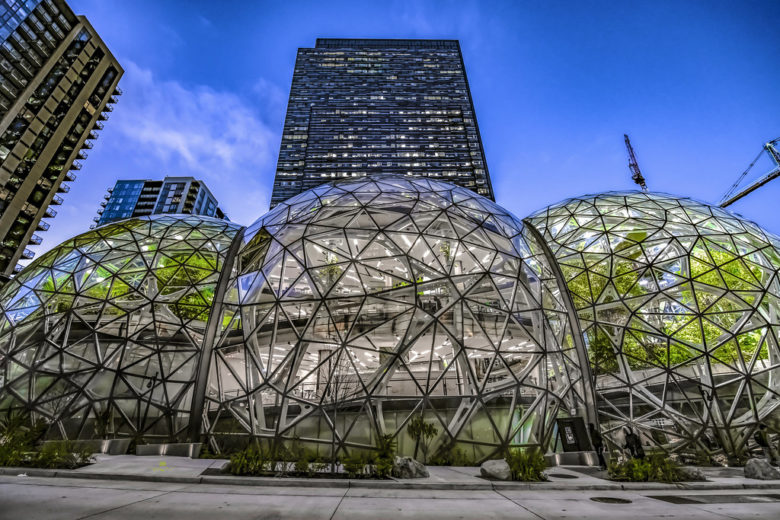
Perhaps the most iconic element of Amazon’s Seattle headquarters is “The Spheres.” These three intersecting glass orbs are filled with more than 40,000 plants from around the world. From a branding perspective, The Spheres serve as a physical manifestation of Amazon’s “Day 1” philosophy. They represent a commitment to thinking differently and providing employees with a space that inspires creativity through biophilic design. It is a landmark that has become synonymous with Seattle’s skyline, cementing Amazon’s identity as a leader in architectural innovation and employee well-being.
The HQ2 Saga: A Masterclass in Brand Positioning
In 2017, Amazon announced a search for a second headquarters, dubbed HQ2, sparking a North American competition that was as much a marketing campaign as it was a business expansion. The search involved 238 cities vying for the brand’s presence, highlighting the immense value the Amazon name brings to local economies.
National Landing and the Arlington Choice
After a highly publicized selection process, Amazon chose Arlington, Virginia—specifically a newly branded area known as National Landing—as the site for HQ2. Located just across the Potomac River from Washington, D.C., this location is a strategic masterpiece. By establishing a massive corporate footprint in the backyard of the United States federal government, Amazon reinforced its identity not just as a retailer or a tech company, but as a critical infrastructure provider and a key player in the national interest.
The Arlington headquarters is designed to mirror the urban success of the Seattle campus. The centerpiece of this expansion is “The Helix,” a distinctive spiral-shaped glass tower that features an outdoor walking path with native trees. Like The Spheres in Seattle, The Helix is designed to be a brand icon—a visual shorthand for a company that is constantly ascending and evolving.
Economic Impact and Corporate Identity
The establishment of HQ2 was a pivotal moment in Amazon’s brand history. It proved that the company had outgrown its identity as a regional Pacific Northwest firm. By splitting its primary leadership and development hubs between the West and East Coasts, Amazon ensured its brand would remain resilient against regional economic shifts while gaining access to the diverse talent pools of both the tech-heavy West and the policy-heavy East.

Designing the Brand: How Architecture Reflects Corporate Values
For Amazon, a headquarters is more than just a place to house servers and desks; it is a communication tool. The design of their physical spaces is meticulously crafted to reflect their corporate identity and marketing goals.
Sustainability and the Climate Pledge
A core pillar of Amazon’s modern brand strategy is sustainability. The company’s headquarters are designed to be showcases for green building technology. In Seattle and Arlington, Amazon has committed to carbon-neutral operations. The use of district energy systems—which recycle heat from data centers to warm office buildings—and the pursuit of LEED Platinum certifications are not just environmental choices; they are essential components of a brand that wants to lead the “Climate Pledge.”
When visitors see the lush greenery of The Spheres or the sustainable materials used in HQ2, they are receiving a subtle but powerful message about Amazon’s long-term vision. The architecture serves as a tangible rebuttal to criticisms of the company’s environmental footprint, positioning them as a steward of the future.
The Concept of “Work-from-Anywhere” and Flexible Branding
Despite the rise of remote work, Amazon has doubled down on its commitment to physical headquarters. Their investment in real estate suggests that their brand identity is intrinsically tied to physical collaboration. They believe that innovation happens when people meet in person, and their buildings are designed to facilitate those “serendipitous encounters.” This focus on the “office of the future” helps define Amazon as a company that values high-velocity decision-making and human connection, even as it dominates the digital world.
Beyond the US: Global Corporate Hubs and Cultural Adaptability
While the primary headquarters are in the United States, Amazon’s global brand strategy is supported by significant regional headquarters that act as cultural and operational anchors in international markets.
The European Hub: Luxembourg
For its European operations, Amazon’s headquarters is located in Luxembourg. This choice is strategic for both regulatory and logistics reasons. Luxembourg serves as a central point from which Amazon can manage its vast network across the European Union. The brand here focuses on navigating the complex legal and cultural landscape of Europe, ensuring that “Amazon.de,” “Amazon.fr,” and other localized sites maintain a consistent brand experience while respecting local nuances.
The Powerhouse of Hyderabad
In India, Amazon has built its largest office building in the world, located in Hyderabad. This campus covers nearly 10 acres and is a testament to the brand’s commitment to the Indian market. The Hyderabad headquarters is a critical engine for Amazon’s global back-end operations, software development, and customer service. By building its largest facility in India, Amazon sent a clear message to the world: its brand is truly global, and its future is deeply intertwined with the growth of emerging economies.
The Evolution of Physical Identity in a Digital Age
As Amazon continues to grow, the question of where its headquarters is located will likely involve even more cities. However, the core of the brand remains tied to its ability to transform the cities it inhabits. Whether it is revitalizing a defunct warehouse district in Seattle or creating a new urban center in Northern Virginia, Amazon uses its physical presence to exert influence and attract the world’s best minds.
The strategic placement of these headquarters allows Amazon to:
-
Recruit Top Talent: By being in vibrant urban centers, they attract the demographic that drives innovation.
-
Influence Policy: Proximity to political hubs like D.C. and Brussels allows for better brand representation in regulatory discussions.
-
Demonstrate Scale: The sheer size and architectural boldness of their campuses serve as a constant reminder of the company’s market dominance.
In conclusion, Amazon’s headquarters is not a static location but a dynamic, multi-hub ecosystem. From the rainy streets of Seattle to the high-stakes environment of Arlington and the bustling tech hubs of Hyderabad, Amazon’s physical offices are the pillars of its corporate identity. They are monuments to the company’s “Day 1” mentality, proving that even a digital giant needs a firm, innovative, and highly visible place to call home. Through its headquarters, Amazon doesn’t just occupy space; it defines the future of work and the very nature of what a global brand can be.
aViewFromTheCave is a participant in the Amazon Services LLC Associates Program, an affiliate advertising program designed to provide a means for sites to earn advertising fees by advertising and linking to Amazon.com. Amazon, the Amazon logo, AmazonSupply, and the AmazonSupply logo are trademarks of Amazon.com, Inc. or its affiliates. As an Amazon Associate we earn affiliate commissions from qualifying purchases.