
The topic of a stock split for Apple Inc. (AAPL) frequently resurfaces among investors, reflecting both the company’s remarkable growth trajectory and the enduring appeal of accessible share prices. A stock split, while merely an accounting adjustment, often triggers excitement and speculation within the financial community, largely due to its perceived psychological benefits for retail investors. Understanding when and why a behemoth like Apple might undertake such a move requires delving into the mechanics of stock splits, Apple’s historical precedents, and the strategic considerations that drive corporate financial decisions.
Understanding Stock Splits: The Mechanics and Investor Psychology
At its core, a stock split is a corporate action where a company increases the number of its outstanding shares by dividing each existing share into multiple shares. While this action significantly reduces the price per share, it’s crucial to understand that it does not alter the company’s total market capitalization or the intrinsic value of an investor’s total holdings.
What is a Stock Split?
Imagine owning one share of a company trading at $700. If that company declares a 7-for-1 stock split, you would then own seven shares, with each share trading at approximately $100. Your total investment value remains $700 (7 shares x $100/share). The company’s market capitalization, calculated as the share price multiplied by the number of outstanding shares, also remains unchanged. It’s akin to exchanging a $10 bill for two $5 bills; the total value in your wallet is the same, just denominated differently. Common split ratios include 2-for-1, 3-for-1, or even larger splits like Apple’s 7-for-1 in 2014.
The Illusion of Value and Psychological Impact
Despite the lack of fundamental change, stock splits often generate positive sentiment. A lower share price can make a stock appear more “affordable” or “cheaper” to individual investors, even though the underlying business value hasn’t shifted. This psychological effect can lead to increased demand, particularly from retail investors who might be hesitant to purchase a single share at a high three or four-digit price point. For instance, buying 10 shares at $150 might feel more substantial than buying one share at $1500, even though the capital outlay is identical. This enhanced accessibility can broaden the investor base, potentially increasing liquidity in the stock. Conversely, a reverse stock split, where the number of shares decreases and the price per share increases, often signals distress and is typically undertaken by companies seeking to boost their share price above minimum exchange requirements or avoid delisting.
Apple’s Stock Split History: A Precedent of Growth
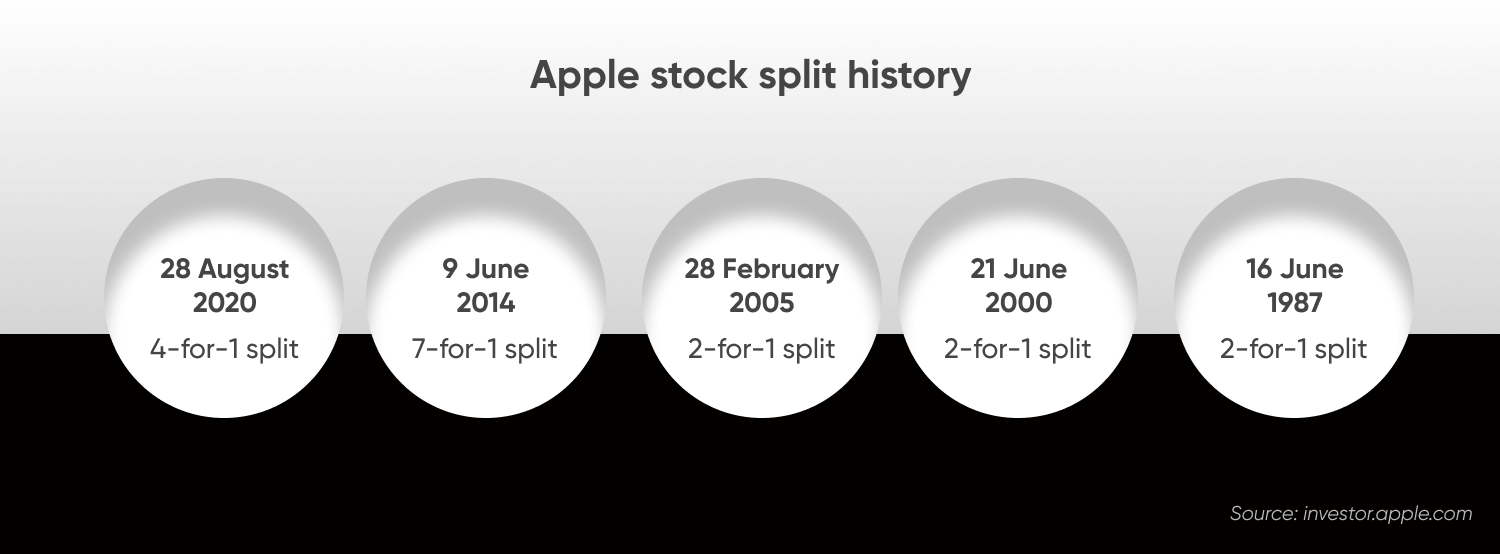
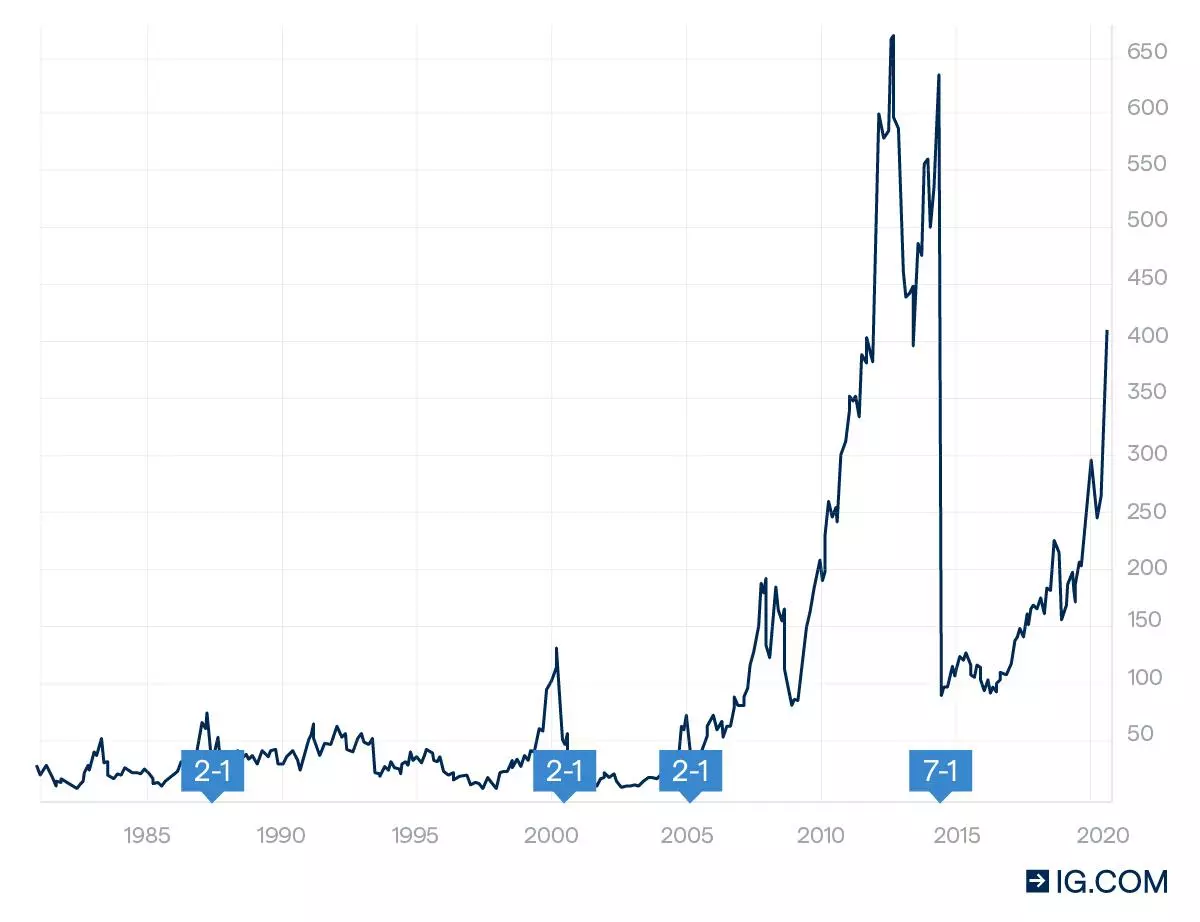
Apple is no stranger to stock splits, having executed five such actions throughout its history. Each split has coincided with periods of significant growth and increasing stock prices, reflecting the company’s expanding market capitalization and investor confidence.
The Early Splits: Growth and Expansion
Apple’s first three stock splits occurred in its earlier growth phases:
- June 1987 (2-for-1): Following its initial public offering (IPO) in December 1980, Apple’s stock soared, necessitating an early split to maintain accessibility.
- June 2000 (2-for-1): This split occurred during the dot-com boom, as Apple navigated a period of innovation and market volatility.
- February 2005 (2-for-1): Driven by the success of the iPod and the nascent stages of its digital ecosystem, this split preceded the monumental iPhone launch.
These initial splits established a pattern: as Apple’s valuation climbed and its stock price became elevated, management opted to divide shares to keep them within a perceived “comfortable” trading range for a broad investor base.
The Landmark 2014 Split: Broadening Appeal and Index Inclusion
The most significant split prior to the recent one came in June 2014, a 7-for-1 split. At the time, Apple’s stock was trading around $650 per share. This substantial split brought the price down to approximately $90 per share (on a split-adjusted basis). The rationale behind this move was multifaceted:
- Enhanced Retail Accessibility: The 7-for-1 split drastically lowered the entry price, making Apple shares more attainable for smaller individual investors.
- Potential for Dow Jones Industrial Average (DJIA) Inclusion: The DJIA is a price-weighted index, meaning stocks with higher prices have a greater impact. A high share price like Apple’s prior to the split would have distorted the index. The split made Apple’s inclusion feasible, and indeed, Apple was added to the DJIA in March 2015, replacing AT&T. This provided a significant stamp of approval and attracted further institutional interest.
The Recent 2020 Split: Sustained Momentum
Apple’s most recent stock split occurred in August 2020, a 4-for-1 split. This happened amidst a strong bull market, fueled by technological adoption during the COVID-19 pandemic. The stock was trading around $500 per share (pre-split adjusted) when the split was announced, bringing it down to approximately $125 per share. The reasoning echoed previous splits:
- Further Democratization of Access: Despite the 2014 split, Apple’s continued growth pushed its stock price back into the high hundreds, making it less accessible for some smaller investors or those wishing to buy full shares with limited capital.
- Reinforcing Investor Confidence: Announcing a split during a period of strong performance can be seen as a vote of confidence from management in the company’s continued growth prospects.
Historically, Apple’s stock has tended to perform well in the periods following its splits, often supported by its robust business fundamentals and continued innovation. However, it’s vital to remember that the split itself doesn’t create value; it’s the underlying business performance that drives long-term appreciation.
Why Companies Split Stocks: Unpacking the Rationale
Companies typically undertake stock splits for a combination of strategic and psychological reasons, all aimed at optimizing their market presence and investor relations.
Enhancing Liquidity and Accessibility
One primary driver is to increase the stock’s liquidity. By having more shares outstanding, the bid-ask spread—the difference between the highest price a buyer is willing to pay and the lowest price a seller is willing to accept—can sometimes narrow, making it easier and cheaper for investors to trade the stock. More importantly, a lower nominal share price broadens the appeal to a wider range of investors, particularly retail investors who might prefer to purchase whole shares rather than fractional ones, or who operate with smaller trading budgets. This wider investor base can lead to increased trading volume and a more liquid market for the shares.
Psychological Thresholds and Market Perception
There’s a well-documented psychological aspect to stock prices. A stock trading at $1,000 might be perceived by some as “expensive,” even if its valuation metrics (like P/E ratio) are reasonable. Splitting the stock to, say, $100 per share can make it feel more attainable and less intimidating. This perception can attract new buyers who might have previously overlooked the stock due to its high nominal price. Companies like Apple, known for their strong retail following, often consider this psychological factor in their split decisions.
Potential for Index Inclusion
For highly valued companies, a stock split can also serve a strategic purpose related to major stock market indices. As seen with Apple’s 2014 split, reducing the share price can make a company eligible for inclusion in price-weighted indices like the Dow Jones Industrial Average. Inclusion in such prominent indices can bring significant benefits, including increased institutional investment (as many funds track these indices) and enhanced visibility.
Factors Influencing a Future Apple Stock Split
While past behavior isn’t a guarantee of future actions, Apple’s history provides a strong framework for anticipating a potential future stock split. Several key factors would likely influence such a decision.
Current Share Price and Historical Trends
The most obvious trigger for a split is a significantly elevated share price. Historically, Apple has considered splits when its stock reached several hundred dollars per share. The 2014 split occurred when the stock was around $650, and the 2020 split when it was nearing $500 (pre-split adjusted). If Apple’s stock price once again climbs substantially into the triple or even quadruple digits, approaching or exceeding previous pre-split thresholds, it would certainly put a new split on the table.
Management Philosophy and Retail Investor Focus
Under Tim Cook’s leadership, Apple has demonstrated a consistent interest in democratizing access to its stock for individual investors. Both the 2014 and 2020 splits were explicitly framed with this objective in mind. If this philosophy continues to guide corporate strategy, a soaring share price that makes the stock less accessible to a broad retail base would likely prompt management to consider another split. The company’s massive market capitalization and widespread appeal make retail investor sentiment an important, albeit not sole, consideration.
Market Conditions and Growth Outlook
A stock split is typically undertaken during periods of sustained growth and positive market sentiment. It signals confidence in the company’s future trajectory. Apple would likely only consider another split if its core business segments—iPhone sales, Services revenue, Mac and iPad growth, and new product categories—continue to demonstrate robust performance, justifying an elevated valuation and ongoing investor interest. A strong balance sheet, consistent profitability, and healthy cash flow are prerequisites for such a move, ensuring the company’s fundamental strength supports the share price.
Peer Company Actions
While not a direct driver, the actions of other highly valued technology companies can sometimes influence decisions. If other mega-cap tech companies with high share prices opt for splits, it could set a precedent or create a comparative environment that encourages Apple to follow suit to maintain accessibility or align with market norms for high-growth stocks.
Investor Considerations Beyond the Split Hype
For long-term investors, it’s crucial to look beyond the immediate excitement of a stock split and focus on the fundamental drivers of a company’s value.
A Split is Not a Fundamental Change
The most important takeaway is that a stock split is a non-event from a fundamental valuation perspective. It does not create wealth, increase earnings, or alter the company’s underlying business. An investor’s percentage ownership in the company remains identical. While a split might temporarily boost trading volume or attract new retail investors, these effects are generally short-lived if not supported by strong business performance. Investors should guard against making investment decisions based solely on the anticipation of a split.
Focus on Underlying Business Fundamentals
A wise investment strategy prioritizes a company’s financial health, competitive advantages, and long-term growth prospects. For Apple, this means evaluating its ability to innovate, expand its services ecosystem, maintain customer loyalty, navigate global supply chains, and generate consistent profits. These are the true determinants of long-term shareholder value, not the nominal price of its shares.

Long-Term Investment Thesis
Investors should consider their original thesis for investing in Apple: whether it’s for its consistent dividend growth, capital appreciation potential, brand strength, global reach, or ecosystem stickiness. A stock split does not validate or invalidate these underlying reasons. Modern investing tools like fractional shares also increasingly mitigate the issue of high nominal share prices, allowing investors to buy into high-value companies with any amount of capital. Therefore, while speculation about the next Apple stock split is an engaging topic, sound financial planning dictates focusing on the company’s enduring financial strength and strategic direction.
aViewFromTheCave is a participant in the Amazon Services LLC Associates Program, an affiliate advertising program designed to provide a means for sites to earn advertising fees by advertising and linking to Amazon.com. Amazon, the Amazon logo, AmazonSupply, and the AmazonSupply logo are trademarks of Amazon.com, Inc. or its affiliates. As an Amazon Associate we earn affiliate commissions from qualifying purchases.