
In the dynamic world of investing, few companies have captivated the market quite like NVIDIA Corporation (NVDA). From its origins in graphics processing units (GPUs) for gaming to its current indispensable role in artificial intelligence, data centers, and advanced computing, NVIDIA has consistently delivered groundbreaking innovation and, consequently, remarkable shareholder value. As its stock price has surged over the years, a recurring question for many investors, both seasoned and new, is: “When was NVDA stock split?”
A stock split is more than just a corporate action; it’s a strategic move that reflects a company’s growth, ambition, and commitment to making its shares more accessible to a broader investor base. Understanding NVIDIA’s stock split history provides critical insights not only into the company’s trajectory but also into the fundamental mechanics of the financial markets. This article will meticulously explore the concept of stock splits, detail NVIDIA’s specific split events, analyze their impact on investors, and discuss broader considerations for those looking to invest in a high-growth entity like NVDA.

Understanding Stock Splits: The Mechanics and Rationale
Before delving into NVIDIA’s specific history, it’s crucial to grasp what a stock split entails and why companies undertake such an action. It’s a fundamental concept in investing, directly influencing how a company’s shares are perceived and traded.
What Exactly is a Stock Split?
At its core, a stock split is a corporate action where a company increases the number of its outstanding shares by dividing each existing share into multiple shares. While the number of shares increases, the total market capitalization of the company remains unchanged. For example, in a 2-for-1 stock split, an investor holding one share priced at $100 would suddenly own two shares, each priced at $50. The total value of their holding—$100—remains precisely the same. Similarly, a 10-for-1 split would transform one $1,000 share into ten $100 shares.
This process is purely an accounting adjustment. It alters the per-share price and the total number of shares, but it does not change the company’s underlying value, its financial health, or an investor’s percentage ownership. Think of it like exchanging a $100 bill for two $50 bills; you still have $100, just in a different denomination.
Why Do Companies Execute Stock Splits?
Companies opt for stock splits for several strategic reasons, primarily aimed at enhancing liquidity and appealing to a wider range of investors:
-
Improving Accessibility for Retail Investors: When a stock’s price climbs to several hundred or even thousands of dollars per share, it can become prohibitively expensive for individual retail investors to purchase whole shares, especially those with smaller portfolios. A stock split brings the per-share price down to a more “digestible” level, making it easier for smaller investors to buy into the company. This democratizes ownership and broadens the investor base.
-
Enhancing Liquidity and Trading Volume: A lower share price generally leads to increased trading activity. More shares in circulation at a lower price point means more potential buyers and sellers, which can lead to tighter bid-ask spreads and easier execution of trades. Enhanced liquidity is beneficial for both investors and the company, as it makes the stock more attractive and easier to trade.
-
Psychological Appeal: There’s a subtle psychological factor at play. A lower stock price can make a stock feel more affordable and accessible, even though its total market value hasn’t changed. Some investors might perceive a $100 stock as having more room for growth than a $1,000 stock, even if the underlying company fundamentals are identical.
-
Signaling Confidence: Announcing a stock split can be seen by the market as a vote of confidence from management. It often indicates that the company believes its stock price will continue to grow, making it necessary to lower the price to maintain accessibility. It’s a positive signal that can attract more attention to the company.
The Difference Between Forward and Reverse Splits
While this article focuses on the more common “forward” stock split, it’s worth briefly mentioning “reverse” stock splits. A reverse stock split consolidates existing shares into fewer, higher-priced shares (e.g., 1-for-2, where two shares become one). Companies typically enact reverse splits to boost a low share price, often to meet exchange listing requirements or improve investor perception of a struggling stock. However, NVIDIA’s history, like many high-growth companies, has exclusively involved forward stock splits, reflecting its continuous upward trajectory.
NVIDIA’s Stock Split History: A Timeline for Investors
NVIDIA’s journey from a startup to a tech titan is punctuated by several stock splits, each marking a significant milestone in its growth story and reflecting its rising valuation. These events have made NVDA shares more attainable for generations of investors.
The Inaugural Splits: Early Growth Phases (2000-2007)
NVIDIA went public in 1999, and its rapid ascent quickly necessitated its first stock splits to keep its shares accessible during its early, explosive growth phase.
-
June 12, 2000: 2-for-1 Stock Split. Just over a year after its IPO, NVIDIA executed its first split. This period was marked by the dot-com boom and NVIDIA’s rising prominence in the nascent graphics card market, crucial for the burgeoning PC gaming industry.
-
September 12, 2000: 2-for-1 Stock Split. Remarkably, NVIDIA conducted a second 2-for-1 split within the same year. This back-to-back action underscored the immense investor enthusiasm and the rapid appreciation of its stock as its GeForce line of GPUs dominated the market.
-
April 7, 2006: 2-for-1 Stock Split. By 2006, NVIDIA had firmly established itself as a leader in GPUs, not just for gaming but also for professional visualization and computing. This split reflected its continued growth and expanding market influence, especially as graphics processing began to be recognized for its broader computational potential beyond mere image rendering.
-
September 11, 2007: 3-for-2 Stock Split. This split, a slightly less common ratio, occurred as NVIDIA’s technology started gaining traction in new areas, including the early stages of parallel computing. The company was diversifying its portfolio, and its financial performance continued to impress, driving up its stock value.
These early splits were crucial in making NVIDIA’s stock a staple for tech-focused portfolios, setting the stage for its eventual super-growth phase.
The Modern Era Splits: Accessibility and AI Dominance (2021 & 2024)
After a long hiatus, NVIDIA’s share price skyrocketed in the 2010s, driven by its leadership in the AI revolution and data center expansion. This exponential growth once again led to a high per-share price, prompting new splits to maintain accessibility.
-
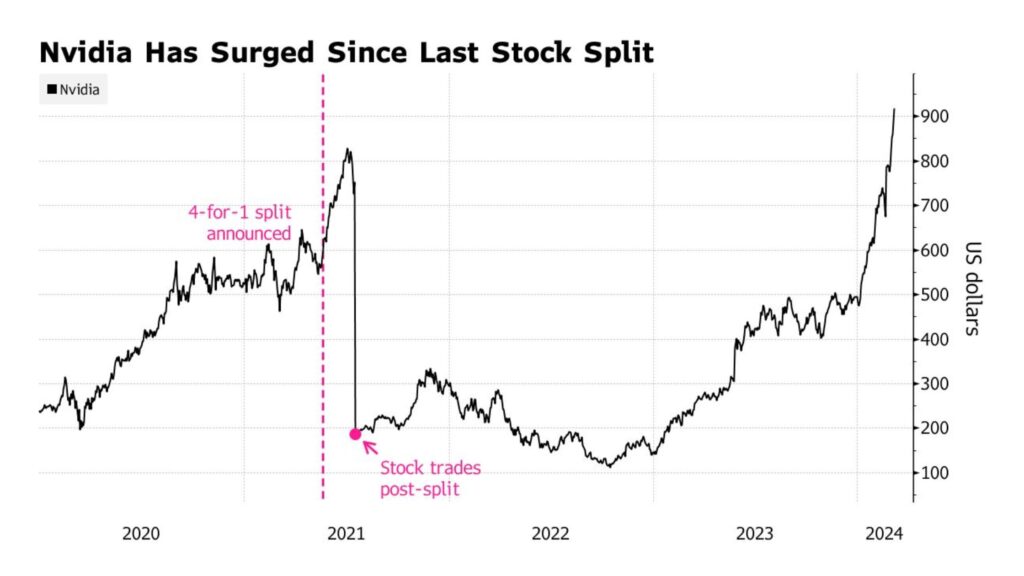
July 20, 2021: 4-for-1 Stock Split. By mid-2021, NVIDIA’s stock had become one of the market’s darlings, fueled by surging demand for its GPUs in gaming, cryptocurrency mining, and critically, artificial intelligence and cloud computing. The stock price had climbed to over $700 per share before the split. This 4-for-1 split brought the price down significantly, making it far more appealing to individual investors who might have been deterred by the high nominal price.
-
June 7, 2024: 10-for-1 Stock Split. This is NVIDIA’s most recent and largest split to date, executed during the zenith of the AI boom, where NVIDIA’s H100 and upcoming Blackwell chips became the gold standard for AI development and deployment. The stock had once again reached stratospheric levels, well over $1,000 per share. This aggressive 10-for-1 split was a clear move to maximize accessibility and attract an even broader pool of investors eager to participate in the AI revolution led by NVIDIA. It significantly reduced the per-share cost, potentially enabling more retail investors to purchase whole shares.
Each of these splits, spanning over two decades, marks a chapter in NVIDIA’s relentless innovation and financial success, directly reflecting the sustained appreciation of its market value.
The Impact of NVIDIA’s Stock Splits on Investors
While a stock split doesn’t fundamentally alter the value of an investor’s holdings, its consequences are significant for trading dynamics, market perception, and overall investment strategy.
Increased Accessibility for Retail Investors
The most immediate and tangible impact of an NVIDIA stock split is the reduction in its per-share price. For a stock trading at $1,000 before a 10-for-1 split, the new price would be $100. This lower price point significantly lowers the barrier to entry for retail investors. While many brokerages now offer fractional share investing, which allows investors to buy portions of expensive shares, the ability to purchase whole shares at a lower price point remains attractive psychologically and practically for many. It expands the pool of potential investors, leading to a broader ownership base for the company.
Enhanced Liquidity and Trading Volume
With a greater number of shares outstanding at a lower price, the liquidity of NVIDIA’s stock typically improves. More shares available for trade can lead to increased daily trading volumes. Higher liquidity means it’s generally easier for investors to buy or sell shares without significantly impacting the price. This can result in narrower bid-ask spreads, making transactions more efficient and potentially reducing trading costs for investors. From a market perspective, a highly liquid stock is generally more attractive.
Psychological Effects and Market Perception
The psychological impact of a stock split cannot be underestimated. A stock trading at $100 often feels more “affordable” and appealing than one trading at $1,000, even if the underlying company value is identical. This perception can draw new investors who might view the lower price as an opportunity for future growth, making the stock seem “cheaper” and more attractive. For existing shareholders, a split often reinforces confidence, as it signals the company’s belief in continued growth and its desire to broaden its investor base, which are generally positive indicators.
No Change to Underlying Value or Market Cap
It’s crucial for investors to remember that a stock split is fundamentally an accounting adjustment. It does not alter NVIDIA’s total market capitalization, its earnings per share (EPS) in a diluted sense (as the increased share count is factored in), its revenue, or its cash flow. An investor’s percentage ownership in the company remains unchanged. If you owned 0.001% of NVIDIA before a 4-for-1 split, you would still own 0.001% after the split, just represented by four times as many shares, each worth one-quarter of its previous value. Therefore, while splits can create excitement and improve accessibility, they are not a direct mechanism for creating new shareholder value. Value creation stems from NVIDIA’s innovation, financial performance, and market execution.
Beyond the Split: What Investors Should Consider with NVIDIA Stock
While understanding stock splits is valuable, an informed investment decision requires looking beyond these corporate actions and focusing on the fundamental health and future prospects of the company. For NVIDIA, this involves several critical financial and market considerations.
Fundamental Analysis: Revenue, Earnings, and Innovation
Any investment in NVIDIA should be grounded in a thorough fundamental analysis. Investors must examine the company’s consistent revenue growth, particularly from its data center and AI segments, which have become primary drivers. Scrutinize its earnings reports, profit margins, and free cash flow generation. NVIDIA’s relentless innovation in GPU architecture, AI software platforms (like CUDA), and systems (DGX servers) is a key differentiator. Its ability to continually develop cutting-edge technology directly translates into its financial performance and long-term viability. Investors should assess its R&D spending, patent portfolio, and pipeline of future products and services.
Market Position and Competitive Landscape
NVIDIA holds a dominant position in several key markets, most notably high-performance GPUs for AI training and inferencing, professional visualization, and gaming. Its CUDA platform has created a significant ecosystem lock-in, making it difficult for competitors to catch up. However, the competitive landscape is intense. Rivals like AMD are continually innovating, and tech giants such as Google, Amazon, and Microsoft are developing their custom AI chips. Investors should assess NVIDIA’s ability to maintain its competitive edge, expand into new markets (e.g., automotive, robotics), and defend its existing strongholds. Understanding its moat and how sustainable it is, is paramount.
Future Growth Drivers and Risks
NVIDIA’s future growth is heavily tied to the continued expansion of AI, cloud computing, and the metaverse. Its leadership in these transformative technologies positions it well for sustained growth. However, investors must also consider potential risks. Geopolitical tensions, particularly concerning US-China relations and semiconductor supply chains, pose significant challenges. Intense competition, rapid technological obsolescence, and reliance on a few key customers (e.g., major cloud providers) are other factors. Furthermore, regulatory scrutiny, especially related to market dominance or energy consumption of AI, could also emerge as a headwind. A balanced view of growth drivers and associated risks is essential.
Long-Term vs. Short-Term Investment Strategy
NVIDIA is often considered a long-term growth investment due to its foundational role in critical future technologies. Long-term investors typically focus on the company’s ability to execute its strategy, innovate, and grow its earnings over many years, largely disregarding short-term market fluctuations. Short-term trading in NVIDIA stock can be highly volatile, influenced by macroeconomic news, competitor announcements, or changes in market sentiment towards the tech sector. Investors should align their investment horizon with their personal financial goals and risk tolerance. Understanding that a stock split doesn’t change the underlying fundamentals, but rather improves market dynamics, helps in formulating a coherent strategy.
Analyzing the Financial Implications for Portfolios
Beyond the strategic reasons for splits, individual investors need to understand the practical financial implications for their portfolios and how to manage them.
Adjusting Cost Basis and Portfolio Tracking
When a stock split occurs, your brokerage account will automatically adjust the number of shares and the price per share. If you bought NVIDIA shares at $400, and a 4-for-1 split occurs, your cost basis per share will automatically be adjusted to $100. It’s important to verify these adjustments in your brokerage statements. For investors who track their portfolios manually, updating the cost basis for all affected shares is crucial to accurately calculate gains or losses for future tax purposes. This also impacts average cost calculations if you have purchased shares at different price points over time.
Tax Considerations of Stock Splits
For most investors, a forward stock split is generally not considered a taxable event. The IRS typically views it as a non-taxable corporate reorganization. You don’t realize a capital gain or loss at the time of the split because your total investment value hasn’t changed. The original cost basis of your investment is simply spread across the increased number of shares. Taxes only become relevant when you eventually sell the shares. At that point, your adjusted cost basis will be used to determine your capital gains or losses. It’s always advisable to consult with a tax professional for personalized advice, especially if you have complex portfolio structures.
Brokerage Account Adjustments
Most reputable brokerage firms handle stock splits automatically. On the ex-split date, you will see your account balance reflect the new number of shares and the adjusted share price. Any fractional shares resulting from the split are usually handled in one of two ways: either your broker will round up to the nearest whole share or sell off the fractional part and credit your account with the cash equivalent. Policies vary between brokers, so it’s good practice to familiarize yourself with your brokerage’s specific approach, though for NVIDIA’s splits, which have been significant, fractional shares are less common unless an investor had a very specific small holding.

Conclusion
NVIDIA’s history of stock splits is a testament to its phenomenal growth and its strategic efforts to keep its shares accessible to a wide range of investors. From its multiple splits in the early 2000s to its most recent significant splits in 2021 and 2024, each event has marked a moment of significant appreciation in its market value.
While stock splits are important corporate actions that can enhance liquidity, improve accessibility, and positively influence market perception, it is crucial for investors to understand that they do not alter the fundamental value of the company or an investor’s total holding. The true value of an investment in NVIDIA, or any company, stems from its innovation, financial performance, strategic market position, and future growth prospects. For those considering an investment in NVDA, a thorough understanding of these underlying financial metrics, combined with an awareness of the company’s stock split history, provides a comprehensive and insightful foundation for decision-making in the ever-evolving financial markets.
aViewFromTheCave is a participant in the Amazon Services LLC Associates Program, an affiliate advertising program designed to provide a means for sites to earn advertising fees by advertising and linking to Amazon.com. Amazon, the Amazon logo, AmazonSupply, and the AmazonSupply logo are trademarks of Amazon.com, Inc. or its affiliates. As an Amazon Associate we earn affiliate commissions from qualifying purchases.