
Deciding when to claim Social Security benefits is one of the most consequential financial decisions an individual will face in their lifetime. For many retirees, Social Security represents the only source of inflation-adjusted, guaranteed-for-life income. However, the system is notoriously complex, governed by thousands of rules that dictate how much you receive based on when you start. This is where a “When Should I Take Social Security” calculator becomes an indispensable part of your financial toolkit. Rather than relying on gut feelings or the advice of neighbors, these tools allow for a data-driven approach to wealth preservation and income optimization.
The Financial Impact of Timing: Why One Size Does Not Fit All
The age at which you begin collecting benefits significantly impacts your monthly check and your cumulative lifetime wealth. While you can claim as early as age 62, doing so results in a permanent reduction in monthly benefits compared to waiting until your Full Retirement Age (FRA). Conversely, for every year you delay claiming beyond your FRA—up to age 70—your benefit increases by approximately 8% annually.
Understanding Full Retirement Age (FRA)
Your Full Retirement Age is the point at which you are entitled to 100% of your primary insurance amount (PIA). For anyone born in 1960 or later, the FRA is 67. If you claim at 62, your benefit is reduced by 30%. If you wait until 70, you receive 124% of your PIA. A calculator helps visualize this delta, showing not just the monthly difference, but the compounding effect over twenty or thirty years of retirement.
The Opportunity Cost of Claiming Early
Claiming early provides immediate cash flow, which can be tempting for those looking to leave the workforce or pay down debt. However, the opportunity cost is high. By using a calculator to model different scenarios, you can see the “cost of waiting” versus the “cost of claiming.” In many cases, the guaranteed 8% annual increase from age 67 to 70 outperforms what most investors can reliably earn in the stock or bond markets on a risk-adjusted basis.
Decoding the Inputs: What Your Calculator Needs to Know
To get an accurate projection from a Social Security calculator, you must input specific variables that go beyond your birthdate. The quality of the output is entirely dependent on the precision of the data provided.
Earnings History and Future Projections
Social Security benefits are calculated based on your 35 highest-earning years, indexed for inflation. A sophisticated calculator will allow you to input your current Social Security Statement data. If you plan to work a few more years at a high salary, the calculator can show how those additional high-income years might replace lower-income years from your youth, potentially boosting your PIA.
Life Expectancy and Longevity Risk
The biggest variable in any Social Security calculation is how long you expect to live. While no one has a crystal ball, calculators allow you to run “what-if” scenarios based on different life expectancies. Longevity risk—the risk of outliving your money—is the primary reason many financial planners recommend delaying benefits. If a calculator shows that you have a “break-even” age of 80, and your family history suggests you may live into your 90s, the data strongly supports waiting until age 70.
Cost-of-Living Adjustments (COLA)
Social Security is unique because it is indexed for inflation. When you use a calculator, it is vital to account for an estimated annual COLA. Because the 8% increase for delaying is applied to a base that is also growing with inflation, the nominal dollar difference between claiming at 62 and 70 grows significantly larger over time. A professional-grade calculator will demonstrate how these adjustments preserve your purchasing power in an inflationary environment.
Comparative Analysis: Break-Even Points and Longevity Risk
The “break-even point” is the age at which the total cumulative benefits of waiting to claim exceed the total cumulative benefits of claiming early. This is a core metric provided by most Social Security calculators and serves as a pivot point for financial decision-making.

Calculating the Break-Even Point
If you claim at 62, you get a head start. You collect checks for 60 months before someone who waits until age 67 even starts. However, the person who waits until 67 receives a much larger check. The break-even point is the moment when the larger checks of the “waiter” finally catch up to the total sum collected by the “early bird.” Typically, this break-even point occurs in the late 70s or early 80s.
Assessing Health and Lifestyle
A calculator can help you weigh your health status against the math. If you have chronic health issues and a shorter life expectancy, claiming early may be the mathematically superior choice. Conversely, if you are in excellent health, a calculator will likely show that delaying benefits is the most effective way to hedge against the high costs of late-life healthcare and assisted living.
Market Returns vs. Guaranteed Increases
Some retirees argue they should claim at 62 and invest the money. A calculator can test this theory. By inputting an expected rate of return (e.g., 5% or 7%), you can see if your investments are likely to outpace the guaranteed 8% annual increase offered by the Social Security Administration. In most historical contexts, the guaranteed, inflation-adjusted “return” of delaying Social Security is difficult to beat in the private market without taking on substantial risk.
Advanced Strategies: Spousal Benefits and Coordination
For married couples, the decision is not just about one individual; it is about a coordinated household strategy. This is where simple calculators often fail and more advanced financial tools are required.
Maximizing the Survivor Benefit
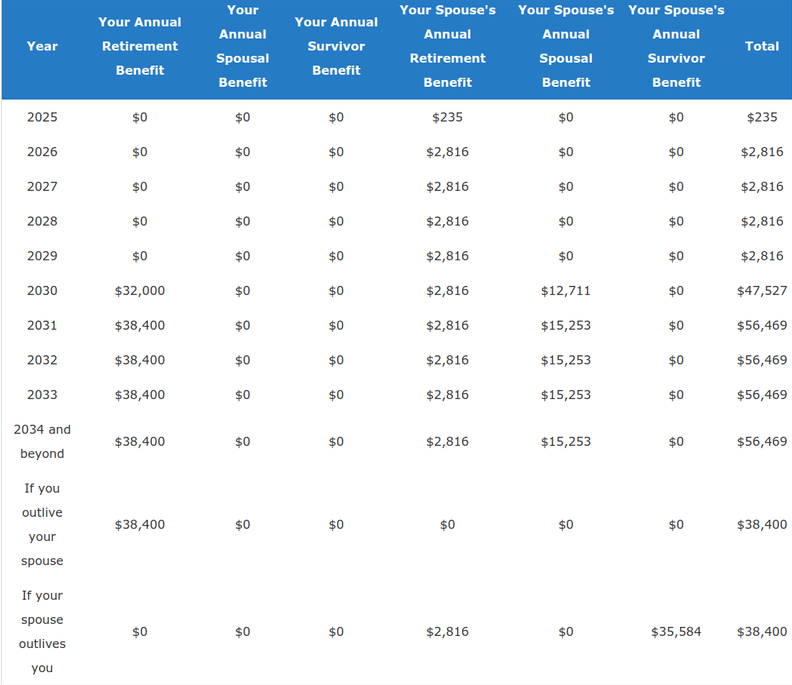
One of the most overlooked aspects of Social Security is the survivor benefit. When one spouse dies, the survivor is entitled to the higher of the two individual benefits. By using a calculator to model a “joint” strategy, high-earning spouses often find that delaying until age 70 is a form of life insurance. It ensures that the surviving spouse—who may live decades longer—has the highest possible floor of guaranteed income.
Spousal Claiming Rules
Calculators can help navigate the complexities of spousal benefits, which allow a lower-earning spouse to claim up to 50% of the higher-earner’s PIA. The timing of these claims must be coordinated to ensure that the household receives the maximum total cash flow. A calculator can run hundreds of combinations to find the “optimal” month for each spouse to file.
Divorce and Survivor Benefits for Former Spouses
If you were married for at least 10 years and are currently unmarried, you may be eligible for benefits based on an ex-spouse’s record. A specialized calculator can determine if claiming on an ex-spouse’s record while allowing your own benefit to grow is a viable strategy, potentially adding tens of thousands of dollars to your lifetime wealth.
Integrating Social Security with Your Total Investment Portfolio
Social Security does not exist in a vacuum. It is one piece of a larger retirement puzzle that includes 401(k)s, IRAs, taxable brokerage accounts, and home equity. A comprehensive financial calculator helps you see how Social Security fits into your broader “safe withdrawal rate.”
The Tax Torpedo and Social Security
Social Security benefits can be taxable depending on your “provisional income.” If your income exceeds certain thresholds, up to 85% of your benefits may be subject to federal income tax. A calculator can help you plan your withdrawals from tax-deferred accounts (like traditional IRAs) to minimize the tax impact on your Social Security checks. This is often referred to as avoiding the “tax torpedo.”
The “Bridge Strategy”
In some scenarios, it makes financial sense to spend down a portion of your IRA or 401(k) between the ages of 62 and 70 to “buy” a higher Social Security benefit. By using a calculator to model this “bridge,” you can see how reducing your liquid assets now to secure a higher guaranteed income later can actually increase the total value of your estate over a long-term horizon.

Sequencing of Returns Risk
For retirees entering the market during a downturn, Social Security provides a critical buffer. A calculator can demonstrate how a higher Social Security benefit reduces the amount you need to withdraw from your investment portfolio during a market crash. This protects your portfolio from “sequencing of returns risk,” ensuring that you don’t have to sell stocks at the bottom to pay for basic living expenses.
Ultimately, the question of when to take Social Security is a mathematical problem with a deeply personal solution. By utilizing a high-quality calculator, you move away from guesswork and toward a strategic plan that accounts for longevity, inflation, and household security. Whether the goal is to maximize every penny or to provide a safety net for a surviving spouse, the data provided by these financial tools is the foundation of a successful retirement.
aViewFromTheCave is a participant in the Amazon Services LLC Associates Program, an affiliate advertising program designed to provide a means for sites to earn advertising fees by advertising and linking to Amazon.com. Amazon, the Amazon logo, AmazonSupply, and the AmazonSupply logo are trademarks of Amazon.com, Inc. or its affiliates. As an Amazon Associate we earn affiliate commissions from qualifying purchases.