
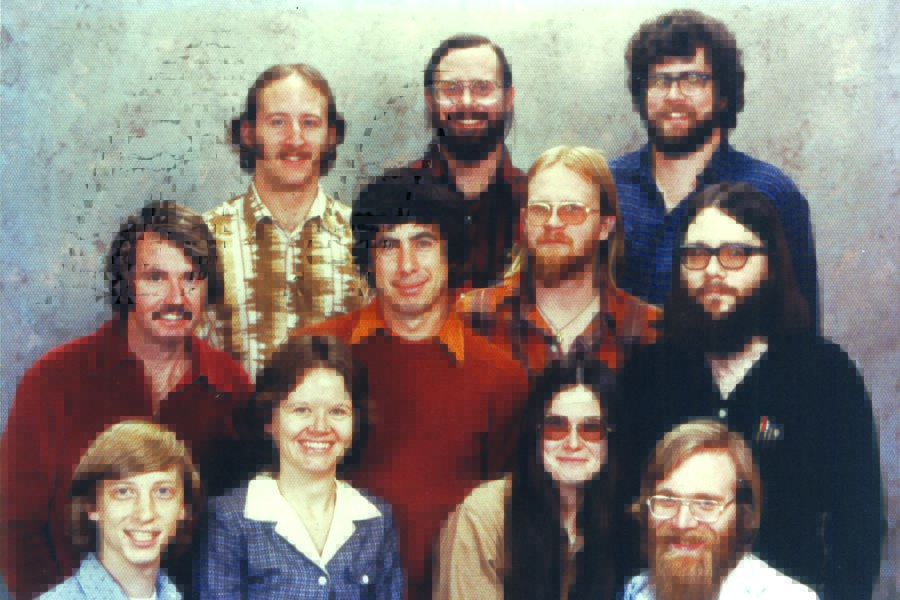
On April 4, 1975, in a small office in Albuquerque, New Mexico, two childhood friends—Bill Gates and Paul Allen—embarked on a journey that would fundamentally alter the trajectory of human civilization. When Microsoft was founded, the concept of a “personal computer” was largely the domain of hobbyists and engineering enthusiasts. Most computers were massive mainframes housed in climate-controlled rooms, inaccessible to the average person. Gates and Allen, however, possessed a technical foresight that was decades ahead of its time: they envisioned a world with a computer on every desk and in every home.

Choosing the “Tech” niche to explore this history allows us to look beyond the corporate balance sheets and dive into the software architecture, the evolution of operating systems, and the technical milestones that transformed Microsoft from a two-man startup into the backbone of the global digital infrastructure.
The Technical Spark: BASIC and the Altair 8800
The founding of Microsoft wasn’t a random event; it was a direct technical response to the first spark of the microcomputer revolution. In January 1975, Popular Electronics featured the MITS Altair 8800 on its cover. This machine was the first commercially successful microcomputer kit, but it had a significant technical limitation: it had no software. To make it do anything useful, a user had to manually flip switches on the front panel to enter machine code.
Developing the First Microcomputer Language
Gates and Allen saw the Altair not just as a piece of hardware, but as a platform waiting for an abstraction layer. They contacted MITS and claimed they had developed a version of the BASIC (Beginner’s All-purpose Symbolic Instruction Code) programming language for the Altair. In reality, they hadn’t written a single line of code for the 8080 microprocessor yet.
In a feat of legendary technical endurance, they spent the next eight weeks developing an interpreter. Since they didn’t have an actual Altair, Allen wrote a simulator for the 8080 that ran on a PDP-10 mainframe. When Allen finally flew to Albuquerque to test the code on a real Altair, it worked on the first try. This was the technical birth of Microsoft: the realization that software could be decoupled from hardware and sold as a standalone product.
The Shift from Albuquerque to Bellevue
While the company began in New Mexico to be near MITS, the technical talent pool and the need for a more robust corporate structure eventually drew them back to their roots in Washington State. In 1979, Microsoft moved to Bellevue. This relocation coincided with a shift in their technical focus. They were no longer just a “language company” providing BASIC, Fortran, and COBOL; they were beginning to look at the underlying architecture of how computers managed data and tasks.
The Architectural Foundation: MS-DOS and the IBM Partnership
The most pivotal technical moment in Microsoft’s early history occurred in 1980. IBM, the titan of the computing world, was looking to enter the personal computer market and needed an operating system. Rather than building one from scratch, they turned to Microsoft.
Licensing vs. Selling: A Technical Strategy
The technical genius of the IBM deal wasn’t just in the code; it was in the licensing agreement. Microsoft didn’t have an operating system ready, so they purchased QDOS (Quick and Dirty Operating System) from Seattle Computer Products, refined it, and renamed it MS-DOS (Microsoft Disk Operating System).
Crucially, Microsoft retained the right to license MS-DOS to other hardware manufacturers. This created the “PC-compatible” market. From a technical standpoint, this meant that software written for an IBM PC would run on a Compaq or a Dell. This standardization of the x86 architecture and the DOS environment created a unified technical ecosystem that allowed the software industry to explode.
The Command Line Era
MS-DOS was a text-based, command-line interface. While primitive by today’s standards, it introduced millions to the logic of file systems, directories, and executable files. It forced a generation of users to understand the technical hierarchy of computing. However, as hardware capabilities grew—specifically with the advent of better graphics processing—the limitations of a text-only interface became a technical bottleneck.
The Graphical Evolution: The Windows Revolution
By the mid-1980s, the technical landscape was shifting toward Graphical User Interfaces (GUIs), popularized by Xerox PARC and implemented by Apple’s Macintosh. Microsoft recognized that for computing to become truly universal, the “tech” had to become “invisible.”
From Windows 1.0 to Windows 95
The journey from Windows 1.0 (released in 1985) to the global phenomenon of Windows 95 represented a massive technical leap. Early versions of Windows were essentially shells running on top of MS-DOS. They managed memory poorly and were prone to crashes.
However, with Windows 95, Microsoft introduced a more robust 32-bit architecture, “Plug and Play” hardware detection, and the iconic Taskbar and Start Menu. Technically, this was a masterpiece of backward compatibility. Microsoft managed to provide a modern interface while still allowing users to run legacy DOS applications, a technical feat that ensured their dominance in the enterprise sector.
Building the Developer Ecosystem
A key component of Microsoft’s technical strategy has always been the developer. By providing robust Application Programming Interfaces (APIs) and development tools like Visual Basic and later the .NET framework, Microsoft made it easy for third-party developers to build software for Windows. This created a “network effect”: more software meant more users, and more users attracted more developers. This technical feedback loop solidified Windows as the primary OS for the global workforce.
The Modern Pivot: Cloud Infrastructure and the AI Frontier
As the 21st century progressed, the “PC on every desk” goal had been achieved, and the technical focus of the industry shifted from local hardware to distributed networks. Under the leadership of Satya Nadella, Microsoft underwent a “Cloud First, Mobile First” transformation.
Azure and the Shift to Distributed Computing
Microsoft Azure, launched in 2010, represents the modern technical soul of the company. It moved the “operating system” from the individual machine to the global data center. Azure provides the compute power, storage, and networking capabilities for millions of businesses.
The technical complexity of Azure is staggering, involving massive-scale virtualization, software-defined networking, and global content delivery networks. By pivoting to the cloud, Microsoft ensured that it remained technically relevant in an era where smartphones and IoT devices began to outnumber traditional PCs.
The Integration of Generative AI
Today, Microsoft is at the forefront of the most significant technical shift since the internet: Artificial Intelligence. Through its multi-billion dollar partnership with OpenAI, Microsoft has integrated Large Language Models (LLMs) into its entire stack.
From “GitHub Copilot,” which helps programmers write code by predicting the next logical line, to “Microsoft 365 Copilot,” which automates document creation, the company is redefining the technical interface between humans and machines. This is not just a feature update; it is a fundamental shift in how software is architected, moving from “deterministic” programming (if-this-then-that) to “probabilistic” AI-driven interactions.
The Lasting Technological Legacy of Microsoft’s Founding
When we reflect on when Microsoft was founded, we are looking at the birth of the modern software industry. Before 1975, software was often bundled for free with hardware or custom-built for specific institutional tasks. Microsoft proved that software was a distinct, infinitely scalable technical asset.
Democratizing Technology
The most significant technical legacy of Microsoft is the democratization of high-performance tools. By creating a standardized operating system and a suite of productivity tools (Microsoft Office), they provided the technical means for individuals and small businesses to compete with global corporations. The spreadsheet (Excel) and the word processor (Word) are perhaps the most influential pieces of software ever written, fundamentally changing how data is analyzed and how information is shared.

Security and the Future of the Stack
As we look toward the future, Microsoft’s technical challenges have shifted toward cybersecurity and ethical AI. In a world of constant digital threats, the company has had to re-engineer the Windows kernel and its cloud protocols to prioritize “Zero Trust” security models.
The founding of Microsoft in 1975 wasn’t just about starting a business; it was about initiating a technical era. From the 8-bit BASIC interpreter of the 70s to the massive neural networks of the 2020s, Microsoft has remained at the center of the technological conversation. As they continue to push the boundaries of quantum computing and augmented reality (HoloLens), the spirit of that 1975 Albuquerque office—the belief that software can change the world—remains the driving force of their technical evolution.
aViewFromTheCave is a participant in the Amazon Services LLC Associates Program, an affiliate advertising program designed to provide a means for sites to earn advertising fees by advertising and linking to Amazon.com. Amazon, the Amazon logo, AmazonSupply, and the AmazonSupply logo are trademarks of Amazon.com, Inc. or its affiliates. As an Amazon Associate we earn affiliate commissions from qualifying purchases.