
The world of futures trading is a dynamic, interconnected marketplace that operates with a rhythm distinct from traditional stock market hours. Unlike a simple 9-to-5 operation, understanding when futures markets open and close across the globe is not just a logistical detail but a critical component of successful financial strategy and risk management. For investors and traders looking to leverage these sophisticated financial instruments, deciphering the global trading schedule is paramount. This article delves into the intricacies of futures market hours, exploring the factors that dictate their operation, the significance of their continuous nature, and the practical implications for anyone engaging with these powerful financial contracts.

Unpacking the World of Futures Contracts
Before we dissect the “when,” it’s crucial to grasp the “what” and “why” of futures contracts. These derivatives are a cornerstone of modern finance, enabling participants to manage risk, speculate on future price movements, and facilitate efficient price discovery across a vast array of assets.
What Exactly Are Futures?
At its core, a futures contract is a legally binding agreement to buy or sell a specific commodity or financial instrument at a predetermined price at a specified time in the future. What sets them apart is their standardization and the fact that they are traded on organized exchanges. This standardization dictates the quantity, quality, and delivery specifications of the underlying asset, making them highly liquid and transparent.
Futures contracts exist for a diverse range of underlying assets:
- Commodities: Energy (crude oil, natural gas), agriculture (corn, wheat, soybeans), metals (gold, silver, copper).
- Financials: Equity indices (S&P 500, Nasdaq 100, DAX), interest rates (Treasury bonds, Eurodollars), currencies (Euro, Yen, British Pound).
Participants typically don’t intend to take physical delivery of the asset. Instead, they close out their positions before expiration, profiting or losing from the difference between their entry and exit prices. The beauty of futures lies in their leverage potential, allowing traders to control large contract values with a relatively small amount of capital (margin), which amplifies both potential gains and losses.
Why Trading Hours Matter for Futures
Unlike the clear-cut opening and closing bells of major stock exchanges, futures markets operate on a more extended, almost continuous schedule. However, this “near 24/5” operation is not uniform across all contracts or exchanges. Understanding the specific trading hours for the contracts you are interested in is vital because these times directly influence:
- Liquidity: The volume of trading activity, which affects how easily you can enter or exit positions without significantly impacting the price.
- Volatility: Price swings can be more pronounced during certain sessions, especially around major economic data releases or during periods of thinner liquidity.
- Risk Management: Knowing when a market opens or closes helps in anticipating potential price gaps, managing overnight exposure, and planning hedges against unforeseen events.
The global nature of futures means that while one region’s market may be “closed” for its primary session, another’s might be wide open, contributing to a continuous flow of price discovery that dictates the market’s pulse.
The Global Tapestry of Futures Trading Hours
The concept of a truly global financial market is perhaps best exemplified by futures trading. The sun never truly sets on these markets, with various exchanges taking up the mantle of trading as time zones shift.
The Concept of Near 24/5 Trading
The advent of electronic trading has revolutionized futures markets, moving them away from the confines of physical trading pits and into a digital realm accessible almost around the clock. This has given rise to the “near 24/5” trading environment, meaning markets are open virtually continuously from Sunday evening (typically US time) until Friday afternoon.
This continuous operation is achieved through a relay system of major exchanges located in different time zones:
- Asia-Pacific Session: Kicking off the trading week and continuing through their local business hours.
- European Session: Overlapping with the latter part of the Asia-Pacific session and setting the tone for European markets.
- North American Session: Overlapping with the European session and concluding the daily cycle.
While there are brief daily maintenance breaks, typically late afternoon/early evening in the US for many contracts, and a longer break over the weekend, the market’s continuous nature ensures that major geopolitical events or economic announcements can be priced in almost immediately, regardless of when they occur.
Major Exchanges and Their Schedules
Different futures contracts are traded on various exchanges, each with its own specific trading schedule. Here’s a look at some of the prominent players and their general operational hours (note: these are indicative and subject to change by the exchanges):
-
CME Group (Chicago Mercantile Exchange): As one of the world’s largest derivatives exchanges, CME offers a vast array of futures across equity indices (e.g., E-mini S&P 500, Nasdaq 100), commodities (e.g., Crude Oil, Gold), and FX.
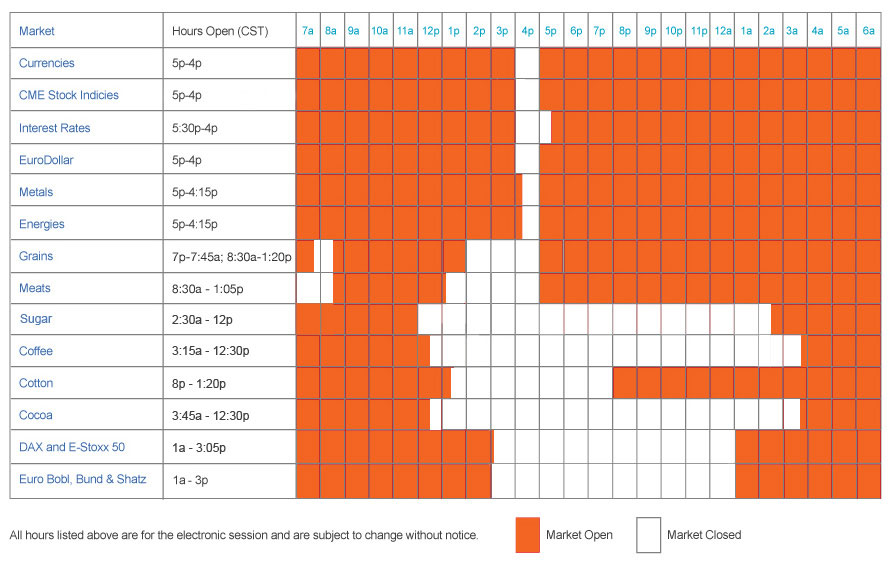
- Equity Futures (e.g., E-mini S&P 500): Often open Sunday evening (around 5:00 PM CT) and trade almost continuously until Friday afternoon (around 4:15 PM CT), with a brief daily pause (e.g., 4:15 PM – 4:30 PM CT).
- Energy Futures (e.g., WTI Crude Oil): Similar extended hours, typically Sunday evening to Friday afternoon, with a shorter daily maintenance period.
- Metals & FX Futures: Also follow extended electronic trading hours.
-
ICE (Intercontinental Exchange): A major player, particularly in energy and soft commodities.
- Energy Futures (e.g., Brent Crude, Gasoil): Extended hours often mirroring CME, enabling continuous global trading.
- Soft Commodities: Specific hours depending on the contract, often with extended electronic sessions.
-
Eurex (European Exchange): Dominant for European equity index futures (e.g., DAX, Euro Stoxx 50) and interest rate futures.
- Equity Index Futures: Primary session aligns with European business hours, but electronic trading extends significantly, often starting late Sunday evening (CET) and running until Friday evening, with daily breaks.
-
Asia-Pacific Exchanges (e.g., SGX, HKEX, TOCOM): These exchanges facilitate trading in regional indices (e.g., Nikkei 225, Hang Seng), currencies, and commodities, often opening the global trading week.
- Their primary trading hours correspond to their local time zones, but many offer after-hours electronic trading, creating seamless transitions with Western markets.
Overlaps and Liquidity Hotspots
The continuous nature of futures trading means that there are periods when multiple major markets are open simultaneously. These “overlaps” are crucial because they typically represent periods of highest liquidity and tightest bid-ask spreads.
- European/North American Overlap: This is often the most liquid period, as both London/Frankfurt and New York traders are actively engaged. It’s during this time (roughly 8:00 AM to 12:00 PM ET) that major economic data from both continents is released, leading to increased volatility and trading opportunities.
- Asian/European Overlap: Less pronounced than the Western overlap but still significant, especially for commodity markets and currency pairs involving Asian currencies.
Understanding these liquidity hotspots allows traders to strategically plan their entry and exit points, taking advantage of efficient price discovery and minimizing slippage.
Key Determinants of Futures Market Openings
While the 24/5 model provides a general framework, the precise trading hours for any given futures contract are shaped by several specific factors.
The Underlying Asset’s Nature
The characteristics of the asset underlying the futures contract play a significant role in determining its trading hours:
- Energy Commodities (e.g., Oil, Gas): Given their global supply chains, constant demand, and geopolitical influences, energy futures like WTI Crude Oil and Brent Crude demand near 24/5 trading. News or events in any time zone can impact prices, necessitating continuous market access.
- Agricultural Commodities (e.g., Corn, Wheat): While still globally traded, their pricing can be heavily influenced by regional growing seasons, weather patterns, and government reports (e.g., USDA reports). This can lead to more defined primary trading hours, often extending from an open outcry session into electronic trading.
- Equity Indices: Futures contracts like the E-mini S&P 500 largely mirror the hours of their underlying stock markets but extend significantly. This allows investors to hedge or speculate on US equity market performance even when the New York Stock Exchange is closed.
- Currencies: With the spot forex market being truly 24/5 (Sunday evening to Friday evening), currency futures naturally adopt a similar, extended trading schedule to reflect continuous global currency flows.
Exchange Regulations and Operational Models
Each futures exchange is an independent entity with its own rulebook governing trading hours, holiday schedules, and operational procedures.
- Evolution from Pit to Electronic: Historically, futures trading was dominated by “open outcry” in trading pits, which necessitated strict, limited hours. The transition to fully electronic trading has dramatically expanded trading windows, allowing for the current extended hours and greater accessibility.
- Maintenance Breaks: Even in electronic markets, exchanges schedule short daily breaks for system maintenance, processing daily settlements, and preparing for the next trading session. These breaks, while brief, are important for traders to be aware of, as liquidity vanishes during these times.
- Settlement Procedures: Daily settlement (marking to market) is a crucial aspect of futures trading, where gains and losses are realized daily. The exchange’s settlement process often dictates specific cut-off times or influences the daily breaks.
Weekends, Holidays, and Special Events
Futures markets are not entirely ceaseless. They observe specific closures and modified hours:
- Weekend Closures: Virtually all futures markets close for the weekend, typically from Friday afternoon/evening until Sunday evening (local time of the exchange). This provides a break for market participants and system maintenance.
- Public Holidays: Futures exchanges observe public holidays in their host countries. For example, US-based exchanges like CME will close or have abbreviated hours on US holidays (e.g., Thanksgiving, Christmas, New Year’s Day). It’s crucial to check the specific exchange’s holiday calendar.
- Early Closures/Late Opens: Exchanges may announce early closures before major holidays or adjust hours in response to extraordinary market conditions or technical issues.
- Daylight Saving Time: Changes in daylight saving time can affect the nominal clock times for openings and closings, especially for traders operating in different time zones.
The Strategic Edge of Knowing When Futures Open
For serious traders and institutional investors, a deep understanding of futures trading hours is not merely about convenience; it’s a strategic imperative that directly impacts profitability and risk exposure.
Mitigating Overnight and Weekend Risk
Perhaps one of the most significant advantages of knowing trading hours is managing “gap risk.” This occurs when a major news event breaks outside of trading hours, causing a significant price difference between the previous close and the next open.
- Overnight Risk: For positions held through a daily break or overnight, unexpected news (e.g., geopolitical developments, company earnings announcements after market close) can lead to a substantial price gap when the market reopens.
- Weekend Risk: The longest closure period presents the largest gap risk. Events that unfold over the weekend can cause dramatic moves in futures prices when markets resume on Sunday evening. Knowing these closure periods allows traders to adjust their positions (e.g., reduce exposure, implement stop-losses) or prepare for potential volatility.
Optimizing Trading Strategies
Strategic traders leverage knowledge of trading hours to enhance their operational efficiency and maximize potential returns:
- Liquidity-Driven Entry/Exit: Trading during peak liquidity hours (e.g., the European/North American overlap) often means tighter bid-ask spreads, making it cheaper and easier to execute large orders without moving the market against you. Conversely, trading during thin, illiquid periods can lead to wider spreads and greater slippage.
- Volatility Targeting: Some strategies thrive on volatility, while others seek stability. Knowing when specific markets tend to be more volatile (e.g., around major economic announcements, at market opens) allows traders to tailor their strategies accordingly.
- Reaction to News: Price action around market openings, especially after a closure, often reflects the market’s initial reaction to new information. Traders can devise strategies to capitalize on these initial moves, provided they have the systems and discipline to act quickly.
Enhancing Data Analysis and Algorithmic Trading
For quantitative analysts and algorithmic traders, precise knowledge of trading hours is fundamental to data integrity and system design.
- Accurate Time Series Data: Ensuring that historical data aligns with actual trading sessions is crucial for backtesting and developing robust trading models. Ignoring breaks or non-trading hours can lead to flawed analysis.
- Session-Based Analysis: Algorithms can be designed to perform differently during distinct trading sessions (e.g., a high-frequency strategy during peak liquidity vs. a momentum strategy during quieter periods).
- Post-Settlement Price Action: Understanding when daily settlement occurs is vital, as price action immediately following settlement can sometimes reflect a “re-setting” of market sentiment for the new trading day.
Practical Considerations for Futures Traders
Navigating the complex world of futures trading hours requires more than just theoretical understanding; it demands practical execution and continuous vigilance.
Navigating Pre-Market and Post-Market Sessions
While the major open-outcry sessions might be a thing of the past for most contracts, the distinction between primary and extended electronic hours remains important.
- Thinner Liquidity and Higher Volatility: Pre-market (early electronic trading before a major regional open) and post-market (electronic trading after a major regional close) sessions often exhibit lower trading volumes. This can lead to wider spreads and potentially more exaggerated price moves on smaller order sizes.
- Opportunities and Risks: These sessions can offer opportunities for traders who react quickly to overnight news or who prefer less congested markets. However, the reduced liquidity also means increased risk of slippage and difficulty in exiting positions at desired prices.
The Role of Your Broker and Trading Platform
Your choice of broker and trading platform is critical in how you interact with futures trading hours.
- Exchange Access: Ensure your broker provides access to the specific exchanges and contracts you wish to trade. Not all brokers offer the full spectrum of global futures markets.
- Platform Features: A robust trading platform will clearly display the active trading hours for each contract, provide real-time data feeds, and alert you to upcoming breaks or holiday closures.
- Order Types: Understand how your broker handles various order types (e.g., stop-loss, limit orders) during extended hours and across breaks. Some order types may not be active during certain periods.
Staying Informed: Your Continuous Homework
The global nature of futures markets means that trading hours are not static. They can change due to:
- Exchange Announcements: Always refer to the official websites of the relevant futures exchanges for the most up-to-date trading calendars, holiday schedules, and any special announcements regarding hours.
- Economic Calendars: Stay abreast of major economic data releases and central bank announcements. These are often timed to coincide with specific trading sessions and can trigger significant volatility.
- Geopolitical Events: Global news, from political instability to natural disasters, can impact commodity and currency markets at any time, emphasizing the need for continuous awareness, even during non-trading hours.
Conclusion
Understanding “when does futures open” is far more nuanced than a simple glance at a clock. It encompasses a deep appreciation for the global, interconnected nature of financial markets, the specific characteristics of different asset classes, and the regulatory frameworks of individual exchanges. From the relentless 24/5 electronic relay across continents to the strategic implications of liquidity hotspots and overnight risk, trading hours are a fundamental pillar of futures trading. For anyone looking to navigate this dynamic landscape, a diligent approach to monitoring schedules, understanding their impact, and integrating this knowledge into a robust trading strategy is not just advisable—it’s essential for sustained success.
aViewFromTheCave is a participant in the Amazon Services LLC Associates Program, an affiliate advertising program designed to provide a means for sites to earn advertising fees by advertising and linking to Amazon.com. Amazon, the Amazon logo, AmazonSupply, and the AmazonSupply logo are trademarks of Amazon.com, Inc. or its affiliates. As an Amazon Associate we earn affiliate commissions from qualifying purchases.