
For nearly two decades, Tesla was the ultimate Rorschach test for investors. To the bulls, it was a generational opportunity to get in on the ground floor of a technological revolution. To the bears, it was a cash-burning furnace destined for bankruptcy. The central question that divided Wall Street for seventeen years was simple yet profound: When—and indeed if—Tesla would ever become profitable.
The answer to that question is not a single date, but a series of financial milestones that transformed the company from a speculative startup into one of the most profitable automotive manufacturers in the world. Understanding Tesla’s path to profitability requires looking past the cars themselves and into the complex mechanics of business finance, capital markets, and the aggressive scaling of industrial operations.
The Long Road to Black Ink: A Seventeen-Year Journey
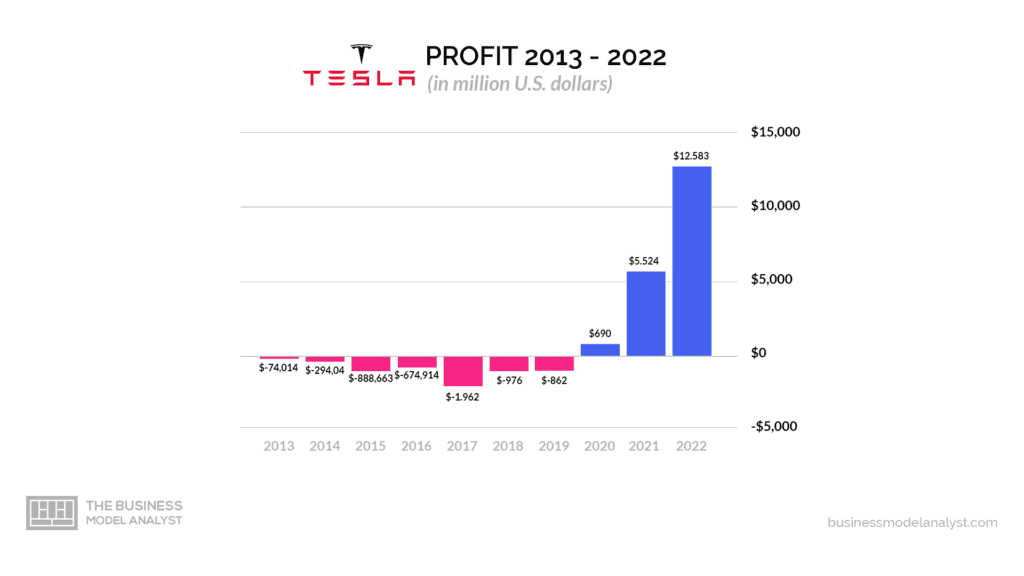
Tesla was founded in 2003, but it did not report its first full year of profitability until 2020. For the 17 years in between, the company relied on a combination of venture capital, public offerings, and debt to fund its research, development, and massive capital expenditures.
The First Signs of Life: 2013
Tesla’s first brush with profitability occurred in the first quarter of 2013. This was a landmark moment for the company, as it reported a GAAP (Generally Accepted Accounting Principles) net income of $11.2 million. This was driven primarily by the initial deliveries of the Model S and, significantly, the sale of Zero Emission Vehicle (ZEV) credits to other automakers.
However, this profitability was fleeting. The company immediately pivoted back into heavy spending to build out the Model X platform and, more importantly, to begin the massive undertaking of the Gigafactory in Nevada. For several years following 2013, Tesla returned to a cycle of heavy losses as it attempted to solve the “production hell” associated with the Model 3.
The 2019 Pivot
The true turning point for Tesla’s financial health began in the third quarter of 2019. After a disastrous first half of the year characterized by delivery logistics nightmares and concerns over demand, Tesla surprised the markets by posting a profit of $143 million in Q3 2019.
Unlike the 2013 blip, this profit felt sustainable. The company had begun to achieve the “unit economics” necessary for long-term survival. By optimizing the production line at its Fremont factory and reducing the cost per vehicle, Tesla proved it could generate positive free cash flow. This set the stage for 2020, the year Tesla finally shed its “unprofitable” label for good.
2020: The First Profitable Year
Tesla officially became profitable on an annual basis in 2020, reporting a net income of $721 million. This was a historic achievement, especially considering the global economic disruptions caused by the COVID-19 pandemic. By recording four consecutive quarters of GAAP profitability, Tesla met the final requirement for inclusion in the S&P 500, a move that validated the company’s financial maturity in the eyes of institutional investors.
Dissecting the Revenue Mix: How the Money Is Made
Tesla’s profitability is often scrutinized because it doesn’t look like a traditional automaker’s balance sheet. To understand how they reached the black, one must look at the diverse streams of income and the unique cost-saving measures they employed.
The Role of Regulatory Credits
In the early years of its profitability, Tesla’s “secret weapon” was the sale of regulatory credits. Governments in jurisdictions like California and the European Union require automakers to produce a certain percentage of zero-emission vehicles. Since Tesla only produces EVs, it consistently has a surplus of these credits, which it sells to traditional manufacturers who fail to meet the mandates.
In 2020, Tesla earned $1.58 billion from selling these credits—a figure that exceeded its total net income for the year. Critics argued that Tesla wasn’t “really” profitable because its car business was still losing money without these credits. However, from a business finance perspective, this was a brilliant monetization of a regulatory environment. As the company scaled, the reliance on these credits diminished, but they provided the essential “bridge” to keep the company solvent during its high-growth phase.
Economies of Scale and Giga Shanghai
The most significant driver of Tesla’s sustained profitability has been the massive reduction in the cost of goods sold (COGS). The opening of Gigafactory Shanghai in late 2019 was a masterstroke in business strategy. By manufacturing cars in China for the Chinese and European markets, Tesla drastically reduced labor costs, shortened supply chains, and avoided heavy import tariffs.

By the time the Model Y became the company’s primary volume driver, Tesla had mastered the art of “large-scale casting” and battery pack integration. These manufacturing innovations allowed Tesla to achieve industry-leading operating margins, often exceeding 15-20% at a time when legacy automakers were struggling to maintain 5-8% margins on their internal combustion engine fleets.
Software and Services
Tesla’s financial model also borrows heavily from the tech industry. Through the sale of Full Self-Driving (FSD) software packages and over-the-air upgrades, Tesla generates high-margin revenue that carries almost no incremental cost per unit. While the “Services and Other” segment was a drag on the bottom line for years, the growing fleet of Tesla vehicles on the road has turned this into a significant recurring revenue stream through Supercharging fees, insurance, and connectivity subscriptions.
The Investor Perspective: From Speculation to Blue-Chip
The transition to profitability fundamentally changed Tesla’s relationship with the financial markets. For over a decade, Tesla was a “story stock,” valued on its future potential rather than its present earnings.
The Short Squeeze and Market Cap Explosion
As Tesla approached sustained profitability in late 2019 and 2020, it triggered one of the largest short squeezes in stock market history. Investors who had bet billions on Tesla’s failure were forced to buy back shares as the company’s financial health improved. This surge in buying pressure, combined with the news of S&P 500 inclusion, sent Tesla’s market capitalization into the hundreds of billions, eventually crossing the $1 trillion mark in 2021.
Valuation Metrics: P/E Ratios and Beyond
Once Tesla became profitable, analysts could finally use traditional valuation metrics like the Price-to-Earnings (P/E) ratio. For a long time, Tesla’s P/E was astronomical, often exceeding 1,000x. As earnings have grown, this ratio has compressed, though it remains significantly higher than traditional automakers like Ford or GM.
The justification for this premium in the investing community is Tesla’s growth rate and its vertical integration. Unlike competitors who rely on third-party suppliers for software and batteries, Tesla’s in-house approach allows for better capital efficiency. Investors today view Tesla not just as a car company, but as a diversified energy and AI company, which keeps the valuation elevated despite the cyclical nature of the auto industry.
Future Challenges to Financial Sustainability
While Tesla has secured its place in the black, the landscape of business finance is never static. Several factors now threaten the high margins that Tesla fought so hard to achieve.
Price Wars and Margin Compression
In 2023 and 2024, Tesla began aggressively cutting prices across its lineup to maintain volume growth in an increasingly competitive market. From a financial standpoint, this is a double-edged sword. While it keeps the factories running at high utilization, it inevitably eats into the gross margins. Investors are now closely watching whether Tesla can maintain its profitability if the average selling price of its vehicles continues to drop to compete with low-cost manufacturers, particularly those from China.
The Capital Intensity of AI and Robotics
Tesla’s pivot toward AI, the Optimus robot, and the Robotaxi network requires massive capital expenditure. Investing billions into H100 GPU clusters and R&D for autonomous driving is a high-risk, high-reward financial play. If these ventures succeed, they could offer software-like margins that dwarf the automotive business. If they stall, they could once again pressure the company’s free cash flow.
Interest Rates and Consumer Finance
As an expensive durable good, Tesla’s sales are highly sensitive to interest rates. High rates increase the monthly payment for consumers, forcing Tesla to either lower prices or offer subsidized financing. Managing these macroeconomic headwinds requires a sophisticated treasury and finance team to ensure that the company maintains its multi-billion dollar cash cushion.

Conclusion: A Masterclass in Financial Perseverance
Tesla’s journey to profitability is a case study in strategic capital management and industrial scaling. It proved that a hardware-intensive startup could survive the “valley of death” if it could successfully bridge the gap with creative revenue streams like regulatory credits and then back it up with genuine manufacturing innovation.
When Tesla finally became profitable in 2020, it didn’t just save the company; it validated the entire electric vehicle industry as a financially viable path forward. For investors and business leaders, the Tesla story serves as a reminder that profitability is rarely a straight line—it is a grueling marathon of cost optimization, scale, and the relentless pursuit of efficiency. Today, with a fortress balance sheet and billions in annual net income, Tesla stands as a testament to the idea that visionary disruption can, eventually, pay off in very real, very liquid dividends.
aViewFromTheCave is a participant in the Amazon Services LLC Associates Program, an affiliate advertising program designed to provide a means for sites to earn advertising fees by advertising and linking to Amazon.com. Amazon, the Amazon logo, AmazonSupply, and the AmazonSupply logo are trademarks of Amazon.com, Inc. or its affiliates. As an Amazon Associate we earn affiliate commissions from qualifying purchases.