
Alphabet Inc. (the parent company of Google) is a cornerstone of the modern global economy. For many investors, it represents one of the most successful growth stories in corporate history. However, as the company’s share price climbed into the thousands of dollars over the decades, it became increasingly difficult for the average retail investor to purchase a single whole share. To address this, Alphabet has undergone strategic stock splits.
Understanding when these splits occurred, why they were executed, and how they impacted the share structure is essential for any investor looking to analyze the company’s performance or manage their personal portfolio. Historically, Google (now Alphabet) has undergone two major stock splits that fundamentally altered its trading landscape: the unique 2014 split and the massive 20-for-1 split in 2022.

The Chronology of Alphabet’s Stock Splits
To answer the question of “when,” we must look at two distinct eras of the company’s financial history. Unlike some tech giants that split their stock frequently, Alphabet has been relatively conservative, choosing only to split when the share price reached levels that significantly hindered market accessibility.
The 2014 Split: A Strategic Structural Shift
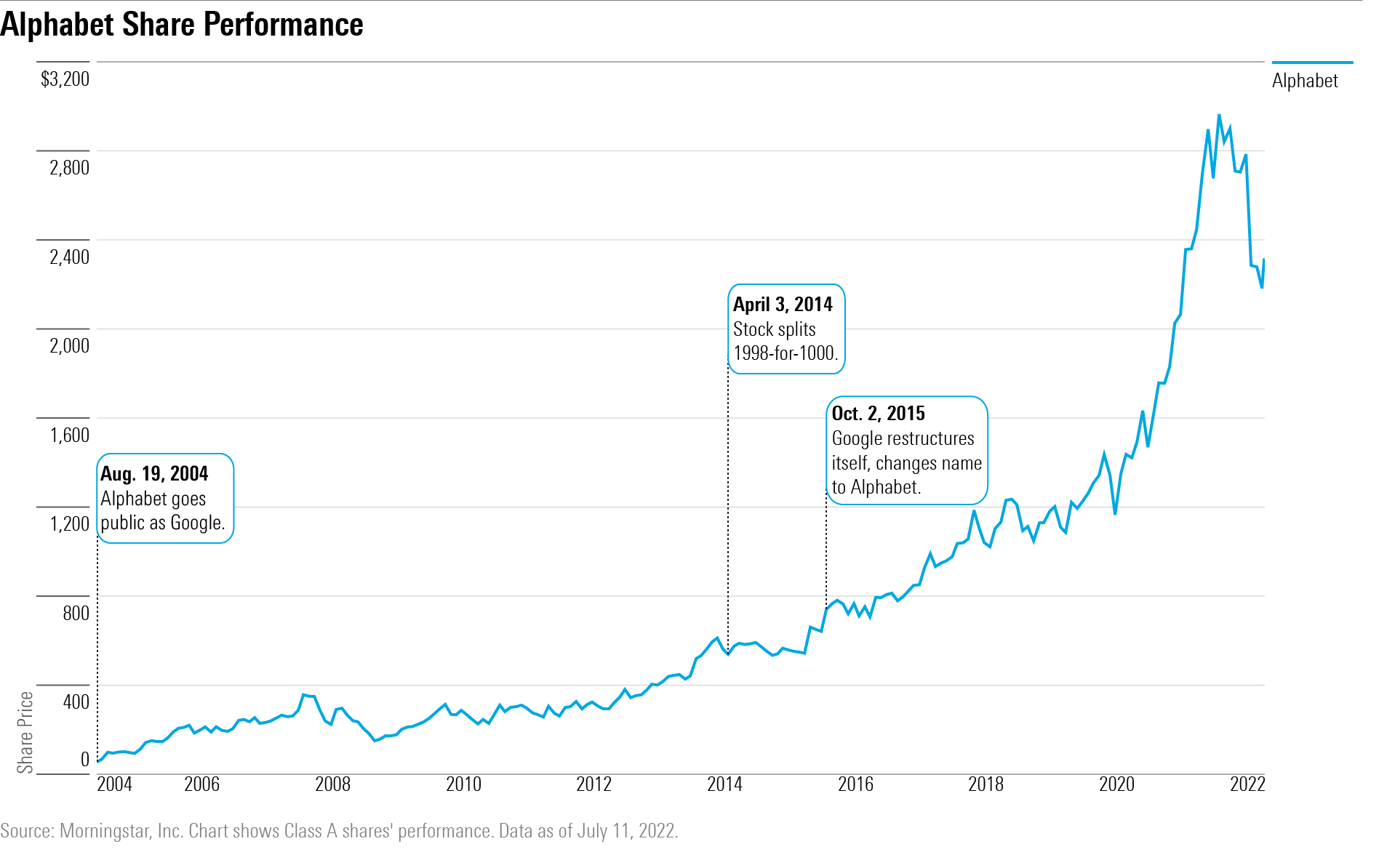
The first time Google split its stock was on April 3, 2014. This was not a traditional split intended purely for price reduction; rather, it was a move designed to preserve the voting control of the company’s founders, Larry Page and Sergey Brin.
In this 2-for-1 split, Google distributed a new class of non-voting shares (Class C) to existing shareholders of Class A shares. For every share of Class A (GOOGL) an investor owned, they received one share of Class C (GOOG). This effectively halved the price of the stock but doubled the number of shares in circulation. More importantly, it established the dual-ticker system that investors see today: GOOGL (with voting rights) and GOOG (without voting rights).
The 2022 Split: The 20-for-1 Transformation
The most significant split in the company’s history occurred on July 15, 2022. At the time, Alphabet shares were trading at approximately $2,200 each. For many individual investors, a single share represented a significant portion of a monthly salary or a total portfolio.
Alphabet announced a 20-for-1 stock split, which took effect after the close of business on July 15. When the market opened on Monday, July 18, the stock price was adjusted downward to approximately $110 per share. Shareholders received an additional 19 shares for every one share they previously held. This split applied to all three classes of Alphabet stock: Class A, Class B, and Class C. This move was widely celebrated by the retail investment community, as it made the company’s “sticker price” much more manageable.
The Mechanics and Motivation: Why Companies Split Their Stock
While a stock split does not change the fundamental value of a company—much like cutting a pizza into twelve slices instead of eight doesn’t create more pizza—it serves several strategic purposes in the financial markets. Alphabet’s decisions to split were driven by a combination of market accessibility, liquidity, and index inclusion.
Increasing Retail Accessibility
Before the 2022 split, Alphabet’s high share price was a barrier to entry. While many modern brokerage platforms offer fractional shares, many traditional investors and international platforms still require the purchase of whole shares. By lowering the price from over $2,000 to roughly $100, Alphabet made its stock accessible to a much broader demographic of retail investors. This democratization of ownership often leads to increased demand from the “main street” investing public.
Enhancing Market Liquidity
Liquidity refers to the ease with which an asset can be bought or sold without affecting its price. Stocks with very high prices often have lower trading volumes because fewer people are transacting in them. By increasing the number of shares outstanding and lowering the price per share, a stock split typically increases the daily trading volume. This higher liquidity benefits both institutional and retail investors by narrowing the “bid-ask spread”—the difference between the highest price a buyer is willing to pay and the lowest price a seller is willing to accept.
Eligibility for the Dow Jones Industrial Average
One of the most discussed reasons for the 2022 split was the potential for Alphabet to be included in the Dow Jones Industrial Average (DJIA). Unlike the S&P 500, which is market-cap weighted, the Dow is a price-weighted index. This means that a stock trading at $2,000 would exert an outsized, distorting influence on the entire index, making it impossible to include. By splitting 20-for-1 and bringing the price into the $100 range, Alphabet positioned itself as a viable candidate for the Dow, which is one of the most prestigious indices in the world.
Decoding the Ticker Symbols: GOOG vs. GOOGL
A unique byproduct of the 2014 split is the existence of two different ticker symbols for Google on the Nasdaq. For new investors, the distinction between GOOG and GOOGL is often a source of confusion, but it is a critical component of the company’s corporate governance strategy.
Class A Shares (GOOGL)
Class A shares are the “common” shares that most individual investors purchase. They carry one vote per share. If you are an investor who wants to have a say in shareholder proposals or elect the board of directors, GOOGL is the ticker to watch. Historically, Class A shares have traded at a slight premium to Class C shares due to these voting rights.
Class C Shares (GOOG)
Class C shares have no voting rights. They were created during the 2014 split to allow the company to issue stock for employee compensation and acquisitions without diluting the voting power of the founders. Because they lack voting power, they often trade at a very small discount compared to GOOGL, though the two typically move in tandem.
Class B Shares (The “Insider” Shares)
There is a third class of shares that is not traded on the public markets: Class B shares. These are held exclusively by founders and early insiders. Class B shares carry 10 votes per share, ensuring that Larry Page and Sergey Brin maintain majority control over the company’s direction, regardless of how many Class A or Class C shares are issued to the public.
Historical Performance: How the Market Reacted Post-Split
Investors often look for patterns in how a stock behaves immediately following a split. While a split is technically a “non-event” for a company’s valuation, the psychological impact on the market is often tangible.
The “Split Pump” Phenomenon
In the months leading up to the July 2022 split, Alphabet saw a surge in interest. Often, the announcement of a split is viewed by the market as a sign of management’s confidence. If a company is splitting its stock, it usually implies that the price has risen significantly and that management expects it to continue growing. This can lead to a “run-up” where investors buy into the stock in anticipation of the split.
Long-Term Value Creation
While the immediate reaction to a split can involve volatility, the long-term value of Alphabet has always been driven by its earnings, cloud computing growth, and dominance in search and advertising. Data from past decades shows that companies that split their stocks often outperform the broader market in the year following the split. However, financial analysts caution that this is a correlation, not necessarily a causation. The outperformance is usually because the company was already doing well enough to warrant a split in the first place.
Tax Implications and Portfolio Management for Investors
For the individual investor, a stock split is generally a tax-neutral event. However, there are administrative details that must be managed to ensure a portfolio remains accurate.
Cost Basis Adjustment
When a stock splits, your total investment value remains the same, but your “cost basis” per share is adjusted. For example, if you bought one share of Alphabet at $2,000 before the 2022 split, your cost basis for that single share was $2,000. After the 20-for-1 split, you would own 20 shares, and your new cost basis would be $100 per share ($2,000 divided by 20). It is vital to keep track of these adjustments for tax reporting purposes when you eventually sell the shares.
Impact on Options Trading
The 2022 split had a massive impact on the options market. A single options contract represents 100 shares of the underlying stock. Before the split, controlling 100 shares of Alphabet required a capital outlay of over $200,000, making many options strategies (like covered calls) inaccessible to retail traders. After the split, a 100-share contract represented a much more manageable $11,000. This increase in options activity provides more tools for investors to hedge their positions or generate income from their holdings.

Looking Ahead: Will Alphabet Split Again?
While there are no current plans for another split, Alphabet’s history suggests that if the stock price were to climb back toward the $1,000 to $2,000 range, management would likely consider the move again. For investors, the timing of a split is less important than the underlying health of the business. Alphabet’s diversified revenue streams—from YouTube and Google Cloud to its investments in Artificial Intelligence—remain the primary drivers of its share price. Whether the stock trades at $150 or $1,500, the intrinsic value of the company is determined by its ability to innovate and maintain its competitive advantages in the digital age.
aViewFromTheCave is a participant in the Amazon Services LLC Associates Program, an affiliate advertising program designed to provide a means for sites to earn advertising fees by advertising and linking to Amazon.com. Amazon, the Amazon logo, AmazonSupply, and the AmazonSupply logo are trademarks of Amazon.com, Inc. or its affiliates. As an Amazon Associate we earn affiliate commissions from qualifying purchases.