
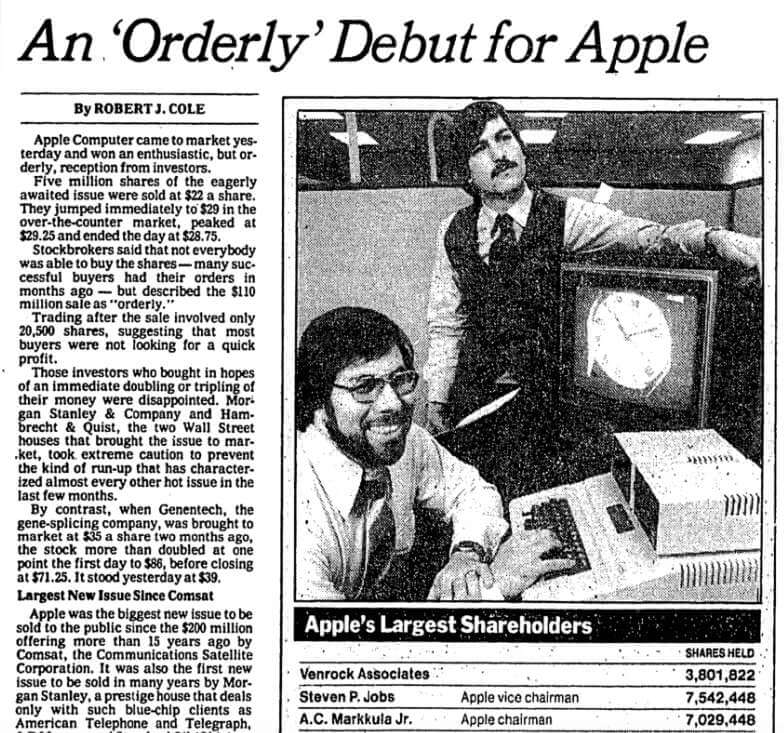
On December 12, 1980, the financial world witnessed an event that would eventually redefine the parameters of modern investing and corporate valuation. Apple Computer Inc. (now Apple Inc.) went public, offering 4.6 million shares at $22 each. Within minutes, the stock sold out, marking the beginning of one of the most storied journeys in the history of the Nasdaq. For the modern investor, understanding the Apple IPO is not merely a lesson in nostalgia; it is a fundamental case study in long-term wealth creation, market volatility, and the power of compound interest.

At the time of its debut, Apple’s IPO was the largest since Ford Motor Company went public in 1956. It created approximately 300 millionaires overnight—more than any company in history at that point. However, the path from a $22-per-share speculative tech play to a multi-trillion-dollar global titan was far from linear. By examining the financial mechanics of Apple’s market entry and its subsequent fiscal evolution, investors can gain critical insights into how generational wealth is built through equity markets.
The Financial Mechanics of the 1980 Debut
The Apple IPO was co-managed by Morgan Stanley and Hambrecht & Quist. In the late 1970s and early 1980s, the venture capital landscape was still in its relative infancy, and technology stocks were viewed with a mix of awe and deep skepticism. Apple, led by Steve Jobs and Steve Wozniak, represented the vanguard of the “personal computer” revolution, a concept that many traditional institutional investors struggled to quantify.
Valuation and Initial Market Cap
When the opening bell rang on December 12, Apple’s market capitalization sat at roughly $1.8 billion. To put this in perspective, the company’s valuation has since grown by over 150,000%. For the disciplined investor, the 1980 IPO serves as a reminder that the most significant returns often come from companies that solve problems consumers didn’t yet know they had. Apple wasn’t just selling hardware; it was selling a new way of interacting with information.
The demand for the stock was so high that it generated significant “pop” on its first day of trading. By the end of the session, the stock closed at $29, a 32% increase from its offering price. For those who secured shares at the $22 price point, the immediate unrealized gains were substantial, but the true value lay in the decades of growth that followed.
The Competitive Landscape of 1980
Investing in Apple at its IPO was a high-risk proposition. The company was competing against established giants like IBM and Hewlett-Packard. Unlike the Apple of today, which boasts a fortress-like balance sheet with hundreds of billions in cash, the 1980 version of Apple was a capital-intensive hardware manufacturer. The IPO proceeds were essential for scaling production of the Apple II and funding the development of the Lisa and the Macintosh. From a business finance perspective, the IPO was a survival mechanism as much as it was a wealth-generation event.
The Power of Stock Splits: Turning $22 into Pennies
For an investor who purchased a single share of Apple at the $22 IPO price and held it through the present day, the nominal value of that share would be astronomical. However, the actual number of shares owned would have increased significantly due to a series of stock splits. Understanding these splits is crucial for calculating the true “split-adjusted” IPO price, which reveals the staggering scale of the company’s growth.
A Chronology of Apple Stock Splits
Apple has executed five stock splits since its IPO. These corporate actions are typically taken to make shares more accessible to retail investors by lowering the price per share without changing the overall market capitalization of the company.
-
June 16, 1987: 2-for-1 split
-
June 21, 2000: 2-for-1 split
-
February 28, 2005: 2-for-1 split
-
June 9, 2014: 7-for-1 split
-
August 31, 2020: 4-for-1 split
Through these splits, a single share purchased in 1980 has transformed into 224 shares today.
The Split-Adjusted IPO Price
When we factor in these splits, the original $22 IPO price translates to a split-adjusted price of approximately $0.10 per share. This figure is one of the most compelling statistics in the world of personal finance. It illustrates that while the “sticker price” of a stock may seem high, the long-term compounding effect of growth and splits can reduce the effective entry point to mere pennies over a multi-decade horizon. For the value investor, this emphasizes the importance of time in the market over timing the market.
Financial Milestones and the Near-Death Experience
The trajectory of Apple’s stock was not a straight line upward. In fact, between the IPO in 1980 and the return of Steve Jobs in 1997, Apple’s financial health deteriorated to the point of near-bankruptcy. For investors, this period offers a masterclass in risk management and the importance of leadership in corporate finance.
The 1990s Crisis and the Microsoft Lifeline
By 1996, Apple was hemorrhaging cash. The company had lost its way with a bloated product line and dwindling market share. In 1997, the stock was trading at historic lows (adjusted for splits). The turning point came when Steve Jobs returned and negotiated a $150 million investment from Apple’s arch-rival, Microsoft.
From a strategic finance perspective, this investment was revolutionary. It provided the liquidity Apple needed to survive and signaled to the market that the company still had institutional backing. Investors who had the fortitude to hold or “buy the dip” during this era of extreme uncertainty saw their portfolios transformed in the following decade.
The Shift to a Services and Ecosystem Model
The modern financial strength of Apple is rooted in its transition from a pure hardware vendor to an ecosystem-based business. The introduction of the iPod (2001), iPhone (2007), and iPad (2010) shifted the company’s revenue streams toward recurring, high-margin software and services.
For the “Money” focused reader, the key takeaway is the evolution of Apple’s Gross Margin. As the company moved toward the App Store, iCloud, and Apple Music, its ability to generate free cash flow skyrocketed. This massive cash pile eventually led to the implementation of one of the largest capital return programs in corporate history, involving both dividends and aggressive share buybacks.
Dividend Policy and Share Buybacks
For decades after its IPO, Apple did not pay a dividend. Steve Jobs famously preferred to keep cash on the balance sheet to maintain “infinite” flexibility. However, under the leadership of Tim Cook, Apple’s financial strategy shifted to include returning value to shareholders directly.
The Reintroduction of Dividends (2012)
In 2012, Apple reinstated its dividend, instantly becoming one of the largest dividend payers in the world. For income-focused investors, this turned a growth stock into a “total return” powerhouse. The dividend has seen consistent annual increases, making Apple a favorite for those practicing dividend growth investing (DGI).
The Buyback Machine
Perhaps more significant than the dividend is Apple’s share repurchase program. Since 2012, the company has spent hundreds of billions of dollars buying back its own stock. In the world of business finance, buybacks reduce the total number of shares outstanding, which increases Earnings Per Share (EPS) and often boosts the stock price. This strategy has been a primary driver of Apple’s share price appreciation over the last decade, as it effectively makes each remaining share “scarcer” and more valuable.
Lessons for Modern Portfolio Management
The story of the Apple IPO is more than a history lesson; it is a blueprint for building a resilient investment portfolio. It highlights several core principles of successful long-term investing.
The Role of Volatility
Apple’s stock has experienced multiple drawdowns of 50% or more throughout its history. Investors who panicked during the dot-com bubble or the 2008 financial crisis missed out on the subsequent recoveries. The lesson here is that even the most successful companies in history require a high tolerance for short-term volatility to capture long-term gains.
Market Weight and Indexing
Today, Apple is a dominant component of major indices like the S&P 500 and the Nasdaq-100. For many retail investors, Apple is their largest holding, whether they realize it or not, through their retirement accounts and ETFs. This “concentration at the top” means that the health of the broader market is now intrinsically tied to Apple’s financial performance.

Conclusion: The Legacy of December 12, 1980
When Apple went public in 1980, few could have predicted it would become the first company to reach a $1 trillion, $2 trillion, and then $3 trillion market cap. The IPO was the catalyst that allowed a small garage-based operation to scale into a global empire. For the individual investor, the Apple story serves as the ultimate validation of the “Buy and Hold” philosophy. While the $22 price tag of 1980 is long gone, the financial principles that drove Apple’s success—innovation, ecosystem lock-in, and disciplined capital allocation—remain the gold standard for evaluating the next generation of market leaders.
aViewFromTheCave is a participant in the Amazon Services LLC Associates Program, an affiliate advertising program designed to provide a means for sites to earn advertising fees by advertising and linking to Amazon.com. Amazon, the Amazon logo, AmazonSupply, and the AmazonSupply logo are trademarks of Amazon.com, Inc. or its affiliates. As an Amazon Associate we earn affiliate commissions from qualifying purchases.