
The story of Amazon is often told as a tale of technological disruption, but at its core, it is one of the most significant financial narratives in modern history. Long before it became the “everything store” or a titan of cloud computing, Amazon was a loss-making online bookseller operating out of a garage in Bellevue, Washington. For investors, the pivotal moment occurred on May 15, 1997, when the company transitioned from a private venture to a publicly-traded entity.
Understanding Amazon’s Initial Public Offering (IPO) is not just a lesson in history; it is a fundamental case study for any modern investor interested in capital allocation, long-term growth strategies, and the power of compounding. When Amazon debuted on the Nasdaq, few could have predicted that a company with a $438 million market capitalization would eventually cross the $2 trillion threshold.

The Financial Mechanics of the 1997 Debut
Amazon’s IPO took place during the early, optimistic days of the dot-com boom. While many companies were rushing to market with little more than a “dot-com” suffix, Jeff Bezos approached the public markets with a specific, albeit unconventional, financial philosophy. On May 15, 1997, Amazon listed its shares under the ticker symbol AMZN.
The May 15, 1997 Launch
Amazon went public at a price of $18.00 per share. The offering was led by Deutsche Morgan Grenfell, alongside firms like Alex. Brown & Sons and Hambrecht & Quist. At the time of the IPO, the company offered 3 million shares, raising roughly $54 million in capital. This influx of cash was critical; in 1996, the year prior to the IPO, Amazon had reported net sales of $15.7 million but a net loss of $5.8 million. The IPO provided the “war chest” necessary to scale operations and expand beyond the book category.
Initial Valuation and Market Reception
Upon its debut, Amazon was valued at approximately $438 million. To put that in perspective, contemporary retail giants like Barnes & Noble were much larger and perceived as more stable. However, the market’s reception was surprisingly warm for a company that had yet to turn a profit. Investors were betting on the scalability of the internet and Bezos’s vision of a “frictionless” retail experience. Within the first day of trading, the stock price climbed, closing at $23.50, a nearly 30% jump from its offering price.
Navigating the Dot-Com Bubble and Financial Resilience
To understand the financial journey of Amazon post-IPO, one must look at how the company managed its capital during the late 90s and early 2000s. The period following the IPO was characterized by extreme volatility that tested the resolve of even the most seasoned institutional investors.
Surviving the Tech Crash of 2000
The “dot-com bubble” burst in early 2000, sending tech stocks into a tailspin. Amazon was not immune. From its peak in 1999 to its trough in late 2001, Amazon’s stock price plummeted by more than 90%. Many analysts predicted the company would run out of cash before it could achieve profitability. However, Amazon had strategically raised $672 million in convertible bonds just weeks before the market crashed, providing a liquidity cushion that allowed it to survive while competitors went bankrupt. This move remains a classic example of prudent financial timing in the face of macro-economic uncertainty.
Reinvesting Profits: The “Bezos” Financial Model
One of the most distinctive aspects of Amazon’s post-IPO finance strategy was its refusal to prioritize short-term quarterly earnings. In his first letter to shareholders in 1997, Bezos famously stated, “It’s all about the long term.” For decades, Amazon took nearly every dollar of operating cash flow and reinvested it into fulfillment centers, technology, and new business lines. This “low-margin by choice” strategy allowed the company to defer taxes and build an impenetrable moat, prioritizing market share and free cash flow over traditional net income metrics.
The Power of Stock Splits and Long-Term Holding

For the individual investor, the “Money” story of Amazon is most vividly illustrated through its history of stock splits. Stock splits do not change the fundamental value of a company, but they increase liquidity and make shares more accessible to retail investors.
Understanding the Historical Splits
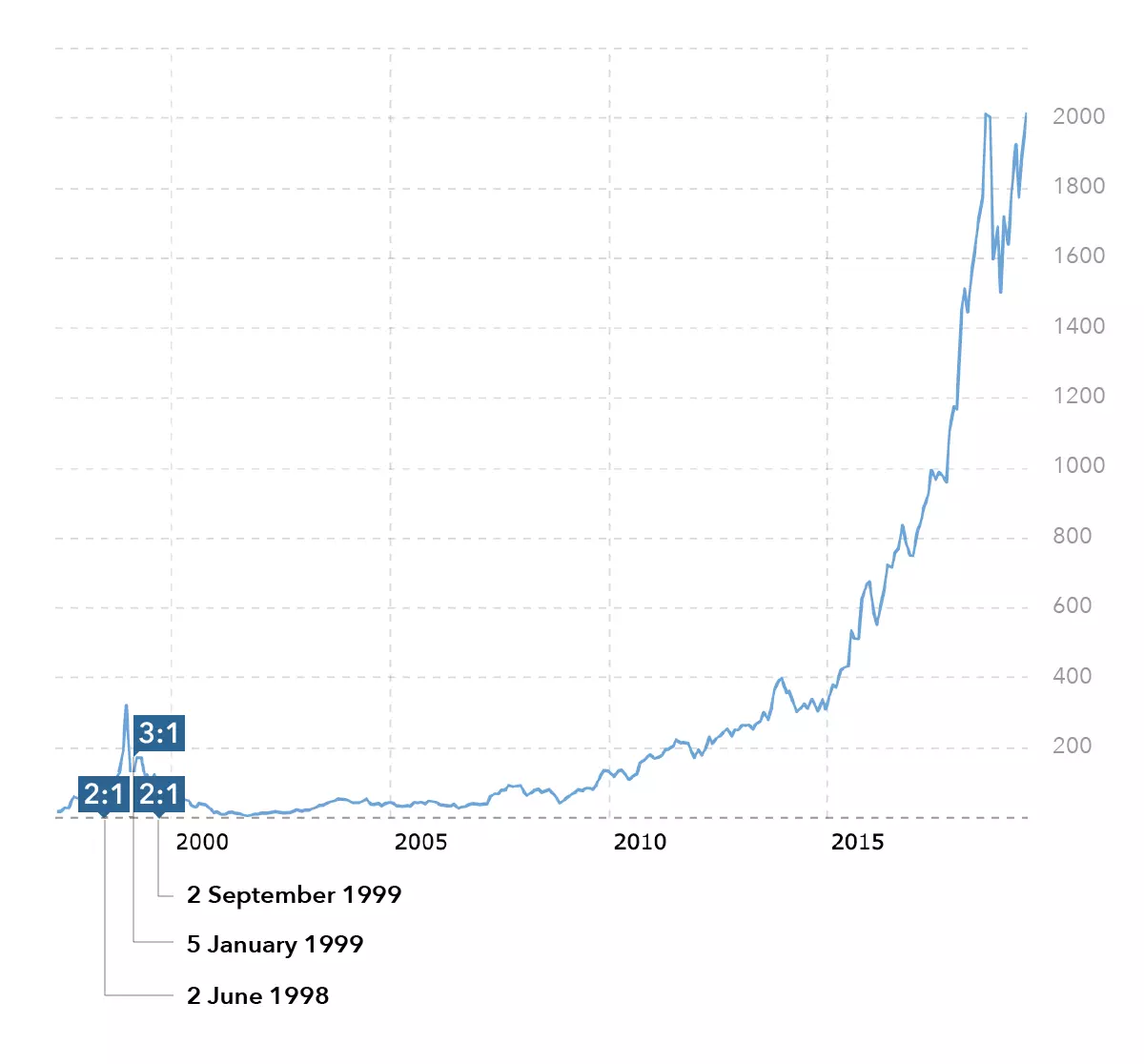
Since its IPO, Amazon has undergone four stock splits:
- June 1998: A 2-for-1 split.
- January 1999: A 3-for-1 split.
- September 1999: A 2-for-1 split.
- June 2022: A 20-for-1 split.
These splits have a massive cumulative effect on an investor’s share count. An investor who purchased a single share at the IPO would, through the magic of these splits, own 240 shares today (2 x 3 x 2 x 20).
Calculating the ROI: What a $1,000 Investment is Worth Today
If an investor had the foresight—and the stomach—to invest $1,000 at the IPO price of $18.00 per share, they would have purchased roughly 55 shares. Following the various stock splits, those 55 shares would have ballooned into approximately 13,200 shares. At a hypothetical current market price of $180.00 per share, that initial $1,000 investment would be worth roughly $2.37 million. This represents a compounded annual growth rate (CAGR) that stands as one of the highest in the history of the equity markets, underscoring the life-changing potential of identifying high-growth companies early in their lifecycle.
Strategic Diversification and Revenue Growth
The trajectory of Amazon’s stock price post-IPO is inextricably linked to its evolution from a retail merchant to a diversified conglomerate. From a financial perspective, the company’s ability to generate high-margin revenue streams fundamentally changed its valuation multiples.
From Retail to AWS: The Profit Engine
While Amazon.com provided the volume, Amazon Web Services (AWS) provided the profit. Launched in 2006, AWS allowed Amazon to monetize its internal infrastructure. From a business finance standpoint, AWS transformed Amazon’s balance sheet. Cloud computing offers significantly higher margins than physical retail. Today, AWS often accounts for the majority of Amazon’s operating income, allowing the company to subsidize its logistics network and continue its aggressive expansion into groceries, healthcare, and streaming.
The Role of Prime in Predictable Cash Flow
Another masterstroke in Amazon’s financial strategy was the introduction of Amazon Prime. By charging an annual fee for a subscription service, Amazon turned “variable” shoppers into “recurring” revenue sources. Subscription revenue is highly valued by Wall Street because it is predictable and provides immediate cash flow. Prime members spend significantly more than non-members, creating a “flywheel effect” where increased volume leads to lower costs, which leads to lower prices, which attracts more customers.
Lessons for Modern Investors
The Amazon IPO story offers several evergreen takeaways for anyone looking to build wealth through the stock market. While we cannot go back to 1997, we can apply the lessons of Amazon’s growth to today’s emerging sectors.
Identifying Visionary Leadership
One of the key qualitative factors in Amazon’s success was Jeff Bezos’s ability to communicate a clear, long-term financial vision. Investors who succeeded with Amazon were those who looked past the “noise” of quarterly earnings and focused on the company’s stated goal of maximizing free cash flow per share. When evaluating modern startups, looking at the quality of leadership and their commitment to long-term value creation is often more important than the current P/E ratio.
The Importance of the “Long-Game” Mentality
Perhaps the most difficult lesson from Amazon’s IPO is the necessity of patience. To achieve the millionaire-maker returns mentioned above, an investor had to hold through the 2000 crash, the 2008 financial crisis, and numerous 20-30% corrections along the way. In a world of high-frequency trading and 24-hour news cycles, the Amazon story serves as a reminder that the greatest financial rewards go to those who can withstand volatility in favor of a long-term thesis.
In conclusion, Amazon’s IPO was more than just a date on a calendar; it was the birth of a new financial paradigm. By focusing on the customer, reinvesting relentlessly, and maintaining a long-term horizon, Amazon grew from a $18-per-share underdog into a global financial powerhouse. For the modern investor, the “Amazon way” remains a blueprint for understanding how capital, vision, and time can combine to create unprecedented wealth.
aViewFromTheCave is a participant in the Amazon Services LLC Associates Program, an affiliate advertising program designed to provide a means for sites to earn advertising fees by advertising and linking to Amazon.com. Amazon, the Amazon logo, AmazonSupply, and the AmazonSupply logo are trademarks of Amazon.com, Inc. or its affiliates. As an Amazon Associate we earn affiliate commissions from qualifying purchases.