
Navigating the complexities of the tax calendar is a fundamental pillar of sound financial management. Whether you are a salaried employee, a high-net-worth investor, or a small business owner, understanding precisely when taxes are due is essential for maintaining liquidity, avoiding punitive interest charges, and ensuring long-term fiscal health. The federal tax system in the United States operates on a “pay-as-you-go” basis, meaning that the government expects to receive revenue throughout the year rather than in one lump sum at the end. Consequently, “Tax Day” is merely the final deadline for a much larger cycle of financial obligations.
Federal Income Tax Deadlines for Individuals
For the vast majority of Americans, the most significant date on the calendar is April 15. This is the deadline for filing individual income tax returns (Form 1040) and paying any remaining balance owed for the previous calendar year. However, the exact date can shift slightly if April 15 falls on a Saturday, Sunday, or a legal holiday. In such cases, the deadline is pushed to the next business day. For residents of certain states, local holidays—such as Patriot’s Day in Maine and Massachusetts or Emancipation Day in Washington, D.C.—can also provide a brief window of additional time.
The Standard April 15 Filing and Payment
The April deadline serves two primary purposes: it is the final date to submit your tax return and the final date to pay any tax liability incurred during the prior year. It is a common misconception that obtaining a filing extension also extends the time allowed to pay. Even if you receive an extension, the Internal Revenue Service (IRS) requires that you estimate your tax liability and pay that amount by the April deadline to avoid interest and late-payment penalties.
The Nuances of Tax Extensions
If you find yourself unable to complete your paperwork by mid-April, you can file Form 4868 to receive an automatic six-month extension, moving your filing deadline to October 15. This is particularly useful for individuals with complex investments, such as K-1s from private equity or hedge funds, which often arrive late in the season. While the extension provides relief from the “failure to file” penalty, it does not stop the clock on interest for unpaid balances. Therefore, savvy financial planning involves overestimating your liability in April to ensure a “safe harbor” payment is made.
Estimated Quarterly Tax Payments
For individuals who do not have taxes withheld from their income—such as freelancers, gig economy workers, and those with significant investment income—the IRS requires quarterly estimated tax payments. These are due on a strictly defined schedule:
-
First Quarter (Jan 1 – March 31): Due April 15.
-
Second Quarter (April 1 – May 31): Due June 15.
-
Third Quarter (June 1 – Aug 31): Due September 15.
-
Fourth Quarter (Sept 1 – Dec 31): Due January 15 of the following year.
Failure to make these payments in a timely fashion can result in underpayment penalties, even if you pay the full amount by the following April. This emphasizes the importance of a “Money-first” mindset where cash flow is managed proactively to meet these recurring obligations.
Business Tax Obligations and Filing Timelines
Business entities face a different set of rules and deadlines that depend largely on their legal structure. Because businesses often serve as the primary source of income for their owners, these deadlines are inextricably linked to personal financial planning.
C-Corporations vs. Pass-Through Entities
For C-Corporations, the tax filing and payment deadline is generally the 15th day of the fourth month following the close of their fiscal year. For most corporations operating on a standard calendar year, this matches the individual deadline of April 15. However, pass-through entities such as S-Corporations and Partnerships (Form 1065) have an earlier deadline: March 15.
The rationale behind the March 15 deadline is to allow the entity to process its financial data and issue Schedule K-1s to its partners or shareholders. This ensures that the individuals receiving that income have the information necessary to file their personal returns by the April deadline. Missing the March 15 deadline can lead to significant per-month, per-partner penalties that can quickly erode a business’s capital.
Employment and Payroll Taxes
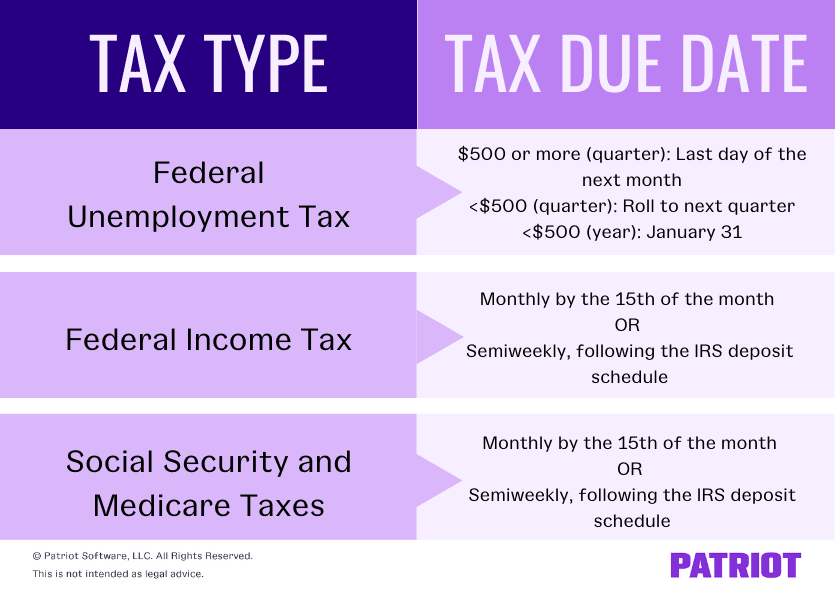
Beyond income tax, businesses with employees must adhere to rigorous payroll tax schedules. These are not annual or quarterly events but are often semi-weekly or monthly, depending on the size of the payroll. Employers must withhold Social Security, Medicare, and federal income taxes from employees’ wages and contribute the employer’s share of FICA taxes. These funds are held in trust and must be deposited via the Electronic Federal Tax Payment System (EFTPS). The stakes are high here; the IRS is particularly aggressive regarding payroll tax delays, as these funds are legally considered the property of the employees and the government.
Excise and Industry-Specific Taxes
Certain industries are subject to excise taxes, which are often due on a quarterly basis using Form 720. This applies to businesses involved in transportation, environmental services, and the sale of specific commodities. Understanding these niche deadlines is vital for maintaining a compliant and profitable business model in specialized sectors.
State and Local Tax Considerations

While federal deadlines provide a general framework, state and local tax jurisdictions operate on their own schedules. Most states align their income tax deadlines with the federal calendar, but this is not a universal rule.
Variances in State Income Tax
States like Delaware, for instance, have historically set their individual filing deadlines for April 30. Other states may offer different extension periods or have unique requirements for estimated payments. If you live in one state but work in another, or if you own property in multiple jurisdictions, you must manage a “tax nexus” that involves multiple, potentially conflicting deadlines.
Property and Sales Taxes
Property taxes are typically handled at the county or municipal level and are often due in two installments (e.g., December and June). For many homeowners, these are bundled into mortgage escrow payments, but for those who own property outright or hold commercial real estate, missing these dates can lead to tax liens.
Similarly, business owners must stay vigilant regarding sales tax filings. Depending on the volume of sales, these may be due monthly, quarterly, or annually. With the rise of e-commerce and the “Wayfair” ruling, businesses are now often responsible for collecting and remitting sales tax in states where they have no physical presence, adding a significant layer of administrative complexity to the financial calendar.
Strategies for Managing Tax Liability Throughout the Year
The key to mastering the tax calendar is to view it as a continuous process rather than an annual event. Proactive management reduces stress and allows for more efficient capital allocation.
Record Keeping and Digital Financial Tools
In the modern economy, manual bookkeeping is a liability. Using robust accounting software allows for real-time tracking of income and expenses. This visibility is crucial for calculating accurate quarterly estimated payments. By categorizing expenses as they occur, you can identify deductible business costs, charitable contributions, and medical expenses long before the year ends, allowing you to project your final tax bill with precision.
Leveraging Tax-Advantaged Accounts
One of the most effective ways to manage what you owe is by contributing to tax-advantaged accounts. For individuals, contributions to a Traditional IRA or a Health Savings Account (HSA) can often be made up until the April filing deadline and still count toward the previous year’s tax deductions. For business owners, setting up a SEP-IRA or a Solo 401(k) can provide significant relief, though the deadlines for establishing these accounts vary. Utilizing these tools effectively requires an awareness of the intersection between contribution deadlines and tax filing deadlines.
The Role of Professional Consultation
Given the shifting landscape of tax law—including changes to standard deductions, credits, and corporate rates—consulting with a Certified Public Accountant (CPA) or a tax strategist is often a high-return investment. Professionals can help identify “tax-loss harvesting” opportunities in investment portfolios before the end of the calendar year, which can offset capital gains and reduce the total tax due in April.
The Consequences of Missing Deadlines
Understanding when taxes are due is only half the battle; one must also understand the gravity of missing those dates. The IRS and state agencies employ a tiered system of penalties designed to encourage compliance.
Interest and Penalties
There are two primary penalties to be aware of: the failure-to-file penalty and the failure-to-pay penalty. The penalty for failing to file is generally much higher—typically 5% of the unpaid taxes for each month or part of a month that a tax return is late. The penalty for failing to pay is 0.5% of the unpaid taxes for each month. If both apply in the same month, the 5% failure-to-file penalty is reduced by the failure-to-pay penalty.
Interest also accrues on any unpaid tax from the due date of the return until the date of payment. Unlike the penalties, which can sometimes be abated for “reasonable cause,” interest is statutory and almost never waived.

Mitigation Strategies for Late Filers
If you realize you have missed a deadline, the best course of action is to file and pay as soon as possible to stop the accumulation of interest and penalties. For those facing financial hardship, the IRS offers installment agreements and “Offers in Compromise,” though these require full disclosure of financial status and a commitment to future compliance. Staying ahead of the calendar is always more cost-effective than negotiating a settlement after the fact.
By maintaining a rigorous focus on the dates outlined above, individuals and businesses can transform tax compliance from a source of anxiety into a structured component of their broader financial strategy. Wealth is built not just by what you earn, but by what you keep—and keeping your money requires a mastery of the tax clock.
aViewFromTheCave is a participant in the Amazon Services LLC Associates Program, an affiliate advertising program designed to provide a means for sites to earn advertising fees by advertising and linking to Amazon.com. Amazon, the Amazon logo, AmazonSupply, and the AmazonSupply logo are trademarks of Amazon.com, Inc. or its affiliates. As an Amazon Associate we earn affiliate commissions from qualifying purchases.