
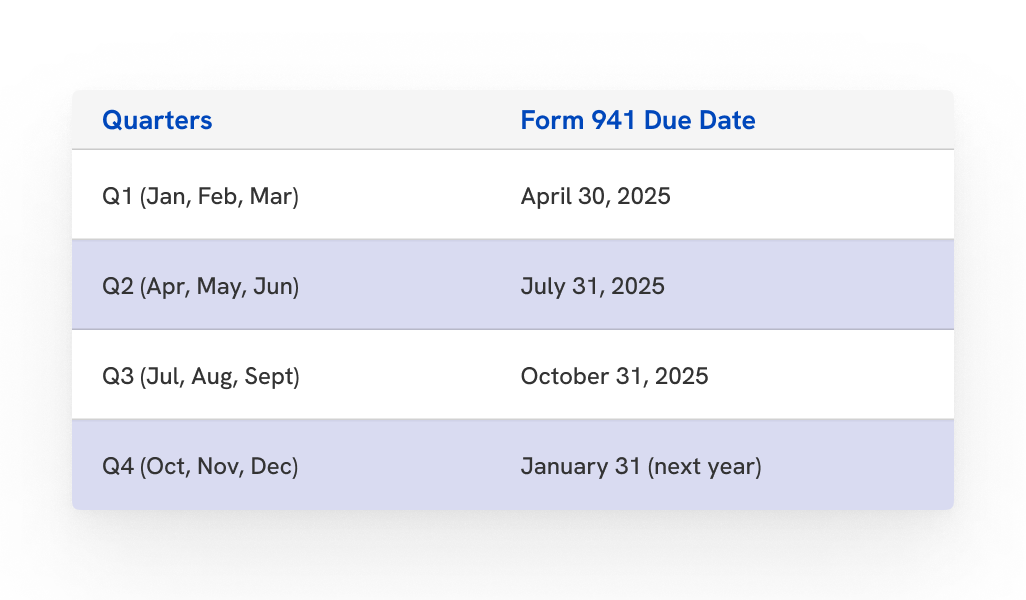
For business owners and financial officers, managing payroll is more than just ensuring employees receive their paychecks on time. It involves a complex web of federal obligations, the most significant of which is the management of Form 941 taxes. Form 941, the Employer’s Quarterly Federal Tax Return, is the mechanism through which businesses report income taxes, Social Security tax, and Medicare tax withheld from employee wages, as well as the employer’s portion of Social Security and Medicare taxes.
While the form itself is filed quarterly, the actual money—the deposits—must often be sent to the IRS much more frequently. Understanding the nuances of when these 941 deposits are due is not merely a matter of administrative bookkeeping; it is a critical component of cash flow management and legal compliance. Failure to adhere to the strict deposit schedules can lead to compounding penalties that can threaten the solvency of a growing enterprise.
Determining Your Deposit Schedule: The Lookback Period
The IRS does not assign a deposit schedule arbitrarily. Instead, your schedule is determined by the total tax liability you reported on Form 941 during a specific timeframe known as the “lookback period.” Understanding this period is the first step in identifying your specific deadlines.
What is the Lookback Period?
For most employers, the lookback period is a 12-month timeframe that covers four quarters, ending on June 30 of the previous year. For example, to determine your deposit schedule for the calendar year 2024, the lookback period would be July 1, 2022, through June 30, 2023.
The IRS examines the total taxes reported during this window. If your total tax liability was $50,000 or less during the lookback period, you are classified as a monthly schedule depositor. If your total tax liability exceeded $50,000, you are classified as a semi-weekly schedule depositor.
New Employers and the Lookback Rule
If you are a new employer and had no employees (and thus no tax liability) during the lookback period, the IRS treats your liability as zero for those quarters. Consequently, most new businesses begin as monthly schedule depositors. However, this status can change instantly if the business experiences rapid growth or a significant payroll event, triggering the $100,000 Next-Day Deposit Rule, which overrides all other schedules.
Annual Re-evaluation
It is important to note that your deposit status is not permanent. Every year, you must re-evaluate your status based on the shifting lookback period. A business that was a monthly depositor in 2023 may find themselves moved to the semi-weekly schedule in 2024 if their payroll expanded significantly during the mid-year peak of the previous lookback cycle.
The Two Primary Deposit Schedules: Monthly and Semi-Weekly
Once you have calculated your total liability from the lookback period, you will fall into one of two primary categories. Each has its own distinct set of rules and deadlines that must be followed with precision.
The Monthly Deposit Schedule
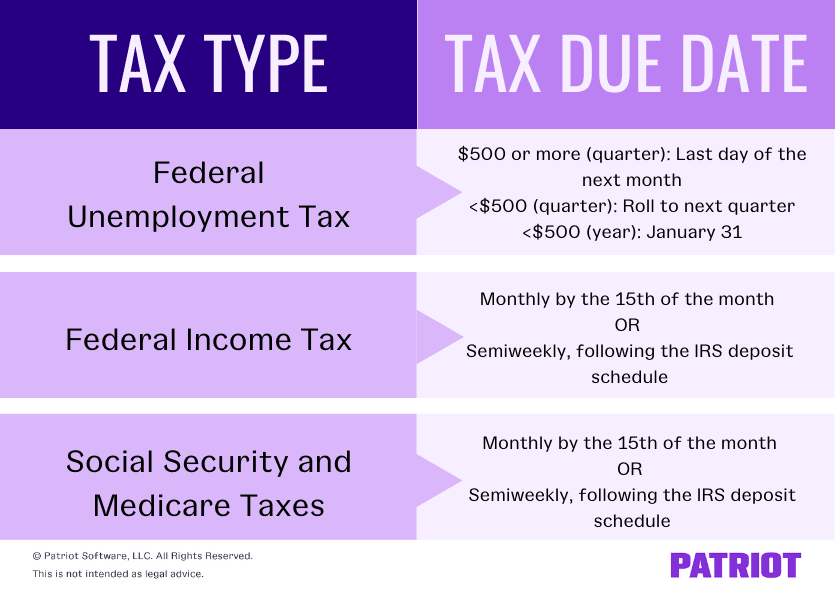
If you are a monthly schedule depositor, your deadline is relatively straightforward. You must deposit the employment taxes for payments made during a specific month by the 15th day of the following month. For instance, the taxes on wages paid in January must be deposited by February 15th.
This schedule provides a consistent rhythm for small to medium-sized businesses, allowing them to integrate tax obligations into their standard monthly closing procedures. However, the simplicity of the monthly schedule should not lead to complacency; missing the 15th deadline by even a single day can trigger a Failure to Deposit (FTD) penalty.
The Semi-Weekly Deposit Schedule
The semi-weekly schedule is more complex and is designed for larger employers who handle significant volumes of tax revenue. Despite the name “semi-weekly,” deposits are not necessarily made twice a week; rather, the due date depends on which day of the week your payday falls.
-
Wednesday, Thursday, or Friday Paydays: If your payday falls on a Wednesday, Thursday, or Friday, you must deposit the associated taxes by the following Wednesday.
-
Saturday, Sunday, Monday, or Tuesday Paydays: If your payday falls on a Saturday, Sunday, Monday, or Tuesday, you must deposit the taxes by the following Friday.
This schedule ensures that the IRS receives large sums of tax revenue shortly after the funds are withheld from employee checks. It requires a much more agile accounting department and tight integration between payroll processing and treasury management.
The $2,500 Rule for Small Liabilities
There is a rare exception for very small businesses. If your total tax liability for the entire quarter is less than $2,500, you are not required to make deposits. Instead, you can pay the full amount when you file your quarterly Form 941. However, if there is any chance your liability will exceed $2,500, it is safer to make monthly deposits to avoid the risk of late-payment penalties if the final quarterly tally exceeds the threshold.
Critical Exceptions and the $100,000 Next-Day Rule
In the world of federal tax compliance, certain events can trigger immediate obligations that override your standard monthly or semi-weekly schedule. The most significant of these is the $100,000 Next-Day Deposit Rule.
The $100,000 Next-Day Rule Explained
If at any point during a deposit period (whether you are a monthly or semi-weekly depositor) your accumulated tax liability reaches $100,000 or more, you must deposit the taxes by the next business day. This rule is absolute and takes precedence over all other schedules.
Furthermore, if a monthly depositor triggers this rule, they are immediately and permanently converted into a semi-weekly depositor for the remainder of the current year and the entirety of the following calendar year. This “acceleration” is a safeguard used by the IRS to ensure that large pools of tax dollars are moved into the federal treasury as quickly as possible.
Handling Weekends and Legal Holidays
Tax deadlines often collide with the calendar’s reality of weekends and federal holidays. The IRS provides a “safe harbor” for these instances: if a deposit due date falls on a Saturday, Sunday, or a legal holiday, the deposit is considered timely if it is made by the close of the next business day.
For semi-weekly depositors, it is important to note that you always have at least three business days to make a deposit. If a legal holiday falls within that three-day window, you are granted an extra day. This nuance is vital for businesses operating across multiple states, as federal holidays apply regardless of local state holiday observations.
The Accuracy of Deposits Rule
The IRS understands that calculating payroll taxes to the penny can be difficult in real-time. Under the “Accuracy of Deposits” rule (also known as the 98% safe harbor), a business will not be penalized if they deposit at least 98% of their tax liability on time, provided that the remaining balance is paid by a specific “make-up” date. For monthly depositors, the shortfall must be paid by the due date of the quarterly return. For semi-weekly depositors, it must be paid by the first Wednesday or Friday that falls on or after the 15th of the month in which the deposit was due.
Consequences of Late Deposits: Penalties and Personal Liability
The IRS views payroll taxes differently than standard corporate income taxes. Because a portion of these funds is “withheld” from employees, the IRS considers these “trust fund taxes.” In the eyes of the law, the employer is merely holding this money in trust for the federal government. Consequently, the penalties for failing to deposit these funds on time are among the most severe in the tax code.
Failure to Deposit (FTD) Penalty Tiers
The FTD penalty is calculated based on how many days the deposit is late. The tiers are as follows:
-
1–5 days late: 2% of the unpaid amount.
-
6–15 days late: 5% of the unpaid amount.
-
More than 15 days late: 10% of the unpaid amount.
-
More than 10 days after the first IRS notice: 15% of the unpaid amount.
While 2% or 5% might seem manageable, these penalties are not deductible as a business expense. Furthermore, they are often accompanied by interest charges that accrue daily, creating a snowball effect that can rapidly drain a company’s cash reserves.
The Trust Fund Recovery Penalty (TFRP)
Perhaps the most daunting aspect of 941 compliance is the Trust Fund Recovery Penalty. If a business fails to pay its withheld taxes, the IRS can “pierce the corporate veil” and hold individuals personally liable for the unpaid amounts. This applies to “responsible persons”—anyone who has the authority and responsibility to ensure the taxes are paid, such as owners, CEOs, CFOs, or even board members. The TFRP allows the IRS to seize personal assets, including bank accounts and property, to satisfy the debt.
Strategic Best Practices for Managing 941 Obligations
To stay compliant and avoid the stress of IRS notices, businesses must move beyond reactive accounting and adopt proactive financial strategies.
Utilizing the Electronic Federal Tax Payment System (EFTPS)
Most businesses are required to use EFTPS to make their 941 deposits. It is a free service provided by the Department of the Treasury. The key to successful EFTPS usage is timing; payments must usually be scheduled at least one calendar day before the due date (before 8:00 p.m. ET) to be considered on time. Relying on last-minute transfers is a risky strategy that often results in late deposits due to technical glitches or banking delays.
Segregating Payroll Tax Funds
A common pitfall for small businesses is treating withheld payroll taxes as operational cash. To prevent this, many financial advisors recommend opening a separate “Tax Escrow” bank account. Every time payroll is processed, the total tax liability should be transferred immediately from the general operating account into the tax account. This ensures that the funds are available when the deposit deadline arrives, regardless of other fluctuations in business revenue.
Automation and Professional Oversight
As a business grows, the complexity of semi-weekly schedules and $100,000 rules often outstrips the capabilities of manual bookkeeping. Leveraging modern payroll software or hiring a dedicated payroll service provider can automate the calculation and deposit process. These systems are designed to update automatically in response to changes in tax laws and lookback periods, providing an essential layer of security for the business’s financial health.
Ultimately, mastering the timing of 941 deposits is a hallmark of a mature, well-managed business. By understanding the lookback period, adhering strictly to the monthly or semi-weekly schedules, and preparing for the next-day rules, business leaders can ensure they remain in good standing with the IRS, protecting both their company’s assets and their own personal financial security.
aViewFromTheCave is a participant in the Amazon Services LLC Associates Program, an affiliate advertising program designed to provide a means for sites to earn advertising fees by advertising and linking to Amazon.com. Amazon, the Amazon logo, AmazonSupply, and the AmazonSupply logo are trademarks of Amazon.com, Inc. or its affiliates. As an Amazon Associate we earn affiliate commissions from qualifying purchases.