
For investors and market enthusiasts, few companies command as much attention as Apple Inc. (AAPL). As a cornerstone of the modern portfolio and a bellwether for the broader technology and consumer goods sectors, Apple’s corporate actions are scrutinized with unparalleled intensity. Among the most frequent questions from retail investors is the timing of the next stock split. While a stock split does not change the fundamental value of a company, it serves as a powerful signal of corporate health and a tool for market accessibility. Understanding when Apple might split its stock requires a deep dive into historical patterns, the mechanics of share pricing, and the strategic objectives of Apple’s board of directors.
The Mechanics and Motivation Behind the Stock Split
To predict when Apple might split its stock again, one must first understand the “why” behind the move. In a technical sense, a stock split is a corporate action in which a company divides its existing shares into multiple shares to boost the liquidity of the shares. Although the number of shares outstanding increases by a specific multiple, the total dollar value of the shares remains the same compared to pre-split amounts, because the split does not add any real value.
Enhancing Accessibility for Retail Investors
The primary motivation for a stock split is often the psychological and practical accessibility of the share price. When a stock price climbs into the several hundreds or thousands of dollars, it can become a barrier for retail investors who may not have access to fractional share trading through their brokerages. By lowering the price per share through a split, Apple makes its stock more “affordable” to a wider range of investors, potentially increasing demand and broadening the shareholder base.
Influencing the Dow Jones Industrial Average
Apple is a constituent of the Dow Jones Industrial Average (DJIA). Unlike the S&P 500, which is market-capitalization-weighted, the Dow is price-weighted. This means that a company with a higher stock price has a greater influence on the index’s performance than a company with a lower stock price, regardless of their relative sizes. If Apple’s share price were to climb too high—say, to $500 or $600—it would exert an outsized influence on the Dow, potentially distorting the index. Historically, Apple has used stock splits to ensure its weighting within the DJIA remains balanced, ensuring it remains a team player within the thirty-stock benchmark.
Apple’s Historical Context: Tracking the Patterns
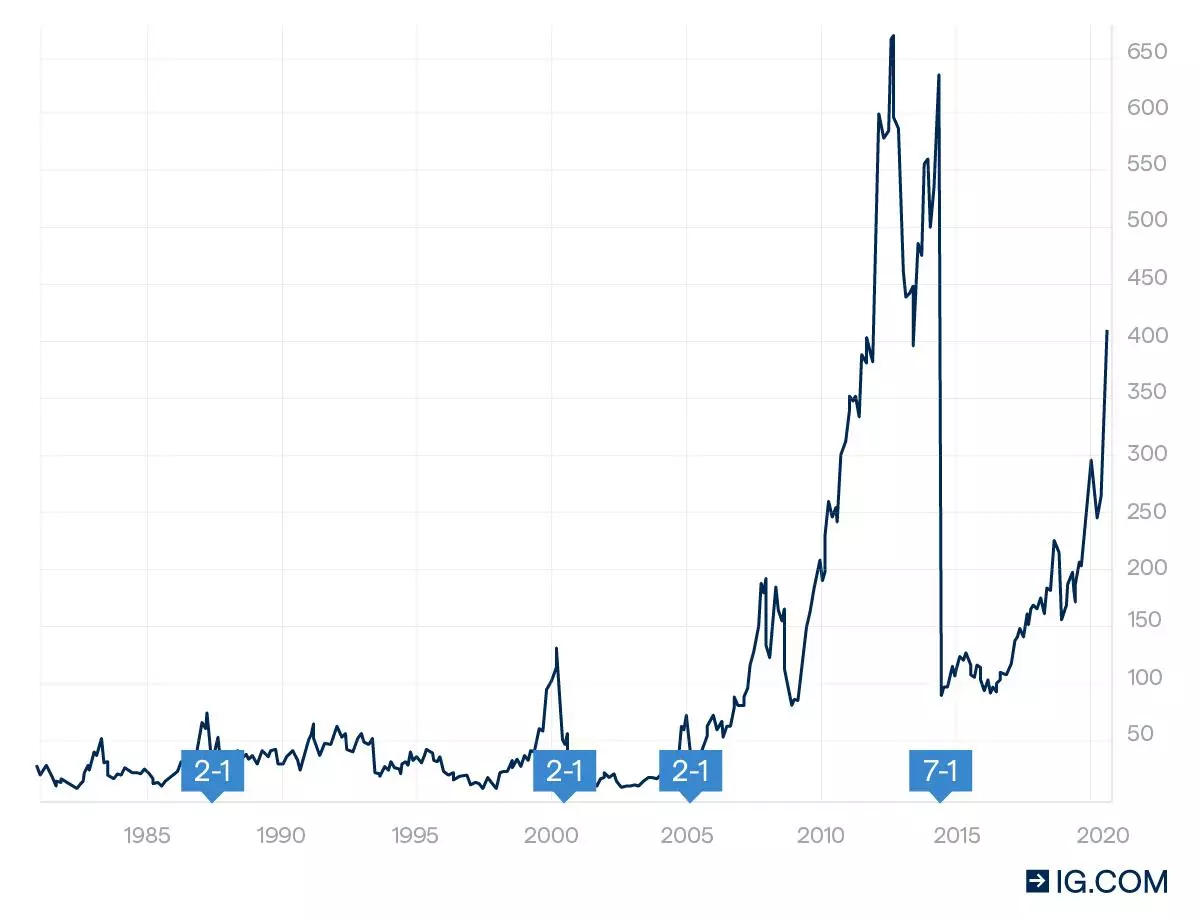
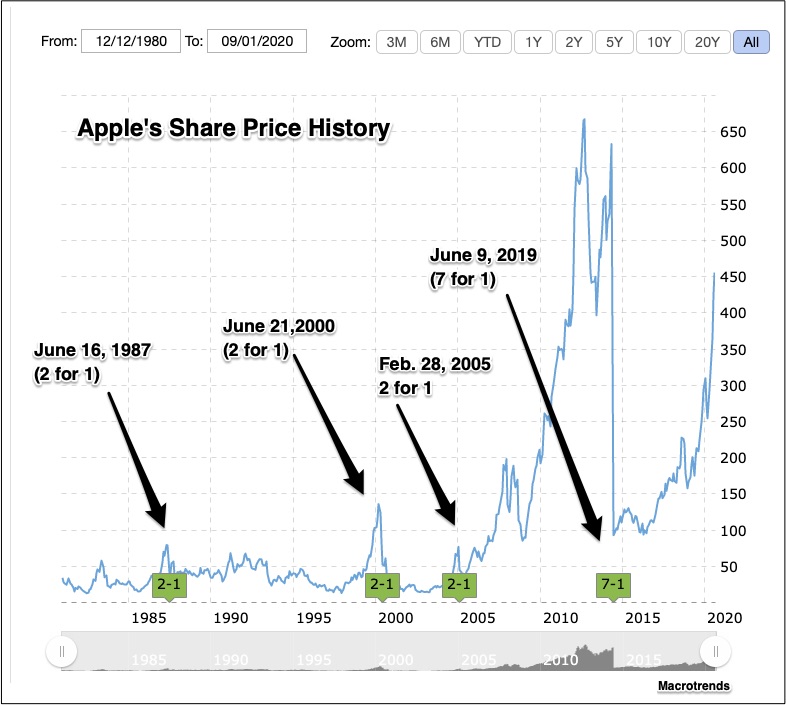
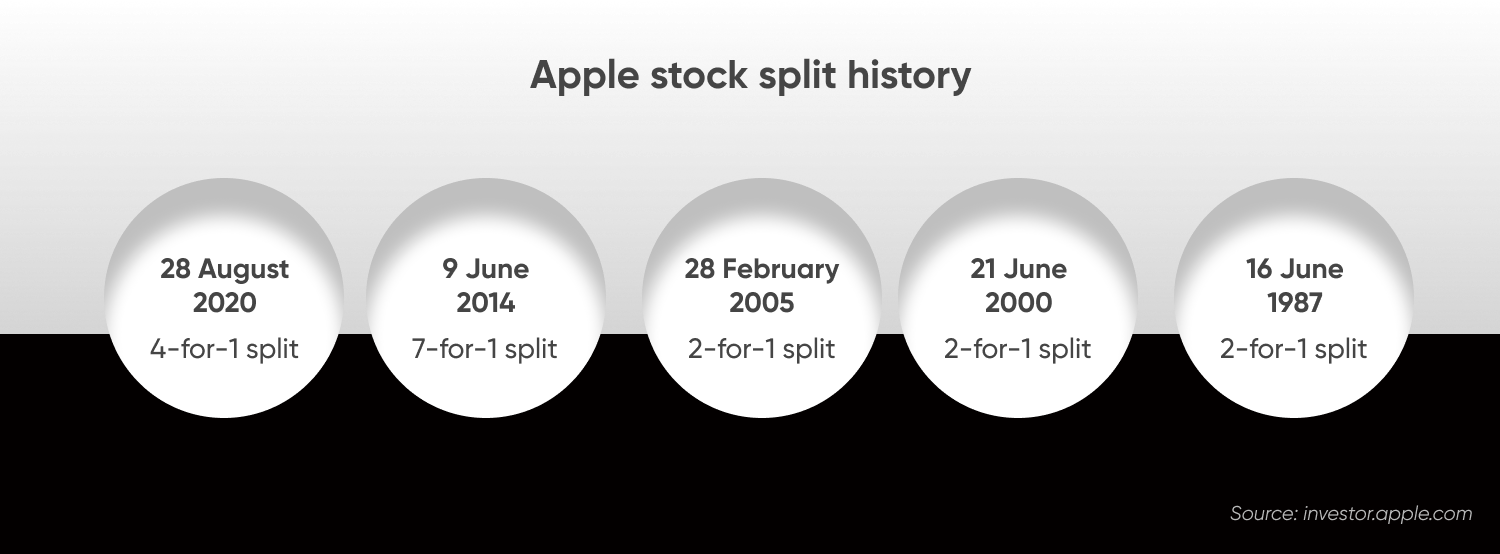
Apple is no stranger to stock splits. The company has executed five splits since it went public in 1980. Analyzing the timing and the share price at the time of these splits provides the most reliable roadmap for when the next one might occur.
The Recent Splits: 2014 and 2020
In June 2014, Apple implemented a massive 7-for-1 stock split. At the time, the stock was trading at approximately $645 per share. The split brought the price down to around $92, making it far more accessible and paving the way for its inclusion in the Dow Jones Industrial Average shortly thereafter.
Fast forward to August 2020, and Apple executed a 4-for-1 split. The stock had surged toward the $500 mark, driven by a robust services ecosystem and the anticipation of the 5G iPhone cycle. Following the split, the share price reset to approximately $125. These two instances suggest a clear trend: Apple’s management tends to view the $500 threshold as a trigger point for a split.
The Early Era Splits
Before the 2014 shift, Apple’s splits were more modest 2-for-1 affairs, occurring in 1987, 2000, and 2005. During these periods, the stock price was significantly lower, but the philosophy remained the same: keep the shares trading in a range that encourages active participation from individual investors. The evolution from 2-for-1 splits to the more aggressive 7-for-1 and 4-for-1 ratios reflects the massive growth in Apple’s market capitalization and its status as the world’s most valuable company.
Key Indicators for the Next Split
While Apple does not provide a specific roadmap for future splits, investors can monitor several key indicators that suggest the company is nearing such a decision. The decision rests with the Board of Directors, but their logic is usually driven by market conditions and share price performance.
The $500 Psychological Barrier
If history is our guide, the most significant indicator is the absolute price of the stock. Currently, Apple trades in a range that is well below its previous split triggers. However, as the company explores new revenue streams in spatial computing, artificial intelligence, and expanded services, the path to a $400 or $500 share price becomes clearer. Once the stock approaches the $450 to $500 range, the “split watch” among analysts will begin in earnest.
Relative Valuation and Market Peer Pressure
Apple also looks at its peers in the “Magnificent Seven.” Companies like Amazon, Alphabet (Google), and Nvidia have all executed significant splits in recent years to manage their high share prices. If Apple’s price begins to look “expensive” relative to the nominal share prices of its trillion-dollar peers, the board may feel pressure to act to maintain the stock’s attractiveness to retail traders and option speculators. Low nominal share prices often correlate with higher trading volume and tighter bid-ask spreads, which are beneficial for the overall health of the stock’s market.
How a Future Stock Split Affects Your Investment Portfolio
For the individual investor, a stock split is often a neutral event in terms of math, but a positive event in terms of sentiment. It is essential to distinguish between the perceived value and the fundamental value when these announcements occur.
The Impact on Cost Basis and Share Count
If you hold 10 shares of Apple at $200 and the company announces a 2-for-1 split, you will suddenly own 20 shares. However, the price of those shares will be adjusted to $100. Your total investment value remains $2,000. For long-term investors, the split is largely an accounting exercise. However, it does allow for more granular control over a portfolio. It is easier to sell 5 shares of a $100 stock to rebalance a portfolio than it is to sell a single share of a $500 stock.
Options Trading and Volatility
One area where stock splits have a tangible impact is the options market. Standard options contracts represent 100 shares of the underlying stock. If a stock is trading at $500, a single call option represents $50,000 worth of stock, making the premiums prohibitively expensive for many retail traders. A split reduces the nominal price of the shares and, consequently, the cost of entering an options position. This often leads to increased speculative activity and higher volatility surrounding the split date, as a new class of traders enters the fray.
Predicting the Next Move: When Should Investors Expect an Announcement?
Predicting the exact date of a stock split is impossible without insider knowledge, but we can look at the corporate calendar for clues. Apple typically announces major corporate changes during its quarterly earnings calls, particularly those following the conclusion of its fiscal year in September.
The Role of Capital Return Programs
Apple’s stock split decisions are often tied to its broader capital return program, which includes dividends and share buybacks. The company is famous for its massive buyback program, which reduces the total number of shares outstanding and helps boost earnings per share (EPS). A stock split is the inverse of a buyback in terms of share count, but they are not mutually exclusive. A company can reduce its total shares via buybacks to increase value while simultaneously splitting those shares to keep the price per share manageable.
Market Conditions and Economic Outlook
The board is unlikely to announce a split during periods of extreme market instability or economic downturn. They prefer to announce splits when the company is in a position of strength and the outlook is bullish. This ensures that the split serves as a “victory lap” that generates positive headlines and reinforces investor confidence.
As of the current market cycle, Apple continues to demonstrate resilient earnings and a growing services division. While a split may not be imminent in the next few months, a sustained rally in the tech sector could bring the stock back toward the levels where a split becomes a logical necessity. For the savvy investor, the “when” is less important than the “why.” As long as Apple continues to innovate and maintain its dominant market position, the share price will eventually rise to a level that demands a split. When that day comes, it will be a testament to the company’s enduring growth and its commitment to remaining accessible to the global investing public.
aViewFromTheCave is a participant in the Amazon Services LLC Associates Program, an affiliate advertising program designed to provide a means for sites to earn advertising fees by advertising and linking to Amazon.com. Amazon, the Amazon logo, AmazonSupply, and the AmazonSupply logo are trademarks of Amazon.com, Inc. or its affiliates. As an Amazon Associate we earn affiliate commissions from qualifying purchases.