
In the rapidly evolving landscape of optical technology, the terms “infrared” and “thermal imaging” are frequently used interchangeably by consumers, tech enthusiasts, and even some professionals. However, while they occupy the same branch of the electromagnetic spectrum, they represent fundamentally different methods of capturing and interpreting data. Understanding the nuances between these two technologies is essential for anyone looking to integrate advanced sensors into security systems, industrial maintenance, or consumer electronics.
This article explores the technical foundations of infrared and thermal imaging, examines how they function in real-world environments, and highlights the critical differences that define their specific use cases in the modern tech era.

Understanding the Electromagnetic Spectrum: The Foundation of Infrared Technology
To understand the difference between these two technologies, we must first look at the science of light. The human eye can only see a tiny portion of the electromagnetic spectrum, known as visible light. Beyond the red end of this visible spectrum lies infrared (IR) radiation. Infrared radiation is essentially energy that we perceive as heat, though it behaves similarly to light in terms of reflection and refraction.
What is Infrared (IR) Light?
Infrared light covers a broad range of wavelengths, typically categorized into Near-Infrared (NIR), Short-Wave Infrared (SWIR), Mid-Wave Infrared (MWIR), and Long-Wave Infrared (LWIR). In general “infrared” gadgets—like your TV remote or standard “night vision” security cameras—we are usually dealing with Near-Infrared. This wavelength is very close to visible light. While humans cannot see it, digital sensors can be calibrated to detect it quite easily.
The Role of Photons vs. Heat
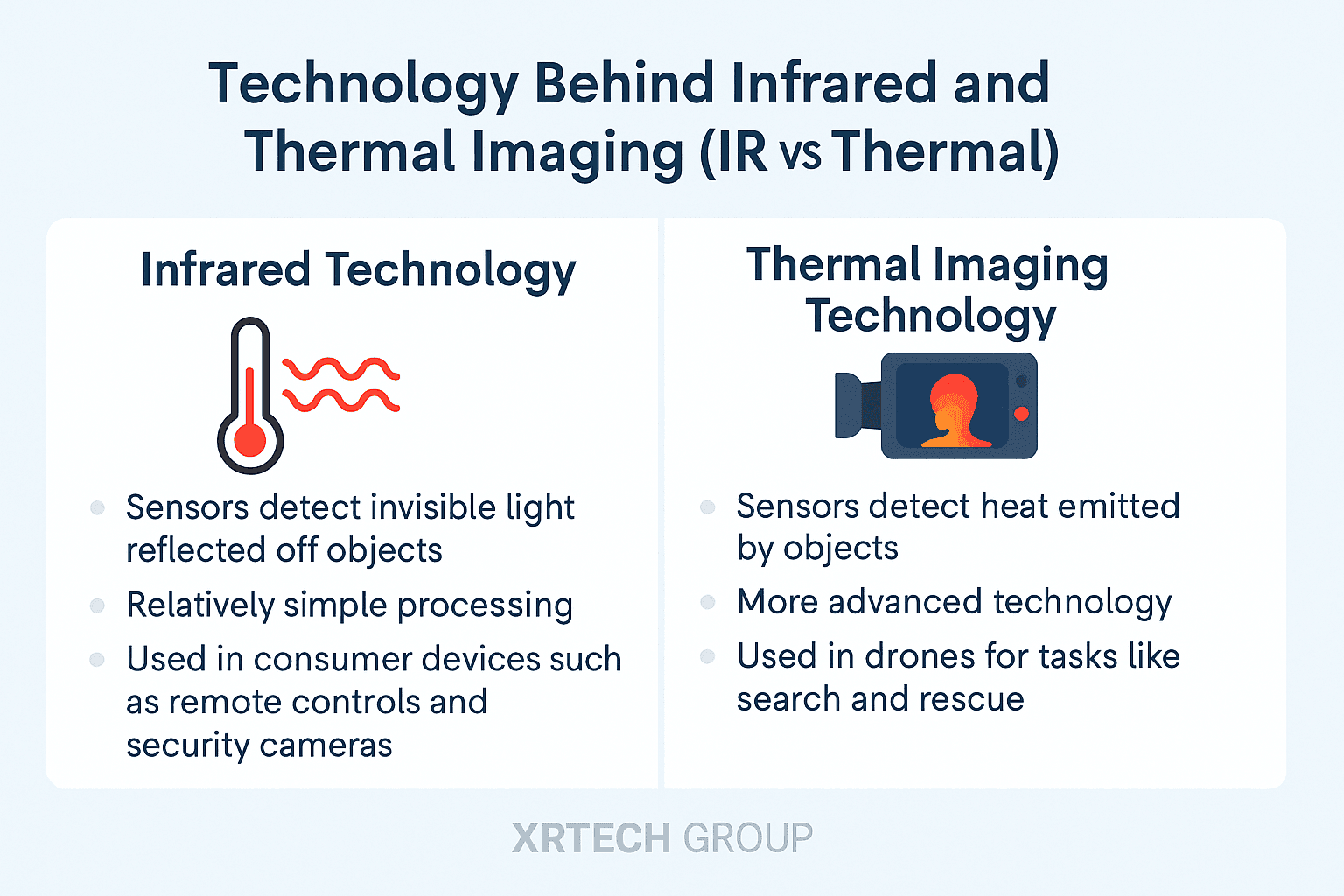
The primary distinction in how we use the spectrum lies in whether we are looking for “reflected” light or “emitted” energy. Standard infrared technology relies on photons bouncing off an object, much like how a flashlight allows you to see in the dark. Thermal imaging, conversely, ignores reflected light entirely and focuses on the heat energy emitted by the object itself. Every object with a temperature above absolute zero (-273.15°C) emits infrared energy in the LWIR range, making thermal imaging a “passive” sensing technology.
Active vs. Passive Systems: How Infrared Cameras Work
When most people think of an “infrared camera,” they are actually thinking of “active infrared” or “near-infrared” night vision. This is the technology found in most budget-friendly home security cameras and baby monitors.
Near-Infrared (Night Vision) Explained
Active infrared systems function by flooding a scene with IR light that is invisible to the human eye but visible to the camera’s sensor. This is typically achieved through a ring of IR Light Emitting Diodes (LEDs) around the camera lens. When these LEDs turn on, they act as a “floodlight” for the camera. The camera captures the IR light as it reflects off people, walls, and furniture, creating a high-resolution image that usually appears in black and white or a ghostly green.
The Role of IR Illuminators
Because active infrared relies on reflection, it requires a light source. If you are in a pitch-black room with a standard IR camera and turn off the IR LEDs, the camera will see nothing. This is why these systems are called “active.” They provide their own illumination. The limitation here is distance; once an object moves beyond the reach of the IR illuminator (often 30 to 100 feet for consumer devices), the image fades into darkness. Furthermore, active IR is easily obscured by environmental factors like thick fog, heavy rain, or even glass, as the light reflects off the surface of the obstruction rather than passing through it.
Thermal Imaging: Seeing Heat, Not Light
Thermal imaging represents a significant leap in technological complexity. Unlike active IR, thermal imaging does not require any external light source. It is a “passive” system that “sees” the heat signature of objects.
How Microbolometers Detect Temperature
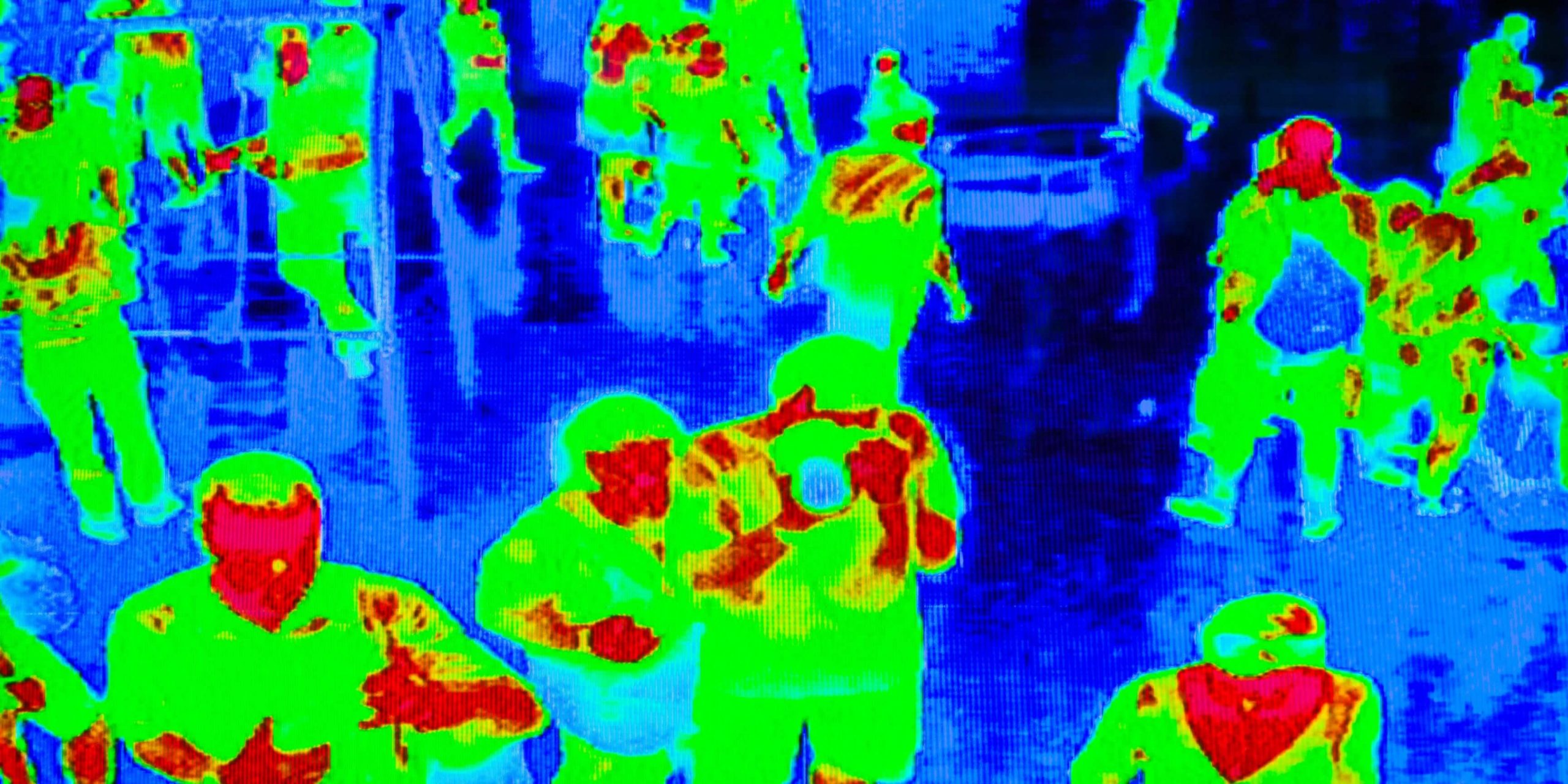
The heart of a thermal imaging camera is a specialized sensor called a microbolometer. Instead of capturing photons of light, a microbolometer measures the intensity of the thermal radiation hitting it. Each pixel on the sensor calculates the temperature of the corresponding point in the scene and assigns it a color or shade of grey. This process, known as thermography, results in a “heat map” where warmer objects (like a person or an engine) stand out sharply against cooler backgrounds (like a concrete wall or the night sky).
The Concept of Emissivity
One of the more technical aspects of thermal imaging is emissivity—the ability of a surface to emit thermal radiation. Not all objects emit heat equally. For example, a piece of wood has high emissivity and shows its true temperature clearly on a thermal camera. Conversely, a polished metal surface has low emissivity; it acts like a “thermal mirror,” reflecting the heat of other objects nearby rather than showing its own temperature. High-end thermal tech includes software algorithms to correct for emissivity, allowing for precise temperature measurements used in industrial and medical applications.
Key Differences: A Comparative Analysis
When choosing between these two technologies, it is important to compare them across three main vectors: environmental conditions, image detail, and cost.
Light Requirements and Environmental Factors
The most significant difference is that thermal imaging works in total, absolute darkness. Because it doesn’t rely on reflected light, it can “see” through smoke, dust, light foliage, and heavy fog—conditions that would render a standard IR night vision camera useless. This makes thermal imaging the gold standard for search and rescue operations and firefighting. However, it’s worth noting that thermal imaging cannot see through glass, as glass acts as a thermal barrier that reflects heat back at the camera.
Range, Resolution, and Detail
Standard IR (night vision) generally offers much higher resolution than thermal imaging. Because it uses light, it can capture fine details like facial features, license plate numbers, and clothing patterns. Thermal imaging provides a lower-resolution “blob-like” image. While you can clearly see that a human is standing in a field from a mile away using thermal tech, you likely won’t be able to identify who that person is based on their facial features. Thermal imaging is about detection and classification, whereas infrared is about identification.
Cost and Hardware Complexity
From a manufacturing perspective, standard IR sensors are relatively cheap. They are built using modified CMOS sensors, the same tech found in smartphone cameras. Thermal sensors, however, are made from exotic materials like Germanium or Vanadium Oxide. These materials are expensive to source and difficult to process, which is why a high-quality thermal camera can cost thousands of dollars, while a standard IR security camera costs less than fifty.
Real-World Applications in Modern Tech
As hardware becomes more compact, both technologies are finding new niches across various industries.
Security and Surveillance
In the security tech sector, the best systems often use a “layered” approach. Thermal cameras are used for long-range perimeter detection because they excel at spotting the heat signature of an intruder against a cold background. Once the intruder is detected, the system triggers a standard IR or visible-light camera to zoom in and capture high-resolution footage for identification purposes. This combination ensures that no one can hide in the shadows or use camouflage to evade detection.
Industrial Diagnostics and Building Inspection
Thermal imaging has become an indispensable tool for engineers and technicians. In electrical engineering, thermal cameras can identify “hot spots” in circuit breakers or transformers before they fail and cause a fire. In the construction tech industry, thermography is used to identify heat leaks in building insulation or to find moisture trapped behind walls. Since water changes temperature at a different rate than wood or drywall, a thermal camera can “see” a leak long before it becomes visible to the naked eye.
Automotive and Autonomous Vehicles
One of the most exciting frontiers for this tech is the automotive industry. Companies like FLIR are integrating thermal sensors into Advanced Driver Assistance Systems (ADAS). While standard cameras and LIDAR (Light Detection and Ranging) are excellent for identifying road lines and other vehicles, they can struggle in low-visibility conditions. Thermal sensors allow autonomous vehicles to “see” pedestrians or wildlife through glare, fog, and darkness far more reliably than light-based sensors alone.
Conclusion
While “infrared” and “thermal imaging” share a common heritage in the electromagnetic spectrum, they serve distinct roles in the tech ecosystem. Infrared night vision is a light-dependent tool designed for high-resolution identification in low-light settings. Thermal imaging is a light-independent tool designed for detection, temperature measurement, and visibility through environmental obstructions.
As we move forward, the miniaturization of thermal sensors and the improvement of IR processing power will likely lead to even more “fused” sensor arrays. Whether it’s in the palm of your hand via a smartphone attachment or integrated into the brain of a self-driving car, both technologies are essential for bridging the gap between what humans can see and what is actually there.
aViewFromTheCave is a participant in the Amazon Services LLC Associates Program, an affiliate advertising program designed to provide a means for sites to earn advertising fees by advertising and linking to Amazon.com. Amazon, the Amazon logo, AmazonSupply, and the AmazonSupply logo are trademarks of Amazon.com, Inc. or its affiliates. As an Amazon Associate we earn affiliate commissions from qualifying purchases.