
In an era dominated by the convenience of Wi-Fi 6 and the expansion of 5G cellular networks, the physical wired infrastructure of a network often goes overlooked. However, for professionals in IT, hardcore gamers, and businesses relying on uninterrupted data flows, the Ethernet cable remains the backbone of digital stability. When setting up a local area network (LAN), the most common debate centers on two specific standards: Category 5e (Cat5e) and Category 6 (Cat6). While they may look identical to the naked eye—terminating in the same RJ45 connectors—the internal engineering and performance capabilities of these cables differ significantly.

Understanding the nuances between Cat5e and Cat6 is not merely a matter of technical trivia; it is a critical decision that impacts bandwidth, latency, and the long-term scalability of your hardware ecosystem.
Decoding the Performance Gap: Speed and Bandwidth
The primary metrics used to evaluate Ethernet cables are data transfer speed (throughput) and bandwidth (frequency). While both Cat5e and Cat6 can facilitate high-speed internet, their “ceilings” are built at different heights.
Throughput Capabilities
Category 5e was introduced as an “enhanced” version of the older Category 5 standard. It was designed to support Gigabit Ethernet (1,000 Mbps). For nearly two decades, this has been the industry standard for residential and small-business networking. Cat5e handles 1 Gbps reliably at distances up to 100 meters (328 feet).
Category 6, conversely, was engineered to push the boundaries of copper cabling. While it also supports 1 Gbps at 100-meter distances, it is capable of achieving 10 Gbps (10-Gigabit Ethernet) under ideal conditions. The caveat for Cat6 is distance: to maintain 10 Gbps speeds, the cable run should typically not exceed 55 meters (180 feet). Beyond that length, the speed naturally throttles back to 1 Gbps.
The Role of Frequency (MHz)
Bandwidth is often confused with speed, but it is better thought of as the “width of the pipe.” Cat5e cables operate at a frequency of 100 MHz. This means they can process 100 million signals per second. Category 6 cables are tested and rated for up to 250 MHz.
This higher frequency allows for a higher “signal-to-noise” ratio. In practical terms, even if your current internet service provider (ISP) only offers 500 Mbps, a Cat6 cable can carry that data more efficiently than a Cat5e cable because it has more available bandwidth to handle the “overhead” of data transmission, resulting in lower latency and fewer dropped packets during peak usage.
Physical Construction and Interference Mitigation
The most significant engineering differences between Cat5e and Cat6 are internal. As data speeds increase, cables become more susceptible to electromagnetic interference (EMI) and a specific type of interference known as “crosstalk.”
Combating Crosstalk
Crosstalk occurs when the electrical signals from one wire pair inside the cable bleed into an adjacent pair, causing data corruption and requiring the hardware to re-send packets. Cat5e cables are twisted relatively tightly to mitigate this, but Cat6 takes it several steps further.
In Cat6 cables, the internal copper wire pairs are twisted more tightly than in Cat5e. Furthermore, Cat6 standards mandate stricter specifications for Near-End Crosstalk (NEXT) and Alien Crosstalk (AXT). By reducing the noise floor, Cat6 ensures that the data reaching the destination is clean and uncorrupted, which is vital for high-speed 10GBASE-T applications.
The Presence of the Spline
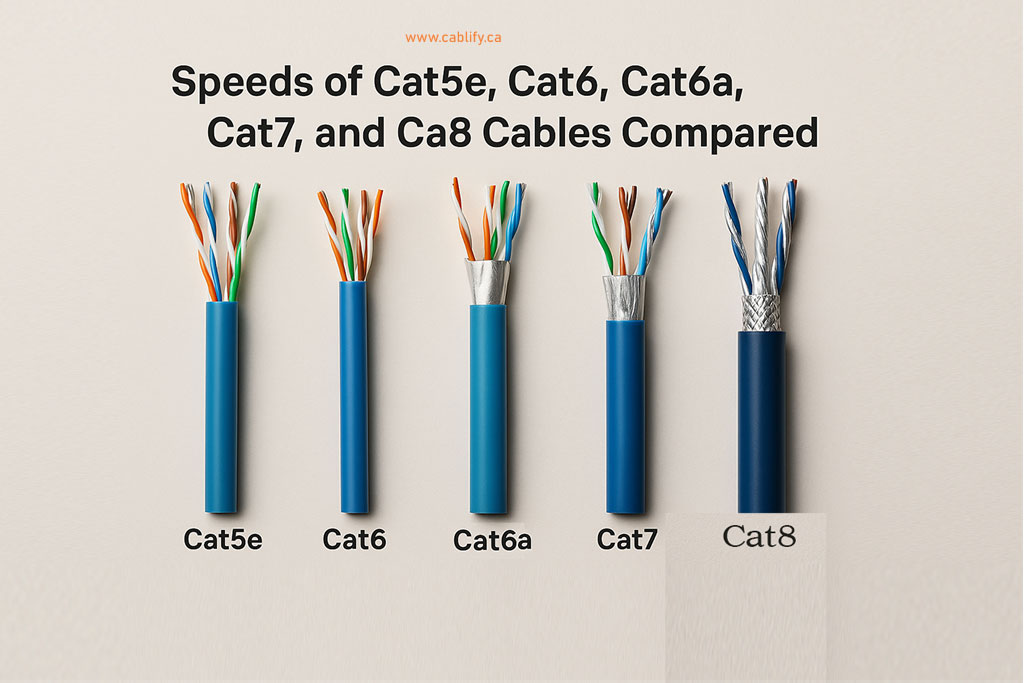
If you were to strip the outer jacket of a Cat6 cable, you would likely find a “spline”—a cross-shaped plastic separator that runs the length of the cable. This spline keeps the four pairs of twisted copper wires physically separated from one another. By maintaining consistent spacing, the spline drastically reduces internal interference.
While not every Cat6 cable uses a spline (some manufacturers use high-precision twisting techniques instead), it is a hallmark of the Cat6 category. Because of this spline and the thicker insulation required to meet the 250 MHz standard, Cat6 cables are generally thicker, stiffer, and slightly more difficult to route through tight corners or conduit than the more flexible Cat5e.
Practical Application: When to Use Cat5e vs. Cat6
Choosing between these two standards requires a balance between current needs, budget constraints, and the physical environment of the installation.
Residential and Home Office Environments
For the average household, Cat5e is often sufficient. If your internet plan is 1 Gbps or lower, and you are primarily browsing the web, streaming 4K video, or participating in Zoom calls, Cat5e will likely meet your needs without bottlenecking. It is also more cost-effective for large-scale home wiring projects and easier to crimp for DIY enthusiasts.
However, as “Prosumer” home offices become more common—incorporating Network Attached Storage (NAS) devices for video editing or large backups—the jump to Cat6 becomes logical. Transferring a 100GB file from a workstation to a server is significantly faster over a 10 Gbps Cat6 link than a 1 Gbps Cat5e link.
Gaming and High-Definition Streaming
Gamers are particularly sensitive to latency (ping). While Cat5e can technically handle the speeds required for gaming, Cat6 provides a more “stable” signal environment. The reduced crosstalk in Cat6 means fewer packet re-transmissions. In competitive environments where milliseconds matter, the superior shielding and higher frequency of Cat6 offer a marginal but measurable performance advantage.
Commercial and Data Center Deployments
In a professional or enterprise setting, Cat6 is the minimum recommended standard. Modern offices utilize a high density of cables packed into trays and ceilings. This proximity increases the risk of Alien Crosstalk (interference between different cables). Cat6’s superior insulation and tighter twists protect against this environmental noise. Furthermore, for businesses planning to deploy 10-Gigabit switches in their server rooms, Cat6 is a prerequisite for short-to-medium length patches.
Power over Ethernet (PoE) and Distance Considerations
Another critical factor in the Cat5e vs. Cat6 debate is Power over Ethernet (PoE). This technology allows a single cable to provide both a data connection and electric power to devices like VoIP phones, Wireless Access Points (WAPs), and IP security cameras.
Supporting IoT and Security Hardware
As we move toward the “Internet of Things” (IoT), devices are demanding more power. The latest PoE standards (such as PoE++ or 802.3bt) can deliver up to 60W or even 100W of power. Cat6 cables typically use thicker copper conductors (usually 23 AWG) compared to Cat5e (usually 24 AWG).
Thicker wire has less electrical resistance, which means it generates less heat when carrying current. In bundles of cables—common in commercial security setups—heat buildup can actually degrade data performance. Therefore, Cat6 is the safer and more efficient choice for high-power PoE applications, ensuring that cameras and access points remain powered without compromising the integrity of the data stream.
Signal Degradation Over Length
Both cables are rated for a maximum “channel length” of 100 meters for standard speeds. However, users must be aware that “speed at a distance” is a sliding scale. While Cat6 is a powerhouse at 55 meters, its performance begins to mirror Cat5e as it approaches the 100-meter mark. For organizations operating in massive warehouses or multi-story complexes, understanding these distance limitations is essential for placing switches and repeaters effectively.
Future-Proofing Your Infrastructure
One of the most expensive aspects of networking is not the hardware or the cables themselves, but the labor required to install them. Tearing out drywall or climbing through crawlspaces to replace outdated wiring is a task most property owners want to do only once.
The Cost-Benefit Analysis
At the point of purchase, Cat6 is typically 10% to 20% more expensive than Cat5e. On a 1,000-foot spool, this might amount to a few dozen dollars. When viewed in the context of a total renovation or a new office build, this price difference is negligible.
By installing Cat6 today, you are effectively “future-proofing” the building. Even if your current hardware only utilizes 1 Gbps, the day you upgrade to a 10 Gbps router or a multi-gigabit modem, your internal wiring will be ready to handle the load. Opting for Cat5e to save a small amount of money today could result in a much larger expense five years down the line when the network environment demands higher throughput.
Beyond Cat6: A Glimpse at the Horizon
While the choice today is usually between Cat5e and Cat6, it is worth noting that Cat6a (Augmented) and Cat7 also exist. Cat6a, for instance, supports 10 Gbps at the full 100-meter distance and operates at 500 MHz. However, Cat6a is significantly thicker and more expensive, often requiring specialized grounding. For most high-end residential and standard commercial applications, Cat6 strikes the “sweet spot” between performance, ease of installation, and cost.

Final Verdict: Which Cable Should You Choose?
The decision between Cat5e and Cat6 ultimately depends on your performance requirements and your timeline.
Choose Cat5e if:
- You are on a very tight budget.
- You are wiring a basic residential space where internet speeds will not exceed 1 Gbps.
- Flexibility and ease of installation in very tight spaces are your primary concerns.
Choose Cat6 if:
- You are wiring a new home or office and want it to remain relevant for the next decade.
- You use high-bandwidth devices like NAS servers or perform frequent large file transfers.
- You are a competitive gamer looking to minimize latency and interference.
- You plan to use high-power PoE devices for security or smart-home automation.
In the rapidly evolving landscape of digital technology, your network is only as strong as its weakest link. While Cat5e has served the world well for two decades, Cat6 is the current standard for those who value speed, reliability, and the peace of mind that comes with a future-ready infrastructure. Whether you are a technician, a business owner, or a tech enthusiast, investing in the right copper today ensures you won’t be left behind tomorrow.
aViewFromTheCave is a participant in the Amazon Services LLC Associates Program, an affiliate advertising program designed to provide a means for sites to earn advertising fees by advertising and linking to Amazon.com. Amazon, the Amazon logo, AmazonSupply, and the AmazonSupply logo are trademarks of Amazon.com, Inc. or its affiliates. As an Amazon Associate we earn affiliate commissions from qualifying purchases.