
When an entrepreneur moves beyond the simplicity of a sole proprietorship or a general partnership, they arrive at a critical financial crossroads: the decision to incorporate. In the realm of business finance, the choice between a C corporation and an S corporation is one of the most consequential decisions a founder will ever make. This choice dictates how the business is taxed, how it can raise capital, who can own shares, and ultimately, how much profit stays in the pockets of the stakeholders.
While both entities offer the “corporate veil” of limited liability protection—shielding personal assets from business debts and lawsuits—their fiscal architectures are diametrically opposed. Understanding these nuances is essential for any business owner looking to optimize their financial health and long-term growth strategy.
Foundations of Corporate Structure: Legal vs. Tax Designations
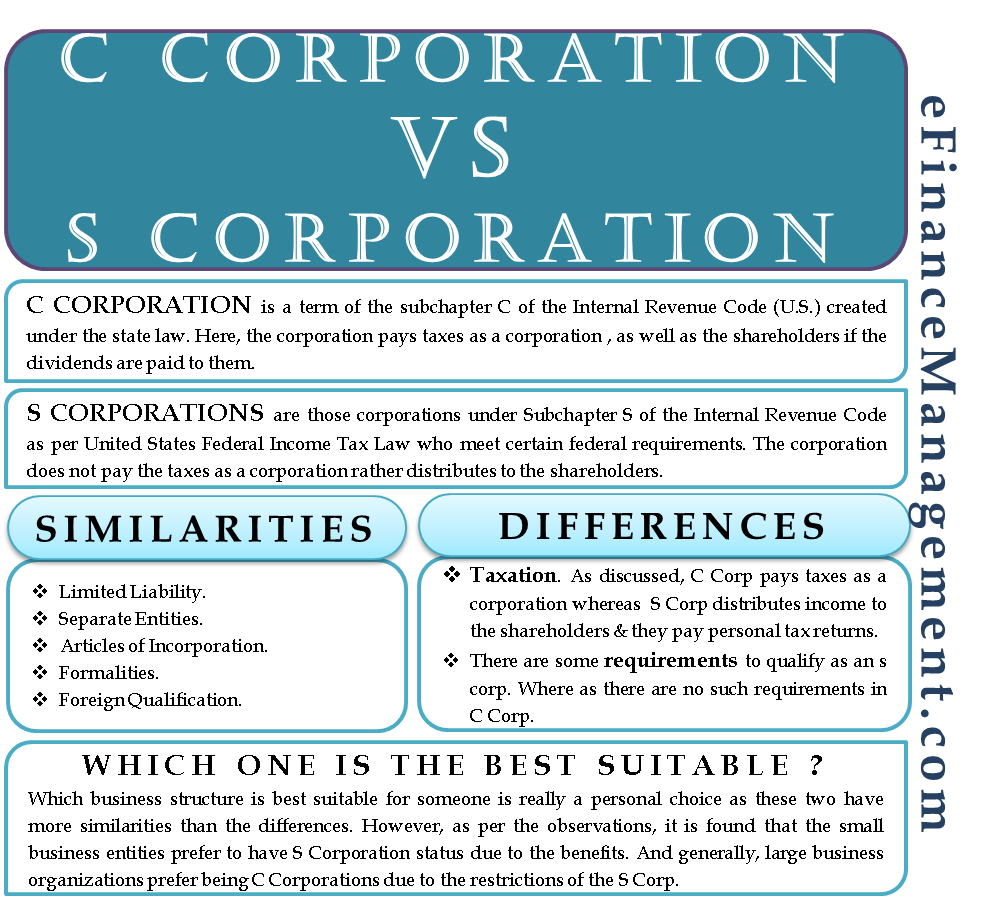
To understand the difference between these two entities, one must first understand that a “corporation” is a legal entity created under state law. The distinction between “C” and “S” refers primarily to how the Internal Revenue Service (IRS) treats the entity for federal income tax purposes.
Understanding the C Corp as the Default Entity
By default, when you file articles of incorporation with your Secretary of State, the IRS views the entity as a C corporation. It is named after Subchapter C of the Internal Revenue Code. From a financial perspective, a C corp is a separate taxable entity. It earns its own income, pays its own taxes, and is legally distinct from the people who own it. This “separateness” is a hallmark of corporate finance, allowing the business to retain earnings within the company to fuel future expansion without those earnings being immediately taxed at the individual shareholder level.
The S Corp Election: A Tax Designation, Not a Separate Entity
An S corporation is not a specific type of corporation in the eyes of state law; rather, it is a regular corporation that has requested “S status” from the IRS by filing Form 2553. Named after Subchapter S of the Code, this election transforms the corporation into a “pass-through” entity. In this model, the corporation itself generally does not pay federal income tax. Instead, the profits and losses “pass through” to the shareholders’ personal tax returns. This structure was designed to give small businesses the liability protection of a corporation while avoiding the complexities of corporate-level taxation.
Taxation Dynamics: Double Taxation vs. Pass-Through
The most significant divergence between these two structures lies in the flow of money and the subsequent tax liability. For a business owner focused on maximizing net income, the tax strategy is often the deciding factor.
How C Corporations are Taxed at the Federal Level
C corporations are subject to what is commonly referred to as “double taxation.” First, the corporation pays a flat federal corporate income tax rate (currently 21%) on its annual net profit. After the corporation pays its taxes, it may choose to distribute the remaining profits to shareholders in the form of dividends. These dividends are then taxed a second time on the shareholders’ individual tax returns at the applicable capital gains or dividend tax rate.
While “double taxation” sounds inherently negative, C corps offer a strategic advantage: the ability to “tax bracket shift.” Because the corporate tax rate is a flat 21%, it may be lower than the top individual tax brackets. Businesses that plan to reinvest every dollar of profit back into the company for R&D or equipment can benefit from the lower corporate rate, as the second layer of tax (on dividends) is never triggered if no dividends are paid.
The Benefits and Limits of Pass-Through Taxation in S Corps
The S corporation eliminates the corporate-level tax. If an S corp earns $100,000 in profit, that $100,000 is reported on the shareholders’ personal 1040 forms, regardless of whether the money was actually distributed to them as cash. This avoids the double tax, but it also means shareholders could potentially owe taxes on money that remains in the business’s bank account (often called “phantom income”).
Furthermore, S corp owners can benefit from the Qualified Business Income (QBI) deduction, which allows eligible taxpayers to deduct up to 20% of their pass-through business income from their federal taxes. This is a significant financial lever that is unavailable to C corp shareholders.
Dividend Distributions and Personal Income Tax
In a C corp, distributions are almost always taxed as dividends. In an S corp, distributions are generally tax-free to the extent that the shareholder has “basis” in the stock. This is because the shareholder has already paid income tax on those profits when they were earned by the entity. For a sophisticated investor, managing “basis” and “distributions” in an S corp requires meticulous accounting but offers superior flexibility in managing personal cash flow and tax liability.
Ownership Constraints and Growth Potential
While tax efficiency is vital, the ability to scale and attract investment is the lifeblood of many enterprises. This is where the C corporation often outshines the S corporation.

Shareholder Limits and Citizenship Requirements for S Corps
The IRS imposes strict limitations on who can own an S corporation. To maintain S status, the company can have no more than 100 shareholders. Additionally, all shareholders must be U.S. citizens or resident aliens. Most significantly, S corps cannot be owned by other corporations, partnerships, or certain types of trusts.
These restrictions make the S corp an “exclusive club.” If your financial goal is to eventually take the company public or sell to a private equity firm, the S corp status will likely need to be revoked, as institutional investors generally do not meet the IRS eligibility requirements for S corp shareholders.
Raising Capital: Why VCs and Institutional Investors Prefer C Corps
If you are building a startup with the intent of seeking Venture Capital (VC), the C corporation is the industry standard. Professional investors prefer C corps for several reasons. First, they avoid the administrative headache of “K-1” tax forms associated with pass-through entities. Investors in a C corp do not have to report the company’s profits or losses on their personal tax returns; they only report capital gains when they exit their position.
Second, C corporations allow for “Qualified Small Business Stock” (QSBS) treatment under Section 1202. This is one of the most powerful tax incentives in the U.S. tax code, potentially allowing founders and early investors to exclude up to 100% of their capital gains (up to $10 million or more) from federal taxes upon the sale of their shares, provided certain conditions are met.
Classes of Stock: Flexibility in Control and Equity
S corporations are legally restricted to one class of stock. While you can have voting and non-voting shares, all shares must have identical rights to distributions and liquidation proceeds. This prevents complex equity structuring.
C corporations, conversely, can have multiple classes of stock (Common, Preferred Series A, Series B, etc.). This allows founders to create different tiers of liquidation preference and dividend rights, which is essential for sophisticated fundraising rounds. If your business model requires complex capital stacks to fuel growth, the C corp is the only viable financial vehicle.
Operational Costs and Compliance Requirements
Beyond the high-level tax and equity strategies, the day-to-day financial management of these entities differs significantly, particularly regarding payroll and administrative oversight.
Administrative Overhead and Formalities
Both C and S corporations require a high level of “corporate hygiene.” This includes holding annual meetings, recording board minutes, and maintaining a clear separation between personal and business finances. Failure to follow these formalities can lead to “piercing the corporate veil,” where a court ignores the corporate structure and holds the owners personally liable for the company’s debts. From a cost perspective, both entities require more robust legal and accounting support than a simple LLC or sole proprietorship.
Self-Employment Tax and Reasonable Salary Requirements for S Corp Owners
One of the most popular reasons for choosing an S corp is the potential for payroll tax savings. In a C corp, all money paid to an owner-employee is treated as wages and is subject to FICA taxes (Social Security and Medicare).
In an S corp, the owner-employee can split their income into two categories: a “reasonable salary” (subject to FICA) and “shareholder distributions” (not subject to FICA). By paying themselves a fair market salary and taking the remaining profit as a distribution, an S corp owner can save thousands of dollars annually in self-employment taxes. However, the IRS closely monitors this. If the salary is deemed too low for the industry and the owner’s role, the IRS can reclassify distributions as wages and assess back taxes and penalties.
Strategic Decision Making: Which Model Fits Your Financial Goals?
Selecting the right entity is not about finding the “best” structure, but rather the best fit for your specific financial trajectory and exit strategy.
When to Choose a C Corp for Long-Term Scale
The C corporation is the vehicle of choice for high-growth companies. If you plan to reinvest profits back into the business, if you require institutional investment, or if you are eyeing an IPO, the C corp provides the necessary flexibility. Furthermore, if the company qualifies for Section 1202 (QSBS), the potential tax savings at the time of sale can dwarf any year-to-year tax advantages offered by other structures. It is a long-term play for significant capital accumulation and equity liquidity.

When to Choose an S Corp for Tax Efficiency
The S corporation is often the optimal choice for profitable, service-based businesses or closely-held family companies that do not plan to seek outside venture capital. For a business owner who wants to pull most of the profits out of the company each year to fund their lifestyle or personal investments, the S corp’s single layer of taxation and the potential for payroll tax savings offer immediate, tangible financial benefits. It is a strategy designed for cash-flow optimization and minimizing the aggregate tax burden on the owner’s total income.
In conclusion, the choice between a C corp and an S corp is a foundational element of business finance. One prioritizes capital raising, institutional growth, and long-term exit incentives, while the other prioritizes immediate tax efficiency and simplified cash flow for the owners. By aligning your corporate structure with your financial objectives, you ensure that your business entity serves as an engine for wealth creation rather than a hindrance to it.
aViewFromTheCave is a participant in the Amazon Services LLC Associates Program, an affiliate advertising program designed to provide a means for sites to earn advertising fees by advertising and linking to Amazon.com. Amazon, the Amazon logo, AmazonSupply, and the AmazonSupply logo are trademarks of Amazon.com, Inc. or its affiliates. As an Amazon Associate we earn affiliate commissions from qualifying purchases.