
Establishing a dedicated business bank account is a pivotal milestone for any entrepreneur. It serves as the financial foundation upon which your company’s credibility, legal protection, and organizational health are built. Moving from personal commingling of funds to a formalized business banking structure is not merely a bureaucratic requirement; it is a strategic maneuver that simplifies tax reporting, protects your personal assets, and positions your firm for scalable growth.
The Legal and Organizational Prerequisites
Before approaching a financial institution, you must ensure your business entity is formally recognized. Banks are strictly regulated and require specific documentation to verify that your business is a legitimate legal entity.

Business Registration Documents
Depending on your business structure, the documentation requirements will vary. If you are operating as a Sole Proprietor, you may need a registered “Doing Business As” (DBA) name if you are not operating under your personal legal name. For Limited Liability Companies (LLCs), you will need your Articles of Organization. Corporations must provide their Articles of Incorporation. These documents prove to the bank that your entity has been filed with the state and is authorized to conduct business.
Employer Identification Number (EIN)
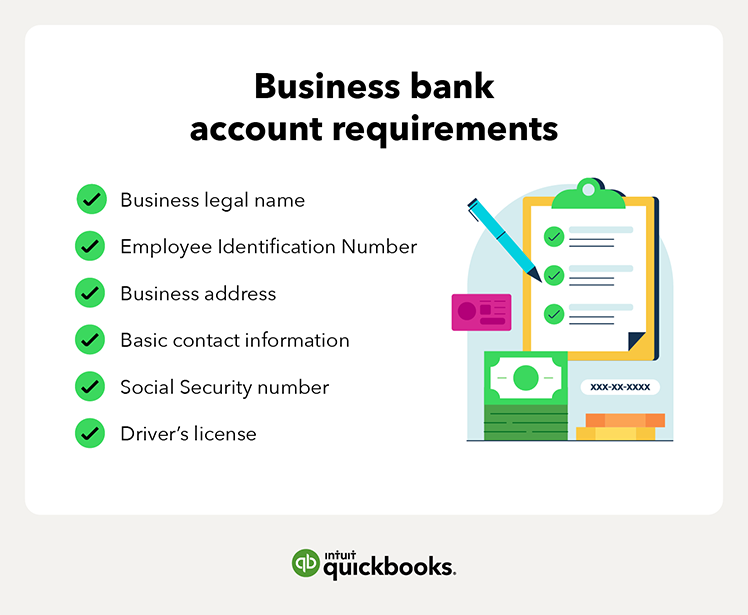
An EIN, also known as a Federal Tax Identification Number, is essentially a Social Security number for your business. It is a mandatory requirement for most business bank accounts. It allows the IRS to track your business financial activities and is necessary for hiring employees or opening lines of credit. Even if your business structure does not strictly require an EIN for tax purposes, opening an account with one is highly recommended to keep your personal Social Security number private and minimize the risk of identity theft.
Ownership Agreements and Resolutions
If your business has multiple owners or partners, the bank will require a document that identifies who has the authority to act on behalf of the business. An Operating Agreement for an LLC or a Corporate Resolution for a corporation specifies which individuals are authorized to open accounts, sign checks, and manage digital banking access. This prevents internal disputes and ensures the bank knows exactly who holds the signing authority for company funds.
Understanding the Financial Documentation Required
Beyond legal status, banks must perform due diligence to understand the nature of your business operations. This is part of the “Know Your Customer” (KYC) regulations designed to prevent fraud, money laundering, and illegal financial activities.
The Beneficial Ownership Rule
Banks are legally mandated to identify the “beneficial owners” of an entity. This refers to any individual who owns 25% or more of the equity interests of the legal entity, or any individual who exercises significant responsibility to control, manage, or direct the legal entity. You will likely be asked to provide personal identification—such as a driver’s license, passport, or state-issued ID—for every owner who meets these criteria.
Nature of Business Activities
Be prepared to provide a brief description of what your business does. Banks ask this to assess the risk profile of your account. A high-volume e-commerce business may have different monitoring thresholds than a local consulting firm. You should be ready to provide a business plan or a website URL that clearly demonstrates your revenue model, your primary customers, and your expected monthly transaction volume. This information helps the bank set appropriate deposit limits and security filters for your account.
Opening Deposit Requirements
Almost every business bank account requires an initial deposit to activate the account. While some digital-first banks offer accounts with no minimum balance requirements, traditional brick-and-mortar institutions may require a specific opening deposit. Ensure you have the necessary funds available in a liquid format—such as a cashier’s check or a transfer from your current personal account—to satisfy this requirement during the onboarding process.
Selecting the Right Financial Institution
Not all business bank accounts are created equal. Choosing the right partner depends on your business model, your need for physical branch access, and your reliance on digital tools.
Brick-and-Mortar vs. Digital-Only Banks
Traditional national banks offer the advantage of physical branches, where you can deposit cash, speak with a banker face-to-face, and establish a long-term banking relationship that may be beneficial when you eventually seek business loans. However, these institutions often come with higher monthly service fees and more stringent minimum balance requirements.
Conversely, digital-first banks and fintech platforms are revolutionizing business banking by offering user-friendly mobile interfaces, low or zero monthly fees, and seamless integration with accounting software like QuickBooks or Xero. These are often the superior choice for small startups, freelancers, and remote-first businesses that do not handle physical cash.
Fee Structures and Service Capabilities
When evaluating a bank, look beyond the initial interest rate. Focus on the total cost of ownership. Evaluate the following:
- Monthly Maintenance Fees: Are these fees waivable if you maintain a minimum balance?
- Transaction Limits: Does the account charge you for exceeding a certain number of electronic or cash transactions?
- Integration Capabilities: Does the bank’s platform sync directly with your bookkeeping software? Automated data entry saves hours of administrative time and reduces accounting errors.
- Wire and ACH Fees: If you plan on moving money frequently to vendors or international suppliers, ensure you understand the fee structure for outgoing and incoming wires.
Best Practices for Maintaining Your Business Account
Once your account is open, the way you manage it dictates your financial efficiency and the strength of your credit profile.
The Principle of Zero Commingling
The most fundamental rule of business banking is to never mix personal and business expenses. Commingling funds makes it nearly impossible to accurately track your profit margins, complicates tax filings, and can legally “pierce the corporate veil.” If you operate an LLC or corporation and you treat the business bank account like a personal piggy bank, you risk losing the limited liability protection that the entity provides. Use the business account exclusively for business-related income and expenses.
Leveraging Banking Tools for Growth
A business bank account is more than a place to store money; it is a financial management tool. Utilize the reporting features provided by your bank to monitor cash flow trends. Many modern business accounts offer “sub-accounts” or “envelopes” where you can set aside tax savings or rainy-day funds, ensuring you aren’t accidentally spending money that is owed to the government.

Preparing for Future Credit Needs
If you intend to scale, your relationship with your bank will become your most valuable asset. Banks prefer to lend to businesses they have a history with. By maintaining a clean, active, and well-funded account, you build “bankability.” Over time, your consistency in managing cash flow and your adherence to deposit schedules will make it significantly easier to secure lines of credit, equipment financing, or Small Business Administration (SBA) loans when the time comes to expand.
In conclusion, opening a business bank account is a foundational task that requires preparation, organization, and a clear understanding of your business’s financial trajectory. By gathering the correct legal documentation, understanding your obligations under banking regulations, and choosing an institution that aligns with your operational needs, you set the stage for financial success and professional legitimacy. Treat your banking relationship with the same level of seriousness as your business strategy, and you will ensure that your company has the liquidity and stability required to thrive in a competitive market.
aViewFromTheCave is a participant in the Amazon Services LLC Associates Program, an affiliate advertising program designed to provide a means for sites to earn advertising fees by advertising and linking to Amazon.com. Amazon, the Amazon logo, AmazonSupply, and the AmazonSupply logo are trademarks of Amazon.com, Inc. or its affiliates. As an Amazon Associate we earn affiliate commissions from qualifying purchases.