
The acronym “IRA” is one of the most frequently encountered terms in personal finance, yet its full scope and strategic importance often remain a mystery to many. Far more than just another savings account, an Individual Retirement Account (IRA) is a powerful, tax-advantaged investment vehicle designed to help individuals save for retirement. Understanding what an IRA is, its various types, and how to effectively utilize it is a cornerstone of robust financial planning, offering a path to tax-efficient growth and a more secure future. This comprehensive guide aims to demystify IRAs, equipping you with the knowledge to make informed decisions about your retirement savings.
Demystifying the Individual Retirement Account (IRA)
At its heart, an IRA is a retirement savings plan that allows investments to grow tax-deferred or tax-free, depending on the type of account. Unlike employer-sponsored plans like a 401(k) or 403(b), an IRA is set up by an individual directly with a financial institution—be it a bank, brokerage firm, or mutual fund company. This direct control gives individuals immense flexibility in choosing their investments, a critical advantage for those who prefer to manage their own portfolios or seek specific asset allocations.
What is an IRA?
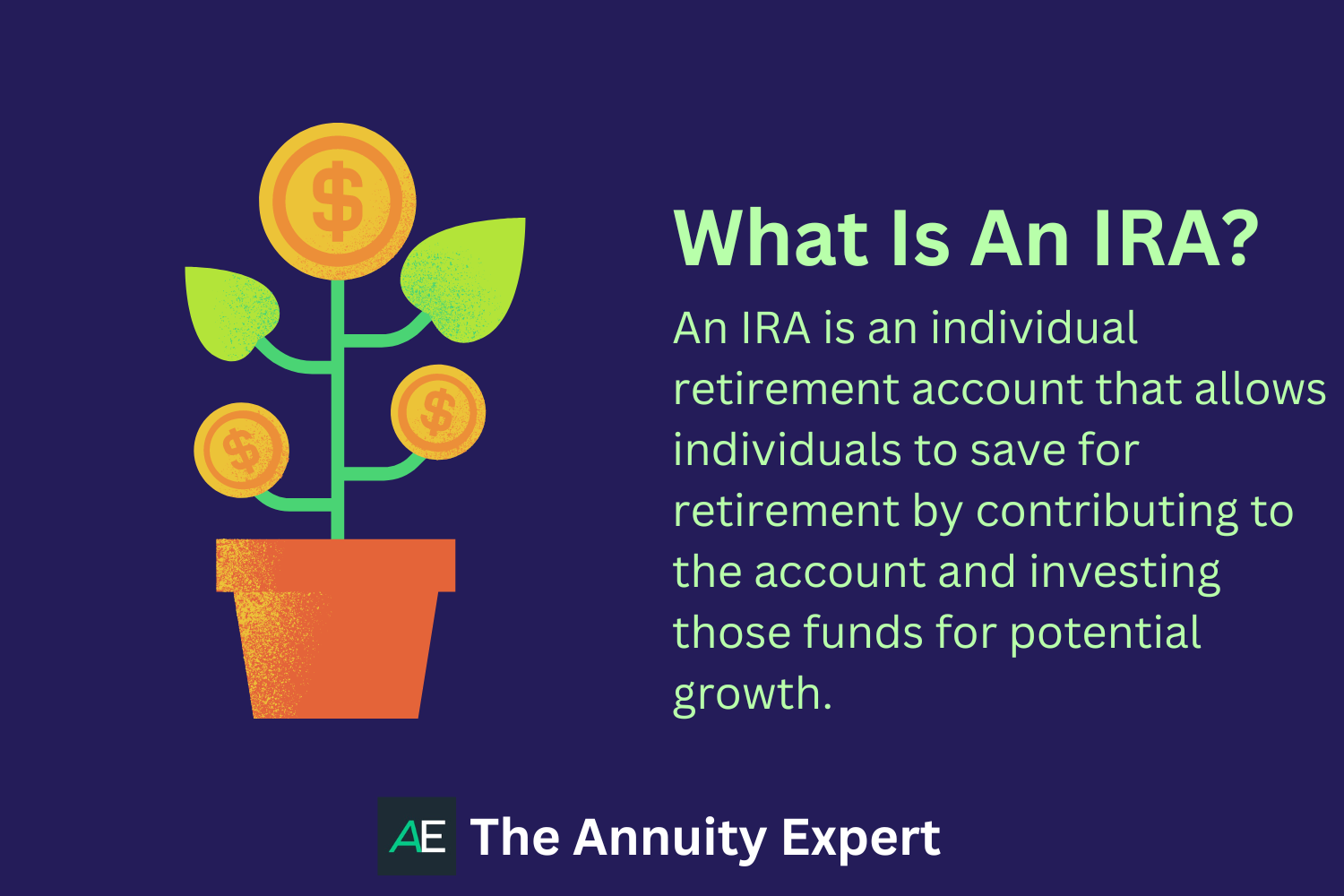
An Individual Retirement Account (IRA) is a specialized savings account designed specifically for retirement planning, offering significant tax benefits to encourage long-term saving. It functions as a container for various types of investments, such as stocks, bonds, mutual funds, exchange-traded funds (ETFs), and certificates of deposit (CDs). The core purpose of an IRA is to allow your money to grow over decades, compounding returns, often shielded from immediate taxation. This tax-advantaged status is what makes IRAs so appealing and a staple in most retirement strategies.
Why are IRAs Important for Retirement Planning?
The importance of IRAs in retirement planning cannot be overstated. They serve as a vital complement, or even a primary vehicle, to other retirement savings methods. Their significance stems from several key advantages:
- Tax Benefits: The most compelling reason to use an IRA is its tax advantages. Depending on the type of IRA, you might get an upfront tax deduction on contributions (Traditional IRA) or tax-free withdrawals in retirement (Roth IRA). These benefits can significantly enhance your long-term wealth accumulation by allowing more of your money to work for you.
- Compounding Growth: IRAs harness the power of compound interest. By shielding investments from annual taxation, particularly in a Traditional IRA where taxes are deferred, your earnings can generate further earnings, accelerating the growth of your nest egg exponentially over time.
- Flexibility and Control: Unlike some employer-sponsored plans that may offer limited investment choices, IRAs typically provide a vast array of investment options. This flexibility allows individuals to tailor their portfolios to their risk tolerance, financial goals, and market outlook. You choose the custodian, the investments, and the strategy.
- Accessibility: Most individuals with earned income are eligible to contribute to an IRA, regardless of whether they also participate in an employer-sponsored plan. This broad accessibility makes IRAs a universal tool for nearly anyone looking to save for retirement.
- Catch-Up Contributions: For those nearing retirement age (age 50 and older), the IRS allows “catch-up contributions,” enabling them to contribute more than the standard annual limit to help bolster their savings.
Types of IRAs: Navigating Your Options
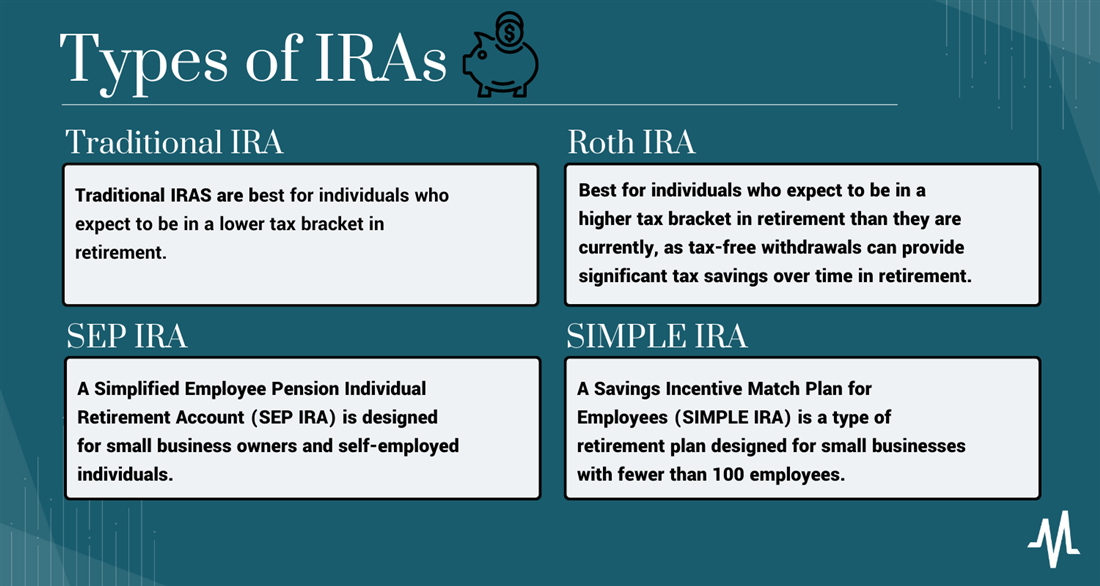
While the fundamental goal of all IRAs is retirement savings, their structures, tax implications, and eligibility requirements differ significantly. Understanding these distinctions is crucial for selecting the IRA type that best aligns with your financial situation and retirement goals. The two most common types are Traditional and Roth IRAs, but there are also specialized options for the self-employed and small businesses.
Traditional IRA: Pre-Tax Contributions and Deferred Growth
The Traditional IRA is perhaps the most classic form of individual retirement account. Its defining characteristic is the potential for tax-deductible contributions.
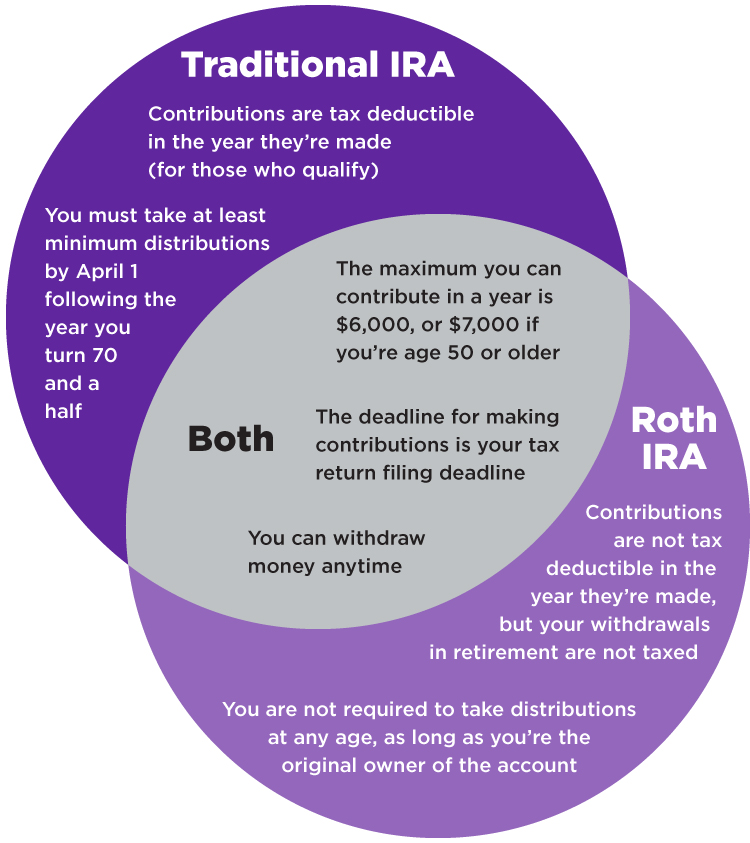
- Tax Deduction: Contributions to a Traditional IRA may be tax-deductible in the year they are made, effectively reducing your taxable income. This immediate tax break can be particularly attractive for those in higher tax brackets. The deductibility depends on your income, filing status, and whether you or your spouse are covered by a retirement plan at work.
- Tax-Deferred Growth: Investments within a Traditional IRA grow tax-deferred. This means you don’t pay taxes on the investment gains until you withdraw the money in retirement. This deferral allows your money to compound more aggressively without being eroded by annual taxes.
- Withdrawals in Retirement: When you take distributions in retirement (typically after age 59½), both your original contributions (if deducted) and all investment earnings are taxed as ordinary income.
- Required Minimum Distributions (RMDs): At a certain age (currently 73), you must begin taking Required Minimum Distributions (RMDs) from your Traditional IRA, whether you need the money or not. Failure to do so can result in substantial penalties.
Roth IRA: After-Tax Contributions and Tax-Free Withdrawals
Introduced in 1997, the Roth IRA offers a compelling alternative to the Traditional IRA, particularly for those who anticipate being in a higher tax bracket in retirement than they are today.
- After-Tax Contributions: Contributions to a Roth IRA are made with after-tax dollars, meaning you don’t get an upfront tax deduction.
- Tax-Free Growth and Withdrawals: The significant advantage of a Roth IRA is that qualified withdrawals in retirement (after age 59½ and after the account has been open for at least five years) are completely tax-free. This includes both your contributions and all investment earnings.
- No RMDs for Original Owner: Unlike Traditional IRAs, the original owner of a Roth IRA is not subject to RMDs during their lifetime. This allows funds to continue growing tax-free for as long as desired and provides greater flexibility for estate planning.
- Income Limitations: Eligibility to contribute directly to a Roth IRA is subject to income limitations based on your Modified Adjusted Gross Income (MAGI). If your income exceeds these limits, you may still be able to contribute indirectly through a “backdoor Roth IRA” strategy.
SEP IRA: Simplified Employee Pension for the Self-Employed and Small Businesses
For self-employed individuals and small business owners, the Simplified Employee Pension (SEP) IRA offers a powerful and relatively simple way to save for retirement.
- Employer Contributions Only: A SEP IRA is funded solely by employer contributions (even if you are the employer of yourself). Employees cannot contribute directly, though they must receive contributions if the employer makes them for themselves.
- Higher Contribution Limits: SEP IRAs allow for significantly higher contribution limits than Traditional or Roth IRAs, making them ideal for high-earning self-employed individuals. Contributions are a percentage of an employee’s (or owner’s) compensation, up to an annual maximum.
- Tax-Deductible: Contributions made by the employer (or self-employed individual) are tax-deductible for the business.
- Tax-Deferred Growth: Similar to a Traditional IRA, investments grow tax-deferred, and withdrawals in retirement are taxed as ordinary income.
SIMPLE IRA: Savings Incentive Match Plan for Employees
The Savings Incentive Match Plan for Employees (SIMPLE) IRA is designed for small businesses (typically with 100 or fewer employees) that want to offer a retirement plan without the administrative complexities of a 401(k).
- Employer Match or Non-Elective Contribution: Employers are required to make contributions to employee accounts, either by matching a percentage of employee contributions or by making a non-elective contribution (e.g., 2% of compensation for all eligible employees).
- Employee Contributions: Employees can also contribute to their SIMPLE IRA, similar to a 401(k), via payroll deductions.
- Tax Advantages: Both employer and employee contributions are pre-tax and grow tax-deferred. Withdrawals in retirement are taxed as ordinary income.
- Lower Administrative Costs: SIMPLE IRAs are generally less expensive and easier to administer than 401(k) plans, making them an attractive option for small businesses.
Contribution Limits and Eligibility: Planning Your Funding
Understanding how much you can contribute to an IRA and whether you’re eligible is fundamental to maximizing your retirement savings. The IRS sets annual limits, and these can vary by IRA type and your specific circumstances.
Annual Contribution Limits
The IRS updates IRA contribution limits periodically. For most individuals, the annual contribution limit applies across all Traditional and Roth IRAs combined. For example, if the limit is $6,500, you could contribute $3,000 to a Traditional IRA and $3,500 to a Roth IRA, but not $6,500 to each.
- Standard Limit: This is the maximum amount you can contribute if you are under age 50.
- Catch-Up Contributions: For individuals age 50 and older, the IRS allows an additional “catch-up” contribution amount each year. This is a crucial provision for those who started saving later or wish to accelerate their retirement savings in their prime earning years.
- SEP and SIMPLE IRA Limits: These plans have significantly higher contribution limits than Traditional or Roth IRAs, reflecting their design for business owners and their employees. SEP IRA limits are based on a percentage of compensation, while SIMPLE IRA limits include both employee deferrals and employer contributions.
Income Limitations for Roth IRAs
While virtually anyone with earned income can contribute to a Traditional IRA, direct contributions to a Roth IRA are subject to income phase-out rules. These rules are based on your Modified Adjusted Gross Income (MAGI).
- MAGI Thresholds: If your MAGI exceeds a certain level, your ability to contribute directly to a Roth IRA may be reduced or eliminated entirely.
- Phase-Out Range: There’s a specific income range where your maximum contribution gradually decreases. Once your MAGI surpasses the upper end of this range, you cannot make direct contributions.
- Backdoor Roth IRA: For high-income earners who are phased out of direct Roth contributions, the “backdoor Roth IRA” strategy is a popular method. This involves contributing non-deductible funds to a Traditional IRA and then immediately converting those funds to a Roth IRA. While the conversion itself may be a taxable event if you have pre-tax IRA money, the subsequent growth and qualified withdrawals from the Roth are tax-free.
Earned Income Requirement
A crucial eligibility criterion for contributing to Traditional and Roth IRAs is having “earned income.”
- Definition of Earned Income: This includes wages, salaries, commissions, tips, bonuses, and net earnings from self-employment. It generally does not include investment income, pension income, or passive income like rental income.
- Spousal IRA: Even if you don’t have earned income, you may still be able to contribute to an IRA if you file a joint tax return with a spouse who does have earned income. This is known as a spousal IRA, allowing non-working spouses to save for retirement. The combined contributions for both spouses cannot exceed the earned income of the working spouse, up to their individual limits plus catch-up contributions if applicable.
Investing Within Your IRA: Growing Your Nest Egg
An IRA is an account that holds investments; it is not an investment itself. The real power of an IRA lies in the strategic investment choices you make within the account. This is where your money truly grows, and careful planning is essential.
Permitted Investments
One of the key advantages of an IRA, particularly compared to some employer-sponsored plans, is the broad range of investment options typically available.
- Stocks: Individual stocks of publicly traded companies, offering potential for high growth but also higher risk.
- Bonds: Debt instruments issued by governments or corporations, generally offering lower risk and more stable returns than stocks.
- Mutual Funds: Professionally managed portfolios of stocks, bonds, or other securities, offering diversification and convenience.
- Exchange-Traded Funds (ETFs): Similar to mutual funds but trade like stocks on an exchange, often with lower expense ratios.
- Certificates of Deposit (CDs) and Money Market Accounts: Lower-risk, lower-return options suitable for preserving capital or short-term savings within the IRA.
- Real Estate (Limited): While more complex, certain IRAs can invest in real estate, but it typically requires a self-directed IRA custodian and adherence to strict IRS rules regarding prohibited transactions. This is not for the novice investor.
- Precious Metals: Some self-directed IRAs allow investments in certain approved precious metals, like gold and silver bullion.
What you generally cannot invest in directly within an IRA includes collectibles (art, antiques, stamps, most coins), life insurance contracts, and certain speculative ventures.
Choosing an IRA Custodian
To open an IRA, you need to select a financial institution that acts as the custodian for your account. This custodian holds your assets and handles the administrative duties, such as reporting to the IRS.
- Brokerage Firms: Many full-service and discount brokerage firms offer IRAs. They typically provide the widest range of investment options (stocks, bonds, mutual funds, ETFs) and may offer research tools, educational resources, and advisory services. Examples include Fidelity, Charles Schwab, Vanguard, E*TRADE, and TD Ameritrade.
- Banks and Credit Unions: These institutions often offer IRAs primarily through CDs and savings accounts, which are generally lower-risk but also provide lower returns compared to market-based investments. They are a good option for those prioritizing capital preservation.
- Mutual Fund Companies: If you primarily want to invest in mutual funds, opening an IRA directly with a mutual fund company (like Vanguard or Fidelity) can be straightforward, offering access to their proprietary funds.
- Robo-Advisors: These are automated investment platforms that use algorithms to manage your portfolio based on your risk tolerance and financial goals. They offer low-cost, diversified portfolios, often using ETFs, and are ideal for hands-off investors. Examples include Betterment and Wealthfront.
When choosing a custodian, consider factors such as investment options, fees (trading fees, maintenance fees, advisory fees), customer service, research tools, and minimum deposit requirements.
Diversification and Risk Management
Investing within an IRA should always incorporate principles of diversification and risk management.
- Diversification: Spreading your investments across different asset classes (stocks, bonds), industries, geographies, and company sizes helps reduce risk. If one investment performs poorly, others might perform well, balancing your overall portfolio. An IRA is an excellent vehicle for building a diversified portfolio that aligns with your long-term goals.
- Asset Allocation: This refers to the mix of different asset classes in your portfolio. Your optimal asset allocation will change over time, typically becoming more conservative (more bonds, less stocks) as you approach retirement. Regularly rebalancing your IRA portfolio ensures it stays aligned with your target allocation and risk tolerance.
- Long-Term Perspective: Remember that IRAs are for retirement—a long-term goal. Market fluctuations are normal, and a long-term perspective, coupled with a diversified portfolio, helps weather downturns and capture long-term growth. Avoid making impulsive decisions based on short-term market movements.
Managing and Withdrawing from Your IRA
The journey with an IRA doesn’t end with contributions and investment; it extends to managing the account over decades and eventually navigating the withdrawal process in retirement. Understanding these aspects is key to maximizing the benefits of your IRA.
Rollovers and Transfers
Life circumstances, employment changes, or simply finding a better financial institution may necessitate moving your IRA funds.
- Direct Rollover: When you leave an employer, you can typically roll over your 401(k) or other employer-sponsored plan into an IRA. A direct rollover means the funds are transferred directly from your old plan to your new IRA custodian. This is generally the safest method, as it avoids any potential for immediate taxation or penalties.
- 60-Day Rollover: If you receive a check for your retirement funds (e.g., from an old 401(k)), you typically have 60 days to deposit those funds into a new IRA without incurring taxes or penalties. However, some of the funds may be withheld, which you’d need to replace out-of-pocket to roll over the full amount.
- Trustee-to-Trustee Transfer: This is a direct transfer of funds from one IRA custodian to another without you ever taking possession of the money. It’s often used when you want to consolidate multiple IRAs or move to a custodian with better fees or investment options. This method is not considered a distribution and is tax-free.
- Roth Conversion: As mentioned earlier, converting a Traditional IRA to a Roth IRA is a specific type of rollover. The converted amount is generally taxable in the year of conversion (unless it was already after-tax contributions), but all subsequent qualified withdrawals from the Roth IRA are tax-free.
Early Withdrawal Penalties and Exceptions
IRAs are designed for retirement, and the IRS discourages early withdrawals before age 59½ by imposing penalties.
- 10% Early Withdrawal Penalty: Generally, if you withdraw money from a Traditional IRA before age 59½, the distribution is subject to your ordinary income tax rate plus a 10% early withdrawal penalty. For Roth IRAs, the 10% penalty also applies to earnings withdrawn early, unless a specific exception applies.
- Key Exceptions: The IRS allows penalty-free early withdrawals for certain qualified expenses, although income tax may still apply depending on the IRA type. Common exceptions include:
- Unreimbursed medical expenses exceeding a certain percentage of your Adjusted Gross Income (AGI).
- Health insurance premiums while unemployed.
- Qualified higher education expenses for yourself, your spouse, children, or grandchildren.
- Up to $10,000 for a first-time home purchase (lifetime limit).
- Payments due to disability.
- Payments to a beneficiary upon the IRA owner’s death.
- Substantially Equal Periodic Payments (SEPPs) under IRS Rule 72(t).
Required Minimum Distributions (RMDs)
For Traditional, SEP, and SIMPLE IRAs, the IRS mandates that you start withdrawing a minimum amount each year once you reach a certain age (currently 73, though this has changed recently). These are called Required Minimum Distributions (RMDs).
- Purpose: RMDs ensure that the government eventually collects the deferred taxes on these accounts.
- Calculation: The RMD amount is calculated annually by dividing your IRA account balance (as of December 31 of the previous year) by a life expectancy factor provided by the IRS.
- Penalty for Non-Compliance: Failing to take your RMD or taking less than the required amount can result in a significant excise tax (currently 25%, reduced to 10% if corrected promptly) on the amount not withdrawn.
- Roth IRA Exception: As previously noted, the original owner of a Roth IRA is exempt from RMDs, offering greater flexibility and the ability to continue tax-free growth throughout retirement.
Beneficiary Designations
A crucial, often overlooked, aspect of IRA management is designating beneficiaries.
- Importance: Beneficiary designations determine who inherits your IRA assets upon your death, overriding your will. This ensures a smooth transfer of assets and can have significant tax implications for your heirs.
- Primary and Contingent Beneficiaries: You can designate primary beneficiaries (who inherit first) and contingent beneficiaries (who inherit if the primary beneficiaries predecease you).
- Spousal vs. Non-Spousal Beneficiaries: The rules for inherited IRAs differ significantly depending on whether the beneficiary is a spouse or a non-spouse. Spouses have more options, including rolling the inherited IRA into their own. Non-spouses typically face a 10-year rule for withdrawing the funds, with some exceptions.
- Regular Review: It’s vital to review your beneficiary designations periodically, especially after major life events such as marriage, divorce, birth of a child, or death of a loved one.
The Power of IRAs in Securing Your Financial Future
In a world where financial security in retirement is increasingly dependent on individual effort, Individual Retirement Accounts stand out as indispensable tools. From the immediate tax deductions of a Traditional IRA to the tax-free withdrawals of a Roth IRA, and the tailored solutions for the self-employed, IRAs offer a flexible and powerful means to build wealth for your golden years.
They empower you with control over your investments, provide significant tax advantages, and foster the long-term compounding necessary to achieve substantial growth. By understanding the different types of IRAs, their contribution rules, and the strategies for managing them through investment and withdrawal, you can harness their full potential. Whether you’re just starting your career or nearing retirement, incorporating an IRA into your financial plan is a smart and strategic move toward a more secure and prosperous future. Take the time to assess your options, consult with a financial advisor if needed, and start investing in your retirement today.
aViewFromTheCave is a participant in the Amazon Services LLC Associates Program, an affiliate advertising program designed to provide a means for sites to earn advertising fees by advertising and linking to Amazon.com. Amazon, the Amazon logo, AmazonSupply, and the AmazonSupply logo are trademarks of Amazon.com, Inc. or its affiliates. As an Amazon Associate we earn affiliate commissions from qualifying purchases.