
Determining the exact net worth of Donald Trump is one of the most complex exercises in the world of high-stakes business finance. Unlike a typical executive with a portfolio of liquid stocks and bonds, Trump’s wealth is an intricate web of commercial real estate, licensing agreements, golf courses, and, more recently, a highly volatile digital media conglomerate. For the financial analyst or the curious investor, examining his balance sheet offers a unique look into the mechanics of asset valuation, debt leveraging, and market sentiment.
In the world of personal finance, “net worth” is a simple calculation: total assets minus total liabilities. However, when applied to a global business mogul, this equation becomes subject to intense fluctuation. Estimates from reputable financial outlets like Forbes and Bloomberg often vary by billions of dollars, reflecting the different methodologies used to value illiquid assets and the “brand premium” associated with the Trump name.
The Composition of a Multi-Billion Dollar Portfolio
To understand Donald Trump’s net worth, one must first deconstruct his portfolio into its primary asset classes. His wealth is not sitting in a savings account; it is tied up in “hard assets” that require constant management and are subject to the whims of the real estate market.
Commercial Real Estate: The Foundation of Wealth
The bedrock of Trump’s financial identity remains his New York City commercial real estate holdings. Properties such as 40 Wall Street, Trump Tower on Fifth Avenue, and his stake in 1290 Avenue of the Americas represent hundreds of millions in equity. In business finance, these are valued based on “Capitalization Rates” (Cap Rates)—the ratio of Net Operating Income (NOI) to the property’s asset value. When office occupancy rates in Manhattan fluctuate, or when interest rates rise, the valuation of these massive structures shifts accordingly.
The Trump Media & Technology Group (TMTG) Factor
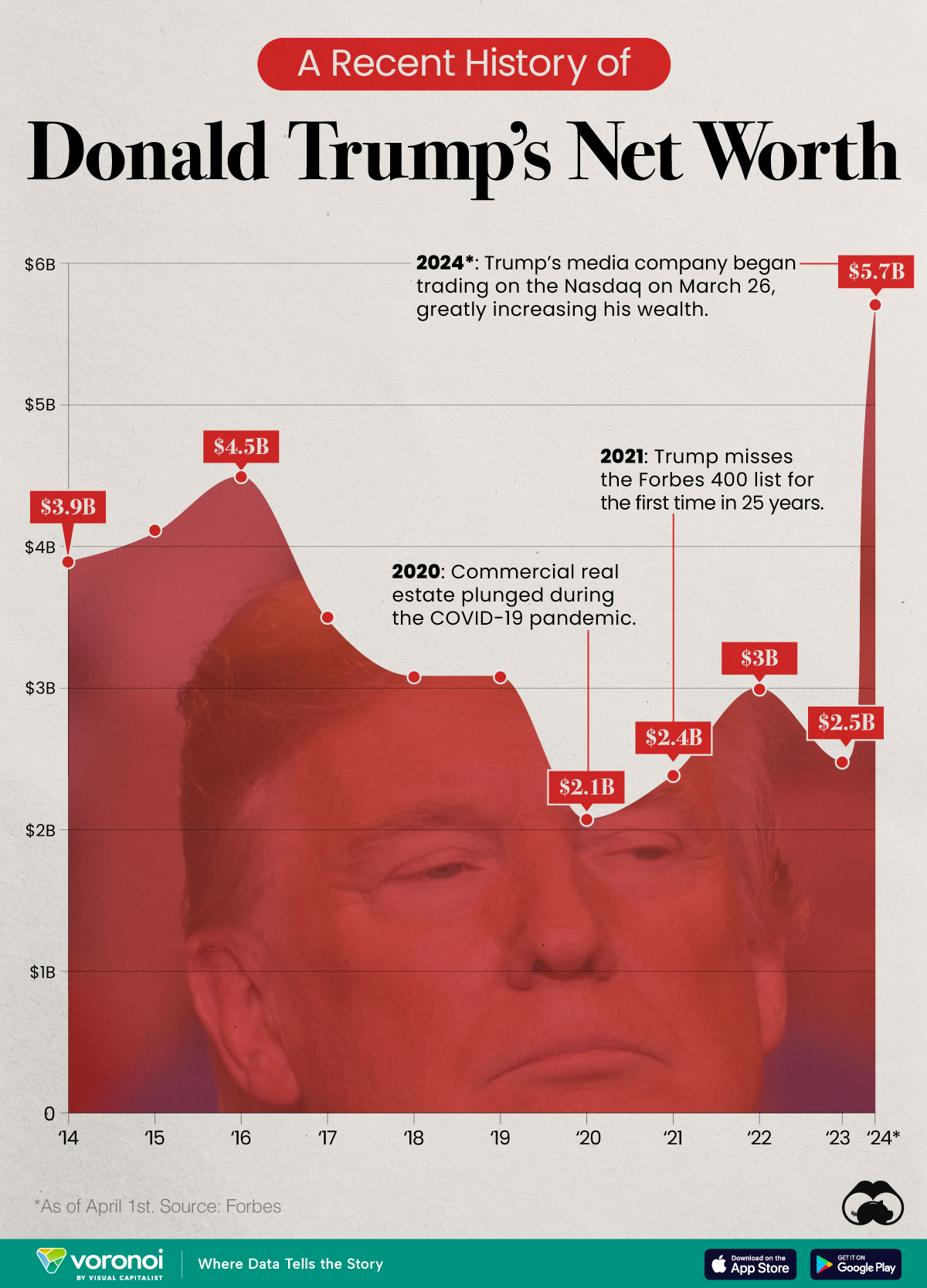
Perhaps the most significant shift in Trump’s net worth in recent years has been the public listing of Trump Media & Technology Group, the parent company of Truth Social. From a financial perspective, this represents a transition from “private equity” to “public equity.” At various points in 2024, the market capitalization of TMTG has added billions to his paper wealth. However, as any seasoned investor knows, paper wealth is distinct from realized wealth. The stock’s high volatility and the “lock-up” periods associated with insider selling make this a high-risk, high-reward component of his balance sheet.
Luxury Resorts and Global Golf Holdings
Beyond the skyscrapers, a significant portion of the portfolio is dedicated to the hospitality and leisure industry. This includes the Mar-a-Lago club in Palm Beach, Florida, and a string of golf courses across the United States, Scotland, and Ireland. Valuing these assets is notoriously difficult. Unlike a standard apartment building, a luxury resort’s value is often tied to its “exclusive” status and membership revenue, which can be subjective. Mar-a-Lago, in particular, has seen its estimated value skyrocket in recent years, though experts debate whether it should be valued as a social club or a residential estate.
Valuation Methodologies: How Net Worth is Calculated
In the realm of business finance, there are several ways to determine what an asset is worth. For an individual like Trump, different organizations use different “lenses,” which explains why one publication might cite $2.5 billion while another suggests over $7 billion.
Debt vs. Equity: The Leverage Equation
One cannot discuss Trump’s assets without discussing his liabilities. Real estate is a capital-intensive industry that relies heavily on leverage (borrowed money). To find the true net worth, analysts must subtract outstanding mortgages and loans from the total property value. Over the last decade, Trump has significantly reduced his debt load, moving from a highly leveraged position in the 1990s to a more “equity-rich” position today. Analyzing the maturity dates of these loans and their interest rates is crucial for understanding his “liquidity profile”—essentially, how much cash he has available versus how much is tied up in long-term debt.
Brand Value vs. Tangible Assets
A unique challenge in Trump’s financial valuation is the “brand premium.” For decades, the Trump Organization generated significant revenue through licensing deals—putting the name “Trump” on buildings, steaks, and clothing without owning the underlying production. In accounting terms, this is “intangible assets” or “goodwill.” While Forbes typically excludes the “intrinsic value” of a name from its net worth calculations, Trump himself has argued that his brand is worth billions. From a marketing and business strategy standpoint, the brand is a powerful tool for generating cash flow, even if it doesn’t appear as a physical asset on a balance sheet.

Cash and Liquid Assets
In personal finance, liquidity is king. For many years, Trump was considered “asset-rich but cash-poor.” However, following the sale of the lease on the Trump International Hotel in Washington D.C. and other strategic divestments, his cash position significantly improved. Having a “war chest” of liquid capital is vital for a business owner, as it provides a buffer against market downturns and the ability to settle legal or financial obligations without being forced to sell real estate at a discount.
The Impact of Legal and Economic Fluctuations
Net worth is a “snapshot in time,” and for high-profile figures, that snapshot can change overnight due to external pressures. For Trump, the year 2024 has been a landmark period for financial volatility due to both legal judgments and macroeconomic shifts.
Legal Liabilities and Contingent Liabilities
From a financial reporting perspective, the civil fraud judgments in New York represent a massive “account payable.” A judgment of roughly $454 million, plus interest, creates a significant dent in liquid net worth. In corporate finance, these are treated as contingent liabilities that must be accounted for. The process of posting bonds to appeal these judgments also affects liquidity, as it requires collateralizing assets or paying significant fees to insurance companies.
Macroeconomic Factors: Interest Rates and Real Estate
The broader economy plays a silent but dominant role in Trump’s net worth. As the Federal Reserve adjusted interest rates to combat inflation, the “cost of capital” increased. High interest rates generally lower the valuation of commercial real estate because they make it more expensive for buyers to finance acquisitions. Conversely, the post-pandemic migration to Florida has significantly boosted the value of his Sunshine State holdings. This illustrates a key principle of investing: geographic diversification can protect a portfolio from localized economic slumps.
Lessons in Personal Finance and Business Strategy
While most people will never manage a multi-billion dollar real estate empire, the structure of Donald Trump’s net worth offers several universal lessons in money management and business finance.
Diversification and Concentration Risk
Trump’s portfolio is a study in “concentration risk.” For a long time, he was heavily concentrated in New York commercial real estate. When that market took a hit, his net worth followed. The lesson for the average investor is the importance of diversification. By expanding into different sectors—like digital media or international hospitality—one can mitigate the risk of a single market crash wiping out their wealth.
The Power of Equity
A recurring theme in the Trump financial narrative is the transition from debt-heavy operations to equity-rich ones. In your personal finances, this is the equivalent of moving from a high-interest mortgage to owning your home outright. Equity provides a “margin of safety.” It allows a business to weather storms, such as lawsuits or economic recessions, without the immediate threat of foreclosure or bankruptcy.
Liquidity Management
Perhaps the most important lesson is the distinction between “wealth” and “money.” You can be a billionaire on paper but struggle to pay a $100 million bill if your wealth is locked in skyscrapers and golf courses. Maintaining a “liquidity ratio”—a healthy balance of cash relative to total assets—is essential for both global corporations and individual households. It ensures that you are never a “forced seller,” which is the worst position to be in during a financial negotiation.

Conclusion: The Volatile Nature of High-Net-Worth Assessments
Ultimately, Donald Trump’s net worth is a moving target, shaped by the closing price of TMTG stock, the latest appraisal of a Manhattan office tower, and the outcome of ongoing legal battles. As of 2024, most estimates place his wealth between $3.5 billion and $7 billion, a range that underscores the difficulty of valuing a complex, brand-driven business empire.
For students of finance, the takeaway is clear: wealth is rarely a static number. It is an evolving story told through assets, liabilities, and market sentiment. By studying the components of Trump’s net worth, we gain a deeper understanding of how the world’s most significant fortunes are built, leveraged, and maintained in an ever-changing economic landscape. Whether his net worth continues to grow or faces further contraction will depend on his ability to navigate the intersection of public markets and private real estate—a true test of financial engineering.
aViewFromTheCave is a participant in the Amazon Services LLC Associates Program, an affiliate advertising program designed to provide a means for sites to earn advertising fees by advertising and linking to Amazon.com. Amazon, the Amazon logo, AmazonSupply, and the AmazonSupply logo are trademarks of Amazon.com, Inc. or its affiliates. As an Amazon Associate we earn affiliate commissions from qualifying purchases.